
Written by Arthur Simitian | PartsAdvisory
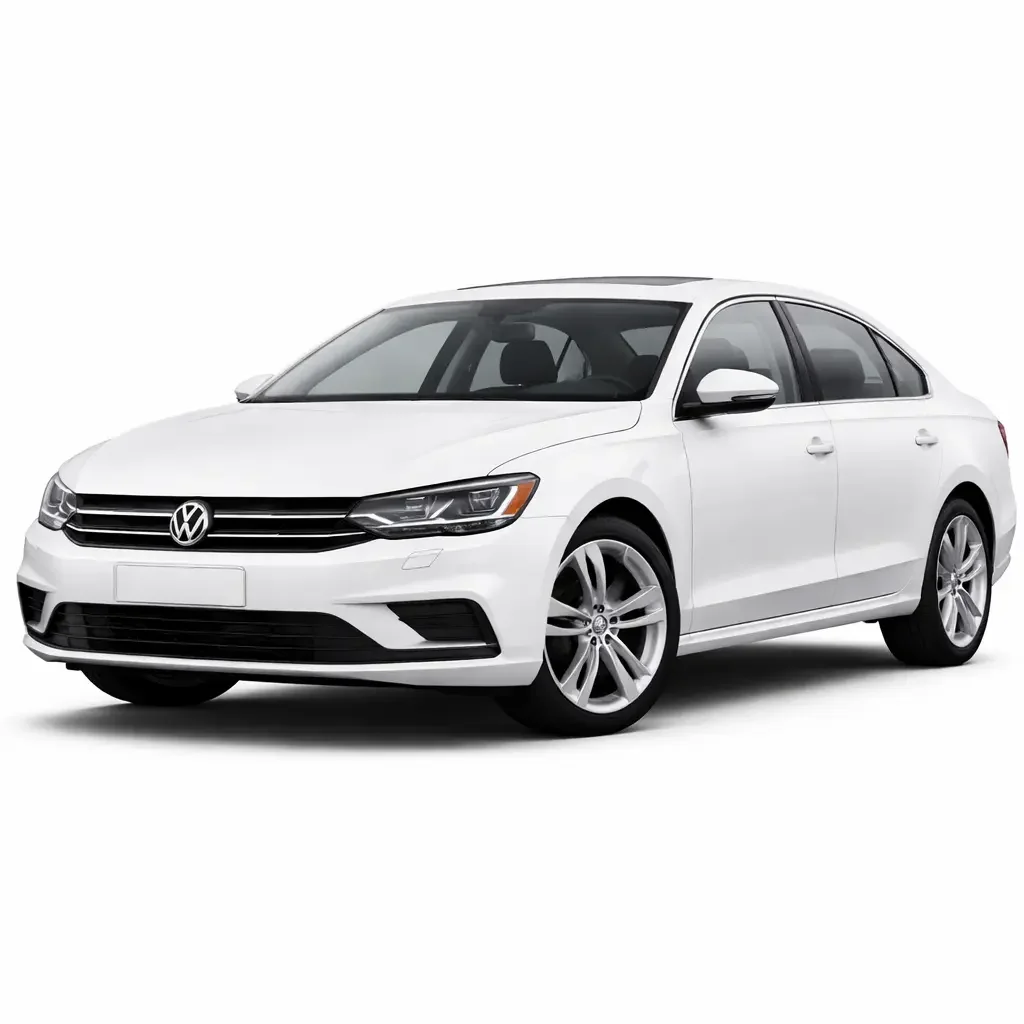
The Volkswagen Passat sold in North America from the 2012 through 2019 model years is the New Midsize Sedan, internally designated NMS and also known by the platform codes A32 and A33. It debuted at the Detroit Auto Show in January 2011 and entered production at Volkswagen's Chattanooga, Tennessee assembly facility in April 2011 as an early 2012 model year vehicle. The NMS replaced the B6 Passat sedan and wagon in the United States and Canada and represents a deliberate departure from both the European Passat lineage and the B6's PQ46 platform. It was designed specifically for the North American market, built in the United States, and shares no platform, body structure, engine mounting geometry, or drivetrain architecture with the European-market B8 Passat that was introduced concurrently and sold in right-hand-drive markets and elsewhere.
This distinction matters for catalog work because the NMS and the B8 Passat look superficially similar, use some overlapping engine families, and share the Passat name. They are nonetheless completely different vehicles from the ground up. An engine or suspension component confirmed for the European B8 Passat does not cross to the North American NMS without independent verification, and vice versa.
The NMS window from 2012 through 2019 contains four catalog-significant boundaries. The first is the 2014 engine change, which replaced the 2.5-litre inline-five with the 1.8 TSI and changed the transmission available with the base gasoline engine. The second is the 2015 TDI engine change, which replaced the EA189 diesel with the EA288 diesel for a single model year before the entire TDI line was permanently discontinued. The third is the 2016 mid-cycle restyle, which changed the hood, front fenders, grille, headlights, front bumper, trunk lid, rear bumper, and taillights while leaving the roof, glasshouse, front doors, and rear doors unchanged. The fourth is the 2019 model year, in which the 3.6 VR6 was discontinued after the 2018 model year, leaving the 1.8 TSI with the six-speed automatic as the only powertrain offered. Each of these boundaries produces a distinct body component catalog split, engine component catalog split, or transmission catalog split that must be tracked independently.
This guide addresses the United States market throughout. Canadian applications follow the same engine and transmission structure as the United States for the NMS within this window. No AWD option was offered in North America for the NMS in any year.
Platform: NMS, Sedan Only, Front-Wheel Drive Only Throughout
The NMS platform was developed by Volkswagen of America working from a German design basis but with North American market priorities driving its proportions and packaging. The vehicle is larger than the B6 it replaced: it is longer, wider, and taller, with a wheelbase of 2,803 mm (110.4 inches) compared to the B6's 2,709 mm. The additional wheelbase translated directly into rear-seat legroom that was a class benchmark when the NMS launched. The overall body dimensions mean that no exterior panel, glass, door, or structural component from the B6 crosses to the NMS. This is a complete generational break in body hardware.
The NMS uses a MacPherson strut front suspension and a four-link independent rear axle throughout the entire 2012 through 2019 window. The four-link independent rear is a significant departure from the torsion beam rear axle used on front-wheel-drive B6 Passats. On the B6, only the 4motion all-wheel-drive models used a fully independent rear suspension. On the NMS, all models use the independent four-link rear regardless of engine specification. A rear spring, rear shock absorber, or rear wheel bearing confirmed for an FWD B6 Passat does not cross to the NMS because the rear suspension geometries are different. Conversely, a rear suspension component confirmed for a 4motion B6 Passat also does not cross to the NMS because the NMS has no rear differential and uses a different four-link geometry.
The NMS is front-wheel drive in all configurations across all eight model years of this window. No all-wheel-drive option was offered on the NMS at any point in the United States or Canada. Any catalog entry that assigns AWD drivetrain hardware to an NMS application is assigning components that were never installed on this vehicle. There is no rear differential, no Haldex unit, no center differential, and no rear halfshaft on any NMS built for the North American market.
The NMS is also exclusively a four-door sedan. No wagon, estate, or hatchback version was built for North America. The B6 wagon does not have an NMS successor. Any NMS catalog entry that specifies wagon-specific hardware is wrong.
The NMS platform is not related to the MQB platform used by the Golf Mk7, Jetta Mk6, and European B8 Passat. The MQB platform uses a different engine mounting approach, different suspension geometry, different subframe architecture, and different body construction philosophy. An engine or suspension component confirmed for an MQB-based Volkswagen does not cross to the NMS without individual component-level verification.
Naming and Internal Designation: NMS, A32, A33, and the B7 Question
The NMS was developed and announced internally as the New Midsize Sedan before receiving its production designation. In some North American catalog and ACES data systems, the 2012-2019 Passat appears under the designation A32 or A33, reflecting the internal chassis series used at Chattanooga. The Volkswagen Chattanooga production documentation identifies early production through approximately 2015 under A32 and subsequent production under A33, though the exterior-facing model designation remained Passat NMS throughout. Catalog entries using A32 or A33 as platform or submodel codes are referencing the NMS and should be confirmed against model year before any powertrain or body component is assigned.
Some catalog and industry reference sources call the NMS the B7 Passat, borrowing the designation used for the European PQ46 facelift sold outside North America from 2011 onward. The European B7 is a facelifted B6 on the PQ46 platform with a transverse engine layout and completely different body dimensions from the NMS. The North American NMS is not a B7 in any technical sense. Applying the B7 designation to the NMS in a catalog context and then cross-referencing B7 European Passat components to NMS applications will produce wrong fits. The two vehicles share only the Passat name and some engine families at the code level.
Trim Structure: Two Generations Across the Window
For the 2012 and 2013 model years, the Passat was offered in S, SE, SEL, and SEL Premium trims. Each trim was engine-specific in naming: a full lineup included 2.5L S, 2.5L SE, 2.5L SEL, 2.5L SEL Premium, TDI SE, TDI SEL Premium, V6 SE, and V6 SEL Premium as distinct configurations. This created up to eight distinct equipment levels within a single model year, with engine type baked into the trim designation.
For 2014, a Wolfsburg Edition trim was added between the S and SE levels, and a Sport trim was introduced above the SE. These were one-year or limited-run additions tied to the 1.8 TSI engine introduction. The 2014 lineup was available in S, Wolfsburg Edition, SE, Sport, SEL, and SEL Premium configurations across the three engine families.
For 2015, the lineup simplified back toward S, SE, SEL, and SEL Premium as the core structure, with the Wolfsburg Edition carried over.
For 2016, the trim structure changed substantially alongside the mid-cycle restyle. The lineup shifted to S, R-Line, SE, and SEL. The R-Line was new for 2016 and replaced the Sport trim with a different visual and equipment package. The Wolfsburg Edition was discontinued. The SEL Premium designation was retired. This trim restructuring also coincided with the deletion of the manual transmission from the lineup and the elimination of the TDI engine due to the emissions scandal. From 2016 onward, the NMS lineup was gasoline-only and automatic-only.
For 2017 and 2018, the trim structure remained S, R-Line, SE, and SEL with the 1.8 TSI and 3.6 VR6 as the two available engines.
For 2019, the 3.6 VR6 was discontinued after the 2018 model year. The 2019 NMS was offered in S, SE, R-Line, and SEL trim with the 1.8 TSI and six-speed automatic only.
Engines: Five Configurations Across Eight Model Years
2.5-Litre Inline-Five (2012 and 2013 Only)
The 2.5-litre inline-five was the base engine for the 2012 and 2013 model years. It produces 170 hp at 5,700 rpm and 177 lb-ft of torque at 4,250 rpm. The engine uses two engine codes in North America: CBTA for standard-emissions markets and CBUA for PZEV markets, the latter carrying three oxygen sensors rather than two. Both codes are within the same EA390 five-cylinder family and are mechanically equivalent apart from the emissions hardware. In most catalog contexts the CBTA and CBUA are listed as separate sub-applications because oxygen sensor, catalytic converter, and exhaust manifold components differ between them. Confirming the engine code from the VIN or the vehicle identification label is necessary before assigning oxygen sensor or exhaust component listings for the 2.5-litre application.
The 2.5-litre inline-five was available with a five-speed manual transmission or a six-speed conventional automatic. The five-speed manual is the 0A4 gearbox. The six-speed conventional automatic is the 09G Aisin TF-60SN-based unit. These two transmissions are architecturally different from every other transmission in the NMS lineup. A clutch disc, flywheel, or manual transmission gearbox component confirmed for the 2.5-litre manual application does not cross to any other NMS powertrain combination, because no other engine in the NMS lineup was available with this five-speed manual. The 09G conventional automatic of the 2.5-litre application shares the same family name as the 09G used on the B6 Passat 2.0T, but variant-level specifications differ and the applications must be confirmed individually rather than assumed as identical.
The 2.5-litre inline-five shares some engine service components with the same engine as used in the Jetta and Golf of the same period within the CBTA and CBUA family. Spark plugs, coil packs, PCV system components, and oil filters cross within matching engine code specifications. These cross-references are engine-family-based and require confirmation at the part number level.
The 2.5-litre engine was discontinued for the 2014 model year and was not offered in any NMS configuration from 2014 onward. Any catalog entry assigning 2.5-litre engine components or the five-speed manual transmission to a 2014 or later NMS application is assigning hardware from an engine and gearbox that were not available in those years.
1.8-Litre TSI (2014 Through 2019)
The 1.8-litre TSI replaced the 2.5-litre inline-five beginning with the 2014 model year. It produces 170 hp at 4,800 rpm and 184 lb-ft of torque at 1,750 rpm. The North American NMS application uses the engine codes CPKA and CPRA, both within the EA888 Gen3 family in transverse mounting. The CPKA is the standard-emissions variant and the CPRA is the PZEV variant, with the same oxygen sensor count and exhaust system architecture distinction as in the 2.5-litre application. Engine code confirmation from the VIN fifth position or the vehicle identification label is required before assigning oxygen sensor or catalytic converter components for the 1.8 TSI.
The 1.8 TSI in the NMS uses a timing chain, not a timing belt. Any timing belt kit, timing belt tensioner, or timing belt idler listing applied to a 1.8 TSI NMS application is assigning components that do not exist on this engine. The EA888 Gen3 family uses a chain-driven timing system throughout.
The 1.8 TSI also introduced electromechanical power steering to the NMS for the 2014 model year, replacing the hydraulic power steering of the 2012 and 2013 2.5-litre models. Power steering pump, power steering rack, and power steering fluid components for the 2012 and 2013 hydraulic system do not cross to any 1.8 TSI NMS application. The steering rack design on the 1.8 TSI NMS is an electromechanical unit with no hydraulic reservoir and no hydraulic pump. Any hydraulic power steering component listing applied to a 2014 or later NMS is assigning hardware from a system that was not installed.
The 1.8 TSI in the NMS was available only with the six-speed conventional automatic throughout its production run from 2014 through 2019. No manual transmission was offered with the 1.8 TSI in any NMS model year. The DSG dual-clutch transmission was also not offered with the 1.8 TSI in the North American NMS; the VW forum confirmation noted above for several model years is consistent: the 1.8 TSI models used conventional automatics, the DSG was reserved for TDI and VR6 applications. A DSG mechatronic, DSG fluid, or DSG filter listing applied to a 1.8 TSI NMS application is assigning components from a transmission that was not installed in these applications.
The six-speed conventional automatic paired with the 1.8 TSI is designated 09G in VW internal coding and uses the NTJ transmission code as a frequent example in production records for this application. This is the Aisin TF-60SN-based six-speed unit, the same family used with the 2.5-litre. Variant-specific specifications between the 2.5-litre and 1.8 TSI applications of the 09G must be confirmed at the part number level and should not be assumed identical.
2.0-Litre TDI EA189 (2012 and 2013)
The 2.0-litre TDI diesel was offered from the 2012 model year launch and carries the EA189 engine family designation in its North American form, with the CKRA engine code. It produces 140 hp at 4,000 rpm and 236 lb-ft of torque at 1,750 rpm. The EA189 is a unit injection diesel that does not use a urea-based selective catalytic reduction system in its North American configuration; it uses a diesel particulate filter and exhaust gas recirculation as its primary emissions controls. This is the engine at the centre of the Volkswagen emissions scandal, in which defeat device software was found to allow the vehicle to recognize test conditions and alter emission control parameters accordingly. This context is relevant for catalog work because the EPA halted certification of EA189 TDI vehicles and VW was required to buy back or modify EA189-powered vehicles.
The TDI EA189 was available with a six-speed manual transmission or the six-speed DSG dual-clutch transmission, designated 02E in VW internal coding. The DSG on the TDI application is the wet-clutch 02E unit, the same family used on the VR6. TDI DSG fluid specification, TDI DSG filter, and TDI DSG mechatronic are DSG-family-specific and do not cross to the 09G conventional automatic of the 2.5-litre or 1.8 TSI applications.
The six-speed manual available with the TDI EA189 is a different gearbox from the five-speed manual available with the 2.5-litre. The TDI manual carries its own clutch disc, flywheel, and gearbox specification and must be listed as a separate manual transmission application from the 2.5-litre five-speed. A clutch confirmed for the 2.5-litre five-speed manual does not apply to the TDI six-speed manual.
2.0-Litre TDI EA288 (2015 Only)
For the 2015 model year, the TDI was updated to the EA288 engine family, carrying the CRUA engine code in North American form. The EA288 produces 150 hp and 236 lb-ft of torque and uses a urea-based selective catalytic reduction system with an AdBlue reservoir for emissions control. It is architecturally and mechanically different from the EA189 in the fuel injection system, combustion chamber design, emissions control hardware, and engine management software. No fuel system, injection system, or emissions system component from the EA189 crosses to the EA288 without individual confirmation.
The EA288 TDI was available with the same transmission options as the EA189: six-speed manual or six-speed DSG. The DSG application uses the same 02E family as the EA189 TDI and VR6, but fluid specification and mechatronic calibration are engine-specific and must be confirmed against the EA288 application before a component is assigned.
Due to the Volkswagen emissions scandal, the EPA halted TDI certification for the 2016 model year before the EA288 could enter the 2016 NMS lineup, despite the EA288 not being implicated in the defeat device software. The EA288 was sold in the NMS for one model year only, 2015, in North America. No TDI application of any kind exists for the 2016 through 2019 NMS. A diesel fuel filter, diesel injection component, or TDI-specific emissions system component applied to a 2016 or later NMS is assigning hardware from an engine that was not sold in those years.
3.6-Litre VR6 (2012 Through 2018)
The 3.6-litre VR6 FSI was available from the 2012 model year launch through the end of the 2018 model year. It produces 280 hp at 6,200 rpm and 258 lb-ft of torque at 2,500 rpm. The engine code used in the NMS is CDVB, which is within the EA390 VR6 family and is specific to the transverse NMS application. The CDVB is related to but not identical to the BLV used in the B6 Passat. Both are 3.6-litre 24-valve direct-injection VR6 engines in the EA390 family, but they carry different ancillary component specifications due to the different vehicle architectures. Cross-references from the B6 BLV VR6 to the NMS CDVB VR6 must be confirmed at the part number level rather than assumed at the engine-family level.
The 3.6 VR6 in the NMS was available exclusively with the six-speed DSG dual-clutch transmission throughout its seven-year production run. No manual transmission and no conventional automatic was offered with the VR6 in any NMS model year. A conventional automatic pan, conventional automatic filter, or conventional automatic fluid listing applied to a VR6 NMS application is assigning components from a transmission that was not installed in this configuration. Similarly, a manual clutch disc or flywheel listing for a VR6 NMS application is assigning components from a transmission that was never paired with this engine in North America.
The DSG on the VR6 application is the 02E wet-clutch six-speed unit, the same family as on the TDI. VR6 DSG fluid uses the VW G 052 182 A2 specification throughout the 2012 through 2018 production run. DSG filter and mechatronic specifications must be confirmed as CDVB VR6-specific rather than assumed to cross from TDI DSG applications.
The VR6 was discontinued for the 2019 model year. No 3.6 VR6 application exists for the 2019 NMS. A VR6 engine component, VR6 DSG component, or VR6-specific body or chassis component applied to a 2019 NMS is assigning hardware from an engine that was not offered in that year.
Premium-grade fuel is required for the VR6 in all NMS model years. The 2.5-litre and 1.8 TSI are regular-grade applications. The TDI is diesel. A fuel type distinction affects spark plug application (the diesel has no spark plugs) and ignition component listings (TDI and VR6 ignition systems differ fundamentally from the 2.5-litre and 1.8 TSI coil-on-plug systems).
Transmissions: Four Distinct Families in the NMS Window
The NMS window contains four distinct transmission types that must be treated as separate catalog entries: the five-speed manual 0A4, the six-speed manual (TDI only), the six-speed conventional automatic 09G, and the six-speed DSG 02E.
The five-speed manual 0A4 was available only on 2.5-litre applications in 2012 and 2013. It was not available with any other engine and was not offered after the 2013 model year when the 2.5-litre was discontinued.
The six-speed manual was available only on TDI applications in 2012 and 2013 with the EA189, and in 2015 with the EA288. It was a different gearbox from the 0A4 with different clutch, flywheel, and internal specifications. It was never offered with the 2.5-litre, 1.8 TSI, or VR6 in the NMS.
The six-speed conventional automatic 09G was available on the 2.5-litre application in 2012 and 2013 and on the 1.8 TSI application from 2014 through 2019. It was not available with the TDI or VR6 at any point in the NMS window.
The six-speed DSG 02E was available on TDI applications in 2012, 2013, and 2015 and on VR6 applications from 2012 through 2018. It was not available on 2.5-litre or 1.8 TSI applications at any point in the NMS window.
The 2016 model year is the first NMS year in which no manual transmission was offered at all, coinciding with the mid-cycle restyle and the TDI discontinuation. From 2016 onward, every NMS sold in the United States used either the 09G conventional automatic (1.8 TSI) or the 02E DSG (VR6).
The 2016 Mid-Cycle Restyle: Body Component Boundary
Volkswagen refreshed the North American Passat for the 2016 model year, introducing new exterior sheet metal and lighting at both ends while leaving the body structure and glasshouse unchanged. The components that changed for 2016 are the hood, the front fenders, the grille, the headlamp assemblies, the front bumper cover and lower structure, the trunk lid, the rear bumper cover, and the taillamp assemblies. The components that did not change are the windscreen, the front door glass, the rear door glass, the roof panel, the front doors, the rear doors, the rear quarter panels, and the rear glass.
This creates a precise body panel catalog boundary at the 2015-to-2016 model year line. A hood confirmed for a 2012 through 2015 NMS does not fit a 2016 through 2019 NMS. A front fender confirmed for a 2012 through 2015 NMS does not fit a 2016 through 2019 NMS. A headlamp assembly confirmed for a 2012 through 2015 NMS does not fit a 2016 through 2019 NMS. A front bumper cover confirmed for a 2012 through 2015 NMS does not fit a 2016 through 2019 NMS. The same applies to the trunk lid, rear bumper cover, and taillamp assemblies in reverse.
Front door glass, rear door glass, windscreen, and rear glass cross freely across the full 2012 through 2019 window within the NMS because the glasshouse was not changed in the restyle. The A-pillars, B-pillars, C-pillars, rocker panels, and structural floor are also continuous across the full window.
The official VW body part catalog confirms the 2016 body component boundaries explicitly in part number breaks. An aftermarket listing that groups all NMS years from 2012 through 2019 as a single application for the hood, fenders, headlamps, front bumper, trunk lid, rear bumper, or taillamps is wrong. These are two distinct applications that must be split at the 2015-to-2016 boundary.
Early 2016 production, specifically vehicles built before the February 2016 production date noted in VW parts documentation for some components, may carry over pre-restyle hardware on specific items such as the windscreen assembly. Any component listing for 2016 model year vehicles where a build date qualifier appears in OEM documentation should carry a build date confirmation note rather than treating the entire 2016 model year as a single homogeneous application.
The R-Line trim introduced for 2016 uses a unique front bumper with distinctive visual styling that differs from the standard S, SE, and SEL front bumper of the same model year. A front bumper confirmed for the 2016-2019 SE or SEL does not cross to the 2016-2019 R-Line. R-Line front bumper, side sill, and rear diffuser applications must be listed as R-Line-specific and must not be assumed to cross to other trim levels of the same year.
Relationship to the B6 Passat: No Component Crossover
The NMS replaced the B6 Passat in the United States but shares no body component, suspension component, engine mount, or drivetrain component with it. The B6 used the PQ46 transverse platform developed from the Golf Mk5 architecture. The NMS uses a purpose-built North American platform with different suspension geometry, different body dimensions, different subframe mounting, and different steering system architecture. The NMS is not a development or continuation of the B6 platform.
The B6 had a wheelbase of 2,709 mm. The NMS has a wheelbase of 2,803 mm. The additional 94 mm of wheelbase means that any body component behind the A-pillar and above the rocker of the B6 does not match the NMS in dimensional fit. This includes front doors, rear doors, rear quarter glass, and windscreen, all of which have different dimensions between the two vehicles.
The B6 front suspension is MacPherson, and the NMS front suspension is also MacPherson, but the specific geometry, strut dimensions, lower control arm length, and front subframe mounting points are different between the two vehicles. A front strut cartridge, front spring, front wheel bearing, or front brake rotor confirmed for the B6 must not be applied to the NMS without independent part number verification.
The B6 rear suspension on FWD models is a torsion beam. The NMS rear suspension is a four-link independent design. These are fundamentally different architectures. No rear suspension component from a B6 FWD application crosses to the NMS.
Relationship to the European B8 Passat: Separate Vehicles
The European B8 Passat entered production in 2014 and was sold in Europe, Australia, and other right-hand-drive markets. It is built on the MQB platform, uses transverse engine mounting in a different orientation and geometry from the NMS, and has a different body structure, different suspension design, and different overall dimensions. The B8 Passat and the NMS were sold concurrently from 2015 onward but are completely different vehicles.
Some catalog systems in North America have incorrectly assigned European B8 Passat components to NMS applications based on shared engine codes, shared model year ranges, and shared Passat naming. The 1.8 TSI EA888 Gen3 engine family is used in both the B8 Passat and the NMS CPKA/CPRA application, but the transverse engine mounts, engine management calibration, and engine ancillary component specifications differ between the two platforms. An engine mount confirmed for the B8 Passat in a European application does not cross to the NMS.
No MQB platform suspension, brake, or steering component applies to the NMS. The NMS does not use MQB subframe mounting. Any catalog cross-reference that bridges a B8 Passat application to an NMS application on the basis of shared platform must be rejected.
Common ACES/PIES Catalog Mistakes
The first error is assigning AWD drivetrain components to any NMS application. The NMS was never offered with all-wheel drive in North America. There is no rear differential, no Haldex unit, and no rear halfshaft in any NMS configuration. A 4motion rear differential or Haldex service kit applied to an NMS application is assigning hardware from a system that does not exist on this vehicle.
The second error is assigning wagon body components to the NMS. No NMS wagon was built for North America. Any rear liftgate, wagon-specific rear glass, or wagon cargo floor component listed for the NMS is wrong.
The third error is treating the CBTA and CBUA as identical for emission system components. The CBUA carries three oxygen sensors and PZEV-specification catalytic hardware. Oxygen sensors, catalytic converters, and exhaust manifold components must be listed as CBTA-specific or CBUA-specific and must not be merged into a single application.
The fourth error is applying 2.5-litre engine service components to 2014 or later applications. The 2.5-litre was discontinued for 2014. A timing drive component, spark plug, ignition coil, or fuel injector confirmed for the 2.5-litre CBTA or CBUA does not apply to any 2014 or later NMS application.
The fifth error is applying a five-speed manual 0A4 clutch or flywheel to a TDI or 1.8 TSI application. The five-speed manual was available only on the 2.5-litre in 2012 and 2013. The TDI used a separate six-speed manual. The 1.8 TSI was never offered with any manual transmission.
The sixth error is applying DSG components to 1.8 TSI applications. The 1.8 TSI used the 09G conventional automatic exclusively in all NMS model years. DSG fluid, DSG filter, and DSG mechatronic components do not apply to any 1.8 TSI NMS application.
The seventh error is applying conventional automatic 09G components to VR6 applications. The VR6 used the 02E DSG exclusively in all NMS model years. A 09G pan, 09G filter, or 09G fluid listing for a VR6 NMS application is assigning components from a transmission that was not installed.
The eighth error is applying TDI engine or transmission components to 2016 or later NMS applications. The TDI was permanently discontinued after the 2015 model year. No TDI application of any kind exists for the 2016 through 2019 NMS. A diesel fuel filter, diesel injector, DSG fluid listed specifically for the TDI 02E, or TDI-specific emissions component applied to a 2016 or later NMS is assigning hardware from an engine that was not sold.
The ninth error is applying VR6 engine or DSG components to 2019 NMS applications. The VR6 was discontinued after the 2018 model year. The 2019 NMS was offered with the 1.8 TSI and six-speed conventional automatic only. A VR6 spark plug, VR6 coil pack, or VR6 DSG component applied to a 2019 NMS application is assigning hardware from an engine that was not offered in that year.
The tenth error is applying a 2012-2015 hood, front fender, front bumper, headlamp, trunk lid, rear bumper, or taillamp to a 2016-2019 NMS, or vice versa. The 2016 restyle changed all of these body components. A hood confirmed for a 2012-2015 application does not fit a 2016-2019 NMS. These are two distinct body component applications and must be listed separately.
The eleventh error is applying R-Line-trim front bumper or body styling components to S, SE, or SEL trim applications of the same year, or vice versa. The R-Line uses unique front bumper styling that is not shared with other trims in the same model year. These are trim-specific applications that must be distinguished.
The twelfth error is applying hydraulic power steering pump, hydraulic steering rack, or power steering fluid to any 2014 or later NMS application. The 1.8 TSI introduced electromechanical steering for 2014, eliminating the hydraulic system. A hydraulic power steering component applied to any NMS from 2014 onward is assigning hardware from a system that was not installed.
The thirteenth error is applying a timing belt kit or timing belt-associated components to any 1.8 TSI NMS application. The EA888 Gen3 uses a timing chain. There is no timing belt in this engine.
The fourteenth error is cross-referencing European B8 Passat components to NMS applications based on shared engine codes or shared model year. The B8 Passat uses the MQB platform with different engine mounting, different suspension geometry, and different component specifications from the NMS. Engine code alone does not confirm component fit.
The fifteenth error is treating all 2012-2019 applications as a single window for door glass, windscreen, and roof-area components while simultaneously treating them as two windows for hood, fender, and bumper components. The glass applications are continuous across the full window because the glasshouse was not changed in the 2016 restyle. The sheet metal and lighting applications are split at the 2015-to-2016 boundary. These two boundaries must be tracked separately.
Pre-Listing Checklist for the 2012-2019 NMS Passat
Platform confirmed as NMS (A32/A33), sedan only, FWD only throughout the 2012-2019 window; no AWD component, wagon component, or B6 platform component applies to any NMS application.
Engine confirmed as 2.5L inline-five CBTA or CBUA (2012-2013 only), 1.8 TSI CPKA or CPRA (2014-2019), 2.0 TDI EA189 CKRA (2012-2013), 2.0 TDI EA288 CRUA (2015 only), or 3.6 VR6 CDVB (2012-2018); engine-specific service components confirmed as not crossing between families on the basis of displacement alone.
For 2.5L applications, engine code confirmed as CBTA or CBUA before oxygen sensor, catalytic converter, or exhaust component is assigned; PZEV emissions hardware confirmed as CBUA-specific.
For 1.8 TSI applications, electromechanical steering confirmed as replacing hydraulic steering for 2014 onward; no hydraulic power steering components apply; timing chain confirmed as the only timing drive system; no timing belt components apply.
Transmission confirmed as five-speed manual 0A4 (2.5L, 2012-2013 only), six-speed manual (TDI only, 2012-2013 and 2015), six-speed conventional automatic 09G (2.5L 2012-2013 and 1.8 TSI 2014-2019), or six-speed DSG 02E (TDI 2012-2013 and 2015, VR6 2012-2018); no manual exists for any engine after the 2015 model year; no DSG applies to 2.5L or 1.8 TSI applications; no conventional automatic applies to VR6 or TDI applications.
TDI applications confirmed as EA189 CKRA (2012-2013) or EA288 CRUA (2015 only); no TDI application exists for 2016-2019; TDI-specific fuel, injection, and emissions components confirmed as TDI-specific and not applied to gasoline applications.
VR6 application confirmed as available in 2012-2018 only; no VR6 application exists for 2019; VR6 DSG fluid and service components confirmed as 02E DSG-specific and not applied to 09G conventional automatic applications.
Body component application confirmed as 2012-2015 or 2016-2019 for hood, front fenders, grille, headlamps, front bumper, trunk lid, rear bumper, and taillamps; these are two separate applications and must not be merged into a single 2012-2019 listing.
Glass component application confirmed as continuous 2012-2019 for windscreen, front door glass, rear door glass, and rear glass; the glasshouse was not changed in the 2016 restyle.
R-Line trim confirmed as 2016-2019 only; R-Line front bumper and body styling components confirmed as R-Line-specific and not applied to S, SE, or SEL applications of the same years.
European B8 Passat components confirmed as not crossing to NMS applications on the basis of engine code or model year overlap alone; platform difference between MQB and NMS confirmed as a complete component separation.
Final Take
The 2012-2019 NMS Passat is a platform unto itself. It was designed for North America, built in North America, and replaced by a reskinned update in 2020 that continued using the same underlying platform. It shares neither the B6 architecture it replaced nor the MQB architecture of its European contemporary. This isolation from the broader VW Group platform family means that the typical cross-reference strategies used on PQ35-derived or MQB-derived vehicles do not apply to the NMS. Front suspension cross-references to the Golf or Jetta, engine cross-references to the B6, and body cross-references to the European Passat all require individual part number verification rather than platform-level assumption.
The most practically significant catalog boundary within the window is the 2016 restyle, because it creates a sheet-metal split partway through the production run that is easy to miss when the catalog treats the eight-year window as a single application. The second most consequential boundary is the 2014 engine change, because it eliminates the five-speed manual, introduces electromechanical steering, and changes the base engine from a naturally aspirated five-cylinder to a turbocharged four-cylinder with a chain-based timing system. Both boundaries are clean annual breaks with no mid-year production transitions reported in the primary sources reviewed here, making them easier to apply consistently than transitions in other Passat generations.
The TDI discontinuation after 2015 is the third major boundary, and it is the one most likely to create persistent catalog errors because TDI models were popular and widely sold, creating a large field population of 2012-2015 TDI vehicles alongside the 2016-2019 gasoline-only lineup. A catalog that does not explicitly exclude TDI components from 2016-2019 applications will produce wrong assignments for that field population for as long as those vehicles are in service.
Disclaimer
This guide is intended for catalog research, fitment analysis, and parts advisory reference. Production specifications, option availability, and regulatory compliance requirements vary by model year, regional market, and assembly date within any given window. Always confirm application data against vehicle identification number decoding, factory build sheets, and OEM parts documentation before finalizing a listing or parts recommendation. PartsAdvisory and its contributors are not responsible for fitment errors arising from catalog data that has not been independently verified against physical vehicle inspection or official OEM sources.