
Written by Arthur Simitian | PartsAdvisory
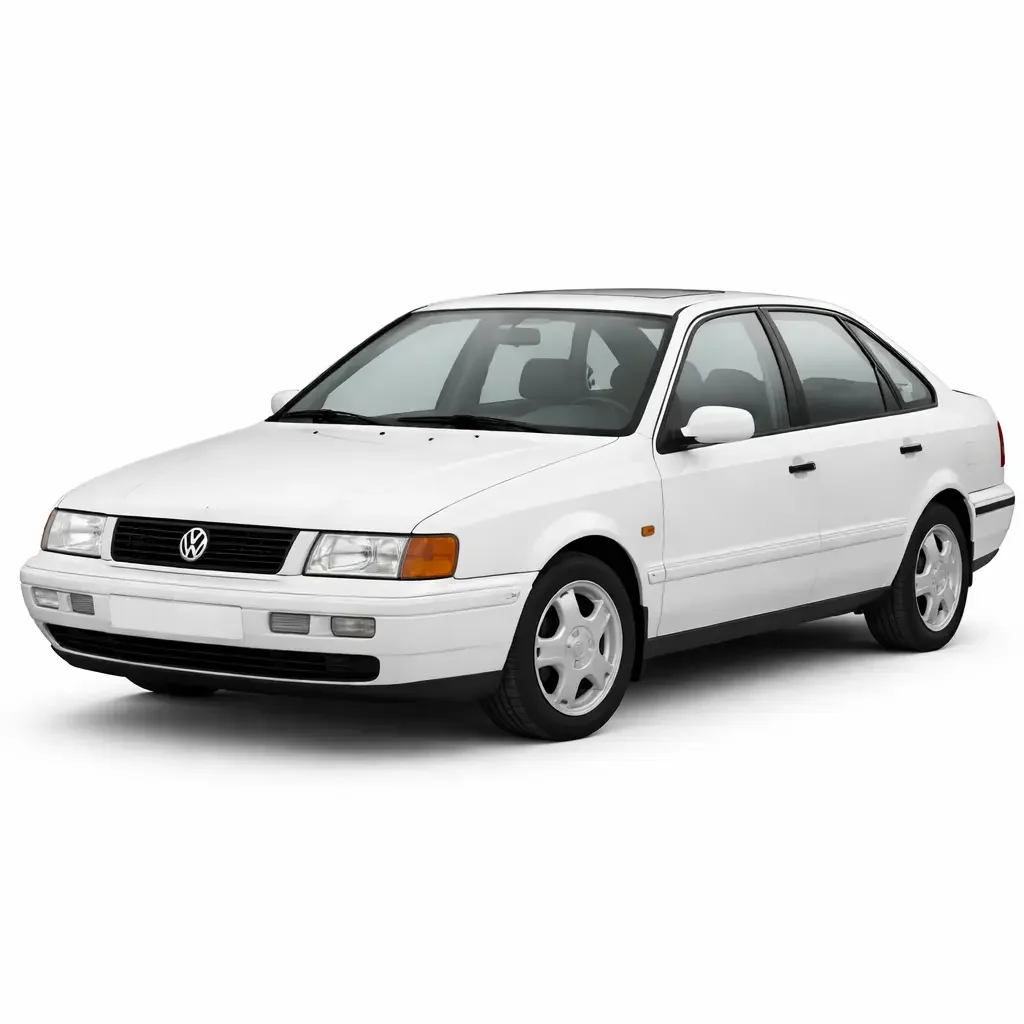
The Volkswagen Passat sold in North America from 1995 through 1997 is the B4 generation, the final iteration of the Typ 35i platform family that began with the B3 in 1988. The B4 arrived in the United States for the 1995 model year, a year after it debuted in Canada and two years after its European introduction in late 1993. It departed North American dealerships at the end of the 1997 model year, when the all-new B5 Passat on the PL45 platform replaced it in both sedan and wagon configurations for 1998.
The B4 is not a new vehicle but a comprehensive facelift of the B3, and it shares the B3's Typ 35i platform, its A2-derived transverse engine layout, its wheelbase, and its core undercar mechanical architecture. The facelift revised every external body panel except the roof and glass, reintroduced a radiator grille that had been absent from the B3, and added dual front airbags and pyrotechnic seatbelt pre-tensioners as standard equipment. The B4's catalog complexity in the North American context comes primarily from three sources: the three-engine lineup that carries significant trim and body style availability restrictions, the introduction of the TDI diesel as the first direct-injection diesel sold in the United States Passat lineup, and the OBD transition that occurred within the production run of the 1995 and 1996 model years.
This guide addresses the United States and Canadian B4 markets for the 1995 through 1997 window, with attention to the specific trim, body style, and engine availability splits that create catalog errors, and to the OBD1-to-OBD2 boundary that affects engine management and emissions component listings within the window. The companion 1990-1994 guide covers the B3 generation and establishes the platform and body change context that directly precedes this window.
Platform Continuity: What the B4 Shares with the B3 and What Changed
The B4 retains the same Typ 35i platform as the B3 in every structural and mechanical respect. The wheelbase of 2,631 mm (approximately 103.6 inches) is unchanged. The transverse engine layout, the MacPherson strut front suspension, the torsion beam rear axle on front-wheel-drive models, the front wheel bearing specification, the front brake mounting geometry, and the steering rack design are all carried forward from the B3 without modification.
This continuity means that front suspension components, front wheel bearings, front brake components, steering rack, and engine service items for the 2.8-litre VR6 cross freely between the B3 and B4 at matching engine and equipment specifications. The undercar cross-reference family established in the B3 window, which includes the Golf Mk2, Golf Mk3, Jetta Mk2, Jetta Mk3, and Corrado at matching engine specifications, carries through unchanged into the B4 window. A researcher confirming a front strut assembly or a VR6 timing chain component for a 1995 Passat GLX can draw on B3 Passat, Golf Mk3 VR6, and Jetta VR6 cross-reference data with confidence.
What changed at the B3-to-B4 boundary are all exterior body panels except the roof and glass. The B4's new grille-equipped front end brought a new hood, new front fenders, new headlamp housings with a different optical geometry, a new front bumper and grille assembly, and new rear panels including new taillamp clusters, a new rear bumper, and a revised trunk lid on the sedan and a revised rear hatch on the wagon. The B4 headlamp housings use a different lens geometry and mounting bracket from the B3 units. A B3 headlamp does not fit the B4 aperture, and a B4 headlamp does not fit the B3 aperture. Any catalog that treats the 1995 model year as continuous with 1994 for front body panel applications is assigning B3 panels to a B4 vehicle in the United States, or assigning B3 panels to a B4 vehicle across an annual boundary that in the American market coincides exactly with the generation change.
The roof panel, windscreen glass, rear window glass, and all door glass continue unchanged from the B3 to the B4. These are valid cross-references between the two generations and represent the most reliable glazing shared component family between B3 and B4 North American Passat applications.
North American Lineup Year by Year: 1995 Through 1997
1995: GLX Only at Launch, GLS Arrives Late in the Model Year
The United States B4 Passat launched for the 1995 model year with a single trim: the GLX, powered by the 2.8-litre VR6 producing 172 hp. The GLX was available in both the four-door sedan and the five-door station wagon from the start of the model year. Both body styles came fully equipped with a standard package that included ABS, traction control, dual front airbags, power windows, power locks, cruise control, air conditioning, and alloy wheels. The only options were a four-speed automatic transmission, a sunroof, and a CD player.
Late in the 1995 model year, Volkswagen introduced the GLS as an entry-level trim powered by the 2.0-litre 8-valve four-cylinder producing 115 hp. The GLS was available only as a sedan; no GLS wagon was offered in 1995 or in any subsequent model year of the B4 generation in the United States. The GLS arrived after the GLX had been on sale for several months, meaning that early 1995 production consisted entirely of VR6 GLX vehicles. A catalog entry that assigns GLS trim components to early 1995 production must account for the mid-year availability start.
In Canada, the B4 had been on sale since the 1994 model year, entering with the VR6 only and adding the 2.0-litre four-cylinder for 1995. Canadian 1995 models also included the AAZ 1.9-litre pre-TDI turbo-diesel, a non-direct-injection diesel carrying 75 hp that was not offered in the United States and was replaced in Canada by the 1Z/AHU TDI for 1996. The AAZ turbo-diesel and the 1Z TDI are different engine families. The AAZ uses an indirect pre-chamber injection system and a distributor injection pump. The TDI uses a direct injection system with a different pump, different glow plugs, different injectors, and a different turbocharger specification. Engine internal components, fuel system components, and emissions components must not be cross-referenced between the AAZ and the TDI.
1996: GLS Continues Sedan-Only, TDI Arrives Mid-Year, Daytime Running Lights Added
For the 1996 model year the GLX VR6 continued in both sedan and wagon configurations, and the GLS 2.0-litre continued as a sedan only. Daytime running lights were added as standard equipment across the lineup for 1996, and two new exterior colors were introduced.
The most significant addition for 1996 was the TDI, which arrived mid-year in both sedan and wagon body styles. This was the first time a direct-injection turbodiesel Passat was offered in the United States. The TDI was sold exclusively with a five-speed manual transmission; no automatic transmission was offered on the TDI in the B4 generation. A catalog entry assigning an automatic transmission to any B4 Passat TDI application is assigning a transmission that was never sold on this engine variant. The five-speed manual on the TDI carries a different internal specification from the five-speed on the 2.0-litre and VR6 applications, reflecting the TDI's different torque characteristics.
The TDI engine used in the 1996 model year North American Passat is primarily the 1Z code unit. Some later 1996 and early 1997 production used the AHU code, which is mechanically nearly identical to the 1Z but carries differences in the injection pump calibration and some emissions hardware. Both produce 90 hp at 3,750 rpm and the same torque output. Fuel injection pump components, turbocharger specifications, and glow plug circuits are common between the 1Z and AHU applications, but engine management calibration differs. A parts catalog that treats the 1Z and AHU as fully interchangeable for all components without distinguishing the injection pump software calibration may generate incorrect emissions-related components on some applications.
1997: Final Year, GLS Discontinued, VR6 and TDI Continue
The 1997 model year was the final year of the B4 in North America. The GLS 2.0-litre four-cylinder was discontinued after the 1996 model year; it did not carry into 1997. The 1997 lineup consisted of only two powertrains: the VR6 GLX in both sedan and wagon, and the TDI in both sedan and wagon. No four-cylinder gasoline engine was offered in any trim for 1997.
The B4 sedan was replaced in the United States by the B5 Passat for the 1998 model year. The B4 wagon was also replaced at the same time. There was no carry-over of B4 body styles alongside the B5 in the United States. A catalog that extends B4 body panel listings into 1998 for North American applications is assigning components from a discontinued body to a market that had already transitioned to the B5 platform.
Engines: Three Distinct Families With Different Service Profiles
2.0-Litre 8-Valve Four-Cylinder (GLS, 1995 Late and 1996 Only)
The 2.0-litre 8-valve four-cylinder in the B4 Passat GLS carries the engine code 2E and produces 115 hp. It is a SOHC 8-valve naturally aspirated unit, entirely different from the 2.0-litre 16-valve engine that powered the B3 Passat GL and GLS in the 1990-1993 window. The B3's 2.0-litre 16-valve carried the engine code 9A and used a DOHC 16-valve head with Digifant fuel injection. The B4's 2.0-litre 8-valve 2E uses a simpler single-cam 8-valve head with a different fuel injection system. These are not the same engine, and engine internal components, timing belt, cylinder head components, and fuel system parts do not cross between the 9A and the 2E.
The 2E engine in the B4 Passat GLS also appears in the Golf Mk3 2.0 and the Jetta Mk3 2.0 of the same period. Engine service components including timing belt, water pump, spark plugs, oil filter, and air filter cross between the B4 Passat 2.0 and the Golf Mk3 2.0 and Jetta Mk3 2.0 at matching fuel system specifications. This cross-reference is the primary undercar component family for the 2.0 GLS application.
The 2E was available only in the GLS sedan and only for the late 1995 and 1996 model years. It was not offered in the wagon, not offered in the GLX, and not offered in the 1997 model year. Any catalog entry assigning the 2E to a wagon body, to a 1997 model year vehicle, or to a 1995 early-production vehicle before the GLS was introduced is assigning an engine to an application in which it was not sold.
No automatic transmission was technically excluded from the 2.0 GLS; both the five-speed manual and the four-speed automatic were available on the GLS as they were on the VR6 GLX. The TDI was the only powertrain in the North American B4 lineup restricted to manual transmission only.
2.8-Litre VR6 (GLX, All Years)
The 2.8-litre VR6 in the B4 Passat GLX carries the engine code AAA and produces 172 hp. This is the same AAA engine code used in the B3 Passat GLX from 1992 through 1994, and in the Golf Mk3 VR6, the Jetta Mk3 VR6, and the Corrado VR6 of the same period. Engine internal service components including timing chain components, spark plugs, oil filter, air filter, water pump, and coolant system parts cross between all these applications within matching build specifications.
The B4 VR6 carries forward the OBD and ignition transition issues that began during the B3 window. In the B3 window, the VR6 transitioned from distributor ignition to coil-pack ignition during the 1993 model year. By the time the B4 arrived in the United States for 1995, the VR6 had completed this ignition transition and was universally equipped with coil-pack ignition. The remaining OBD transition in the B4 window concerns the engine management system type rather than the ignition hardware and is addressed in the OBD section below.
The VR6 front brake specification is larger than the 2.0-litre GLS specification, carrying 280 mm front rotors versus the smaller rotors on the four-cylinder application. This brake distinction is well documented in owner community resources, where parts suppliers have historically sent GLS brake components to VR6 owners who did not specify the GLX application. Any front brake rotor or caliper listing for the B4 must confirm the engine application before the specification is assigned.
The VR6 timing chain guide rail failure documented in the B3 generation carries through into the B4 generation. Guide rails on VR6 engines produced through approximately the 1995 model year are the original specification prone to cracking. From 1996 onward, the VR6 guide rail specification was revised in conjunction with the OBD2 transition, and the revised guide design is more durable than the original. A timing chain guide listing for the B4 VR6 must confirm the production year and OBD specification before assigning either the original or the revised guide rail specification.
1.9-Litre TDI (1996 Mid-Year Through 1997, Manual Only)
The 1.9-litre TDI is the most catalog-distinctive engine in the B4 North American lineup. It represents the first turbocharged direct-injection diesel offered in the United States Passat series, and it carries several restrictions and specifications that must be tracked separately from the gasoline applications.
The TDI uses the 1Z or AHU engine code as described above, producing 90 hp and approximately 149 lb-ft of torque at 1,900 rpm. The direct-injection system uses a Bosch VE distributor-type injection pump, glow plugs for cold starting, a turbocharger without an intercooler in the B4 application, and a diesel particulate filtration approach appropriate to mid-1990s emissions standards. The TDI's fuel economy in the EPA test cycle of 45 mpg highway for the sedan was a significant marketing point and represents a combination of direct injection efficiency and diesel energy density that no gasoline B4 application approached.
All North American B4 TDI applications use a five-speed manual transmission. No four-speed automatic was ever offered on the TDI in this generation. This is the most important single transmission restriction in the B4 North American catalog. A catalog that lists automatic transmission availability for the B4 TDI, or that assigns automatic transmission components to a TDI application, is wrong for every TDI vehicle in the fleet.
The TDI was available in both sedan and wagon body styles from its mid-1996 introduction through the end of the 1997 model year. The TDI wagon accounts for fewer than 1,000 United States sales across its entire 1996-1997 production run, making it one of the rarest configurations in the North American B4 fleet. The rarity of the TDI wagon does not affect its catalog validity; both sedan and wagon TDI applications are legitimate and must carry separate rear body component listings.
The TDI is not compatible with the four-speed automatic transmission. Beyond the transmission exclusion, diesel-specific components including glow plugs, glow plug relay, injection pump, injectors, diesel fuel filter, and diesel air filter must not be cross-referenced to the gasoline GLS or GLX applications. A unified fuel filter listing that does not distinguish diesel from gasoline will generate a gasoline filter element for a diesel application on every TDI fuel filter order placed against a merged entry.
OBD Transition: The 1995-1996 Diagnostic Boundary
The B4 Passat underwent a transition from OBD1 engine management to OBD2 engine management during the 1995 and 1996 production run, creating a catalog boundary that falls within model years rather than between them. The transition is complicated by the fact that Volkswagen began fitting the physical OBD2 diagnostic connector in the B4 from the start of the 1995 model year, even on vehicles that still used OBD1 engine management internally. The connector type alone is therefore not a reliable indicator of the engine management generation.
The practical rule, confirmed by B4 owner community documentation, is that most 1995 model year B4 Passats are OBD1, with the OBD2 engine management system arriving on late 1995 production vehicles and becoming universal for the 1996 model year. ECU identification is the only reliable way to confirm the OBD status of a 1995 vehicle: the ECU code suffix 258 indicates OBD1 and the suffix 259 indicates OBD2. On the VR6 specifically, the presence of the EGR system indicates OBD1, as the EGR assembly behind the intake manifold was part of the OBD1 emissions equipment and was not present in the same form on OBD2 VR6 applications.
The OBD generation affects catalog listings for engine management components including the ECU itself, the oxygen sensor specification and wiring harness, the EGR valve and EGR circuit on VR6 applications, and the diagnostic system interface. OBD1 and OBD2 ECUs are not interchangeable. OBD1 oxygen sensors use a different signal protocol from OBD2 sensors. EGR components present on OBD1 VR6 applications are absent from OBD2 VR6 applications. Any catalog entry covering the 1995 model year VR6 must treat OBD1 and OBD2 as separate engine management applications rather than applying a single component listing to all 1995 production.
The 2.0-litre GLS, which did not arrive until late in the 1995 model year, was introduced concurrent with or after the OBD transition and is generally treated as OBD2 throughout its production run in the late 1995 and 1996 model years. The TDI, arriving mid-1996, is universally OBD2. OBD transition concerns for the B4 North American window are therefore primarily relevant to the VR6 GLX application in the 1995 model year.
Body Style Availability Matrix
The body style and trim availability in the B4 North American lineup is more restrictive than the B3 window and carries specific limitations that a catalog must track per engine application rather than treating all trims as available in both body styles.
The GLX VR6 was available in both the four-door sedan and five-door station wagon in all three model years of the North American B4 window, 1995 through 1997. Both body styles are valid for VR6 GLX applications throughout the window.
The GLS 2.0-litre was available only as a sedan. No GLS wagon was sold in the United States or Canada during the B4 window. The GLS was also limited to the late 1995 and 1996 model years; it was not available at the start of the 1995 model year and was discontinued before the 1997 model year. A catalog entry assigning GLS wagon body panels or GLS 1997 components is assigning a configuration that did not exist in the North American market.
The TDI was available in both sedan and wagon configurations from its mid-1996 introduction through the end of the 1997 model year. Despite the small total sales volume of the TDI wagon, both body styles are valid TDI applications for the 1996 and 1997 model years.
As with the B3, the sedan and wagon share identical front body structure, front suspension, front brakes, and all undercar mechanical components at matching engine specifications. Aft of the C-pillar they are different vehicles with body-style-specific rear quarters, rear glass, rear lamp clusters, and rear bumpers on the sedan, and a different rear hatch, rear glass, and rear lamp arrangement on the wagon. Rear spring rates differ between the sedan and wagon on front-wheel-drive applications; the wagon uses stiffer rear springs to support its greater payload capacity. Rear body panel listings and rear spring listings must be confirmed against body style before any cross-reference is published.
Relationship to the B5 Passat: Where the Cross-References Stop
The B5 Passat that replaced the B4 in North America for the 1998 model year is built on the PL45 platform shared with the Audi A4. It uses a longitudinal engine layout rather than the transverse layout of the Typ 35i B3 and B4 generations. This platform and layout change means that no drivetrain, engine, or transmission component from the B4 crosses to the B5, and no B5 drivetrain or engine component applies to the B4.
The B5 also uses a true 2.8-litre 30-valve V6 engine rather than the narrow-angle VR6 of the B4. These are different engine architectures: the VR6 uses a single cylinder head for both banks and a 15-degree angle between the cylinder banks, while the B5's V6 uses a conventional 90-degree configuration with separate heads. Cylinder head components, valve train components, ignition system, and engine management components from the B5 V6 do not cross to the B4 VR6. A catalog that applies B5 V6 engine components to a B4 VR6 application is applying a completely different engine family.
The B5 Passat TDI that appeared in the United States from the 2003 model year uses the BHW Pumpe Duse 2.0-litre direct-injection diesel, a different displacement and different injection architecture from the B4's 1.9-litre 1Z and AHU engines. B5.5 TDI components do not cross to the B4 TDI. The 1Z and AHU injection pump, injectors, glow plugs, and diesel management components are specific to those engine codes and must not be merged with later TDI applications from the B5 or subsequent generations.
Cross-Reference Family: Golf Mk3, Jetta Mk3, Corrado
The undercar cross-reference family for the B4 Passat is the same A2-platform-derived family as the B3, extended to include the Golf Mk3 and Jetta Mk3 that were introduced alongside and during the B4 production run.
For the VR6 application, front suspension components, front brake components, and engine service items cross between the B4 Passat GLX, the Golf Mk3 VR6, the Jetta Mk3 VR6, and the Corrado VR6 at matching engine and OBD specifications. Timing chain components, water pump, thermostat, coil packs, and spark plugs are the most frequently confirmed cross-references in this family.
For the 2.0-litre GLS application, engine service components cross between the B4 Passat GLS, the Golf Mk3 2.0, and the Jetta Mk3 2.0 at matching fuel system specifications. The 2E engine in these applications is mechanically consistent across the model range.
For the TDI application, engine service components including timing belt, water pump, glow plugs, and air filter cross to the Golf Mk3 TDI and the Jetta Mk3 TDI at matching engine code specifications, with attention to the 1Z and AHU code differences noted above. The B4 Passat TDI is the only wagon application in this cross-reference family for the North American market.
No exterior body component crosses between the B4 Passat and any Golf Mk3 or Jetta Mk3 application. The platform cross-reference is an undercar family only.
Common ACES/PIES Catalog Mistakes
The first error is assigning GLS trim components or a GLS 2.0-litre engine listing to a wagon body style. The GLS was a sedan-only trim throughout the entire B4 North American window. No GLS wagon exists. Any rear wagon body panel, wagon rear glass, or wagon rear lamp cluster listing assigned to a GLS application is assigning components to a body style that was never sold in that trim.
The second error is assigning GLS trim or 2.0-litre engine components to 1997 model year applications. The GLS was discontinued after 1996. The 1997 lineup consisted only of the VR6 GLX and the TDI. A 2.0-litre engine listing for a 1997 North American Passat is assigning an engine that was not available in that model year.
The third error is applying an automatic transmission listing to any B4 TDI application. The TDI was manual only throughout the 1996 and 1997 North American B4 window. No four-speed automatic was ever offered on the TDI in this generation. Automatic transmission components listed for the B4 TDI do not apply to any production vehicle.
The fourth error is treating all 1995 VR6 GLX applications as a uniform OBD specification. Most 1995 production VR6 units are OBD1, but late 1995 production transitioned to OBD2. OBD1 and OBD2 ECU units, oxygen sensors, and EGR components are not interchangeable. A single 1995 VR6 engine management listing without OBD qualification will generate wrong components for a portion of the 1995 fleet.
The fifth error is cross-referencing B4 VR6 timing chain guide rails across all B4 production years without distinguishing the original guide specification from the revised specification. Guide rails on early VR6 production are the original specification with a documented failure history. From 1996 production onward the guide rail specification was revised. Applying the original guide listing to a 1996 or 1997 VR6 application, or applying the revised guide listing to early 1995 VR6 production, will generate the wrong guide design.
The sixth error is cross-referencing B3 Passat 2.0-litre components to the B4 Passat 2.0-litre GLS. The B3 used the 9A 16-valve DOHC engine. The B4 GLS uses the 2E 8-valve SOHC engine. These are different engines sharing only displacement. Cylinder head components, valve train components, timing belt, and fuel system components from the B3 9A do not cross to the B4 2E.
The seventh error is applying TDI diesel fuel system components to gasoline applications or gasoline fuel system components to the TDI. Diesel fuel filters, diesel air filters, glow plugs, injection pump components, and injectors are TDI-specific. Gasoline spark plugs, ignition coils, and gasoline fuel filters apply only to the VR6 and 2.0-litre applications.
The eighth error is applying Canadian AAZ turbo-diesel components to United States or 1996-onward Canadian TDI applications. The AAZ is a pre-chamber indirect injection diesel offered in Canada only for the 1995 model year. It uses a different injection system from the TDI's direct injection setup. AAZ injection pump, glow plugs, and injectors are not compatible with TDI components.
The ninth error is assigning B5 Passat V6 or B5 TDI engine components to B4 applications. The B5 uses a longitudinal 2.8-litre 30-valve V6 and later a 2.0-litre Pumpe Duse TDI, both entirely different from the B4's transverse VR6 and 1.9-litre 1Z/AHU TDI. No B5 engine component applies to a B4 application.
The tenth error is applying B4 front body panels to B3 applications or B3 front body panels to B4 applications on the basis of shared platform. The B4 facelift replaced every external body panel forward of the A-pillar with new geometry that accommodates the grille. B4 headlamp housings, hood, front fenders, and front bumper do not fit B3 apertures, and B3 components do not fit B4 apertures.
Pre-Listing Checklist for the 1995-1997 Passat
Generation confirmed as B4 throughout this window for United States applications; B4 begins with the 1995 United States model year; no B3 components apply to any 1995 United States Passat application.
Engine confirmed as 2.8-litre VR6 (GLX trim, all three years, both body styles), 2.0-litre 8-valve 2E (GLS trim, late 1995 and 1996 only, sedan only), or 1.9-litre TDI 1Z/AHU (mid-1996 through 1997, both body styles, manual only); each engine confirmed as a separate service application with no component cross-reference between the three families except at the front suspension and front brake level within matching engine weight specifications.
Body style confirmed against trim and engine: GLS confirmed as sedan only; TDI confirmed as both sedan and wagon for 1996-1997; GLX confirmed as both sedan and wagon for all three years; no GLS wagon and no GLS 1997 application exists.
Transmission confirmed as five-speed manual (standard all trims) or four-speed automatic (optional on VR6 GLX and GLS 2.0 only); automatic transmission excluded from all TDI applications without exception.
OBD specification confirmed for 1995 VR6 GLX applications: OBD1 for most 1995 production; OBD2 for late 1995 and all 1996-1997 production; ECU code suffix used to confirm OBD generation for 1995 model year vehicles before engine management component listings are assigned.
VR6 timing chain guide rail specification confirmed against production year: original specification for early B4 production concurrent with late B3 production; revised specification from 1996 onward confirmed against production date before guide rail listing is assigned.
VR6 front brake rotor diameter confirmed as 280 mm, distinct from the smaller front rotor specification on the 2.0-litre GLS; front brake components not cross-referenced between VR6 and four-cylinder applications.
TDI engine code confirmed as 1Z (most 1996 production) or AHU (some later 1996 and 1997 production); injection pump calibration and emissions hardware confirmed as engine-code-specific for engine management listings; basic service items including glow plugs, timing belt, water pump, and air filter confirmed as common between 1Z and AHU.
Rear body components confirmed as body-style-specific: sedan rear quarter panels, trunk lid, taillamps, and rear bumper excluded from wagon applications; wagon rear hatch, wagon rear glass, wagon rear lamp clusters, and wagon rear bumper excluded from sedan applications; rear spring specification confirmed as body-style-specific with wagon carrying stiffer rear rate.
B5 Passat drivetrain, engine, and transmission components excluded from all B4 applications; B4 VR6 components excluded from B5 V6 applications; B4 TDI components excluded from B5 TDI applications; the platform and engine architecture change at the B4-to-B5 boundary creates a complete drivetrain break with no cross-reference.
Canadian AAZ turbo-diesel confirmed as Canada-only for the 1995 model year only; excluded from United States applications in all years and excluded from Canadian applications from 1996 onward; AAZ components not cross-referenced to 1Z or AHU TDI applications.
Final Take
The 1995-1997 B4 Passat is a three-model-year window with an unusually clean year-by-year structure for catalog purposes, once the three engines are correctly separated. The GLX VR6 is stable across all three years in both body styles. The GLS 2.0 is confined to the late 1995 and 1996 model years in sedan configuration only. The TDI enters mid-1996 in both body styles and continues through 1997 with a manual-only transmission restriction that applies without exception. A catalog that correctly maps these three engines against their model year and body style availability ranges will resolve the large majority of fitment errors on this application in a single step.
The OBD transition in the 1995 model year is the most technically subtle boundary in the window and the one most likely to generate quiet errors over time. A researcher who encounters a 1995 VR6 GLX and assigns OBD2 engine management components without confirming the ECU code will generate the wrong ECU, wrong oxygen sensor, and wrong EGR specification for OBD1 vehicles, which represent the majority of 1995 production. The physical presence of the OBD2 connector on both OBD1 and OBD2 B4 vehicles means the connector provides no reliable diagnostic information; only the ECU code itself confirms the generation.
The TDI introduction is the most historically significant catalog event in this window. The B4 Passat TDI was the first direct-injection diesel Passat sold in the United States, and it established the 1Z and AHU engine codes as the founding generation of the TDI Passat family that continued in successive generations. Keeping the B4 1.9-litre 1Z/AHU TDI clearly separated from the B5's 2.0-litre BHW TDI and from the B3's AAZ indirect-injection turbo-diesel is the single most important engine family boundary in the three-generation B3-B4-B5 Passat catalog arc.
Disclaimer
This guide is intended for catalog research, fitment analysis, and parts advisory reference. Production specifications, option availability, and regulatory compliance requirements vary by model year, regional market, and assembly date within any given window. Always confirm application data against vehicle identification number decoding, factory build sheets, and OEM parts documentation before finalizing a listing or parts recommendation. PartsAdvisory and its contributors are not responsible for fitment errors arising from catalog data that has not been independently verified against physical vehicle inspection or official OEM sources.