
Written by Arthur Simitian | PartsAdvisory
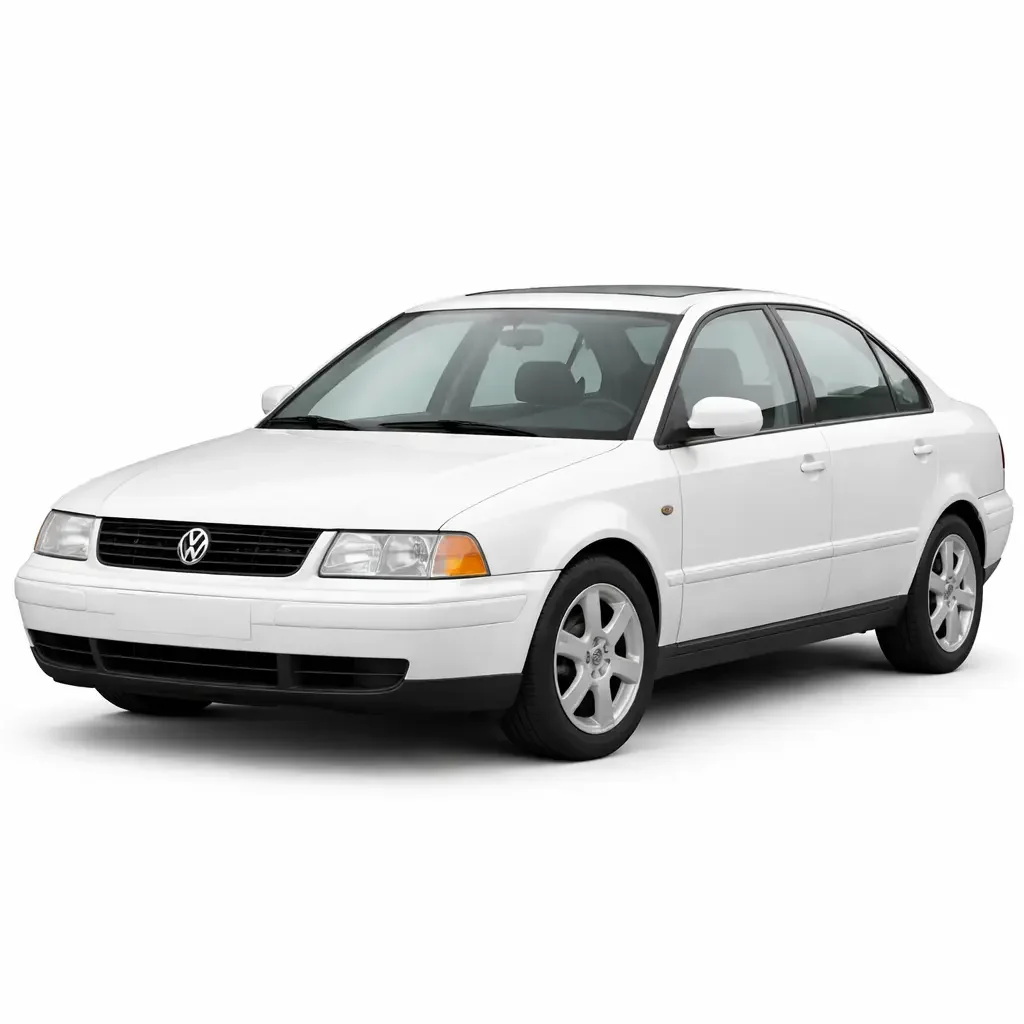
The Volkswagen Passat sold in North America from 1998 through 2005 spans two closely related sub-generations on the same PL45 platform: the B5, sold from the 1998 model year through the 2001 model year, and the B5.5, introduced in production in late 2000 for the 2001.5 model year and continuing through the 2005 model year. The B5 was a complete redesign over the preceding B4, returning the Passat to a longitudinal engine layout shared with the first-generation Audi A4. The B5.5 is not a new generation but a mid-cycle update that revised the front and rear exterior, made interior improvements, introduced the W8 engine, and added the 2.0-litre TDI diesel to the North American lineup in 2003. Both carry the internal designation Typ 3B for the B5 and Typ 3BG for the B5.5.
This window contains more distinct catalog splits than any previous Passat generation covered in this series. The engine lineup grew from two powertrains at launch to four by 2003. The body boundary between B5 and B5.5 affects headlamps, bumpers, and taillamps. The 4motion all-wheel-drive system introduced a rear suspension architecture fundamentally different from front-wheel-drive models. The 1.8T received a power increase mid-production. The W8 carried restrictions unique to a single powertrain. The TDI arrived with a transmission restriction opposite to the B4 TDI. Each of these creates a catalog split that a unified application entry will get wrong on a significant share of vehicles in the fleet.
This guide addresses the United States market throughout, with Canadian distinctions noted where they apply. The companion 1995-1997 guide establishes the B4 context and the platform break that separates the B4 from the B5.
Platform: PL45, Longitudinal Layout, and the Return to Audi Architecture
The B5 Passat is built on the PL45 platform, shared with the first-generation Audi A4 (Typ 8D, 1994-2001). This platform returned the Passat to a longitudinal engine layout after two generations on the A2-derived transverse platform of the B3 and B4. The return to longitudinal mounting is the most consequential architectural distinction between the B4 Passat and the B5 Passat for catalog purposes. Every drivetrain component, every engine mount, every transmission, and every accessory drive geometry is specific to the longitudinal orientation and shares nothing with the transverse B3 and B4 applications.
The PL45 platform uses a four-link independent front suspension, replacing the MacPherson strut front of the B3 and B4. The rear suspension architecture depends on the drivetrain: front-wheel-drive B5 models use a semi-independent torsion beam rear axle, while 4motion all-wheel-drive models use a fully independent multilink rear suspension to accommodate the rear differential and halfshafts. This rear suspension split between FWD and 4motion is addressed in full in the drivetrain section.
The 4motion AWD system on the B5 and B5.5 uses a Torsen T-2 centre differential, a full-time torque-sensing unit that differs from the reactive Haldex system used in the subsequent B6 Passat. The Torsen system is a permanent AWD architecture; it distributes torque continuously to all four wheels rather than engaging reactively when slip is detected. This distinction affects service component cross-references: Torsen differential fluid, centre differential components, and rear differential components from the B5 4motion do not cross to the Haldex-equipped B6 Passat or to the Haldex-equipped B3 and B4 Syncro.
The B5 wheelbase of 2,708 mm (approximately 106.6 inches) is longer than the B4's 2,631 mm. The B5 is also wider and taller than the B4. These dimensional changes mean that no body panel, door, glass, or exterior trim from the B4 crosses to the B5. The platform break between B4 and B5 is absolute: the only components that might cross between these generations are consumables such as fluids, filters, and fasteners that are not vehicle-specific. Engine components from the B5 1.8-litre turbocharged engine also do not cross to the B4's 2.0-litre 8-valve or VR6 applications, as these are different engine families.
The B5 platform is shared at the front suspension and some drivetrain levels with the Audi A4 B5. Front suspension geometry, front wheel bearings, and some front brake components cross between the B5 Passat and the Audi A4 B5 at matching engine and equipment specifications. The rear suspension on FWD models uses a torsion beam that differs from the multilink rear of the Audi A4, meaning rear suspension components do not generally cross between the FWD B5 Passat and the A4 at the rear axle.
The B5 and B5.5 Body Boundary: What Changed and What Did Not
The B5.5 facelift was introduced in production in late 2000 and arrived in North American dealerships as the 2001.5 model year. The facelift revised the front and rear exterior while leaving the doors, roof, glasshouse, and mid-body panels unchanged. The specific components that are generation-specific are the headlamp assemblies, the front bumper assembly, the front grille, and the taillamp clusters. The front bumper and grille on the B5.5 are wider than those on the B5, requiring a wider front clip to accommodate the W8 engine bay. The headlamps changed from the rounded, integrated-fog-light design of the B5 to the sharper projector-optic units with separate fog lamp housings on the B5.5. Taillamps were redesigned with different lens geometry.
The doors, door glass, windscreen, rear quarter glass, rear window glass, door seals, and mid-body panels carry unchanged from B5 to B5.5. These are the primary glazing and mid-body cross-references within the generation and represent a reliable shared component family between the two sub-generations.
The interior received meaningful updates at the B5.5 transition. The center console was revised with a better armrest, improved cupholders, and a double-DIN radio aperture replacing the single-DIN of the B5. The dashboard structure and major interior panels are shared between B5 and B5.5, but the radio surround, center console assembly, and cupholder hardware differ between the two sub-generations. A catalog that applies a single center console listing across all 1998-2005 applications will generate wrong console components for one sub-generation.
The B5.5 also introduced side curtain airbags as standard equipment in addition to the front airbags carried over from the B5. Airbag module listings, side curtain canister dimensions, and curtain deployment hardware must be flagged as B5.5-specific additions not present on B5 applications.
Because the B5.5 production start in late 2000 does not align cleanly with an annual model year boundary in North America, the 2001 model year contains both B5 and B5.5 production depending on build date. A catalog entry assigning B5 headlamp assemblies to all 2001 model year Passats, or assigning B5.5 headlamp assemblies to all 2001 model year Passats, will generate wrong lamps for a portion of 2001 production. Build date confirmation is required before headlamp, front bumper, or taillamp listings are assigned to 2001 model year vehicles.
North American Lineup Year by Year: 1998 Through 2005
1998: Launch Year, GLS 1.8T and GLS V6, Sedan Only
The B5 Passat launched in North America for the 1998 model year with two trims: the GLS powered by the 1.8-litre 20-valve turbocharged four-cylinder producing 150 hp, and the GLS V6 and GLX powered by the 2.8-litre 30-valve V6 producing 190 hp. Only the sedan was available in the launch year; the wagon arrived later. The 1.8T GLS was available with a five-speed manual or a five-speed Tiptronic automatic. The V6 GLX was available with a five-speed automatic as standard and a five-speed manual as an option. No wagon, no diesel, and no 4motion were offered in the United States for the 1998 model year.
1999: Wagon Added, 4motion Available on V6
For the 1999 model year the five-door station wagon was added to the lineup in GLS V6 and GLX configurations. Wagons were initially V6-only. The 4motion all-wheel-drive system became available on V6 models for 1999. The GLS 1.8T wagon was not offered in the United States for 1999; the wagon was V6 territory for the first North American model year it appeared.
2000: GLS 1.8T Wagon Added, B5 Final Full Model Year
The 2000 model year added the 1.8T wagon to the lineup, making the five-door wagon available with both engines for the first time in the United States. The 2000 model year is the final full model year of the B5 body specification in the United States. Late-production 2000 vehicles built after production of the B5.5 began may carry B5.5 exterior components; build date confirmation is required for late 2000 exterior part assignments.
2001 and 2001.5: B5.5 Body Arrives, 1.8T Power Increases to 170 hp
The 2001 model year straddles the B5 and B5.5 body specifications as described above. The most significant mechanical change for 2001.5 is the 1.8T power increase from 150 hp to 170 hp, reflecting the revised AWP engine code with the K03 Sport turbocharger specification that was introduced on the Audi A4 1.8T at the same time. This is not a different engine displacement or a different engine family; it is a revised calibration of the same 1.8-litre turbocharged unit. However, the turbocharger, fuel system calibration, and engine management software differ between the 150 hp and 170 hp specifications. A turbocharger listed for the 150 hp 1.8T does not cross to the 170 hp application, and vice versa. Any 1.8T engine management or turbocharger listing must confirm the power output specification before the component is assigned.
The 4motion system was extended to the 1.8T wagon for the 2001.5 model year. Prior to this, 4motion had been exclusive to V6 models in the United States. The addition of 1.8T 4motion created a new drivetrain application with the Torsen centre differential and multilink rear suspension behind a four-cylinder engine, a combination that did not exist in the B5 window.
The GLX remained V6 only. The GLS was available with both the 1.8T and the V6. The 4motion option was available on V6 GLS, GLX, and 1.8T GLS wagon applications from 2001.5.
2002 and 2003: W8 Arrives, GL Trim Added, TDI Introduced
For the 2002 model year the W8 sedan and wagon were introduced, powered by the 4.0-litre W8 engine producing 270 hp paired with 4motion as standard. The W8 was available only with 4motion and only with a five-speed automatic at launch. A six-speed manual became available for the 2003 model year W8 as part of a sport package that also included revised suspension tuning and 17-inch BBS alloy wheels. The W8 carried four chrome exhaust tailpipes distinguishing it externally from V6 applications.
For the 2003 model year the GL trim was introduced as a new entry-level configuration below the GLS. The GL was available with the 1.8T and, from its introduction, with the TDI. The TDI in the B5.5 uses the BHW 2.0-litre Pumpe Duse direct-injection diesel producing 134 hp. This is a fundamentally different diesel from the B4's 1.9-litre 1Z and AHU engines: different displacement, different injection architecture using unit injectors rather than a distributor-type pump, and different emissions hardware. The BHW TDI does not share fuel system components, injection hardware, or emission control components with the B4's 1Z or AHU TDI.
The TDI in the United States B5.5 was available only with a five-speed automatic transmission. This is the opposite of the B4 TDI, which was manual only. A catalog entry assigning a manual transmission to the North American B5.5 TDI is assigning a transmission that was never sold on this engine in this market. The TDI was also restricted to front-wheel drive in the United States; no 4motion TDI was offered in North America on the B5 or B5.5.
2004: 1.8T 4motion Sedan Added, W8 Final Year Approaches
For 2004 the 1.8T 4motion combination was extended to the sedan body style in the United States, having previously been available only in the wagon. The W8 continued for 2004 before being discontinued at the end of that model year. A 4motion 1.8T sedan application therefore first exists in the United States from the 2004 model year; any 1.8T 4motion sedan catalog entry for 2003 or earlier model years is assigning a drivetrain combination that was not available.
2005: W8 Discontinued, Final B5.5 Year
The 2005 model year was the final year of the B5.5 in North America and marked the discontinuation of the W8 engine. The 2005 lineup consisted of the GL and GLS with 1.8T or TDI (GL), the GLS with 1.8T or V6, and the GLX with V6 only. The W8 was not available for 2005 and its trim designation was retired. The B6 Passat replaced the B5.5 for the 2006 model year.
Engines: Four Families With Distinct Catalog Profiles
1.8-Litre Turbocharged Four-Cylinder (1.8T)
The 1.8T is the volume engine of the B5 and B5.5 North American Passat and carries the most complex catalog history within the window due to the power output change. From 1998 through the 2001 model year on B5 production, the 1.8T carries the AGU or ATW engine code and produces 150 hp. From the 2001.5 B5.5 production onward, the 1.8T carries the AWP engine code and produces 170 hp.
Both specifications use the same 1,781 cc displacement and the same basic block architecture. The critical distinction is the turbocharger and engine management. The 150 hp application uses the K03 turbocharger in its standard specification. The 170 hp application uses the K03 Sport with a higher-flow compressor wheel. Turbocharger assemblies, wastegate actuators, and intake and exhaust manifold configurations differ between the two power specifications. Engine management software differs. A turbocharger replacement confirmed for the 150 hp 1.8T must not be applied to the 170 hp application, and vice versa.
The 1.8T in both specifications is a longitudinally mounted unit, shared with the Audi A4 1.8T of the same period. Engine internal service components including timing belt, water pump, thermostat, spark plugs, oil filter, and air filter cross between the B5 Passat 1.8T and the Audi A4 1.8T at matching power output specifications. These are the most reliable undercar cross-references for the 1.8T application.
The 1.8T carries a documented engine oil sludge concern specific to early production. The longitudinal mounting orientation results in a lower oil capacity than transverse applications of the same engine, at 4.3 US quarts versus 4.6 quarts in transverse installations. Failure to use fully synthetic oil and to change it at short intervals can result in sludge accumulation in the oil galleries. This affects engine internal service specifications: oil capacity listings for the B5 Passat 1.8T must reflect the longitudinal application's lower capacity, not the higher capacity of transverse applications.
2.8-Litre V6
The 2.8-litre V6 in the B5 and B5.5 carries the ATQ or AHA engine code and produces 190 hp. This is not the narrow-angle VR6 of the B3 and B4 Passat but a conventional 30-valve 2.8-litre V6 with two cylinder banks at 90 degrees and a DOHC head per bank. The B5 V6 is therefore an entirely different engine architecture from the B3 and B4 VR6, sharing no internal components and requiring completely separate service listings.
The B5 V6 is shared with the Audi A6 2.8 of the same period and with the Audi A4 2.8. Engine internal service components, timing belt, water pump, and spark plugs cross between these Audi Group applications within matching specifications.
The V6 was available with both front-wheel drive and 4motion throughout the North American B5 and B5.5 window. The GLX trim was V6 only and was available with or without 4motion depending on the year. The GLS V6 was also available with 4motion from 1999 onward. V6 4motion applications require the Torsen rear differential components and multilink rear suspension listings in addition to the front-wheel-drive V6 undercar listings.
The V6 uses a conventional accessory drive belt in addition to the timing belt. Both must be specified in service listings. The timing belt on the V6 is an interference engine application, meaning belt failure results in engine damage. Timing belt replacement interval and kit specification must be confirmed against engine code and production year before listing.
4.0-Litre W8 (2002 Through 2004, 4motion and Sedan or Wagon Only)
The W8 is the most catalog-distinct engine in the B5.5 lineup, carrying the most restrictions and the most unique component specifications. The 4.0-litre W8 uses two narrow-angle VR4 units joined on a common crankshaft to form a W configuration with eight cylinders in 72 degrees. It produces 270 hp and is paired permanently with 4motion all-wheel drive. No W8 was sold in the United States without 4motion.
The W8 uses a wider front clip than the 1.8T or V6 applications to accommodate its larger engine block. This front clip width difference means the W8 front subframe and some front suspension pickup points differ from the 1.8T and V6 applications. Front suspension components confirmed for the 1.8T or V6 should be verified against W8-specific geometry before being applied to W8 listings. The W8 also carries a larger fuel tank at approximately 21 gallons compared to approximately 16.4 gallons on gasoline V6 and 1.8T applications. Fuel system components including the fuel pump and fuel sender unit are W8-specific for this reason.
The W8 was available only with automatic transmission from its 2002 introduction. From 2003, a six-speed manual became available paired with the W8 and a sport-package suspension. The W8 automatic uses the 01V five-speed unit. The W8 six-speed manual carries the 01E code. These are different transmission families from each other and from the five-speed manual used with the 1.8T and V6. A transmission component listed for the 1.8T five-speed manual does not cross to the W8 six-speed manual 01E.
The W8 carries four chrome exhaust tailpipes. A two-tailpipe exhaust listing assigned to a W8 application is wrong. Exhaust system components, catalytic converter configurations, and tailpipe assemblies are W8-specific and must not be cross-referenced to V6 or 1.8T exhaust applications.
The W8 was discontinued after the 2004 model year. Any catalog entry assigning a W8 application to a 2005 Passat is assigning an engine that was not available in that model year.
2.0-Litre TDI (2003 Through 2005, Automatic and FWD Only)
The BHW 2.0-litre Pumpe Duse TDI arrived in the North American B5.5 for the 2003 model year, making the Passat the only mid-size diesel-powered car sold in the United States at the time. It produces 134 hp and is paired exclusively with the five-speed automatic transmission in the North American market. No manual transmission TDI was sold in the United States on the B5.5. This is the opposite restriction from the B4 TDI, which was manual only.
The TDI was restricted to front-wheel drive in North America throughout its 2003 through 2005 production run. No 4motion TDI was offered in the United States. The TDI was available in the GL trim and the GLS trim in sedan and wagon body styles.
The BHW Pumpe Duse uses unit injectors integrated directly into the cylinder head rather than a separate injection pump. This architecture differs fundamentally from the B4's distributor-type injection pump system. Injector service, injector replacement, and diesel fuel system components for the BHW do not cross to the B4 TDI 1Z or AHU applications. A catalog that treats all Passat TDI applications as a single fuel system family will generate wrong injectors, wrong injection pump components, and wrong fuel filter specifications across generations.
Drivetrain Splits: FWD vs 4motion Rear Suspension
The rear suspension architecture difference between front-wheel-drive and 4motion B5 and B5.5 Passats is the most consequential mechanical distinction for catalog work after the engine family separation. Front-wheel-drive models use a semi-independent torsion beam rear axle. 4motion models use a fully independent multilink rear suspension to accommodate the rear differential and halfshafts.
Rear shock absorbers, rear springs, rear wheel bearings, rear hub assemblies, and rear axle geometry components are entirely different between FWD and 4motion applications. A rear shock absorber confirmed for a FWD 1.8T sedan does not fit the 4motion rear suspension mount geometry. A rear spring rate confirmed for a FWD wagon does not apply to a 4motion wagon. Any rear suspension service component listing that does not separate FWD from 4motion will generate wrong components on every rear suspension order placed against the merged entry.
The Torsen T-2 centre differential, rear differential assembly, rear driveshaft, and rear halfshafts are all 4motion-specific and are absent from FWD applications. Torsen differential fluid specifications, rear differential fluid specifications, and centre differential service intervals apply only to 4motion applications. FWD applications have no centre differential, no rear differential, and no rear driveshaft.
The 4motion trunk space in the sedan is reduced relative to the FWD sedan due to the packaging of the rear differential and driveshaft. This affects spare tire configuration: 4motion sedans use a compact spare tire rather than the full-size spare of FWD sedans because the trunk floor cannot accommodate the full-size wheel. A full-size spare listing assigned to a 4motion sedan will generate a component that physically will not fit the trunk.
4motion was available in the following combinations in the United States during this window: V6 sedan from 1999; V6 wagon from 1999; 1.8T wagon from 2001.5; 1.8T sedan from 2004; W8 sedan from 2002; W8 wagon from 2002. The TDI was never paired with 4motion in the United States. Any 4motion rear drivetrain listing assigned to a TDI application is wrong.
Body Style: Sedan and Wagon Cross-References
The four-door sedan and five-door station wagon share identical front body structure, front doors, front door glass, windscreen, A-pillar, and B-pillar geometry throughout the B5 and B5.5 window. All front suspension components, front brake components, and engine service items cross freely between sedan and wagon within matching engine and drivetrain specifications.
Aft of the C-pillar, the sedan and wagon are different vehicles. The wagon has different rear quarter panels, a rear liftgate rather than a trunk lid, different rear glass, different rear lamp clusters, and a different rear bumper from the sedan. The wagon's rear cargo floor, rear seat configuration, and rear door aperture geometry are all wagon-specific. No rear body panel, rear glass item, or taillamp from the sedan crosses to the wagon.
The wagon carries a larger cargo volume than the sedan and uses a different rear spring specification on FWD applications. Wagon rear springs are rated for higher loads than sedan rear springs. Any rear spring listing must confirm body style before the specification is assigned.
The wagon also carries a different fuel tank in the 4motion configuration than the sedan, due to the packaging constraints of the rear differential. Fuel tank listings for 4motion wagons must be confirmed separately from 4motion sedan fuel tank specifications before any cross-reference is published.
Common ACES/PIES Catalog Mistakes
The first error is applying a single 1.8T engine management or turbocharger listing to all B5 and B5.5 production without separating the 150 hp pre-facelift specification from the 170 hp B5.5 specification. The turbocharger, wastegate, and engine software differ between the two power outputs. A turbocharger confirmed for the 150 hp AGU application does not fit the 170 hp AWP specification.
The second error is applying B5 headlamp assemblies to B5.5 applications or B5.5 headlamp assemblies to B5 applications. The headlamp housing geometry, the fog lamp integration, and the mounting bracket differ between the two sub-generations. The B5 uses integrated fog lights within the headlamp housing; the B5.5 uses projector-optic headlamps with separate fog lamp housings in the bumper. These are not interchangeable.
The third error is treating all 2001 model year Passats as a uniform application for headlamp, bumper, and taillamp listings. The 2001 model year contains both B5 and B5.5 production depending on build date. Front and rear exterior components for the 2001 model year must be confirmed against build date before a single specification is assigned.
The fourth error is applying FWD rear suspension components to 4motion applications. The torsion beam rear of FWD models and the multilink rear of 4motion models are architecturally unrelated. Rear shocks, rear springs, rear wheel bearings, and rear axle components from FWD applications will not fit the 4motion rear suspension geometry.
The fifth error is assigning an automatic transmission to the North American B5.5 TDI. The TDI was sold exclusively with the five-speed automatic in North America. A manual transmission TDI listing for the United States B5.5 is assigning a configuration that was never sold in this market. Note that this is the opposite of the B4 TDI, which was manual only; a researcher familiar with the B4 TDI restriction who applies the same logic to the B5.5 will generate wrong transmission listings.
The sixth error is assigning a manual transmission to the W8 for the 2002 model year. The W8 was automatic-only at launch. The six-speed manual 01E became available on the W8 only from the 2003 model year as part of the sport package. A manual W8 transmission listing for 2002 is assigning a configuration that was not available.
The seventh error is applying 4motion rear drivetrain or rear suspension components to any North American TDI application. The TDI was front-wheel drive only in the United States throughout its 2003-2005 production run. No rear differential, Torsen unit, or 4motion multilink rear suspension component applies to any North American TDI Passat.
The eighth error is assigning W8 applications to the 2005 model year. The W8 was discontinued after the 2004 model year. Any catalog entry with a W8 engine application for a 2005 North American Passat is listing an engine that was not sold in that year.
The ninth error is cross-referencing B5.5 BHW TDI fuel system components to B4 TDI 1Z or AHU applications. The BHW uses Pumpe Duse unit injectors directly in the cylinder head. The 1Z and AHU use a distributor-type injection pump. These are different injection architectures with no component overlap in fuel delivery hardware.
The tenth error is applying B4 Passat drivetrain, engine, or suspension components to B5 applications on the basis of shared Passat nameplate. The B4 uses a transverse engine on the Typ 35i A2-derived platform. The B5 uses a longitudinal engine on the PL45 platform shared with the Audi A4. No drivetrain component, engine mount, transmission, accessory drive component, or suspension part crosses between the B4 and B5 generations.
The eleventh error is applying 1.8T 4motion sedan components to model years before 2004. The 1.8T 4motion sedan combination was not available in the United States until the 2004 model year. Prior to 2004, 1.8T 4motion was available only in the wagon body style. Any 1.8T 4motion sedan rear drivetrain listing for 2003 or earlier is assigning a configuration not offered in that year.
The twelfth error is cross-referencing the B5 V6 to the B3 or B4 VR6 on the basis of similar displacement. The B5 2.8-litre V6 is a conventional 90-degree V6 with 30 valves. The B3 and B4 2.8-litre VR6 is a narrow-angle 12-valve single-head unit. These are different architectures, different bore and stroke dimensions, and different engine families. No internal engine component crosses between them.
Pre-Listing Checklist for the 1998-2005 Passat
Sub-generation confirmed as B5 (Typ 3B, 1998-early 2001 production) or B5.5 (Typ 3BG, late 2000-2005 production); for 2001 model year vehicles, build date confirmed before headlamp, front bumper, taillamp, and center console listings are assigned.
Engine confirmed as 1.8T 150 hp (AGU/ATW, B5 production through 2001), 1.8T 170 hp (AWP, B5.5 from 2001.5), 2.8-litre V6 (190 hp, all years), 4.0-litre W8 (270 hp, 2002-2004 only), or 2.0-litre TDI BHW (134 hp, 2003-2005 only); turbocharger, engine management, and fuel system components confirmed as specific to the 150 hp or 170 hp 1.8T specification and not merged between the two.
Drivetrain confirmed as FWD or 4motion; rear suspension confirmed as torsion beam (FWD) or multilink (4motion); all rear suspension components, rear shock absorbers, rear springs, rear wheel bearings, and rear axle components confirmed as drivetrain-specific and not cross-referenced between FWD and 4motion.
Transmission confirmed as five-speed manual (012 or 01W), five-speed automatic Tiptronic (01V), or six-speed manual (01E, W8 sport package from 2003 only); TDI confirmed as automatic-only in the North American market; W8 confirmed as automatic-only for 2002 and six-speed manual or automatic from 2003.
TDI drivetrain confirmed as FWD only in North America; no 4motion TDI application exists for the United States B5.5; Torsen and rear differential components excluded from all TDI listings.
W8 applications confirmed as 2002 through 2004 only; W8 excluded from 2005 model year; W8 front clip geometry confirmed as wider than 1.8T and V6 applications; W8 fuel tank confirmed as larger than 1.8T and V6 sedan fuel tank; W8 exhaust confirmed as four tailpipes distinguishing it from two-tailpipe V6 and 1.8T applications.
1.8T 4motion combinations confirmed: wagon available from 2001.5; sedan available from 2004 only; 1.8T 4motion sedan applications excluded from all model years before 2004.
Body style confirmed as sedan or wagon; rear body panels, rear glass, rear lamps, rear bumper, and rear cargo floor confirmed as body-style-specific; rear spring specification confirmed as body-style-specific with wagon carrying higher load rating.
4motion compact spare tire confirmed for sedan applications; FWD sedan full-size spare confirmed as not applying to 4motion sedan due to trunk geometry; spare tire and trunk floor listings confirmed against drivetrain and body style before assignment.
B4 Passat components excluded from all B5 and B5.5 applications; platform break between B4 and B5 is a complete architectural separation with no component cross-reference in drivetrain, engine, or suspension; B5 V6 confirmed as different engine architecture from B3 and B4 VR6 despite similar displacement.
1.8T oil capacity confirmed as 4.3 US quarts for longitudinal application in the Passat; transverse 1.8T oil capacity of 4.6 quarts from Golf or Jetta applications must not be applied to the Passat 1.8T.
Final Take
The 1998-2005 Passat is the most application-complex North American Passat generation in this series, and its complexity grows progressively through the window as new engines, drivetrain combinations, and trim configurations are added year by year. The generation begins with two engines and one drivetrain in 1998 and ends in 2005 with four engine families, two drivetrains, four trim levels, and a body boundary mid-window that affects exterior components across a full model year of production.
The most consequential single distinction in the catalog is the FWD-versus-4motion rear suspension split, because it creates wrong components across an entire rear axle on every merged application order. The most common quiet error is likely the 1.8T power output split, because both engines are the same displacement and look the same on a parts inquiry, but the turbocharger and engine management components are genuinely different between the 150 hp and 170 hp specifications.
The TDI transmission restriction deserves specific attention in the context of the broader Passat series. A researcher who correctly applied the manual-only rule to the B4 TDI and who then moves to the B5.5 TDI without re-confirming the restriction will generate a manual transmission listing for a vehicle that was automatic only in North America. The rule reverses completely between the two generations, and that reversal is precisely the kind of context-dependent detail that catalog work on related generations tends to get wrong.
The W8 is unique in the series for being a single-powertrain trim that carries its own front clip geometry, its own fuel tank, its own exhaust configuration, and its own transmission availability timeline across just three model years. It rewards catalog work that treats it as an entirely separate application rather than a variant of the V6 GLX, because in physical terms the W8 is a different vehicle from the front subframe rearward despite sharing a nameplate, a platform, and a body shell with the V6 applications around it.
Disclaimer
This guide is intended for catalog research, fitment analysis, and parts advisory reference. Production specifications, option availability, and regulatory compliance requirements vary by model year, regional market, and assembly date within any given window. Always confirm application data against vehicle identification number decoding, factory build sheets, and OEM parts documentation before finalizing a listing or parts recommendation. PartsAdvisory and its contributors are not responsible for fitment errors arising from catalog data that has not been independently verified against physical vehicle inspection or official OEM sources.