
Written by Arthur Simitian | PartsAdvisory
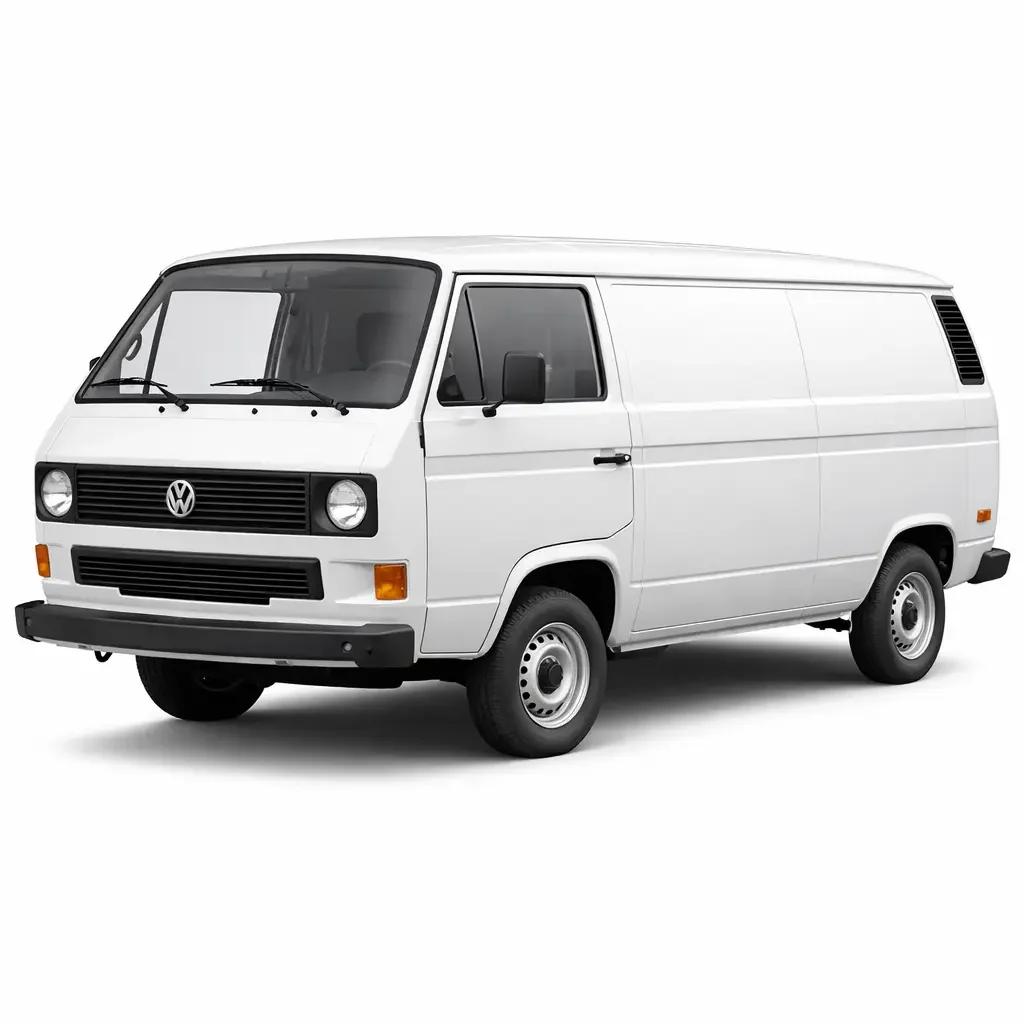
The Volkswagen Panel sold in North America from the 1980 through 1991 model years is the cargo van body style of the third-generation Type 2, known as the T3 and marketed in North America under the Vanagon name. It shares its platform, suspension, engine, and transmission with all other T3 body styles built in the same window: the passenger Bus, the GL and Carat passenger vans, the Westfalia Camper, and the single-cab and double-cab Pickup. The Panel designation identifies the body style, characterized by solid rear quarter panels and rear cargo doors in place of the passenger glass of the Bus. All mechanical components confirmed for one T3 body style apply equally to all others within matching engine, transmission, and drivetrain specifications.
The T3 replaced the T2b Bay Window in North American sales for the 1980 model year. It is larger and heavier than the T2b, with a more angular boxy body. Despite sharing the same forward-control, rear-engine, rear-wheel-drive architecture and the same basic wheelbase of 2,459 mm (96.8 inches), the T3 shares no mechanical component with the T2b. The suspension geometry, brake architecture, body structure, engine family, and transmission are all new for the T3. A component confirmed for any T2b application does not cross to any T3 application, and the two generations must be maintained as entirely separate catalog applications.
The 1980 through 1991 window contains three major engine-level catalog boundaries and one suspension-level boundary introduced by the Syncro all-wheel-drive system. The engine boundaries are the mid-1983 transition from air-cooled to water-cooled Wasserboxer, the 1986 enlargement of the Wasserboxer from 1900cc to 2100cc with a new engine management system, and the brief 1982 through 1983 availability of the 1600cc diesel engine. The Syncro boundary separates all rear-suspension and drivetrain components between 2WD and AWD applications from 1986 onward. Two of these three engine boundaries do not fall on clean annual model year lines and require build date or engine code confirmation rather than year-only assignment.
This guide addresses the United States market throughout. Canadian applications follow the same engine and transmission specifications as the United States for the T3 within this window.
Platform: T3, Rear Engine, Rear-Wheel Drive, Forward Control
The T3 retains the fundamental architecture of the T1 and T2: a forward-control body with the engine mounted in the rear overhang behind the rear axle, driving the rear wheels through a transaxle positioned just ahead of the engine. The wheelbase of 2,459 mm is 59 mm longer than the T2b, and the overall body is substantially larger in all dimensions, providing notably more interior volume. The rear engine placement produces a near-equal 50/50 front-to-rear weight distribution, which is a distinctive handling characteristic of the T3 compared to most contemporary vans with front-mounted engines.
The front suspension of the T3 uses coil springs with MacPherson struts, replacing the torsion bar and king pin front axle of the T2b. This is a significant suspension architecture change from the preceding generation and means no front suspension component from the T2b crosses to the T3. Front strut cartridges, front springs, front wheel bearings, and front brake components are all T3-specific.
The rear suspension on 2WD T3 models uses trailing arms with coil springs and telescopic shock absorbers. This is again architecturally different from the T2b's CV-joint independent rear axle. Rear springs, rear shocks, rear wheel bearings, and rear axle components from the T2b do not cross to the 2WD T3.
Front brakes on the T3 are disc throughout the full production window, larger than those on the T2b. Rear brakes are drums on 2WD models throughout. The Syncro AWD models introduced for 1986 use a different rear suspension and rear brake architecture from the 2WD, as described in the Syncro section below.
The T3 uses a coil spring front suspension that made power steering and air conditioning practical options for the first time on the Transporter in North America. Both were available on water-cooled models.
The Panel Body Style and Its T3 Siblings
The Panel Van on the T3 platform carries no side glass behind the B-pillar and uses two rear cargo doors. The rear cargo area floor, cargo wall panels, and rear door assemblies are Panel-specific and do not cross to the Bus or Camper body styles. The sliding side door is shared between the Panel, Bus, and Camper body styles as a common component within matching production date specifications.
The windscreen, front doors, and front door glass are shared across all T3 body styles. A front door assembly confirmed for a 1988 Camper crosses to a 1988 Panel within matching production specifications. Rear body glass, rear liftgate hardware, and rear quarter panel assemblies are body-style-specific.
The Westfalia Camper is built on the Bus body style with interior conversion hardware added by Westfalia after leaving the VW assembly line. Its mechanical components beneath the conversion are identical to the Bus and cross freely to the Panel within matching specifications. Westfalia-specific hardware including the pop-top roof, cabinetry, propane system, and refrigerator are not VW catalog items and are not Panel-applicable.
The Pickup body style uses a different cab and bed structure from the van variants. Front doors are shared with the van variants but the cab-to-bed junction and all rear body hardware are Pickup-specific.
Engine Architecture: Three Gasoline Families Plus Diesel
The T3 North American window uses three distinct gasoline engine families across its production run, plus a brief diesel availability window. Understanding the architecture of each family is the foundation for correct catalog work because each requires completely different fuel system, cooling system, and ignition service components.
The first family is the air-cooled Type 4 flat-four carried over from the T2b into the T3 at launch. The second family is the water-cooled Wasserboxer flat-four introduced at mid-year 1983, which uses the same basic architecture as the Type 4 but adds water-cooling jackets around the cylinders. The third family is the enlarged Wasserboxer introduced for 1986. The diesel is an inline-four borrowed from the Rabbit and Golf, entirely different in architecture from any flat-four gasoline engine.
These four engine configurations require separate catalog entries for cooling, fuel system, ignition, and exhaust components in every case. A cooling system component from an air-cooled application does not apply to any water-cooled application. A Digijet injection component from the first Wasserboxer does not apply to the Digifant-managed second Wasserboxer. No gasoline engine component applies to the diesel at the fuel system, injection, or exhaust level.
Engine Progression: 1980 Through 1991
1980 Through Mid-1983: 2000cc Air-Cooled Type 4 (CU and CV)
The T3 launched for the 1980 model year carrying the same 1970cc air-cooled Type 4 engine used in the final years of the T2b. The engine codes are CU for the standard application and CV for certain variant configurations. Both are air-cooled overhead-valve flat-fours producing 67 hp. The North American application uses Bosch L-Jetronic electronic fuel injection, the same system introduced on the T2b for 1975. Dual Solex carburetors were used on European market versions but no carburetor application exists for the North American T3 air-cooled engine.
Although the CU and CV share their basic architecture with the GD engine of the final T2b years, they are housed in a different engine case design specific to the T3's engine compartment geometry. Cross-references between T2b GD components and T3 CU or CV components must be confirmed at the part number level. The engine tin, cooling ducting, and engine mounting hardware are all T3-specific. Internal engine components including pistons, cylinders, crankshaft, and camshaft may cross between GD and CU or CV applications within matching displacement specifications, but must be individually confirmed.
The air-cooled T3 has no radiator, no water pump, no thermostat housing, and no coolant reservoir. Air-cooled models can be identified visually by the absence of a lower front grille, since there is no radiator to cool. Any cooling system component applied to an air-cooled T3 application is assigning hardware that does not exist on this vehicle.
The air-cooled T3 continued in North American production through approximately the first half of the 1983 model year. The transition to the water-cooled Wasserboxer occurred mid-year in 1983 and does not align with a clean annual model year boundary. A 1983 model year T3 may be air-cooled or water-cooled depending on its build date. This mid-year engine transition is the most consequential catalog boundary in the entire T3 window and must be handled by engine code or build date confirmation rather than model year alone.
All 1980 and some 1981 T3 models had eight welded-in metal slats covering the engine ventilation passages behind the rear windows. Later models replaced these with black plastic 16-slat covers that slot in at the top. This distinction is not mechanically relevant for catalog work but is a useful production date indicator for the early air-cooled window.
1982 Through 1983: 1600cc Diesel (CS)
For the 1982 and 1983 model years only, Volkswagen offered a 1588cc naturally aspirated diesel engine in the North American T3. The engine code is CS. This is an inline-four cylinder SOHC diesel borrowed from the Rabbit and Golf platform, a completely different engine family from any flat-four gasoline engine used in the T3. It produces 48 hp, which proved severely inadequate for the heavier T3 body. The diesel was discontinued for the US market after the 1983 model year.
The CS diesel is water-cooled and uses a front-mounted radiator. A 1982 or 1983 diesel T3 therefore has a radiator and a lower front grille even though the gasoline-powered T3s of the same years are air-cooled and have no radiator. This means a lower front grille component confirmed for a 1982 or 1983 diesel application does not apply to a 1982 or 1983 gasoline application, which lacks the lower grille entirely.
The CS diesel uses a separate fuel system, injection pump, glow plug system, and exhaust from any gasoline application. No gasoline fuel pump, gasoline injector, or gasoline ignition component applies to the CS diesel. No diesel fuel pump, injection pump, or glow plug applies to any gasoline T3 application.
The CS diesel was available with a five-speed manual transmission as standard, making it the first T3 application in North America to offer the five-speed as a standard fitment. This means a 1982 or 1983 diesel-equipped T3 with a five-speed gearbox is not evidence that the five-speed was also standard on gasoline applications of the same year.
Mid-1983 Through 1985: 1900cc Wasserboxer (DH)
The water-cooled Wasserboxer flat-four was introduced mid-year in 1983, replacing the air-cooled Type 4. The engine code for the North American application is DH. Displacement is 1913cc producing 83 hp. The Wasserboxer retains the flat-four overhead-valve push-rod architecture of the Type 4 but adds water-cooling jackets around the cylinders and cylinder heads. The result is an engine that shares some valve train and internal architecture similarities with the air-cooled Type 4 but uses entirely different cooling, fuel, and engine management systems.
The Wasserboxer uses Bosch Digijet fuel injection, replacing the L-Jetronic of the air-cooled application. Digijet is a digital electronic injection system that manages fuel delivery independently of the ignition system. An L-Jetronic airflow meter, control unit, or injector confirmed for the air-cooled CU or CV application does not apply to the Digijet DH application, and vice versa.
The water-cooled Wasserboxer requires a front-mounted radiator, coolant system, water pump, and thermostat. Water-cooled T3 models can be identified visually by the presence of a lower front grille housing the radiator. All DH water-cooled models from mid-1983 onward carry this lower grille. Coolant system components, water pump, thermostat, and radiator apply only to water-cooled applications. No coolant system component applies to any air-cooled CU or CV application.
The Wasserboxer is known for a documented head gasket and cylinder head sealing weakness that manifests through coolant loss and overheating. This weakness is specific to the Wasserboxer design and is not a characteristic of the air-cooled Type 4. Head gasket, cylinder head bolt, and coolant system service components for the DH Wasserboxer must not be assumed to cross to the air-cooled application, which has different cylinder and head sealing architecture.
The 1983 model year is the only year in which three engine configurations were simultaneously available in the North American T3: the air-cooled CU or CV for earlier production, the water-cooled DH for later production, and the CS diesel for a separate fuel type. Correct application assignment for any 1983 T3 requires engine code confirmation, not model year assignment alone.
1986 Through 1991: 2100cc Wasserboxer with Digifant (MV)
For the 1986 model year the Wasserboxer was enlarged from 1913cc to 2109cc. The engine code for the North American application is MV. Power increased to 95 hp. Along with the displacement increase, the 1986 model year introduced the Bosch Digifant engine management system, which integrates both fuel injection and ignition timing control in a single digital unit, replacing the separate Digijet injection and independent ignition of the DH application.
The Digifant system uses different sensors, a different control unit, and different wiring from the Digijet. A Digijet control unit, Digijet airflow meter, or Digijet injector confirmed for the DH 1983 through 1985 application does not apply to the MV 1986 through 1991 application. The two Wasserboxer generations are separate engine management applications that must be listed independently.
The 2100cc displacement required different cylinders and pistons from the 1900cc DH. A cylinder set or piston confirmed for the DH 1900cc application does not cross to the MV 2100cc application.
The 1986 model year also introduced a redesigned transmission alongside the engine enlargement. The manual transmission was revised for the larger engine, and the automatic transmission received updates as well. A transmission internal component confirmed for a pre-1986 application must be confirmed against the 1986-revised specification before it is applied to a 1986 or later application.
The MV 2100cc Wasserboxer retains the same documented coolant sealing sensitivity as the DH 1900cc, with head gasket service remaining the most frequent major service item. The head gasket specification differs between the 1900cc and 2100cc applications due to the different bore dimensions.
The MV engine and its Digifant management were used without significant change from 1986 through the end of North American T3 importation in 1991. Components confirmed for 1986 production cross to 1991 within matching specifications, making this the most uniform five-year span in the entire T3 window.
Syncro All-Wheel Drive: 1986 Through 1991
The Syncro four-wheel-drive system became available in the North American market for the 1986 model year. All North American Syncro T3s were built by Steyr-Daimler-Puch in Graz, Austria, using T3 bodies and running gear supplied from the Hannover plant, with the AWD system added at the Graz facility. The Syncro uses a viscous coupling center differential that distributes torque to the rear wheels as the primary drive and engages the front axle through the viscous coupling when rear wheel slip is detected.
The Syncro uses a completely different rear suspension from the 2WD T3. Where the 2WD uses trailing arms with coil springs, the Syncro uses a different rear axle arrangement to accommodate the front drive shaft, front differential, and front halfshafts. The Syncro front suspension is also modified to accommodate the front differential and its associated hardware. No rear suspension component from a 2WD T3 crosses to a Syncro application, and no Syncro rear suspension component applies to a 2WD application.
The Syncro's front brakes are larger than those of the 2WD T3. The standard 14-inch wheel Syncro uses 254mm front discs, while the rare 16-inch wheel Syncro uses 280mm front discs with different calipers. No 2WD front brake rotor or caliper crosses to the Syncro without confirming the Syncro-specific specification. The rear brakes on the Syncro are drums, as on the 2WD, but the rear drum specification differs from the 2WD rear drums due to the different rear axle geometry.
The Syncro was available only with the five-speed manual transmission. No automatic transmission was offered with the Syncro in North America. A three-speed automatic transmission component applied to a Syncro application is assigning hardware from a drivetrain configuration that was never installed.
The Syncro was offered only with the 2100cc MV Wasserboxer engine in North America. No air-cooled Syncro and no diesel Syncro were sold in the United States or Canada within the 1980 through 1991 window. An air-cooled engine component or diesel injection component applied to a Syncro application is doubly wrong: wrong engine family and wrong drivetrain configuration.
Syncro-specific drivetrain hardware including the viscous coupling, front differential, front halfshafts, and transfer case are Syncro-exclusive and do not apply to any 2WD T3 application. These components are also specific to the T3 Syncro and do not cross to the Syncro systems used on other VW Group vehicles of the era such as the Golf Syncro.
Transmissions: Three Families Across the Window
The T3 North American window uses three transmission families: the four-speed manual 091, the five-speed manual, and the three-speed automatic 090/010.
The four-speed manual 091 was the primary manual transmission for gasoline applications from 1980 through the end of the window for 2WD non-Syncro models that did not select the five-speed option. It uses a lightweight aluminum alloy case for the gearbox section and a cast iron case for the final drive. This transmission is not the same as the 002 or 091 used in the T2b; the T3 091 has different internal specifications suited to the heavier T3 and its higher-torque Wasserboxer engines.
The five-speed manual became available as an option on gasoline-powered 2WD models from the 1983 model year onward. It was standard equipment on the CS diesel and standard on all Syncro models. The five-speed is a different gearbox from the four-speed and shares no internal components with it. A clutch disc, flywheel, or gearbox internal component confirmed for the four-speed 091 must not be applied to a five-speed application without confirmation.
The three-speed automatic 090/010 was available on 2WD gasoline models throughout the window. It is the same family used in Audi products of the era, using a cast aluminum alloy case for the gearbox section. It is a conventional hydraulic three-speed unit, not a dual-clutch system. No automatic was available with the Syncro or with the diesel. Automatic transmission fluid, filter, and internal components are specific to this unit and do not cross to any later VW automatic transmission families used in Golf or Jetta applications.
The 1986 model year brought transmission revisions alongside the engine enlargement and Digifant introduction. A transmission component listed generically for the T3 must confirm whether it applies to pre-1986 or 1986-and-later specification before the listing is published.
Exterior Boundaries: Round vs Rectangular Headlights
The T3 body remained visually consistent across the full eleven-year North American window with one clear exterior boundary: the 1986 model year change from round sealed beam headlights to rectangular headlights. All 1980 through 1985 T3 models use round headlamp assemblies. All 1986 through 1991 T3 models use rectangular headlamp assemblies with the primary lights outboard and high beams inboard.
This headlamp change is accompanied by revised front bumper styling for 1986, with larger and squarer plastic bumpers replacing the earlier chrome-plated steel bumpers with plastic end-caps. The bumper change creates a body component catalog boundary at the 1985-to-1986 line for front bumper cover and bumper support components.
The remainder of the body shell, including the windscreen, front doors, front door glass, side panel structure, sliding door, rear cargo doors, roof panel, and rear glass, is continuous across the full 1980 through 1991 window within matching body style specifications. A windscreen confirmed for a 1982 Panel crosses to a 1989 Panel. A sliding door roller assembly confirmed for a 1984 Bus crosses to a 1988 Panel within matching specifications.
The lower front grille is present on all water-cooled models regardless of production year: on 1982 and 1983 diesel models, and on all gasoline models from mid-1983 onward. The lower front grille is absent on all air-cooled gasoline models from 1980 through mid-1983. This grille distinction is the single most reliable visual identifier for separating the air-cooled from the water-cooled application within the 1983 model year, and its presence or absence must be accounted for in any front valance or front fascia component listing for 1983 production.
Common ACES/PIES Catalog Mistakes
The first error is applying T2b Bay Window components to T3 Vanagon applications. The T3 is a completely different platform from the T2b with different suspension geometry, different brake architecture, different body structure, and different engine family. No T2b mechanical component crosses to the T3.
The second error is applying air-cooled cooling system or engine tin components to water-cooled Wasserboxer applications, or vice versa. The air-cooled T3 has no radiator, no water pump, and no coolant reservoir. The water-cooled Wasserboxer has no cooling fan tin, no air-cooled engine shroud, and no thermostat of the air-cooled type. These are incompatible cooling architectures.
The third error is assigning a 1983 model year T3 to either air-cooled or water-cooled applications without confirming the engine code or build date. The mid-1983 transition from CU or CV to DH is a production-date boundary, not an annual model year boundary. A 1983 T3 may be either, and the catalog must account for both possibilities with a build date qualifier.
The fourth error is applying L-Jetronic fuel system components from the air-cooled CU or CV application to the Digijet DH application, or from either to the Digifant MV application. These are three distinct fuel injection systems used in sequence and they are not interchangeable at the component level.
The fifth error is applying Digijet fuel system components from the DH 1983-1985 application to the Digifant MV 1986-1991 application. The DH uses Digijet and the MV uses Digifant. The control units, airflow meters, and injector specifications differ between the two systems.
The sixth error is applying DH 1900cc cylinder or piston specifications to the MV 2100cc application. The bore dimensions differ between the two Wasserboxer generations and cylinders and pistons are not interchangeable.
The seventh error is applying CS diesel fuel system, injection pump, or glow plug components to any gasoline T3 application, or applying any gasoline fuel or ignition component to the CS diesel. The diesel and gasoline applications share the T3 body and suspension but are entirely different engines.
The eighth error is assigning CS diesel applications to model years outside 1982 and 1983. The 1600cc diesel was available in North America only for the 1982 and 1983 model years. No diesel application exists for any North American T3 before 1982 or after 1983.
The ninth error is applying 2WD rear suspension components to Syncro applications, or Syncro rear suspension components to 2WD applications. The Syncro uses a different rear axle arrangement from the 2WD to accommodate the front drive system. Rear springs, rear trailing arms, rear wheel bearings, and rear brake hardware are architecture-specific and do not cross between 2WD and Syncro.
The tenth error is applying an automatic transmission component to a Syncro application. No automatic transmission was offered with the Syncro in North America. DSG, automatic fluid, automatic filter, and torque converter components do not apply to any Syncro T3.
The eleventh error is applying an air-cooled or diesel engine component to a Syncro application. The North American Syncro was offered exclusively with the 2100cc MV Wasserboxer. No air-cooled Syncro and no diesel Syncro were sold in the United States or Canada.
The twelfth error is applying round headlamp assemblies to 1986 or later applications, or rectangular headlamp assemblies to 1985 or earlier applications. Round headlamps are 1980-1985 only. Rectangular headlamps are 1986-1991 only. These are two discrete applications at the 1985-to-1986 body boundary.
The thirteenth error is applying pre-1986 front bumper hardware to 1986 or later applications. The 1986 model year introduced larger square plastic bumpers replacing the earlier chrome-plated steel bumpers. A pre-1986 front bumper assembly does not cross to the 1986-and-later specification.
The fourteenth error is applying 1986-revised transmission internal components to pre-1986 applications, or vice versa. The 1986 model year revised the manual and automatic transmissions alongside the engine enlargement. A transmission internal component listed generically across the full 1980-1991 window is an incomplete application that must be split at the 1985-to-1986 boundary for transmission-specific service items.
The fifteenth error is applying a lower front grille to an air-cooled 1980 through mid-1983 application. Air-cooled models have no radiator and no lower grille. A lower front grille component applied to any air-cooled T3 is assigning hardware from a system that does not exist on that vehicle.
Pre-Listing Checklist for the 1980-1991 T3 Panel
Platform confirmed as T3 Vanagon, rear engine, rear-wheel drive on 2WD, all-wheel drive on Syncro; no T2b component, no T4 Eurovan component, and no front-engine van component applies to any T3 application.
Engine confirmed by code: 2000cc air-cooled CU or CV (1980 through mid-1983 gasoline), 1600cc diesel CS (1982-1983 only), 1900cc water-cooled DH Wasserboxer (mid-1983 through 1985), or 2100cc water-cooled MV Wasserboxer (1986 through 1991); 1983 model year applications confirmed by engine code or build date before air-cooled or water-cooled components are assigned.
Cooling system confirmed as air-cooled (no radiator, no water pump, no coolant reservoir) for CU and CV applications, and water-cooled (front-mounted radiator, water pump, thermostat) for DH, MV, and CS applications; no cooling component crosses between air-cooled and water-cooled architectures.
Fuel system confirmed as Bosch L-Jetronic for CU and CV, Bosch Digijet for DH, Bosch Digifant for MV, and diesel injection pump for CS; no fuel system component crosses between these four systems.
Diesel application confirmed as 1982 and 1983 model years only; no diesel application exists for North American T3 before 1982 or after 1983; diesel-specific fuel, injection, and glow plug components confirmed as diesel-only and not applied to any gasoline application.
Drivetrain confirmed as 2WD or Syncro AWD; Syncro confirmed as available 1986-1991 only in North America; Syncro confirmed as MV Wasserboxer with five-speed manual only; no automatic and no air-cooled or diesel engine applies to any Syncro application.
Rear suspension confirmed as 2WD trailing arm or Syncro-specific before rear spring, rear shock, rear wheel bearing, or rear brake component is assigned; 2WD and Syncro rear suspension components do not cross.
Transmission confirmed as four-speed manual 091, five-speed manual, or three-speed automatic 090/010; automatic confirmed as unavailable on Syncro and on diesel; five-speed confirmed as standard on Syncro and diesel, optional on gasoline 2WD from 1983; transmission components confirmed as pre-1986 or 1986-and-later specification where applicable.
Headlamp application confirmed as round sealed beam (1980-1985) or rectangular (1986-1991); headlamp assemblies confirmed as body boundary components at the 1985-to-1986 line.
Front bumper application confirmed as chrome-plated steel with plastic end-caps (1980-1985) or large square plastic bumper (1986-1991); bumper components confirmed as separate applications at the 1985-to-1986 line.
Lower front grille confirmed as absent on air-cooled gasoline applications and present on diesel and all water-cooled gasoline applications; grille application confirmed against cooling architecture before assignment.
Body-specific components confirmed as Panel-only (rear cargo doors, cargo wall panels, rear quarter panels) before cross-reference to Bus, Camper, or Pickup rear body hardware is published; front doors, sliding door, windscreen, and all mechanical components confirmed as shared across T3 body styles within matching specifications.
Final Take
The 1980 through 1991 T3 North American window is defined by a progression of mechanical complexity that runs in the opposite direction from most vehicle series: it starts simple and grows more layered over time. The 1980 application is the most straightforward, using a well-established air-cooled engine with L-Jetronic injection. The complexity accumulates with the mid-1983 cooling architecture transition, the brief 1982-1983 diesel window, the 1986 engine enlargement with its new Digifant management, the Syncro drivetrain introduction, and the 1986 exterior boundary.
The most dangerous single boundary in this window for catalog work is the mid-1983 air-cooled to Wasserboxer transition, because it falls within a model year rather than between model years. Any catalog that treats all 1983 T3 applications as air-cooled is wrong for second-half 1983 production. Any catalog that treats all 1983 applications as water-cooled is wrong for first-half 1983 production. The only correct handling of the 1983 application is to split it at the build date boundary and require engine code confirmation for all 1983 cooling system, fuel system, and ignition component assignments.
The Syncro creates the second major catalog management challenge because it introduces an entirely different rear suspension and drivetrain architecture in a vehicle that is otherwise visually identical to the 2WD. A Syncro application cannot be identified from exterior description alone and must be confirmed from the VIN or build records before AWD-specific components are assigned.
The headlamp and bumper boundary of 1986 is the only significant exterior catalog boundary in the window and provides a clean annual cut that is easier to manage than either of the two engine boundaries. For body component purposes, the T3 North American window divides into a 1980-1985 application and a 1986-1991 application for headlamps and front bumpers, with everything else in the body shell continuous across the full eleven years.
Disclaimer
This guide is intended for catalog research, fitment analysis, and parts advisory reference. Production specifications, option availability, and regulatory compliance requirements vary by model year, regional market, and assembly date within any given window. Always confirm application data against vehicle identification number decoding, factory build sheets, and OEM parts documentation before finalizing a listing or parts recommendation. PartsAdvisory and its contributors are not responsible for fitment errors arising from catalog data that has not been independently verified against physical vehicle inspection or official OEM sources.