
Written by Arthur Simitian | PartsAdvisory
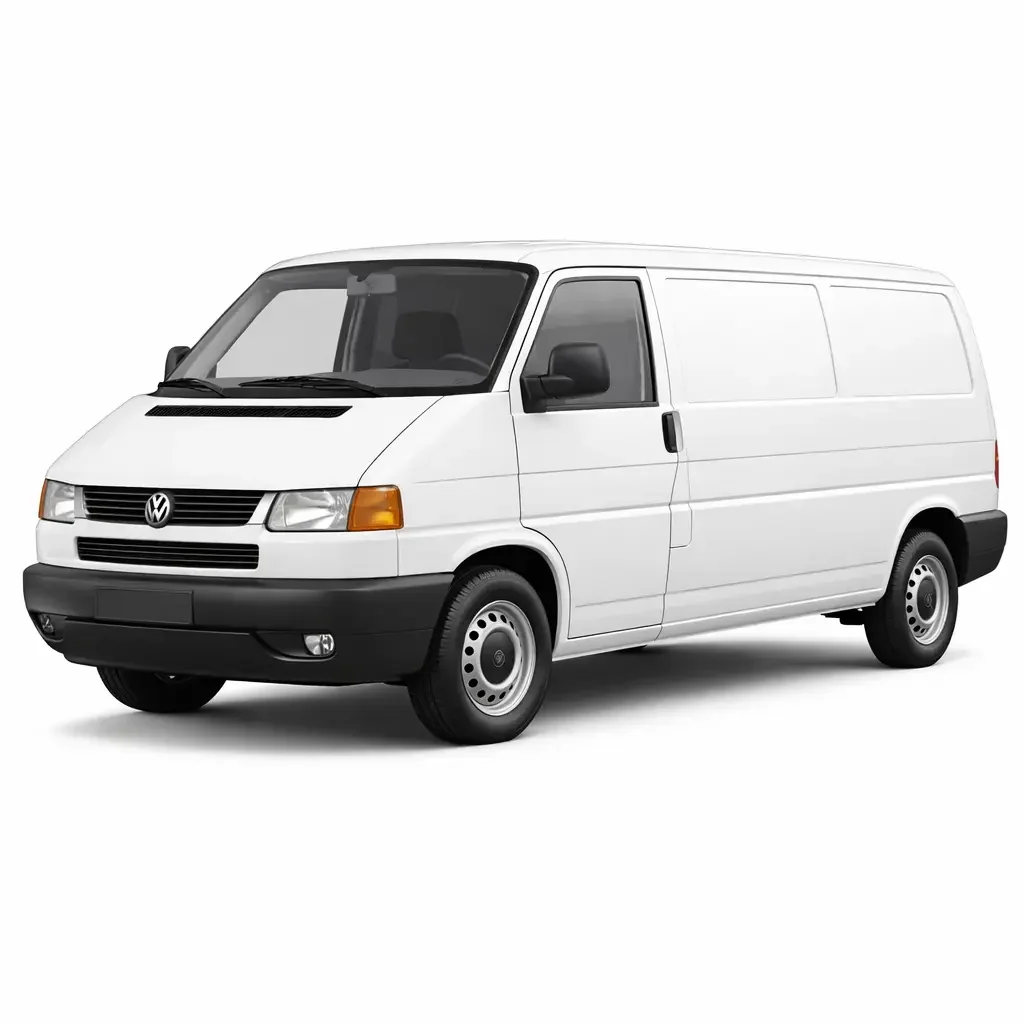
The Volkswagen Panel Van built on the T4 Transporter platform covers the production window from August 1990, when the first T4 rolled off the Hannover assembly line, through 2001. The T4 was the first Volkswagen Transporter to use a front-mounted, transversely installed, water-cooled engine driving the front wheels, breaking entirely from the forty years of rear-engine, rear-wheel-drive architecture that defined the T1, T2, and T3 generations. The Panel Van body style, carrying no side glass behind the B-pillar and using either a single roof-hinged tailgate or twin barn doors at the rear, was available throughout the T4 production window in both short-wheelbase and long-wheelbase configurations at both standard and high-roof heights.
The T4 Panel Van is primarily a European commercial vehicle application. In North America the Panel Van was sold only from 1993 through 1997 in the United States and Canada, exclusively on the long-wheelbase chassis with the 2.5-litre five-cylinder petrol engine. The global T4 Panel Van window is substantially broader, encompassing four-cylinder petrol engines, five-cylinder petrol engines, six-cylinder VR6 engines, and a wide range of diesel and turbodiesel inline engines across the SWB and LWB chassis in standard and high-roof configurations. This guide addresses the global production window and flags North American specifics where the market availability differs from the worldwide range.
The 1990-2001 catalog window covers the T4a short-nose generation in full and extends into the T4b long-nose era introduced in 1996. The single most significant catalog boundary within this window is the 1996 nose extension required to house the VR6 engine, which changed the hood, front fenders, headlamp assemblies, front bumper, and front structure for VR6-equipped variants. The commercial Panel Van retained the short nose through the end of production in 2003, meaning all Panel Van applications within the 1990-2001 window use short-nose front body hardware regardless of build year. A second major boundary, relevant for engine service components, is the mid-1994 transition within the 2.5-litre petrol engine from the AAF to the ACU code, which falls within the 1994 production year rather than at a clean annual boundary.
No component from the T3 Vanagon crosses to the T4 Panel Van in any mechanical category. The two generations are completely different in platform architecture, engine orientation, drivetrain layout, and body construction. Any catalog that bridges T3 and T4 applications for suspension, brake, engine, or drivetrain components is wrong regardless of body style or model year.
Platform: T4, Front Engine, Front-Wheel Drive, Monocoque
The T4 uses a transversely mounted front engine and front-wheel drive, sharing its fundamental layout with the Golf and Jetta of the same era. The body is monocoque unibody construction rather than the body-on-frame or separate-platform architecture of the T1, T2, and T3. Structural body components including the sill, floor pan, and A-pillar are load-bearing elements of the vehicle rather than bolt-on panels over a separate frame.
The front suspension uses a torsion bar arrangement. The rear suspension is independent on both axles. Front brakes are disc throughout the window. Rear brakes are drums on most applications, with the Syncro four-wheel-drive variant using different rear brake specifications as described below.
Two wheelbase lengths are available. The short-wheelbase chassis has a wheelbase of 2,920 mm (approximately 115 inches). The long-wheelbase chassis has a wheelbase of 3,320 mm (approximately 131 inches). These are not interchangeable configurations. A floor panel, sliding door track, or rear body section confirmed for one wheelbase does not apply to the other. Front suspension, front brake, and engine service components are wheelbase-independent and cross freely between SWB and LWB within matching engine and production year specifications.
Two roof heights are available for the Panel Van. The standard roof measures 1,940 mm overall height. The high-top roof measures 2,430 mm. High-top production was exclusively on the long-wheelbase chassis for factory-built units, though aftermarket conversions exist on both wheelbases. Roof panel, roof structure, and upper body components differ between standard and high-top configurations and must not be cross-referenced between them.
A Syncro four-wheel-drive option was available on the T4 Panel Van in certain markets, using a viscous coupling centre differential. The Syncro was available with the 2.5-litre petrol, 2.4-litre diesel, and 2.5-litre TDI engines. No Syncro was offered in North America on the Panel Van. Syncro rear suspension, rear differential, and rear halfshaft components are Syncro-specific and do not apply to two-wheel-drive applications. A two-wheel-drive rear suspension component does not apply to a Syncro application.
The Short-Nose and Long-Nose Body Split
The T4 underwent its single major exterior revision in 1996, when a reshaped and lengthened front end was introduced to accommodate the VR6 engine. Enthusiasts refer to the original nose as T4a and the extended nose as T4b. The relevant catalog fact for the Panel Van is straightforward: the Panel Van retained the original short nose for its entire production run, including all production within and beyond the 1990-2001 window. The long nose was initially introduced only on Caravelle and Multivan VR6 models, and while it was extended as an option to other body styles from approximately 1999 onward, the Panel Van body style did not receive the long nose as a factory configuration.
This means every Panel Van application in the 1990-2001 window uses short-nose front body components regardless of production year. A hood, front fender, headlamp assembly, or front bumper cover confirmed for a short-nose T4a application crosses freely to any Panel Van within this window within matching production specifications. The same component does not cross to a long-nose T4b Caravelle or Multivan application, which uses a dimensionally different front end.
The rear body, sliding door, windscreen, front door glass, and rear glass are continuous across the full production window within matching wheelbase and roof height specifications. A windscreen confirmed for a 1992 Panel Van crosses to a 2001 Panel Van within matching specifications.
Petrol Engines: Four Configurations in the 1990-2001 Window
1.8-Litre Four-Cylinder (PD): 1990 Through 1992
The 1.8-litre four-cylinder with engine code PD was the entry-level petrol engine at T4 launch, producing 67 hp. It uses a single overhead camshaft eight-valve design and was offered only in the early production years from 1990 through approximately 1992. It is a carburettor-fed engine, the only carburettor petrol engine in the T4 range, and uses neither Digifant nor Simos injection. No fuel injection component, no airflow meter, and no ECU applies to the PD application.
The PD is a short-window application that was discontinued before the mid-1990s. Any catalog entry assigning PD engine components must be confirmed to the 1990-1992 production range. A PD-specific carburettor, carburettor jet, or choke component does not cross to any fuel-injected petrol engine in the T4.
2.0-Litre Four-Cylinder (AAC): 1990 Through 2001
The 2.0-litre four-cylinder AAC was available throughout the full 1990-2001 window, making it the only petrol engine continuous across the entire catalog range being covered. It produces 84 hp and uses Digifant electronic fuel injection with a single overhead camshaft eight-valve design. The AAC is a workhorse commercial engine shared with other VW Group applications of the era.
The AAC uses a timing belt. Belt, tensioner, and idler components are specific to this application and are the primary scheduled service item for the engine. The AAC was not offered in North America, where the 2.5-litre five-cylinder was the standard petrol engine. Any North American T4 application does not carry an AAC engine.
2.5-Litre Five-Cylinder (AAF and ACU): 1990 Through 1997
The 2.5-litre ten-valve inline-five is the principal petrol engine for the Panel Van in both the global and North American markets. It uses Digifant I electronic fuel injection with a MAP sensor and produces 110 hp throughout its production run. Despite identical output, the engine underwent a mid-production code change that creates a catalog boundary within the 1994 model year.
From the start of T4 production in 1990 through approximately mid-1994, the engine code is AAF. The AAF uses a two-piece single-outlet exhaust manifold with a documented tendency toward cracking at the joint. The AAF does not carry a knock sensor. California-market North American AAF applications carried OBD1 diagnostics while other markets did not.
From approximately mid-1994 through the end of five-cylinder production in 1997, the engine code is ACU. The ACU uses a redesigned one-piece twin-outlet exhaust manifold, adds a knock sensor, carries higher compression than the AAF, and applies OBD1 diagnostics across all markets rather than California only. The ECU calibration differs between the AAF and ACU due to the compression ratio and knock sensor differences, and ECUs are not safely interchangeable between codes.
The mid-1994 boundary is a production-date split rather than a clean annual model year cut. A 1994 Panel Van may carry either the AAF or the ACU depending on its build date. Exhaust manifold, engine management, and emissions system components must confirm the engine code before assignment. An AAF exhaust manifold does not cross to an ACU application. An ACU knock sensor does not apply to an AAF application.
The five-cylinder uses a timing belt throughout its production run. Timing belt, tensioner, and water pump service components are specific to this engine and must be confirmed as five-cylinder applications rather than assumed to cross from the four-cylinder AAC.
From 1997, the five-cylinder petrol was updated to the AET, APL, and AVT codes, producing 115 hp with Simos fuel injection replacing Digifant. These post-1997 five-cylinder codes use a different injection system from the AAF and ACU, and Digifant-specific control units and sensors from the AAF and ACU applications do not cross to the AET, APL, or AVT applications. The 1997 injection system change is a distinct service component boundary from the mid-1994 AAF-to-ACU manifold and management boundary.
2.8-Litre VR6 (AES and AMV): 1996 Through 2001
The 2.8-litre VR6 was introduced to the T4 range for 1996, initially available only on Caravelle and Multivan body styles with the long-nose front end required to house the wider engine. The AES is a 12-valve VR6 producing 140 hp using Bosch Motronic M5.9 management. The AMV is a 24-valve VR6 producing 204 hp. Both use a timing belt.
The VR6 was not available on the Panel Van body style in North America. In global markets the VR6 Panel Van application is uncommon but exists. Any VR6 Panel Van application requires confirmation of the long-nose front body configuration, since the VR6 requires the T4b extended nose. A short-nose Panel Van front body component does not fit a VR6 Panel Van application if the vehicle was built with the long-nose front end.
AES and AMV are different engine codes with different cylinder head and valve train hardware due to the 12-valve to 24-valve change. Cylinder head, camshaft, and valve train components are engine-code-specific and do not cross between AES and AMV applications.
Diesel Engines: Five Principal Configurations
The diesel engine range is the most complex part of the T4 Panel Van catalog, offering more engine codes and more model year boundaries than the petrol range. All T4 diesel engines are inline configurations, in contrast to the flat-four petrol engines of the preceding T3 generation.
1.9-Litre Diesel NA (1X): 1990 Through 1995
The 1.9-litre naturally aspirated diesel with engine code 1X produces 61 hp and uses indirect injection. It was the entry-level diesel from the start of T4 production through approximately 1995. The 1X is a SOHC eight-valve design. No turbocharger applies to this application, and no intercooler component applies. A turbocharger housing or wastegate confirmed for a turbodiesel application must not be applied to a 1X naturally aspirated listing.
1.9-Litre Turbodiesel (ABL): 1993 Through 2003
The 1.9-litre turbodiesel ABL produces 68 hp and uses indirect injection with a turbocharger but no intercooler. It was introduced in 1993 and ran through the end of T4 production. The ABL uses a timing belt shared with the 1.9-litre naturally aspirated 1X at the core engine level, but the turbocharger, boost control system, and exhaust hardware differ from the naturally aspirated application. A naturally aspirated 1X exhaust component does not cross to the ABL turbodiesel, and a turbocharger oil feed line from the ABL does not apply to the 1X.
2.4-Litre Diesel (AAB and AJA): 1990 Through 2003
The 2.4-litre inline-five diesel is the primary medium-output diesel for the T4 globally and in North American Canada-market applications. The AAB produces 78 hp without a catalyst and the AJA produces 75 hp with a catalyst. Both are indirect injection five-cylinder units. The AAB was the standard specification for most markets; the AJA reflects the catalytic converter requirement of certain market emissions regulations.
AAB and AJA share internal engine architecture and many service components, but exhaust system hardware including the catalytic converter and its associated front pipe differs between the two. An exhaust system confirmed for the AAB non-catalyst application does not apply to the AJA catalyst application, and vice versa. For all other engine service items the two codes are closely related and may share specifications, but part number confirmation is required before a cross-reference is published.
The 2.4-litre diesel uses a timing belt. Belt service components are specific to the five-cylinder diesel family and do not cross to the four-cylinder 1.9-litre diesel or to any petrol engine without confirmation.
2.5-Litre TDI (ACV and Related Codes): 1995 Through 2001
The 2.5-litre five-cylinder TDI diesel is the high-output diesel option for the T4 Panel Van, introducing direct injection, a turbocharger, and an intercooler to the Transporter commercial van range. The primary code for the 1990-2001 window is ACV, producing 102 hp. Related codes in this family include AUF, AYC, and AXL, all within the 2.5-litre TDI specification range during this window. The AHY and AXG codes produce 151 hp and represent the high-output TDI variant.
The 2.5-litre TDI uses direct injection, distinguishing it fundamentally from the indirect-injection 2.4-litre diesel. Injection pump, injector design, and combustion system components are direct-injection-specific and do not cross to the indirect-injection 2.4-litre AAB application. An indirect injection pump confirmed for the AAB does not fit the ACV direct injection system, and ACV injectors do not cross to the AAB.
The ACV and related TDI codes use an intercooler mounted in the front of the van. Intercooler, intercooler hoses, and boost pressure components are TDI-specific and apply to neither the AAB indirect diesel nor any petrol engine. A turbo inlet hose confirmed for the ACV TDI does not cross to the ABL 1.9-litre turbodiesel, which uses a different inlet and turbocharger specification.
The 2.5-litre TDI also uses a timing belt. TDI timing belt specifications differ from the 2.4-litre diesel belt specifications due to the different engine architecture, and belt kits must be confirmed as TDI-specific before they are applied.
Transmissions
The T4 Panel Van was offered with a four-speed manual, a five-speed manual, and a four-speed automatic across the production window. The available transmission varied by engine, market, and production year.
The four-speed manual was the standard transmission for entry-level engine applications in the early production years, particularly with the 1.8-litre PD petrol and smaller diesel options in certain markets. It was superseded by the five-speed as the standard commercial offering as the production run matured.
The five-speed manual is the primary manual transmission for the 2.0-litre AAC petrol, the 2.5-litre five-cylinder petrol, and the 2.4-litre and 2.5-litre diesel engines in most market configurations. The code 02B applies to the five-speed paired with the petrol five-cylinder in North American applications. The five-speed used with the diesel engines may carry different internal specifications from the petrol five-speed and must be confirmed by engine pairing before cross-reference listings are published. Clutch disc, flywheel, and gearbox internal components confirmed for the petrol five-cylinder pairing do not cross to the diesel five-cylinder pairing without individual part number verification.
The four-speed automatic was available with certain petrol engine applications. In North America, the 098 automatic was paired with the 2.5-litre five-cylinder petrol. Automatic transmission fluid, filter, and internal components are automatic-specific and do not cross to any manual transmission application.
No automatic transmission was offered with the diesel engines in the Panel Van globally within this window. A diesel Panel Van application does not carry an automatic transmission within the 1990-2001 range.
North American Panel Van Specifics
The T4 Panel Van was sold in North America only from 1993 through 1997 in both the United States and Canada, on the long-wheelbase chassis only, with the 2.5-litre five-cylinder petrol engine only. No short-wheelbase Panel Van, no diesel Panel Van, no VR6 Panel Van, and no Syncro Panel Van was sold in North America during this window.
The North American Panel Van uses the AAF engine code for 1993 through approximately mid-1994 production and the ACU engine code from mid-1994 through 1997. This engine code boundary falls within the 1994 model year and requires build date or engine code confirmation for 1994 applications at the exhaust manifold, engine management, and knock sensor level.
For North American Panel Van applications, the transmission is either the five-speed manual 02B or the four-speed automatic 098. No other transmission exists for this application.
After 1997, no Panel Van was sold in North America and no Panel Van application exists for the North American T4 after that year. A North American 1998 or later Panel Van catalog entry is wrong.
Common ACES/PIES Catalog Mistakes
The first error is applying T3 Vanagon components to any T4 Panel Van application. The T4 and T3 are completely different platforms with different engine orientation, different drivetrain layout, and different suspension architecture. No T3 component crosses to the T4 in any mechanical category.
The second error is applying long-nose T4b front body components to Panel Van applications. The Panel Van retained the short nose for its entire production run. Hood, front fenders, headlamps, and front bumper from a long-nose Caravelle or Multivan do not fit the Panel Van.
The third error is assigning AAF exhaust manifold components to ACU applications, or ACU knock sensor and management components to AAF applications. The mid-1994 code boundary falls within the 1994 production year. A 1994 Panel Van may be either AAF or ACU and must be confirmed by engine code before manifold, management, or emissions components are assigned.
The fourth error is applying Digifant injection components from the AAF or ACU to the AET, APL, or AVT 115-hp five-cylinder application. The 1997 update to the five-cylinder changed the injection system from Digifant to Simos. These are different fuel management systems with different sensors, control units, and injector specifications.
The fifth error is applying petrol timing belt components to diesel applications, or diesel timing belt components to petrol applications, without confirming the specific engine code. All T4 petrol and diesel engines use timing belts, but the belt specifications differ across the engine families and must be confirmed at the engine code level.
The sixth error is applying indirect injection diesel components to the ACV TDI direct injection application. The 2.4-litre AAB and the 2.5-litre ACV use fundamentally different injection systems. Injection pump, injectors, and injection timing hardware are injection-system-specific and do not cross between indirect and direct diesel applications.
The seventh error is applying an intercooler or intercooler hose to a non-TDI diesel application. The 1.9-litre ABL turbodiesel uses a turbocharger but no intercooler. The 2.4-litre AAB uses neither turbocharger nor intercooler. The 2.5-litre ACV TDI uses both turbocharger and intercooler. Intercooler-specific components apply only to the TDI application.
The eighth error is applying an automatic transmission component to a diesel Panel Van application. No automatic transmission was offered with diesel engines on the T4 Panel Van within the 1990-2001 window.
The ninth error is applying a high-roof body component to a standard-roof application or vice versa. Roof panels, roof vent hardware, and upper body trim are roof-height-specific.
The tenth error is applying an SWB floor, sliding door track, or rear body section to an LWB application, or vice versa. The wheelbase difference of 400 mm is expressed in the intermediate body structure and affects dimension-sensitive components in the rear body and cargo area.
The eleventh error is applying a North American Panel Van application to years outside 1993 through 1997. No North American T4 Panel Van was sold before 1993 or after 1997. Any North American Panel Van catalog entry dated outside this range is wrong.
The twelfth error is applying a diesel engine component to any North American Panel Van application. The North American T4 Panel Van used the 2.5-litre petrol five-cylinder exclusively. No diesel was offered in the US or Canadian Panel Van.
The thirteenth error is applying a carburettor component to any application other than the early 1990-1992 PD four-cylinder. All other petrol engines in the T4 use electronic fuel injection. A carburettor jet, float, or choke confirmed for the PD application does not cross to any injection-equipped engine.
The fourteenth error is applying Syncro rear differential or rear axle components to a two-wheel-drive Panel Van application. The Syncro uses a different rear suspension and rear axle arrangement from the standard FWD Panel Van. Syncro rear components do not cross to the FWD application and no Syncro was sold in the North American Panel Van market.
Pre-Listing Checklist for the 1990-2001 T4 Panel Van
Platform confirmed as T4 Transporter, front-engine, front-wheel drive on standard models, Syncro AWD on four-wheel-drive models; no T3 Vanagon component applies.
Nose configuration confirmed as short-nose T4a throughout the Panel Van production window; no long-nose T4b front body component applies to any Panel Van application.
Wheelbase confirmed as SWB (2,920 mm) or LWB (3,320 mm); wheelbase-sensitive body, floor, and sliding door track components confirmed as wheelbase-specific before assignment.
Roof height confirmed as standard or high-top; roof-specific components confirmed before assignment; high-top factory production confirmed as LWB only.
Engine confirmed by code: PD 1.8 petrol (1990-1992 only), AAC 2.0 petrol (1990 onward), AAF 2.5 petrol (1990-mid-1994), ACU 2.5 petrol (mid-1994-1997), AET/APL/AVT 2.5 petrol 115hp (1997 onward with Simos), AES 2.8 VR6 12v (1996 onward), AMV/AXK 2.8 VR6 24v (2000 onward), 1X 1.9 diesel NA (1990-1995), ABL 1.9 turbodiesel (1993 onward), AAB/AJA 2.4 diesel (1990 onward), ACV and related 2.5 TDI (1995 onward).
For 1994 five-cylinder petrol applications, engine code confirmed as AAF or ACU by build date before exhaust manifold, management, or knock sensor is assigned.
Injection system confirmed as carburettor (PD only), Digifant (AAC, AAF, ACU), Simos (AET, APL, AVT, AEU), Motronic (AES VR6), indirect diesel (1X, ABL, AAB, AJA), or direct diesel TDI (ACV and related); no component crosses between these injection families without individual confirmation.
Intercooler presence confirmed as TDI-only (ACV and related); intercooler components not applied to naturally aspirated or non-TDI turbodiesel applications.
Transmission confirmed as four-speed manual, five-speed manual, or four-speed automatic; automatic confirmed as unavailable with diesel engines within this window; clutch and gearbox internal components confirmed as engine-pairing-specific.
Syncro confirmed as absent from North American Panel Van applications throughout the window; Syncro rear suspension and drivetrain components not applied to FWD applications.
For North American applications: market confirmed as US or Canada; model years confirmed as 1993-1997 only; engine confirmed as 2.5-litre petrol AAF or ACU only; no diesel, no VR6, no SWB, and no Syncro applies.
Final Take
The T4 Panel Van 1990-2001 is a commercially driven application with a broader engine range than any preceding Transporter generation. The shift to a front-mounted water-cooled engine opened the powertrain options considerably: a range spanning a 61-hp naturally aspirated diesel at one end and a 204-hp 24-valve VR6 at the other, across petrol, turbodiesel, and high-output TDI families, creates more distinct catalog entries per model year than any previous Panel generation.
The two boundaries that require the most careful handling are the mid-1994 five-cylinder petrol code change, which falls within the 1994 production year, and the 1997 injection system change from Digifant to Simos on the updated five-cylinder. Both affect engine management and fuel system components in ways that are invisible from the exterior of the vehicle and cannot be determined from model year alone. Both require engine code confirmation before service components are assigned.
The North American Panel Van application within this window is the simplest sub-application: LWB only, AAF or ACU five-cylinder only, manual or conventional automatic only, 1993-1997 only. The global application is more complex, but the North American slice can be handled with a straightforward set of parameters if the market is confirmed at the point of catalog entry creation.
Disclaimer
This guide is intended for catalog research, fitment analysis, and parts advisory reference. Production specifications, option availability, and regulatory compliance requirements vary by model year, regional market, and assembly date within any given window. Always confirm application data against vehicle identification number decoding, factory build sheets, and OEM parts documentation before finalizing a listing or parts recommendation. PartsAdvisory and its contributors are not responsible for fitment errors arising from catalog data that has not been independently verified against physical vehicle inspection or official OEM sources.