
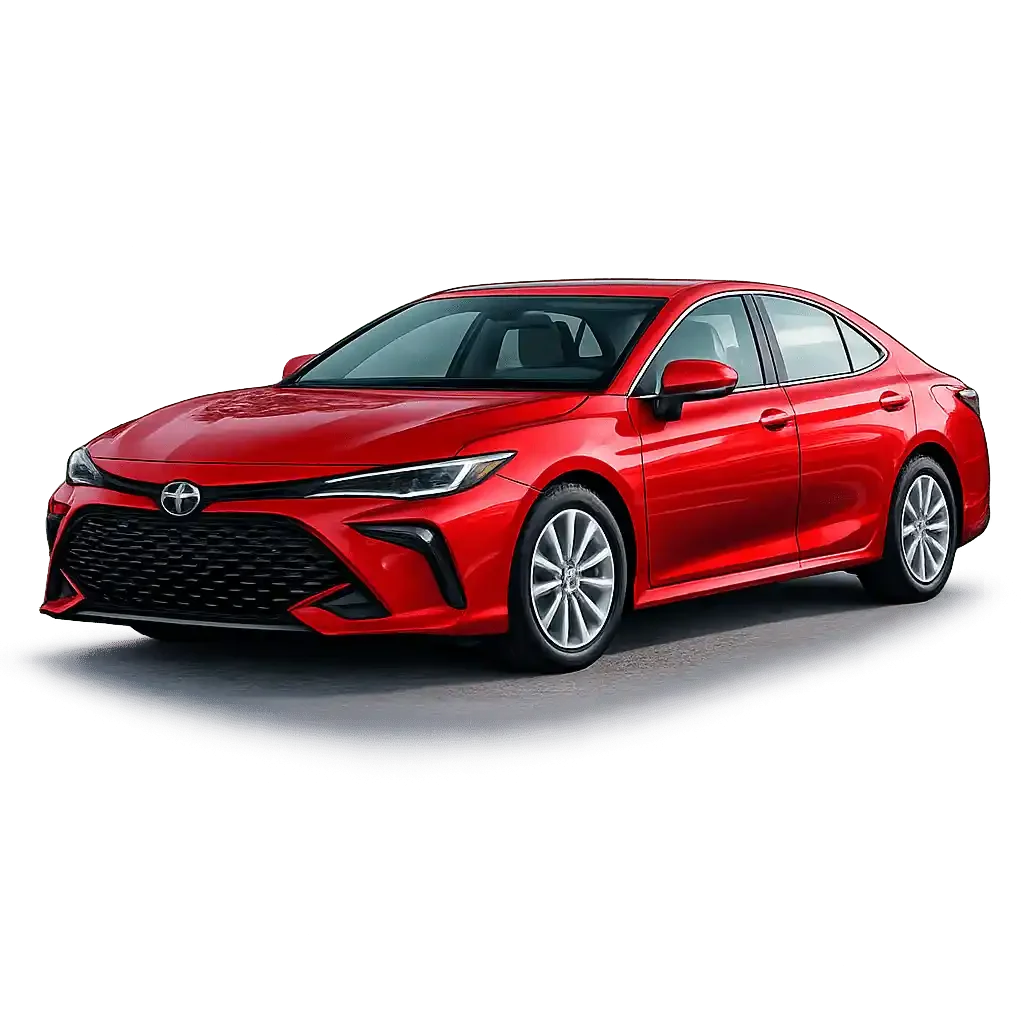
The XV80 Camry is the most dramatic generational shift in the model's history. Toyota dropped every pure-gasoline powertrain, eliminated the V6 entirely, and made the Camry an all-hybrid vehicle for the first time. Every XV80 sold in North America uses the same 2.5-liter Atkinson-cycle four-cylinder hybrid system, with the only powertrain variable being FWD versus AWD. The trim lineup was simplified to four levels (LE, SE, XLE, XSE), and the platform carries over the TNGA-K architecture from XV70 but shares very few exterior or interior parts with it. For parts sellers, the good news is that the powertrain is unified. The complexity lives in the trim-specific exterior styling (which continues the XV70 pattern of separate front fascia families), the FWD versus AWD drivetrain split, the new infotainment and ADAS electronics, and the absolute incompatibility with XV70 body and lighting parts despite sharing the same platform code.
Use this page as a practical ruleset for parts listings and for buying parts online without gambling.
What XV80 covers
This guide covers Toyota Camry 2025 to present, ninth generation XV80. It does not cover the 2018-2024 XV70, which is a completely different vehicle despite sharing the TNGA-K platform designation.
All XV80 Camry models in North America share these characteristics:
All-hybrid powertrain: 2.5-liter Atkinson-cycle inline four-cylinder (A25A-FXS) plus electric motor(s)
225 hp combined (FWD), 232 hp combined (AWD)
eCVT (electronically controlled continuously variable transmission) on all models
Front wheel drive standard on all trims
Electric on-demand all-wheel drive available on all trims (adds a rear electric motor)
Lithium-ion battery pack (located under the rear seat)
4-door sedan only
Trim levels: LE, SE, XLE, XSE
2026: Nightshade Edition added (based on SE)
Toyota Safety Sense 3.0 standard on all trims
No V6 option
No pure-gasoline (non-hybrid) option
The unified powertrain is a major simplification for engine parts. The primary fitment variables on XV80 are FWD versus AWD, trim-specific exterior styling, infotainment tier, and the absolute separation from XV70 parts.
Step 1: XV80 shares almost nothing with XV70 for exterior, interior, and electronics
Despite sharing the TNGA-K platform designation, the XV80 and XV70 are fundamentally different vehicles for body, lighting, interior, and electronics parts. Toyota stated that the XV80 retains the underlying body structure, front doors, and roofline from XV70, but every visible exterior panel has been redesigned.
Key differences from XV70:
Completely new front fascia with "hammerhead" grille and slimmer C-shaped LED headlamps
Completely new rear fascia with C-shaped tail lamps and "CAMRY" lettering across the trunk lid
New hood, new fenders, new rear quarter panel stampings
New trunk lid
New rear bumper cover
New interior dashboard with redesigned instrument panel
New infotainment system: Toyota Audio Multimedia (debuted on Tundra), with 8-inch standard or 12.3-inch available touchscreen
New 7-inch or 12.3-inch digital instrument cluster (replacing the analog cluster on lower XV70 trims)
Toyota Safety Sense 3.0 (upgraded from TSS 2.5+ on XV70), with new sensor hardware
New seat shapes with longer cushions
Rule for catalog teams:
Never cross-list XV80 and XV70 for any exterior body part, lighting assembly, interior trim, infotainment component, or ADAS sensor
Some mechanical underpinnings may cross (suspension geometry points, some subframe components), but verify by part number before listing
The A25A-FXS hybrid powertrain in XV80 is an evolution of the XV70 hybrid system but uses Toyota's fifth-generation hybrid technology with different power electronics, so do not assume XV70 hybrid parts cross with XV80
Step 2: The powertrain is unified, but FWD versus AWD creates the primary mechanical split
Every XV80 Camry uses the same engine and hybrid system. The only powertrain variable is drivetrain:
FWD: front electric motor integrated into the eCVT transaxle, 225 hp combined
AWD (Electric On-Demand): adds a rear electric motor (MGR) on the rear axle, 232 hp combined, with torque split ranging from 100:0 to approximately 20:80 front-to-rear
The AWD system adds:
Rear electric motor and rear axle assembly
Additional high-voltage wiring to the rear motor
Modified exhaust routing to clear rear motor components
Modified underbody panels and heat shields
Different rear suspension mounting to accommodate the rear motor
Potentially different fuel tank or fuel line routing
Because there is no V6, no pure-gasoline engine, and no manual or conventional automatic transmission on XV80, the engine accessories, intake, exhaust manifold, and front-end engine parts are the same across all trims for a given drivetrain (FWD or AWD).
Categories where FWD versus AWD matters:
Rear axle and rear motor assembly
Exhaust system (routing differs to clear rear motor on AWD)
Underbody panels and heat shields
Rear suspension components (mounting points may differ for rear motor)
High-voltage wiring harness (AWD has additional rear motor wiring)
Categories where FWD versus AWD does not matter:
Engine and front transaxle (same A25A-FXS and eCVT on all models)
Front suspension
Steering
Braking system (front and rear brake components are the same, though verify disc size by wheel package)
All body panels, lighting, and interior parts
Practical rule:
For any part behind the front transaxle that touches the underbody or exhaust, require FWD or AWD
For engine-bay parts and front suspension, list as fitting "all XV80" (FWD and AWD share the same front-end layout)
Step 3: Trim-specific exterior styling continues the XV70 pattern
Like XV70, the XV80 gives each trim family a distinct front-end appearance. The split continues between comfort-oriented (LE/XLE) and sport-oriented (SE/XSE) trim families.
Front fascia split:
LE/XLE: wider grille with chrome-accented horizontal elements, smoother bumper contours, chrome headlamp surrounds
SE/XSE: sport mesh grille with darker accents, more aggressive lower bumper with larger air openings, black headlamp surrounds
Nightshade (2026, based on SE): blacked-out exterior accents
These front bumper covers and grille assemblies are not interchangeable between trim families.
Headlamp assemblies:
Bi-LED projector headlamps with integrated C-shaped DRL are standard on all trims
The headlamp internal graphics and bezel treatment may differ between LE/XLE (chrome) and SE/XSE (black)
Wheel sizes:
LE: 16-inch alloy wheels
SE: 18-inch alloy wheels
XLE: 18-inch alloy wheels
XSE: 19-inch alloy wheels
Nightshade: unique black-finish alloy wheels
Bolt pattern: 5x114.3 across all trims
Suspension:
SE/XSE: sport-tuned suspension with firmer springs, dampers, and anti-roll bars
LE/XLE: comfort-tuned suspension
Audio and infotainment:
LE/SE: 8-inch touchscreen standard, 6-speaker audio
XLE/XSE: 12.3-inch touchscreen standard, available 9-speaker JBL premium audio with subwoofer
SE: 12.3-inch touchscreen available
All trims: wireless Apple CarPlay, Android Auto, wireless charging pad, Bluetooth
7-inch digital instrument cluster on LE/SE, 12.3-inch digital instrument cluster on XLE/XSE
Interior:
LE: cloth upholstery
SE: sport fabric or available SofTex
XLE: SofTex or leather-trimmed seats, heated and ventilated front seats available
XSE: SofTex or leather-trimmed seats, heated and ventilated front seats available, available panoramic glass roof with moonroof
High risk categories where trim matters:
Front bumper cover (LE/XLE versus SE/XSE, not interchangeable)
Front grille (chrome-accented versus sport mesh)
Headlamp bezels (chrome versus black)
Wheels (16-inch, 18-inch, or 19-inch)
Suspension (sport versus comfort)
Infotainment display (8-inch versus 12.3-inch, different wiring and mounting)
Instrument cluster (7-inch versus 12.3-inch digital)
Seat assemblies (cloth versus SofTex versus leather, sport bolstering on SE/XSE)
Step 4: ADAS sensor integration is deeper than ever
XV80 comes standard with Toyota Safety Sense 3.0 on all trims. TSS 3.0 builds on TSS 2.5+ with enhanced sensors and expanded functionality.
Standard TSS 3.0 features on all XV80:
Pre-Collision System with Pedestrian Detection (enhanced with intersection support and emergency steering assist)
Full-Speed Dynamic Radar Cruise Control
Lane Departure Alert with Steering Assist
Lane Tracing Assist (lane centering)
Road Sign Assist (can adjust cruise speed to posted limits)
Automatic High Beams
Proactive Driving Assist
Blind Spot Monitor with Rear Cross-Traffic Alert (standard on all trims, previously optional on lower trims)
Components that trigger ADAS recalibration when replaced:
Front bumper cover (houses radar sensor for adaptive cruise and pre-collision)
Windshield (houses forward-facing camera for lane departure, lane tracing, automatic high beams, road sign assist)
Front grille (can affect radar sensor alignment)
Side mirror assemblies (house blind spot monitoring sensors)
Rear bumper cover (houses rear cross-traffic alert sensors)
Because TSS 3.0 uses new sensor hardware compared to TSS 2.5+ on XV70, the radar module, camera module, and associated wiring are not interchangeable between XV80 and XV70.
Practical rule:
For front bumper, windshield, grille, and mirror listings, always note that ADAS sensor recalibration is required after installation
Never cross-list TSS 3.0 sensor components with XV70 TSS 2.5+ components
This is not just a fitment note but a safety requirement
Step 5: Hybrid braking and cooling are the only powertrain configuration on XV80
Because every XV80 is a hybrid, there is no gasoline-versus-hybrid split for braking or cooling components. This is a simplification compared to XV70, where you had to separate gasoline and hybrid brake actuators.
On XV80:
All models use the same regenerative braking system with hybrid brake actuator and ABS module
All models use the same high-voltage battery cooling system
All models use the same eCVT transaxle (front)
AWD models add a rear electric motor with its own cooling needs
This means brake hydraulic and electronic components can be listed as fitting "all XV80" without a gasoline/hybrid split. However, you still need to verify disc size by wheel package (larger wheels may correspond to larger brake rotors on certain trims).
Brake rotor size by trim (verify against current specifications):
16-inch wheels (LE): front and rear rotor sizes may differ from trims with larger wheels
18-inch wheels (SE/XLE): may use larger front rotors
19-inch wheels (XSE): may use the largest front rotors
Practical rule:
For brake pads and rotors, require wheel size or trim to confirm rotor diameter
For brake hydraulic components (actuator, master cylinder, ABS module), list as "all XV80" since every model is hybrid
The biggest return traps on XV80 and how to stop them
1) XV70 parts listed as fitting XV80 because both say "TNGA-K Camry"
Why they get returned:
XV80 shares the platform code with XV70 but almost no visible parts
Headlamps, bumpers, grilles, tail lamps, hood, fenders, trunk lid, dashboard, infotainment, and ADAS sensors are all different
Sellers or buyers assume "same platform means same parts"
How to stop returns:
Treat XV80 (2025-present) and XV70 (2018-2024) as completely separate vehicles in your catalog
Never cross-list body, lighting, interior, or electronics parts between them
Add a buyer check: confirm your Camry is 2025 or newer (XV80) versus 2024 or older (XV70)
2) Front bumper cover mismatched by trim family
Why they get returned:
LE/XLE and SE/XSE use different bumper covers with different grille openings and lower air dam shapes
The trim families are not interchangeable
Sellers list "fits 2025 Camry" without specifying trim family
How to stop returns:
Require trim family: LE/XLE (comfort) or SE/XSE (sport)
Add a photo showing both front-end styles
Add a buyer check: is your grille chrome-accented (LE/XLE) or dark mesh (SE/XSE)?
3) AWD-specific underbody and exhaust parts listed as fitting all XV80
Why they get returned:
AWD models have a rear electric motor, different exhaust routing, and different underbody panels
FWD models do not have the rear motor or its associated components
Sellers list "fits all 2025 Camry" without considering the drivetrain split
How to stop returns:
Require FWD or AWD for exhaust, underbody, and rear axle parts
Add a buyer check: check for an AWD badge on the trunk or look under the rear of the car for a rear motor housing
4) Infotainment components mismatched by display size
Why they get returned:
LE/SE use an 8-inch touchscreen standard (SE can upgrade to 12.3-inch)
XLE/XSE use a 12.3-inch touchscreen standard
The display modules, wiring harnesses, and dashboard mounting brackets differ between sizes
Instrument cluster also splits: 7-inch on LE/SE versus 12.3-inch on XLE/XSE
How to stop returns:
Require touchscreen size (8-inch or 12.3-inch) for head unit and display components
Require instrument cluster size (7-inch or 12.3-inch) for cluster replacements
Add a buyer check: measure your touchscreen or confirm your trim level
5) Brake rotors mismatched by wheel package
Why they get returned:
Rotor diameter may vary by trim and wheel size (16-inch, 18-inch, or 19-inch wheels)
Sellers list "fits all XV80" for brake rotors without confirming disc size
A buyer with 16-inch LE wheels gets rotors sized for 19-inch XSE wheels or vice versa
How to stop returns:
Require wheel size or trim level for brake rotor orders
List the rotor diameter in the listing
Add a buyer check: measure your current rotor diameter or confirm your wheel size
6) Headlamp assemblies mismatched by bezel color
Why they get returned:
All XV80 models use bi-LED projector headlamps, so there is no halogen/LED split
However, the bezel treatment differs: chrome on LE/XLE versus black on SE/XSE
Sellers list "fits 2025 Camry" without specifying bezel color
The lamp housing may be the same, but the bezel cosmetic treatment creates a visual mismatch
How to stop returns:
Require trim family (LE/XLE or SE/XSE) for headlamp assemblies
Note the bezel color in the listing (chrome or black)
Add a buyer check: what color is the ring around your headlamp lens?
A clean XV80 fitment rules block you can paste into listings
Use this exact checklist in your product pages or internal SOP.
Required attributes for Toyota Camry XV80 2025-Present:
Confirm XV80 (2025+), not XV70 (2018-2024)
Drivetrain: FWD or AWD
Trim family for exterior parts: LE/XLE (comfort) or SE/XSE (sport)
Trim level for wheels and brakes: LE, SE, XLE, or XSE (wheel diameter determines rotor size)
For suspension: SE/XSE sport or LE/XLE comfort
For headlamp assemblies: bezel color (chrome for LE/XLE, black for SE/XSE)
For infotainment: display size (8-inch or 12.3-inch touchscreen, 7-inch or 12.3-inch instrument cluster)
For exhaust and underbody: FWD or AWD
For brake rotors: wheel size or trim level
Note ADAS recalibration requirement on bumper, windshield, grille, and mirror listings
Never cross-list with XV70
Buyer confirmation prompts:
Generation: confirm 2025 or newer (XV80), look for "CAMRY" lettering across the trunk lid and C-shaped headlamps
Front bumper and grille: confirm chrome-accented (LE/XLE) or dark mesh (SE/XSE)
Drivetrain: check for AWD badge or look under the rear for a motor housing
Wheels: confirm diameter (16, 18, or 19 inch)
Infotainment: confirm touchscreen size (8-inch or 12.3-inch)
Headlamps: confirm bezel color (chrome or black)
Quick identification guide for buyers
If you want a fast way to reduce wrong orders, tell readers to gather these items before shopping:
Year on registration (must be 2025 or newer for XV80)
Photo of the rear end ("CAMRY" lettering across the trunk lid confirms XV80, not XV70)
Photo of the front end (C-shaped DRL and hammerhead grille confirm XV80; also reveals trim family by grille style)
VIN decode (confirms model year, trim, FWD or AWD)
Trim badge on trunk lid (LE, SE, XLE, XSE)
AWD badge presence or absence
Wheel diameter: measure or check tire sidewall
Touchscreen size: 8-inch or 12.3-inch
Headlamp bezel color: chrome or black
If they cannot answer these, they are not ready to order the parts that typically get returned.
Bottom line
On XV80 Camry, the all-hybrid powertrain eliminates the gasoline/V6/hybrid split that plagued prior generations, and the unified engine means engine-bay parts are simpler to catalog than ever. But the generation boundary with XV70 is absolute for body and electronics parts, the trim-specific exterior styling continues to create non-interchangeable bumper and grille families, the FWD versus AWD split affects exhaust and underbody fitment, and the ADAS sensor calibration requirements are now standard on every vehicle sold.
The critical checks are:
Generation first: confirm XV80 (2025+) versus XV70 (2018-2024), these share almost no visible parts
Trim family for exterior: LE/XLE or SE/XSE (different bumper, grille, and headlamp bezels)
Drivetrain: FWD or AWD (affects exhaust, underbody, and rear axle)
Wheel size for brakes: 16-inch, 18-inch, or 19-inch (rotor diameter may vary)
ADAS awareness: note calibration requirements for bumper, windshield, grille, and mirror work
If you build your listings and your buying decisions around those five checks, XV80 becomes the most catalog-friendly Camry generation in decades, and returns stay low.
For the full year, engine, trim, and body style breakdown across every Camry generation, read my Complete Toyota Camry Generations Guide 1983 to Present.
Disclaimer: This guide is based on publicly available specifications, Toyota press materials, and independent research. Part interchangeability should always be confirmed via VINand OEM part number lookup. Specifications may change without notice. This document does not constitute official Toyota parts catalog data. Visuals and illustrations in this article were generated using AI for representative purposes and may not reflect exact technical schematics.