
Volvo C70 First Generation (P80 Platform) 1998-2005 US Market Fitment Guide
The Complete Fitment Guide
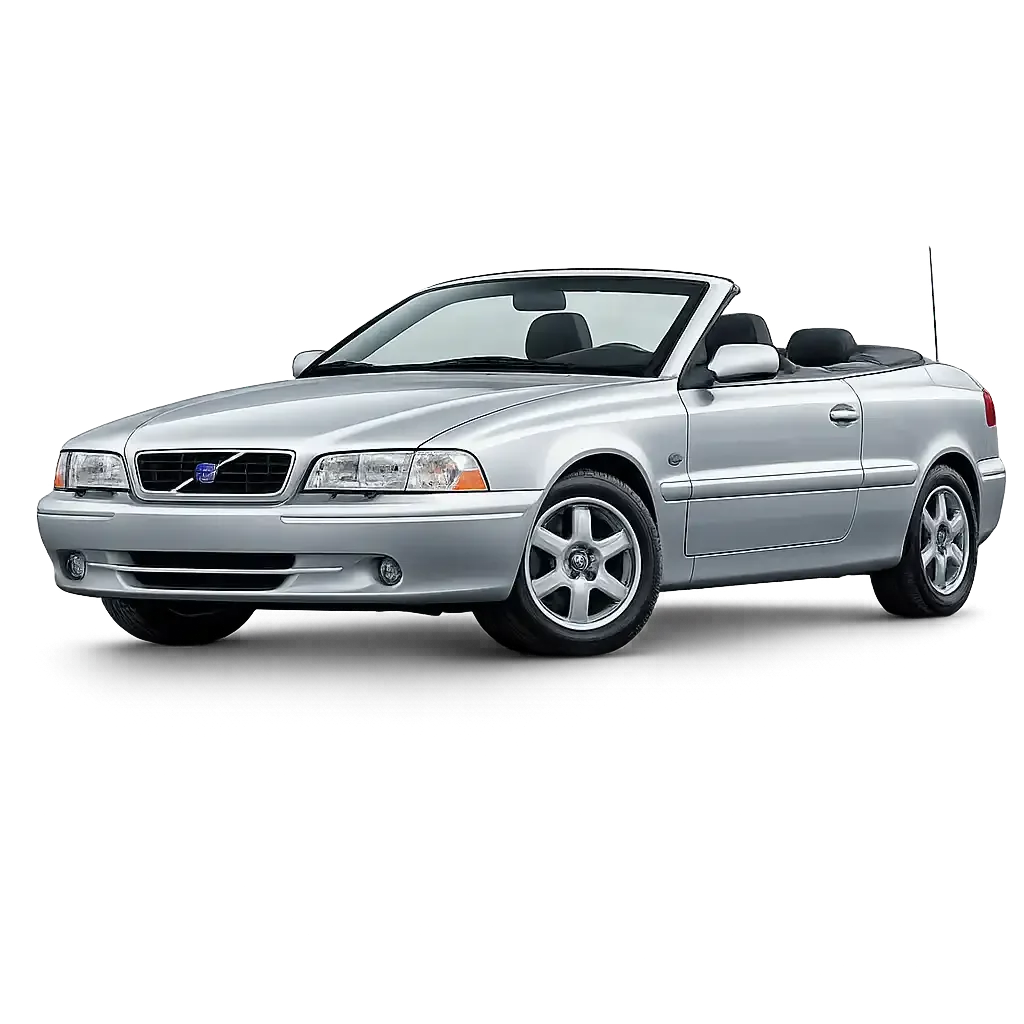
Returns destroy margins. The first-generation Volvo C70 (1998-2005 US market) is Volvo’s modern two-door luxury car, available as both a hardtop coupe (1998-2002) and a soft-top convertible (1998-2005). Built on the Volvo P80 platform derived from the 850, the C70 was co-developed with Tom Walkinshaw Racing (TWR) and manufactured at a dedicated assembly line in Uddevalla, Sweden. The C70 shares its platform, engine family, and many mechanical components with the 850, S70, and V70 (all P80). However, the C70 has a unique body, unique structural reinforcements, and (for the convertible) unique top mechanism and rollover protection components. The C70 uses Volvo’s “Whiteblock” 5-cylinder engine family exclusively in both light-pressure turbo (LPT) and high-pressure turbo (HPT) variants. The C70 is front-wheel drive only - no AWD was offered. There was no 2005 model year C70 sold in North America; leftover 2004 models were sold into 2005. This guide maps every fitment split required to prevent returns on Volvo’s first modern coupe/convertible.
Generation Overview (1998-2005 US Market)
The C70 debuted at the 1996 Paris Motor Show with exterior design by Ian Callum. It was Volvo’s first modern two-door since the 780 coupe ended production in 1991, and broke decisively from Volvo’s boxy styling tradition. The coupe launched in Europe as a 1997 model and arrived in the US as a 1998 model. The convertible followed shortly after for the same model year. The C70 was built on a modified version of the P80 platform (Volvo 850 basis), with TWR handling chassis tuning and co-design.
The coupe was discontinued after the 2002 model year. The convertible continued through 2004 (last US model year; no 2005 MY in North America), receiving a cosmetic refresh for 2003-2004 with new clear headlights and updated rear light clusters. Total first-generation C70 production was approximately 72,000 units, with fewer than 50,000 being convertibles. The second-generation C70 (2006-2013) moved to Ford’s C170/P1 platform and is a completely different vehicle - no parts interchange between generations.
Key Platform Facts
• Platform: P80 (Volvo 850-derived), modified by TWR. Front-engine, front-wheel drive. Transverse inline-5 engine.
• Assembly: Uddevalla, Sweden (dedicated C70 line, separate from S70/V70 production at Torslanda)
• Body styles: 2-door coupe (1998-2002) and 2-door soft-top convertible (1998-2004 US)
• Engine family: Volvo Modular Engine (“Whiteblock”) inline-5, DOHC, 20-valve. Turbocharged only in US market.
• US engines: B5254T 2.4L LPT (190 hp) and B5234T3 2.3L HPT (236 hp). Naturally aspirated B5252S (2.5L, 170 hp) NOT sold in US.
• Transmissions: M56 5-speed manual, AW50-42 4-speed automatic (1998-1999), AW55-50/51 5-speed automatic (2000+)
• Drive: Front-wheel drive (FWD) only. No AWD offered on C70.
• Front suspension: MacPherson struts with coil springs, stabilizer bar
• Rear suspension: Multi-link (Delta-link) with coil springs, stabilizer bar
• Brakes: 4-wheel disc brakes with ABS
• Wheelbase: 104.9 inches (2,664 mm)
• Curb weight: Approximately 3,250 lbs (coupe), 3,500 lbs (convertible)
• Safety: SIPS (Side Impact Protection System), front and side airbags, boron steel A-pillar reinforcements. Convertible: ROPS (Roll-Over Protection System) with pop-up hoops, safety cage.
Complete Engine Reference (US Market)
B5234T3
Displacement: 2.3L (2,319 cc)
Type: HPT (High-Pressure Turbo)
Output (US): 236 hp / 243 lb-ft
US Years: 1998-2002
Notes: T5 badge. Mitsubishi TD04HL-16T turbo. Standard on coupe.
B5254T
Displacement: 2.4L (2,435 cc)
Type: LPT (Low-Pressure Turbo)
Output (US): 190 hp / 199 lb-ft
US Years: 1998-1999
Notes: Light-pressure turbo. Bosch Motronic 4.4 management.
B5244T7 / B5234T7
Displacement: 2.4L / 2.3L
Type: LPT (revised)
Output (US): 197-200 hp
US Years: 2000-2004
Notes: Updated LPT with Bosch ME7 management. Convertible continued with LPT.
B5234T8
Displacement: 2.3L (2,319 cc)
Type: HPT (revised)
Output (US): 242-247 hp
US Years: 2002-2004
Notes: Updated HPT with Bosch ME7. Late convertibles.
Note: The engine management system changed from Bosch Motronic 4.3/4.4 (1998-1999) to Bosch ME7 (2000+). This is a critical split for ECU, wiring harness, and sensor compatibility. The turbocharger, fuel system, and intake components may also differ between early (Motronic) and late (ME7) cars.
Transmission Reference
Code
Type
Speeds
US Years
Notes
M56
Manual
5-speed
1998-2004
Available with both LPT and HPT engines
AW50-42
Automatic
4-speed
1998-1999
Aisin-Warner. Paired with both engines.
AW55-50/51
Automatic
5-speed
2000-2004
Replaced AW50-42. Different bell housing, TCM, wiring.
Critical: The 4-speed (AW50-42) and 5-speed (AW55-50/51) automatic transmissions are NOT interchangeable without significant modification. Different bell housings, different transmission control modules (TCM), different wiring harnesses, and different torque converter specifications.
Catalog Accuracy: The Fitment Splits That Matter
Split 1: Coupe vs. Convertible
This is the most important split for the C70. The coupe and convertible share the same P80 platform, same engines, same transmissions, and most front-end components. However, the convertible has extensive unique structural reinforcements, a completely different roof system, and unique rear body work.
Parts UNIQUE to the convertible (do NOT fit coupe):
• Entire soft-top mechanism (hydraulic system, fabric top, frame, latches, seals)
• ROPS roll-over protection system (pop-up hoops, sensors, pyrotechnic deployment)
• Rear body structure and reinforcements (safety cage / horseshoe structure)
• Trunk/boot lid (different shape to accommodate folded top)
• Rear glass (heated glass rear window on convertible; different from coupe rear window)
• B-pillar and C-pillar structure (convertible has no fixed B-pillar)
• Door window frames (convertible has frameless doors)
• Tonneau cover and related trim
• Rear seat design (different to clear top mechanism)
• Additional sound insulation and body stiffening components
Parts that generally DO interchange between coupe and convertible:
• Engine and transmission assemblies
• Front suspension, steering rack, front subframe
• Rear suspension (Delta-link), rear subframe
• Brakes (calipers, rotors, pads - verify size)
• Hood/bonnet and front bumper
• Headlights (same until 2003 refresh; 2003-2004 convertible has unique clear headlights)
• Fenders (front)
• Dashboard, center console, instrument cluster
• Seats (front seats generally interchange; rear seats differ)
Split 2: Pre-Facelift (1998-2002) vs. Post-Facelift (2003-2004)
The convertible received a cosmetic refresh for 2003-2004 (the coupe was already discontinued). Changes included:
• New clear headlight assemblies (replacing amber-lensed units)
• Updated rear light clusters
• Revised front grille design
• Updated bumper covers (front and rear)
• Interior trim updates (minor)
Pre- and post-facelift headlights, taillights, grilles, and bumper covers do NOT interchange directly. Mechanical and drivetrain components are generally compatible across all years.
Split 3: HPT (High-Pressure Turbo / T5) vs. LPT (Low-Pressure Turbo)
Both engines are Whiteblock inline-5s, but the HPT and LPT have significant differences:
• Different turbocharger (HPT uses larger turbo with higher boost)
• Different intercooler (HPT has larger intercooler)
• Different exhaust manifold and downpipe
• Different ECU/engine management calibration
• Different fuel injectors and fuel rail (HPT requires higher flow)
• Different intake plumbing and boost piping
• Different engine mounts may apply due to torque differences
The engine block, cylinder head casting, and basic ancillaries (alternator, A/C compressor, power steering pump) may be similar or interchangeable, but always confirm by part number. The complete engine assembly does NOT interchange between HPT and LPT.
Split 4: Motronic 4.3/4.4 (1998-1999) vs. ME7 (2000-2004) Engine Management
Volvo switched engine management systems around the 2000 model year. This affects:
• ECU (engine control unit) - completely different hardware and software
• Engine wiring harness
• Sensors (MAF sensor, throttle body, knock sensors may differ)
• Ignition system components
• OBD-II diagnostic protocols and scan tool compatibility
Do not interchange ECUs, engine harnesses, or sensors between Motronic and ME7 cars without confirming exact part number compatibility.
Split 5: 4-Speed Automatic (AW50-42) vs. 5-Speed Automatic (AW55-50)
The transmission change from 4-speed to 5-speed around 2000 affects:
• Transmission assembly (completely different unit)
• Transmission control module (TCM)
• Transmission wiring harness
• Torque converter
• Driveshafts/half-shafts (may differ in length or spline count)
• Shift linkage and console trim
These transmissions are NOT drop-in replacements for each other.
Split 6: C70 (P80) vs. S70/V70 (P80)
The C70 shares the P80 platform with the S70 sedan and V70 wagon. Many mechanical components interchange, including engines, transmissions, front suspension, steering, brakes, and front subframe. However:
• All body panels are unique to the C70 (different dimensions, two doors vs. four)
• Door glass, window regulators, and door handles differ
• Interior trim differs (C70 has unique dashboard layout, different seats, different center console)
• Electrical harness has differences (particularly for convertible top, ROPS, two-door wiring)
• Rear suspension tuning may differ (C70 was tuned by TWR)
• Exhaust system routing may differ due to body geometry
Some tuning and aftermarket communities interchange parts freely between 850/S70/V70/C70. While many engine and drivetrain parts fit, always verify by part number for body, electrical, and trim components.
Split 7: First-Gen C70 (P80, 1998-2005) vs. Second-Gen C70 (P1/C170, 2006-2013)
The second-generation C70 is an entirely different vehicle on a completely different platform (Ford C170/P1, shared with S40/V50/C30). ZERO parts interchange between first-gen and second-gen C70. Different engines (4-cylinder in Gen 2), different transmissions, different body, different electrical architecture, different everything. The only shared element is the C70 name.
Ordering Quick-Reference Checklist
Before ordering any part for a first-generation Volvo C70, confirm:
• Body style: Coupe (1998-2002) or Convertible (1998-2004). Roof, rear body, structure differ completely.
• Model year: Pre-facelift (1998-2002) or post-facelift (2003-2004, convertible only). Lights, grille, bumpers changed.
• Engine: HPT / T5 (2.3L high-pressure turbo) or LPT (2.4L low-pressure turbo). Turbo, exhaust, fuel system differ.
• Engine management: Motronic 4.3/4.4 (1998-1999) or ME7 (2000+). ECU, sensors, harness differ.
• Transmission: M56 manual, AW50-42 4-speed auto, or AW55-50 5-speed auto. Not interchangeable.
• Generation: First-gen (P80, 1998-2005) or second-gen (P1, 2006-2013). Zero parts interchange.
• VIN: Always verify. Running production changes are common across the 7-year production run.
Three Questions to Always Ask
• “Coupe or convertible?” Roof, structure, rear body, ROPS, trunk, and rear seats all differ.
• “What model year?” Determines engine management (Motronic vs. ME7), transmission (4-speed vs. 5-speed auto), and facelift status.
• “T5 (HPT) or LPT?” Turbo, exhaust, fuel system, and ECU calibration all differ.
Disclaimer: This guide is based on publicly available specifications, Volvo press materials, and independent research. Part interchangeability should always be confirmed via VIN and OEM part number lookup. Specifications may change without notice. This document does not constitute official Volvo parts catalog data. Visuals and illustrations in this article were generated using AI for representative purposes and may not reflect exact technical schematics.