
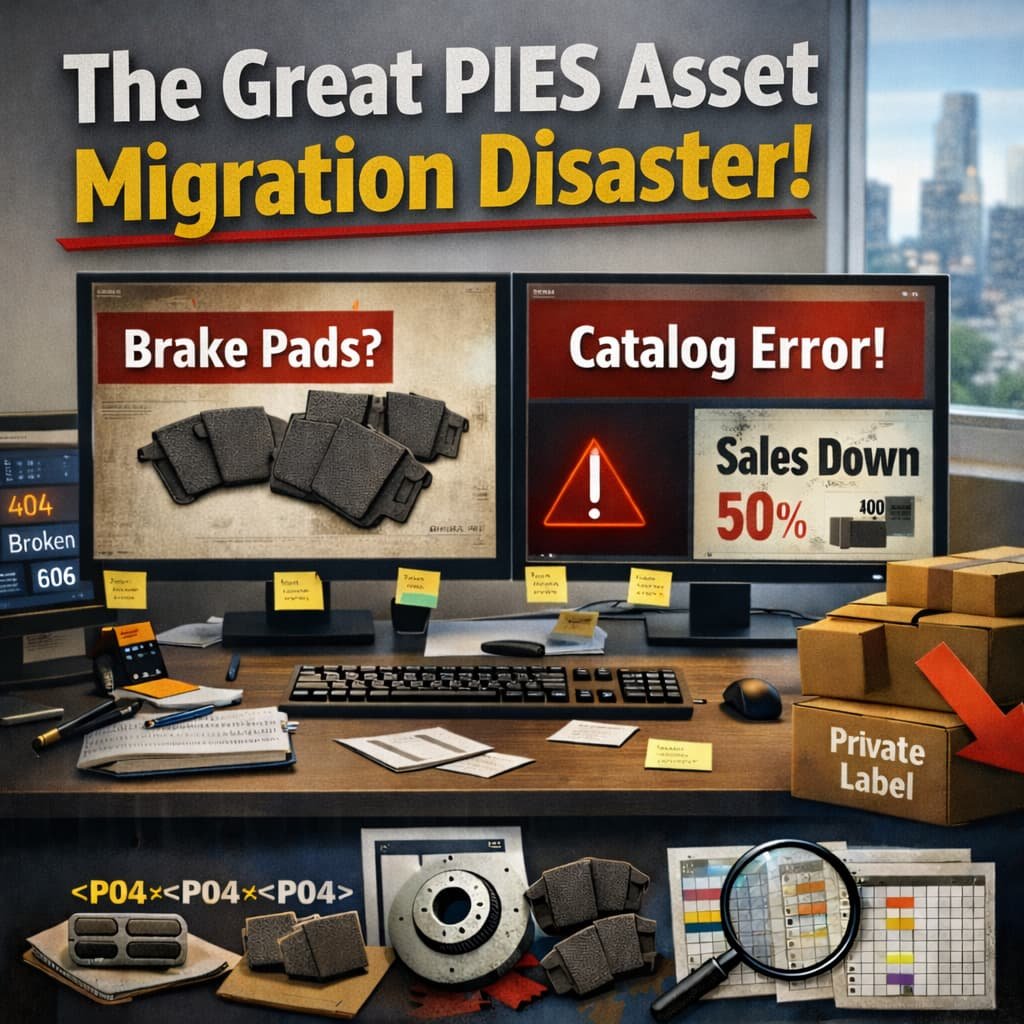
Near midnight on a Friday, my phone didn't just ring. It screamed. Our biggest retail partner was on the line, and through the shouting, I heard the words that every catalog manager fears: "Why am I looking at brake pads where rotors should be?" Everyone else had already logged off from our system. I could see all of them showing as unavailable.
Our entire product catalog had just gone live with the new PIES feed. Our biggest retail partner, who handled drop shipping for us, was threatening to cut us off completely starting Monday. They wouldn't dropship anything for us anymore because they believed we were misrepresenting their brand, the brand names, and the way everything was showing on their site.
By Saturday morning, the damage was clear: our private label brand sales had dropped 50%. Everything else was down 40%.
This wasn't supposed to happen. We had hired experts. We had done testing. We had followed the plan.
But as I sat there looking at the chaos, I knew someone was going to have to go line by line through the data to figure out what went wrong.
The Setup: When "Modernization" Meets Reality
Six months earlier, management decided to modernize our catalog data processing. For years, we'd been running a hybrid system: 90% automated with 10% human verification. It wasn't sexy, but it worked.
They wanted 100% automation. Migrate everything from our legacy system to proper ACES/PIES standards and push it straight to the website. Clean, modern, efficient.
So they hired a consultant with an impressive resume from one of those big tech companies whose name alone opens doors. The problem wasn't where she worked. The problem was she was completely domain agnostic. She understood data structures and XML validation, but she didn't understand that automotive catalog data is fundamentally different from selling t-shirts or cloud storage. Sister brands, asset sequencing logic, the relationship between part numbers and manufacturer prefixes... none of that was in her playbook.
The consultant brought in a vendor. An expensive one. They promised it would be "straightforward and error-free." They'd done it for "so many other companies."
None of them were automotive companies. But they had excellent PowerPoint presentations.
Initial tests looked fine: maybe a few dozen lines at a time. The vendor graded their own homework with fancy green checkmarks and confidence metrics. The company didn't want anybody from the old experienced team to be part of it. We were excluded from all the high-five meetings. They even hired a junior-level person as a VP who had very little automotive experience. He spent more time talking about AI and automation than actually understanding our products (yet another resume, another PowerPoint).
Then we went live.
And they wiped out years of work. All those carefully curated decisions by automotive professionals: which image to show first, which technical diagrams customers needed, which warranty documents should appear last. Gone. Including custom photos we'd taken in our own warehouse because manufacturer images weren't good enough. All that manual work where a vendor might provide an image of two items but would ship only one, or vice versa. Years of manual corrections, gone.
All of it. Scrambled.
The Detective Work: Line by Line
While everyone panicked and pointed fingers, I did what nobody else would do.
I looked at the actual data. Line by line.
I pulled up the old system. I pulled up the new PIES feed. I started comparing.
The AssetType codes were systematically wrong.
Here's the technical failure: The vendor treated the Asset segment as a flat list, completely ignoring the Sequence value and AssetType distinctions. They mapped everything to Product Image (P04) even if it was Line Art (L01), Installation Instructions (I01), or Warranty documents (W01). The images existed in our system. They just weren't being called with the correct AssetType codes.
Here's what happened: Many manufacturers have a main brand and several sister brands. Our legacy system handled each separately with different prefixes and logic. Our human verifiers understood these relationships.
The vendor's automation didn't know and didn't care to learn.
It applied the main brand's AssetType codes to all the sister brands. Thousands of SKUs, all mismatched. To be fair, the main brand kind of worked, displaying everything in the same SKU but not in the order we wanted.
The sequencing logic was also destroyed. The vendor's system had its own ideas about "optimal" ordering. It didn't understand that you show the product shot first, the application photo second, the technical diagram third, and warranty information last. It just... sorted things.
Even our custom warehouse photos, which didn't follow manufacturer naming conventions because we created them, were lost in the shuffle. And it wasn't just images. So many custom part names we'd created disappeared from the site completely. Broken image links were everywhere, creating a terrible customer experience.
The Pushback: Too Simple to Believe
I brought my findings to the team.
The vendor's response? "It's a data issue. Your legacy data doesn't conform to standards. You need to reach out to every brand and ask them to fix their sister SKU formats."
They wanted us to call manufacturers and ask them to restructure their entire product lines to match what their automation expected.
"No," I said. "The data is fine. Your mapping is wrong. You didn't account for the sister brand structure."
"But the data validated correctly!"
Of course it validated. The XML was technically formatted correctly. The problem wasn't syntax. It was logic. Understanding how automotive brands actually structure their products.
Management had a one-year contract with them. But right then, with our dropship partner ready to pull the plug and our private label sales cratering, we didn't have a year. We had a weekend.
The Fix: Two Weeks of Hell
We rebuilt it manually.
Someone had to restore the sequence mapping, verify the AssetType codes, and ensure every SKU pointed to the right assets in the right order. And if you're in automotive, you know there's no such thing as restoring from backup. You have to rebuild it. Because of this new logic, even if you restored a backup, you'd end up in the same spot, plus you'd lose your last 24 to 48 hours of work.
Special thanks to our catalog team members and the knowledgeable IT personnel who stood next to us, helping with reporting and re-uploading corrected files one by one for the entire two weeks. They worked 24/7.
We saved the dropship partner relationship. Barely.
But the damage lingered. All those broken image links, all that time with wrong part types and images scattered across our catalog: we lost organic traffic. It hit company sales hard.
Upper management blamed Google's algorithm.
I kept my head down and kept fixing data.
The Lesson: Automation Without Understanding Fails
Syntax isn't Logic: Valid XML doesn't mean your brake pads won't look like rotors.
Test the Edge Cases: 50 lines of "cherry-picked" data is a demo, not a test. Process a full brand family or don't go live.
Respect the Safety Net: That "inefficient" 10% human verification was actually your most valuable QA layer.
Domain expertise matters: Understanding automotive catalog data is fundamentally different from general data structures. Sister brands, asset sequencing logic, the relationship between part numbers and manufacturer prefixes. These details are what separate working automation from disaster.
We hired a resume, a PowerPoint, and a domain-agnostic approach.
And I spent two weeks fixing it, line by line.
Have you lived through a migration disaster? What's the most "technically correct" but "logically insane" data mapping you've ever seen? Drop a comment below.
And if you're planning a PIES migration, please don't let the vendor grade their own homework. Get someone who knows automotive data to look at the actual results before you go live.
Your Friday night self will thank you.
Disclaimer: The events described in this post are based on real-world professional experiences and are shared for educational and industry-insight purposes only. Out of professional respect, the company and individuals involved have not been named. The views and opinions expressed here are solely my own and do not reflect the positions of any current or former employer.