
The "Big Tech" Resume Trap: Why Logos Don’t Equal Leadership
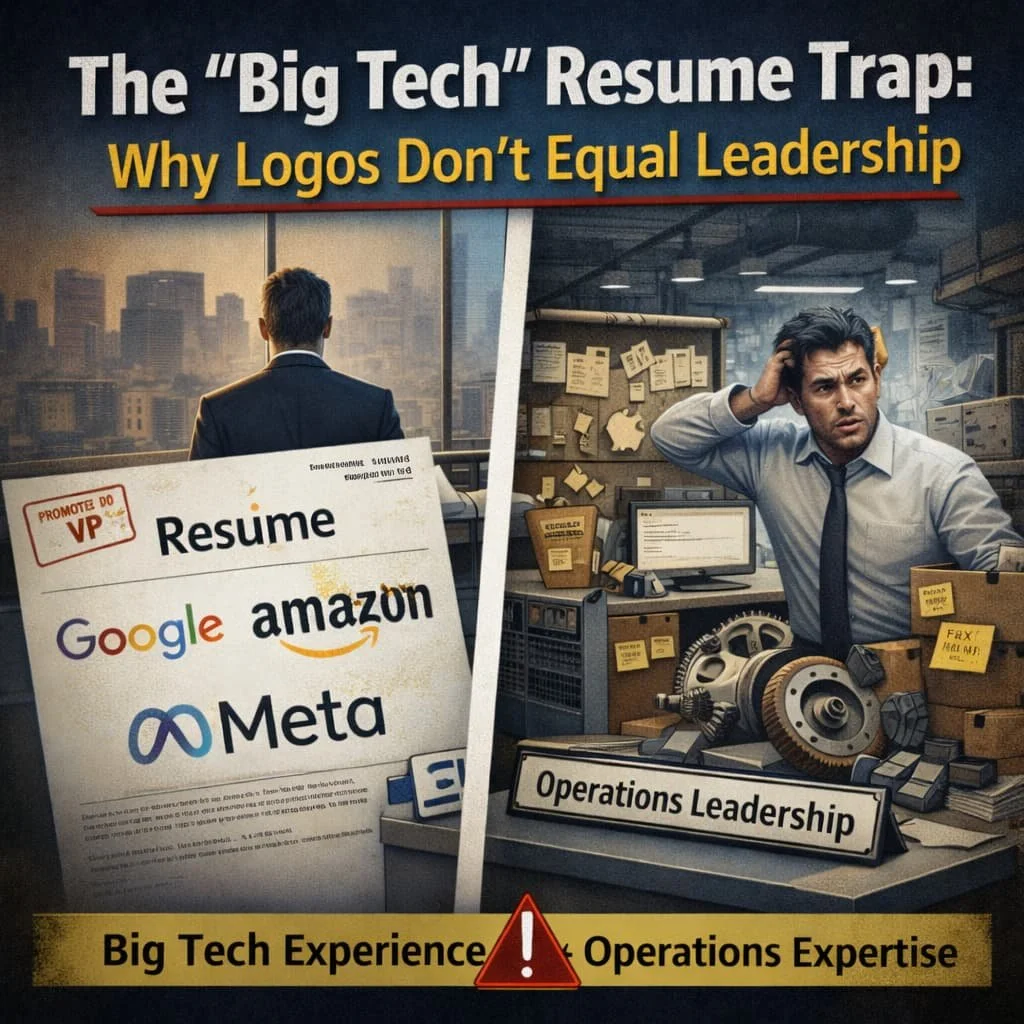
We've all seen the pattern: A "Junior Developer at Google" or an "Associate at Amazon" gets hired as a VP or C-suite executive at a mid-market company. The board sees the logo and assumes they're hiring the "secret sauce" of Silicon Valley.
I've seen this over and over. Not all of these hires turn out poorly, but I've watched some pretty much destroy companies to the point where they're not fixable. The worst part? They think the company they just joined has the same unlimited funds and resources as the company they came from.
Disclaimer: This doesn't apply to everybody. There are many talented professionals from Big Tech who successfully transition to mid-market companies and do exceptional work. This is about a specific pattern I've observed, not a blanket statement about everyone with a Big Tech background.
The "Big Tech Halo Effect"
There's a world of difference between being a steward of scale and an architect of growth. In Big Tech, "innovation" often means optimizing a 1% lift in an existing flow using a $10M internal tool. In a mid-market or scrappy firm, innovation is figuring out how to ship a product when the "tool" is a shared spreadsheet and a prayer.
Here's the reality of the "Ex-Google Fallacy":
The Scale Paradox: Thriving in an established giant with infinite resources and mature processes does not mean you can build a department from scratch in a "lean" environment.
Maintenance vs. Building: Many Big Tech roles are about maintaining a small cog in a massive machine. Operations leadership requires someone who can build the machine, not just polish the gears.
Domain Amnesia: Technical proficiency in a generalized tech stack does not replace domain expertise. Understanding data structures is not the same as understanding why an automotive manufacturer uses specific sister-brand logic.
Three Red Flags I've Noticed
The "Resource Shock": They ask for a six-figure consulting budget or a team of ten before they've even audited the current workflow.
Process Rigidity: They try to implement "Spotify-style squads" or "Amazon Six-Pagers" in a 50-person company where a 15-minute huddle would suffice.
The "Above the Work" Mentality: If they can't explain the manual "how," they usually end up delegating the company into a ditch.
The Bottom Line
A resume should be an indicator of potential, not a "get out of vetting free" card. If a leader cannot explain how to do the work manually, they have no business trying to automate it for your entire company.
Would I say this trap is getting worse as remote work makes it easier for Big Tech employees to jump into leadership roles at smaller, regional firms? Absolutely. The disconnect between what worked at a company with unlimited resources and what actually works in the real world has never been more visible.
Have you seen this pattern? What red flags have you noticed? Drop a comment below.