
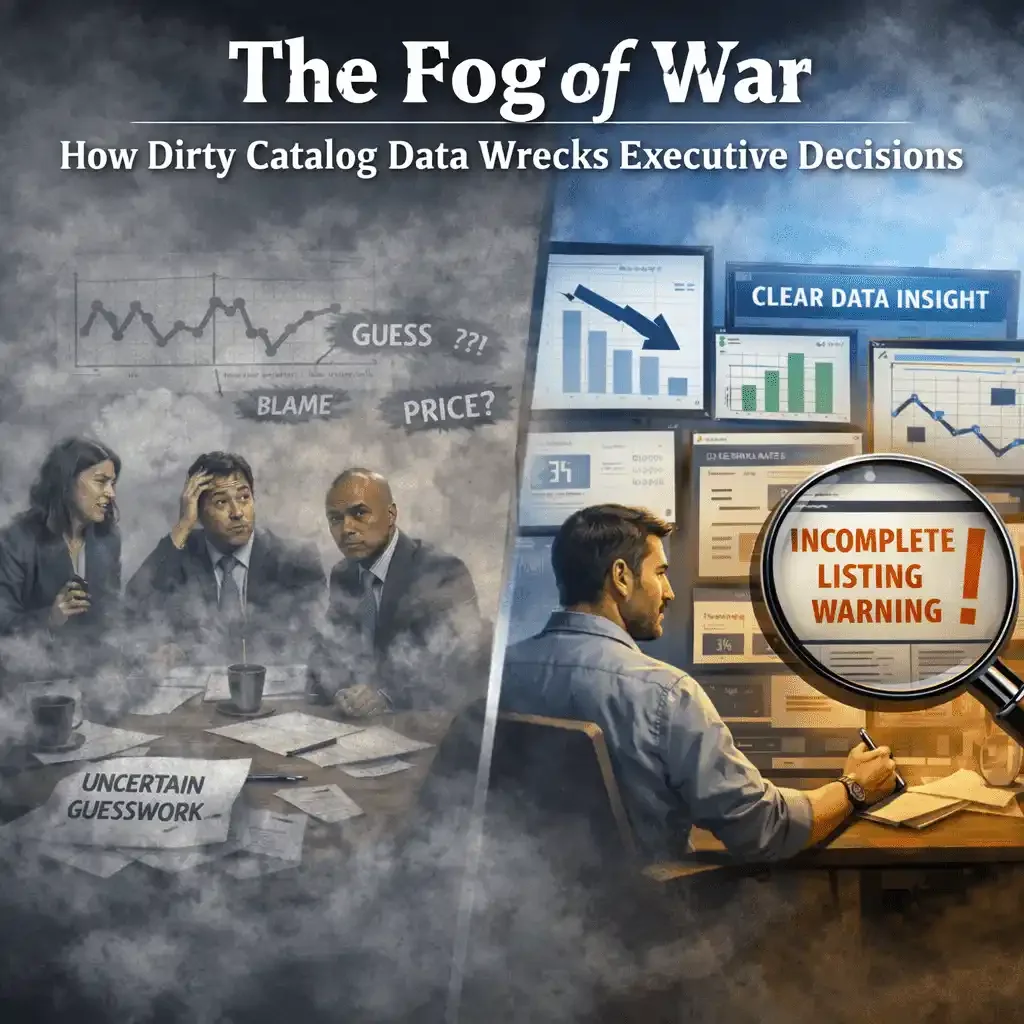
When the data is foggy, strategy becomes opinion. The loudest voice wins, not the most accurate one.
Running an e-commerce business with dirty catalog data is like driving through thick fog. You know the cliff is there. You just do not know how close.
That is what it feels like when your catalog is technically live, but the truth behind it is blurry. The business looks fine at 30,000 feet. Revenue is moving. Orders are shipping. The dashboard has green numbers. Then you zoom in on a single category, or a single product page, and suddenly nothing explains itself.
A category slows down. Paid search loses efficiency. Conversion softens across a product line that used to be reliable. The team gathers in a room and starts throwing theories at the wall.
Pricing. Creative. Competitors. Seasonality. “Amazon is weird this month.”
Sometimes those theories are real. But most of the time, the answer is sitting on the product page in plain sight, hiding behind bad data that nobody thought to check because the listing was live and therefore assumed to be correct.
The executive problem is not a lack of dashboards. It is a lack of visibility you can trust.
Gut Feeling vs. Data Truth
When the data is foggy, decision making becomes a battle of confidence. Not a battle of evidence. A battle of confidence.
The loudest person wins. The most senior person wins. The person with the cleanest PowerPoint wins. Not because they are right, but because the underlying truth cannot be seen clearly enough to settle the argument.
I have watched this pattern play out across multiple companies. Two competent people, both looking at the same category, reaching opposite conclusions. One says the product is underpriced. The other says the product is under surfaced. Both have data that supports their position. Neither can prove the other wrong, because the catalog data underneath is too messy to be definitive.
Dirty data does something subtle. It turns strategy into opinion.
When no one can prove what is actually happening on the product page, the loudest theory wins. That is not leadership. That is guesswork with a conference room.

The Hidden in Plain Sight Problem
Here is the pattern I see constantly.
A category is failing and everyone debates why. Spend gets reduced. Bids get cut. Promotions get layered on. The team tweaks everything downstream, hoping the numbers come back. Meetings multiply. Theories get more creative. Someone builds a slide deck comparing last year’s performance to this year’s weather patterns.
Then somebody finally does the one thing nobody had done yet.
They open a product page.
And they see it. A listing that clearly says something like “without keys.” Or “does not include mounting hardware.” Or a fitment table that claims compatibility with a vehicle that was never manufactured with that engine option.
That is not a marketing issue. That is not a pricing issue. That is a conversion killer baked into the offer itself. It is a product truth that should have been structured, searchable, and filterable, not buried in a sentence that customers discover after the click.
Now zoom out.
If one offer has that issue, you probably have hundreds. Not because people are careless, but because your system allows blur. If your data model cannot express reality cleanly, the business will argue about symptoms forever.
The Real Cost of Fog
Most leaders underestimate the financial drag of dirty catalog data because the cost does not show up in one line item. It shows up everywhere, distributed across departments, and no single person owns it.
It shows up as increased return rates on products where the listing implied something the product did not deliver. It shows up as customer support tickets that could have been prevented by a single correct attribute. It shows up as ad spend wasted on impressions that led to product pages customers bounced from immediately. It shows up as marketplace penalties, including suppressed listings, lost Buy Box eligibility, and reduced organic ranking, that the team discovers weeks after the damage was done.
And it shows up in the subtlest, most expensive way of all.
Decisions that never get made.
A category expansion that stays on hold because nobody trusts the data enough to project demand. A supplier consolidation that stalls because the team cannot confidently map which SKUs overlap. A pricing move that gets delayed quarter after quarter because the margin analysis depends on attributes that were never populated correctly.
Fog does not just cause mistakes. It causes paralysis.
What Fog Looks Like in Real Life
If you have not audited your own catalog recently, here is what you will find when you do. These are the patterns I encounter most often.
Attributes that are technically populated, but meaningless. A field labeled “Material” that says “Other.” A color field that says “As Pictured.” These pass system validation. They destroy customer confidence.
Default values that pass validation and still kill conversion. A shipping weight of 52 pounds on a two-ounce switch because a legacy ERP default was never cleared. A dimension tax that inflates fulfillment cost on every unit shipped.
Category placement that looks correct until you test filters. The product is in the right department but the wrong subcategory. It shows up in search but disappears when a buyer applies the filter they actually use.
Compatibility claims that inflate traffic and inflate returns. Broad fitment rules that make the catalog look comprehensive on paper but generate “this doesn’t fit my vehicle” returns at a rate that erodes margin and account health.
Listings that appear fine until you check eligibility. The product page exists. The listing is live. But the SKU is missing a required attribute for a marketplace program, a shipping badge, or a promotional placement. It is technically available and practically invisible.
And the worst part is that fog creates false confidence. A dashboard can show stable conversion while product pages quietly underperform. The aggregated number looks fine. The individual pages are bleeding.
The Compounding Effect
Fog compounds. One bad attribute does not stay contained. It cascades through every system it touches.
A wrong category in the PIM becomes a wrong filter on the marketplace, which becomes a missing impression in the ad platform, which becomes a missed conversion in the dashboard, which becomes a budget cut in the quarterly review.
By the time the executive team sees the symptom, the root cause is four systems and six months away.
This is why catalog data problems are so difficult to diagnose at the leadership level. The damage does not present itself as a data issue. It presents itself as a performance issue, a marketing issue, a pricing issue, or a competitive issue. The fog disguises itself as something else entirely, and every department optimizes against the wrong target.
I have watched teams spend six figures on ad optimization for a category where the real problem was that 30 percent of the SKUs had missing images. I have seen pricing analysts spend weeks modeling elasticity curves for products that were suppressed from search because of a bad shipping weight.
The fog makes every downstream investment less efficient. No amount of spending downstream can fix a problem that lives upstream.
The Organizational Damage Nobody Talks About
Dirty data does not just hurt metrics. It hurts teams.
When the catalog cannot be trusted, every department develops its own workaround.
Marketing builds their own product spreadsheet because they do not trust the PIM. Operations manually checks weights because they have been burned by ERP defaults. The marketplace team maintains a shadow list of SKUs they know have bad data, and they quietly suppress them instead of fixing them.
This is how organizations fracture. Not through a single dramatic failure, but through a thousand quiet compensations that nobody coordinates. Each workaround is rational on its own. Together, they create a parallel data ecosystem that makes the real system even less trustworthy.
Eventually, the people closest to the problem burn out.
The catalog analyst who flags the same issues every quarter and never sees them fixed. The customer service rep who knows exactly which products will generate returns before the order ships. The marketplace manager who spends half their week patching data instead of growing the channel.
The best people do not leave because the work is hard. They leave because the work is pointless when the system fights them every day.
Why Leaders Should Care
High-quality catalog data is not an operational detail. It is an executive asset.
Clean data gives you confidence.
Confidence to shift budget without fear. Confidence to expand assortment without guessing. Confidence to consolidate suppliers without breaking the shopping experience. Confidence to push a pricing move without accidentally burying the offer. Confidence to double down on a category because you can see what is actually real.
When the data is clean, teams stop arguing about what might be happening and start acting on what is happening. Meetings get shorter. Decisions get faster. Accountability becomes possible because everyone is looking at the same truth.
If your catalog is blurry, your decisions will be too.
You will move slower than you should. You will overcorrect when you should stay steady. You will get lucky instead of getting predictable.
Visibility is not a reporting problem. It is a data problem.
Quick Fix Framework
If you want to clear the fog fast, you do not need a six-month data governance project. You do not need a new platform. You do not need to hire a consulting firm to map your taxonomy.
Those things might help eventually, but they are not the first move.
The first move is simpler and more uncomfortable: look at what the customer actually sees, and compare it to what you think they see. The gap between those two things is your fog.
Here are three concrete actions your team can execute this week:
Pick one failing category and open 20 product pages. Do not look at the dashboard. Look at what the customer sees after the click. Read the titles. Check the images. Read the bullet points. Look at the fitment tables. Find the repeating gotchas, the things that make a reasonable buyer hesitate or bounce.
Translate those gotchas into structured fields. If something matters to conversion, it belongs in an attribute, not buried in a sentence. “Without keys” should be a filterable field. “Mounting hardware not included” should be a structured data point. If your data model cannot express it, your data model is the problem.
Create a visibility scorecard. Track the things that actually drive discoverability and conversion at the SKU level: image coverage, attribute completeness, badge eligibility, shipping class accuracy, fitment confidence, and return flags. Score it weekly. Share it with leadership. Make the fog visible.
You do not need perfection. You need clarity.
FAQ
What counts as dirty catalog data?
Any data that is technically present but functionally misleading. This includes default values that were never updated, attributes populated with placeholder text like “N/A” or “Other,” incorrect fitment or compatibility claims, missing images, inherited category mappings that no longer apply, and shipping dimensions that do not reflect the actual product. The data passes system validation but fails the customer experience.
How does dirty data affect marketplace performance specifically?
Marketplaces use structured data to determine search ranking, filter placement, badge eligibility, shipping class assignment, and promotional inclusion. When attributes are wrong or missing, your SKU may be technically live but practically invisible. It will not surface in filtered searches, it may lose Buy Box eligibility, and it can be excluded from programs like next-day delivery or featured deals.
Our ERP data is accurate. Why would the catalog still be foggy?
Because ERP accuracy and retail accuracy are not the same thing. Your ERP may have the correct part number, weight, and cost. But the catalog needs customer-facing attributes: fitment details, position qualifiers, image coverage, descriptions, and category mappings that align with how buyers actually search and filter. Data that is accurate for procurement can still be incomplete or misleading for retail.
Isn’t this the PIM’s job?
It should be. A well-configured PIM is the layer that catches, normalizes, and validates data before it reaches the channel. But a PIM only works as a gate if its validation rules are active and maintained. Many organizations treat the PIM as a pass-through rather than an enforcement layer. If the PIM is not actively blocking bad data, it is just another place for fog to accumulate.
How do I convince leadership that this is worth fixing?
Tie it to money. Pull return rates on categories with known data issues and compare them to categories with clean data. Calculate ad spend wasted on impressions that led to product pages with missing or incorrect attributes. Show the number of SKUs excluded from marketplace programs because of incomplete fields. The cost of dirty data is real and measurable. It just has not been measured yet because no one has connected the dots.
How often should we audit catalog data quality?
Continuously, ideally through automated scoring. At minimum, run a manual audit quarterly and after any major event: new supplier onboarding, platform migration, feed logic changes, or category expansion. The goal is not a one-time cleanup. The goal is a recurring process that catches drift before it becomes damage.
What is a visibility scorecard and how do I build one?
A visibility scorecard tracks the data quality signals that directly affect discoverability and conversion at the SKU level. Core metrics include image coverage, attribute completeness, badge eligibility, shipping class accuracy, fitment confidence, and return rate flags. Score each SKU or category weekly, set thresholds for green, yellow, and red, and share results with leadership. The scorecard turns invisible data problems into something the executive team can see and act on.
What is the fastest first step I can take this week?
Pick your worst-performing category. Open 20 product pages. Do not look at the dashboard. Look at what the customer sees. Write down every gotcha that would make a reasonable buyer hesitate. That list is your fog map, and it will tell you more about your real problem than any analytics report.
CTA
Are you making decisions based on data, or are you guessing and getting lucky?
Send me one category you believe is mysteriously underperforming and five URLs you think should be winning. I will tell you where the fog is coming from.