
Buying Collision Parts from Taiwan vs China: The Due Diligence Checklist
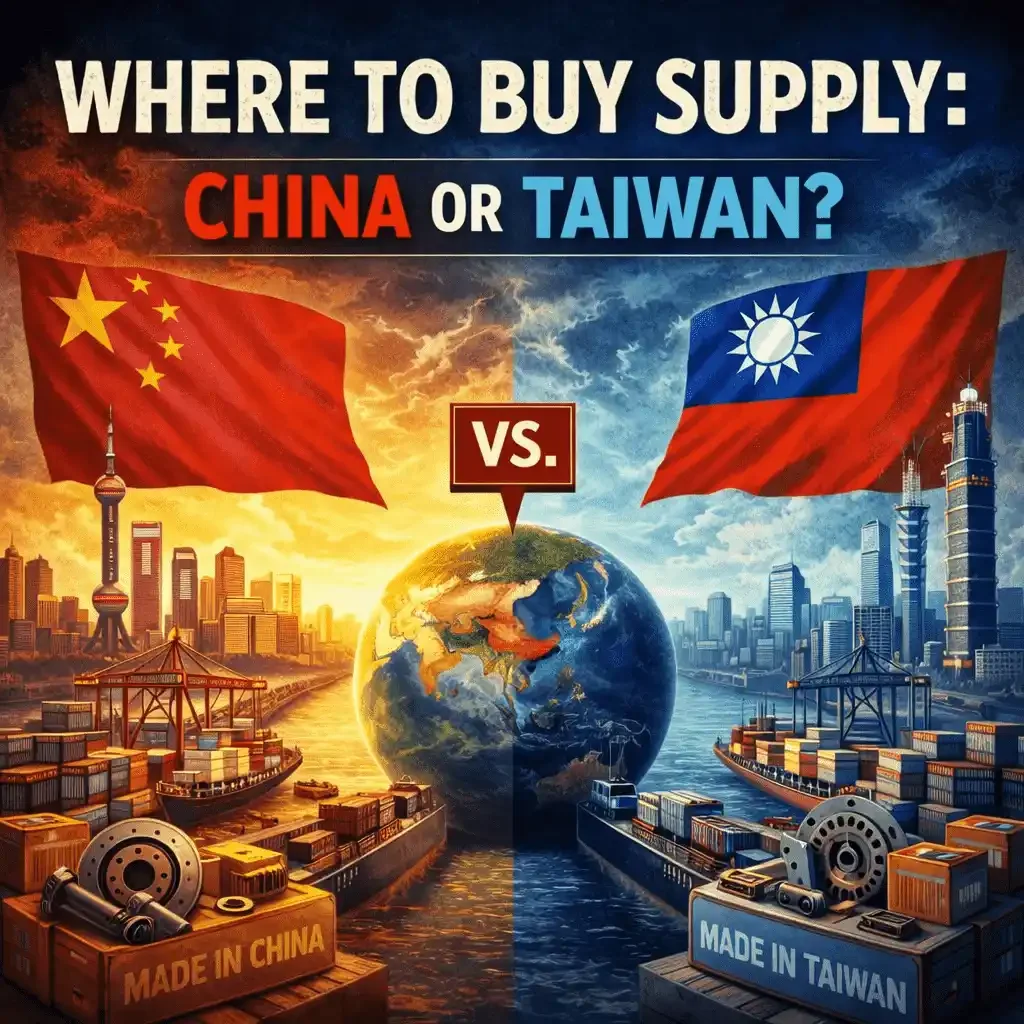
My Marketplace Tracking Report
I spend my weekends auditing 900 plus marketplace sellers. Most people watch football. I watch Country of Origin shifts in the lighting category.
Here is what the market is telling me right now.
I track what sellers list, how they price, which categories climb, and who stays top-rated. Headlights keep floating to the top, usually ahead of bumper covers and hoods. I also track country of origin at the part-name level.
And I keep seeing the same behavior in lighting. Sellers move fast. Some jump into China-sourced product, then disappear just as fast. If I see a reputable seller pushing China-made lights, I will buy one as a test. I do not return them, even if I do not need the item. That is my research budget, and I treat it like tuition.
Other sellers stay and scale. Opportunity and risk show up in the same place.
I’m doing this because it’s my hobby, and you don’t kill habits built over decades. You refine them.
The Quiet Part Out Loud
If the price looks impossible, it usually is. Not because someone “found a better factory.” Because something got skipped.
I’ve spent enough time watching eBay and Amazon listings to notice a pattern. A lot of collision parts, especially body parts, trace back to Taiwan. At the same time, more and more lighting parts are showing up from China, and they are getting bought fast.
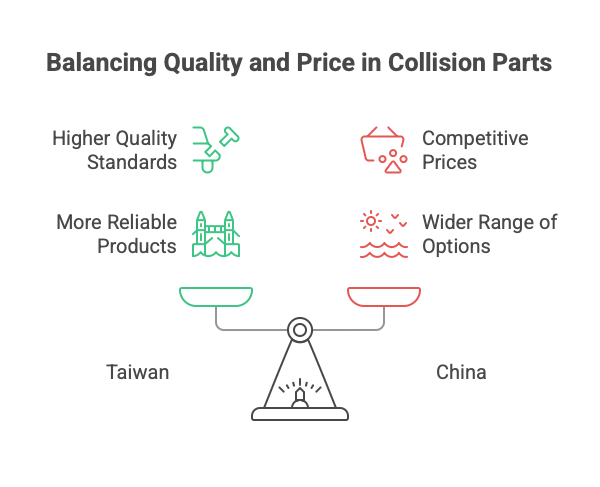
That shift is real. The opportunity is real. The risk is also real.
This is my opinion based on my own experience and what I’ve seen in the market. If you sell parts in the U.S., you have to do your homework. You do not want to learn compliance through chargebacks, returns, marketplace penalties, or a lawyer letter. In the worst case, you can trigger serious government scrutiny. That can include inbound shipments being held for investigation, plus storage and inspection fees that get painfully expensive, fast.
First, a Quick Correction That Matters
On marketplaces you often see “Country of Origin.” People sometimes say “county” by mistake. It’s “country.” And even then, it is not a guarantee. It’s a clue.
Treat it like a lead, not a certification.
Why Taiwan Shows Up So Often in Collision Parts
When I look at collision categories, Taiwan shows up constantly for things like bumper covers, grilles, fenders, and exterior trim.
In my experience, Taiwan suppliers tend to be more consistent on:
repeatable manufacturing
packaging and damage control
dimensional consistency
stable part numbering across revisions
quality programs that match how U.S. retailers operate
That does not mean everything from Taiwan is great. It means the ecosystem is often better aligned with what the aftermarket actually demands.
Why China Is Showing Up More, Especially in Lighting
China is a different game. The range is massive.
You can find excellent factories in China. You can also find “copy a photo, ship a box” operations.
Lighting is where I see the most aggressive pricing and the most aggressive claims. This is also where a buyer has to slow down, because lighting is not just a cosmetic category. It can be regulated, and the claims can be misleading.
The “Too Cheap to Be Legal” Question
When I see a lighting unit priced at a level that feels impossible, I ask one question:
How are you selling this at that price as a legal unit in the U.S.?
Sometimes the answer is efficiency. Sometimes it’s volume. Sometimes it’s a factory that has it together.
And sometimes it’s not actually compliant, and the listing leans on phrases like “DOT approved” to sound official.
Important Reality About “DOT Approved”
A lot of people misunderstand how this works in the U.S. Many overseas factories treat DOT like it is a sticker you buy. That is not the mindset a U.S. seller can afford.
At a practical level, DOT is a compliance claim tied to FMVSS 108 expectations for lighting. It is not a government “approval stamp” the way marketplaces sometimes make it sound. If you cannot produce real documentation when someone asks hard questions, the claim is empty.
People are terrified of recalls for a reason.
One of my coworkers, a guy with easily 20 more years of experience than me, used to repeat a rule that stuck in my head: make sure we only sell DOT lights, because if we ever sold non-DOT by accident, we would have to recall everything. I never fully researched that statement at the time, but it stayed with me for a reason. The risk is real, and the cleanup can be brutal.
This is not legal advice. It’s a risk warning. If you are buying or importing lighting, verify what standard applies to that part and what markings and documentation are actually required.
What I Look For When Choosing Taiwan vs China Suppliers
I do not pick countries. I pick controls.
Here’s a supplier selection checklist that works in the real world.
Ask for Proof, Not Promises
If the supplier says “compliant,” ask:
Which standard?
Which test report?
Which lab?
Which revision date?
Which exact part numbers match that report?
If the answer is vague, assume the risk is yours.
Separate Cosmetic Parts From Regulated Parts
Not all collision items carry the same compliance risk.
A bumper cover has quality risk. A headlamp has quality risk and potential compliance risk.
Different sourcing rules should apply.
Require Traceability
If something fails in the field, you need to trace:
lot number
production date
factory line
revision history
packaging identifiers
No traceability means no accountability.
Buy Samples Like a Skeptic
Before you commit, run a sample program that includes:
unboxing inspection
install fit check
finish check
packaging damage test
photo documentation
If the supplier fights a sample process, that is your answer.
Audit the Marketplace Reality
The marketplace is the best lie detector.
Search the same part across eBay, Amazon, and Walmart. Look at:
review patterns
repeat complaints
return language
weird fitment claims
photos that do not match the item delivered
If the listing looks like it was built to pass SEO instead of pass inspection, be careful.
The Rule I Use: Compliance First
No supplier goes live in my catalog without a human spot-check plus documentation verification.
Not “we’ll validate after we start selling.”
Not “it’s probably fine.”
Not “everyone else sells it.”
If it’s a lighting unit, I want to know exactly what I’m selling and what standard it is supposed to meet.
Red Flags I Watch for on Marketplace Listings
“DOT approved” with no supporting documentation
stock photos only, no real product photos
no consistent markings shown anywhere
vague warranty language
sellers avoiding direct answers about origin or testing
extreme price gaps with no explanation
The Bottom Line
Taiwan can be a strong source for many collision parts. China can be a strong source too, especially if you pick the right factory and enforce controls. The mistake is assuming the country is the quality system.
It isn’t.
Your process is the quality system.
CTA
Are you sourcing collision parts from Taiwan, China, or both?
And be honest. Do you verify what you’re buying, or do you upload it and hope the market sorts it out?
If you want, paste one supplier quote or one product category you’re considering, and I’ll give you a simple “buy or block” checklist you can apply before it ever touches your catalog.
The Disclaimer
A Note on Data Integrity
The insights shared here are based on my own observations and historical snapshots. Data in the automotive aftermarket decays quickly. Before I treat any report as gospel, I ask the uncomfortable questions: are origin fields still accurate, are sellers labeling consistently, and have marketplace policies shifted since the last pull?
I do not cherry-pick data to fit a narrative. If I do not pressure-test my own inputs, I’m just telling a story that feels right instead of one that is true.
Always verify your source, even when that source is me.