
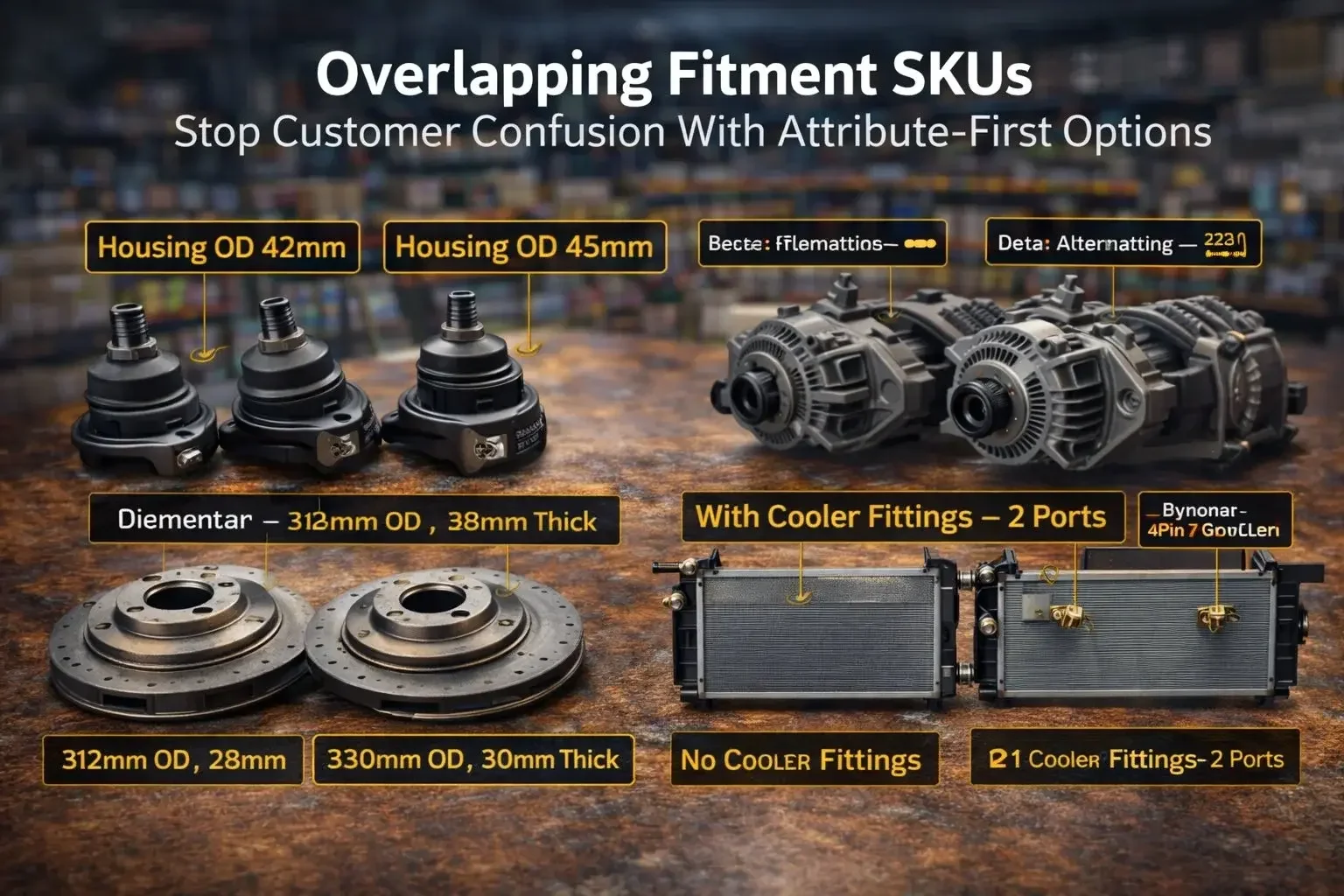
Overlapping Fitment SKUs: Stop Customer Confusion With Attribute-First Options
Category: Improve Your Data
(Secondary if needed: Optimize Your Marketplace)
Core Principle
When a vehicle has two valid options, never label parts as:
“Old / New”
“Sport package”
“VIN starts with…”
“Production date…”
Instead, label them by a customer-comparable attribute:
diameter / thickness / length
connector pin count
port count / fitting type
amperage rating
bolt pattern / stud size
If a customer can measure it, see it, or match it, you win.
Example 1: Ball Joint (two valid options)
Bad differentiation: “Old version” vs “New version”
Better differentiation: Housing OD and/or Stud diameter/taper (and include a quick “how to verify”)
Option A (example): Ball Joint Housing OD 42 mm
Option B (example): Ball Joint Housing OD 45 mm
How to show it to customers
Title: “Ball Joint … Housing OD 42mm” vs “Ball Joint … Housing OD 45mm”
Item specifics / attributes: Housing Outside Diameter, Stud Diameter, Greaseable Yes/No
Fitment note: “Verify housing OD with caliper (press-fit area). Do not choose by ‘old/new’.”
(The exact measurements should come from your supplier/OE spec-this is the pattern that matters.)
Example 2: Brake Rotor (same vehicle, two rotor sizes)
Common reality: Base brakes vs heavy-duty brakes, but don’t call it that in the option label.
Bad differentiation: “Performance brakes” vs “Standard”
Better differentiation: Rotor outside diameter + thickness
Option A: Rotor OD 312 mm, Thickness 28 mm
Option B: Rotor OD 330 mm, Thickness 30 mm
Customer verification
Measure rotor OD (or wheel size if it’s a reliable proxy)
Compare the old rotor photo to listing (include a dimension diagram)
How to list it
Title: “Front Brake Rotor 330mm OD”
Specifics: Rotor Diameter, Thickness, Vented/Solid, Bolt Pattern
Note: “If your current rotor measures ~330mm, choose 330mm option.”
Example 3: Radiator (with vs without integrated transmission cooler)
Bad differentiation: “Tow package” vs “Non-tow”
Better differentiation: Cooler fittings present + port count/location + core thickness
Option A: Radiator without trans cooler (no cooler fittings)
Option B: Radiator with trans cooler (2 cooler line fittings)
Customer verification
Look for trans cooler fittings on current radiator
Count ports and match inlet/outlet orientation
How to list it
Title: “Radiator With Trans Cooler Fittings”
Specifics: Transmission Cooler Included Yes/No, Inlet/Outlet Location, Core Thickness
Note: “If your radiator has two cooler line fittings, choose ‘With Cooler’.”
Example 4: Alternator (same engine, different output/connector)
Bad differentiation: “Premium” vs “Standard”
Better differentiation: Amperage + connector pin count + pulley grooves
Option A: 130A, 2-pin connector, 6-groove pulley
Option B: 220A, 4-pin connector, 7-groove pulley
Customer verification
Match connector shape/pin count
Check alternator label (amperage) if visible
Count pulley grooves
How to list it
Title: “Alternator 220A 4-Pin 7-Groove”
Specifics: Amperage, Connector Quantity, Pulley Grooves, Voltage
Note: “Match pin count + pulley grooves before ordering.”
“Do this every time” mini-checklist (for overlapping SKUs)
When one make/model/year has 2 options, force these fields:
Primary differentiator: a measurable spec (diameter, ports, pins, length, output)
Secondary differentiator: something visual (connector shape, fitting type, groove count)
Customer verify step: 1 sentence (“measure OD” / “count pins” / “check cooler fittings”)
Listing enforcement: title + item specifics must repeat the differentiator
Add Dimensions (“Good Size Info”) - It Boosts Conversion and Cuts Returns
When a vehicle has overlapping fitment options, dimensions are the fastest path to buyer confidence.
If the customer can compare a few key measurements to what’s on the car, you reduce:
“doesn’t fit” returns
wrong-option purchases
pre-sale questions
hesitation that kills conversion
What “good size info” looks like
You don’t need 20 specs. You need 2-4 measurements that separate the options clearly.
Examples by part type:
Ball joints: housing OD, stud diameter/taper, overall height
Brake rotors: rotor OD, thickness, hat height
Radiators: core thickness, port count, fitting type, inlet/outlet location
Alternators: amperage, connector pin count, pulley grooves
Where to show size info (so buyers actually see it)
Title (only the primary differentiator, like “330mm Rotor” or “4-Pin Alternator”)
Item specifics / attributes (all key measurements)
One image with a simple dimension callout (buyers love this)
Fitment note with a 1-line verification step:
“Measure rotor OD (~330mm) before ordering.”
Simple rule
If two options exist, the buyer should be able to answer:
“Which one do I have?” in under 30 seconds.
That single change improves both:
conversion (less uncertainty)
returns (fewer wrong orders)
Want help cleaning up overlapping fitments?
If you share your store link (or catalog sample) and your top problem SKUs, I’ll do a free quick review and recommend the exact attributes, size callouts, and listing rules to reduce returns and improve conversion. Contact me and I’ll share next steps.