
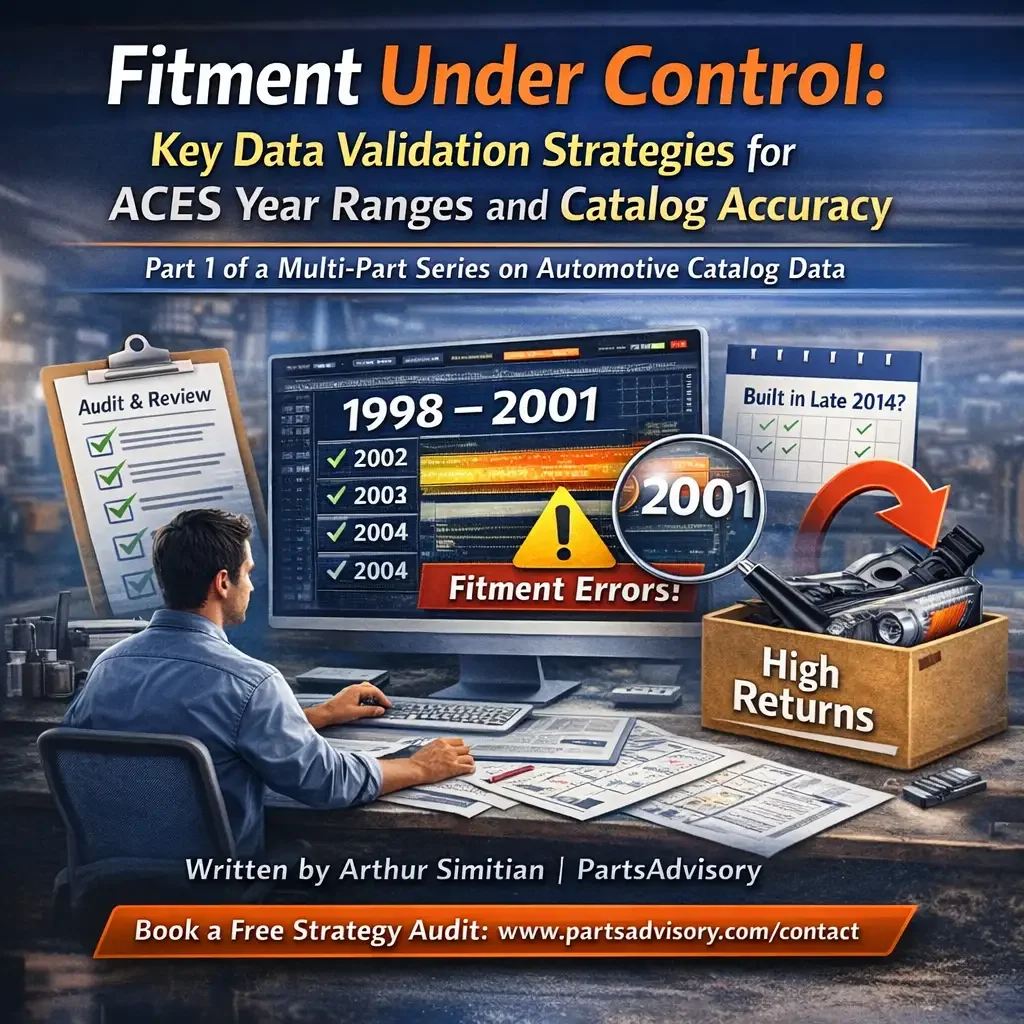
Multi-Part Series on Automotive Catalog Data
In the ongoing race to be first to publish new aftermarket offerings, companies often rely heavily on data supplied by vendors or manufacturers. This is standard industry practice, and there is nothing inherently wrong with it. Speed to market matters. Getting new applications live before competitors can be the difference between capturing a sale and losing it.
However, relying only on incoming data without internal review can introduce avoidable issues. Fitment errors, confusing qualifiers, and inconsistent year ranges quietly erode customer trust, increase returns, and create downstream catalog problems that are far more expensive to fix after publication than before.
At PartsAdvisory, we believe it is important to step back and evaluate how automotive data, whether ACES, PIES, or related formats, is presented and maintained. This article begins a multi-part series on practical automotive catalog data management. Today, we focus on ACES fitment, specifically vehicle year ranges and related qualifiers.
From and To Production Dates
Fitment qualifiers such as "production date from" or "production date to" are common in ACES data, Partslink, and PIM systems. When used correctly, they are highly valuable. They allow catalog teams to precisely define when a part applies within a model year range, catching mid-year production changes that would otherwise result in incorrect fitment.
However, they should only be applied where they are truly relevant. Overuse of production date qualifiers is one of the most common issues we see in aftermarket catalogs.
For example, if a part applies to vehicles produced up to May 1, 2000, does it make sense to carry the qualifier "production date up to May 01, 2000" across every model year from 1995 to 2000? In most cases, the qualifier is only meaningful for the final year of the range, because all vehicles produced in 1995 through 1999 were, by definition, produced before May 2000. Carrying the qualifier across all six model years becomes unnecessary noise that does not add accuracy.
This kind of qualifier overuse reduces clarity for customers, complicates filtering logic in ecommerce platforms and catalog systems, and can potentially hurt conversion rates. When a customer sees a long list of qualifiers on a product listing, their confidence in the fitment may actually decrease rather than increase. They may hesitate, abandon the purchase, or buy from a competitor whose listing appears cleaner and more straightforward.
The principle is simple: qualifiers should clarify, not clutter, your data. Every qualifier attached to an ACES application should earn its place by adding genuine accuracy. If it does not change the fitment outcome for a specific year, it should not be there.
Understanding the Built vs. Bought Concept
Generation transitions are one of the most common sources of catalog errors in the aftermarket industry, and the root cause is often a disconnect between how the industry defines a vehicle and how customers identify theirs.
A new platform may officially begin as a 2015 model year, yet vehicles may have already been available in showrooms and driveways in late 2014. A customer who purchased their car in November 2014 may identify it as a "2014" even though it is technically a 2015 model year vehicle built on an entirely new platform with different parts requirements.
Industry professionals understand this distinction. Most customers do not. They search for parts based on the year they purchased the vehicle, not the model year designation on the VIN plate. If this nuance is not clearly managed in your ACES data, it leads to incorrect purchases, unnecessary returns, and frustrated customers who may not come back.
One practical solution is to clearly identify generation changes through descriptors such as "new body style" or by referencing platform designations where appropriate. ACES does a strong job in many cases, especially in collision parts where body style transitions are well-documented. But it remains the responsibility of each catalog team to apply due diligence and ensure clarity for the end user. Relying solely on the standard ACES application without adding context where needed is a missed opportunity to reduce returns and improve the customer experience.
Auditing New Data Against Existing Applications
When introducing new product offerings and receiving updated ACES and PIES files from suppliers, it is best practice to audit the new data against your existing catalog applications before publication. This step is frequently skipped under time pressure, but the cost of skipping it almost always exceeds the cost of doing it.
A systematic audit process helps identify:
• Overlapping year ranges between new and existing applications
• Duplicate SKUs that may indicate redundant listings or superseded parts
• Missing qualifiers that should distinguish between pre-facelift and post-facelift applications
• Potential fitment errors where year ranges have been carried forward without validation
Consider this real-world example: new data from a supplier indicates 2001 to 2003 headlights for a Lexus LS430, but your existing catalog already lists a 2003 application with a different SKU. Without an audit, both listings go live. The customer searching for a 2003 LS430 headlight now sees two options with no clear guidance on which one fits their specific vehicle.
Is one SKU for the pre-facelift model and the other for the facelifted version? Should the existing year range be revised to 2004 to 2006? Or is there an unintended duplication that will lead to confusion, returns, and lost margin?
Without a systematic review process, these inconsistencies spread. They compound when the same underlying ACES data feeds into kits, sets, and bundled product groupings. A single unresolved overlap at the individual part level can cascade into dozens of incorrect kit listings.
Presenting Data Customers Can Understand
Aftermarket manufacturers often provide technically accurate and highly detailed information in their ACES and PIES data. This is a good thing. However, catalog teams must balance technical precision with customer usability. The goal is not just correct data; it is effective data that helps customers make confident purchasing decisions.
Correct data is not always the best data.
For example, is it more effective to list a qualifier such as "From VIN WVWZZZ1HZ..." or to reference a commonly recognized identifier such as "Mk3" or "New Body Style" for a 1992 Volkswagen Golf? Both are technically valid. But the VIN breakpoint, while precise, assumes the customer knows their full VIN and understands how to interpret it. The generation identifier, while less precise, aligns with how most customers actually think about and identify their vehicles.
Customer knowledge varies widely. A professional mechanic searching for parts may be comfortable with VIN breakpoints and production date ranges. A retail customer searching online may only know the year, make, model, and body style. Whenever possible, fitment data should be presented in a format that aligns with how the broadest range of customers identify their vehicles, with more technical detail available for those who need it.
A Balanced Approach to Complexity
Automotive data management will never be simple. The aftermarket catalog ecosystem is inherently complex, with thousands of vehicles, millions of parts, and constant change. But complexity is not an excuse for confusion. The goal should always be to manage complexity without passing it through to the customer.
Descriptions should be concise and direct. Qualifiers should be relevant and clearly defined. Images should be high quality and accurate. Attributes should be complete, but not overpopulated with redundant or irrelevant data. Year ranges should be carefully reviewed before publication, not simply accepted as received from the supplier.
Errors in foundational ACES data can multiply quickly, especially as product lines expand into kits and bundled offerings. A small oversight at the individual application level can turn into significant downstream issues that affect dozens of related listings, increase return rates, and damage customer confidence.
The aftermarket companies that win are not always the ones with the most SKUs or the fastest time to market. They are the ones whose data customers trust. Building that trust starts with the fundamentals: clean year ranges, meaningful qualifiers, clear generation identifiers, and a consistent audit process.
In the next article, we will continue this series with practical ways to reduce returns and improve catalog accuracy through stronger ACES and PIES data management.
Disclaimer: This article is based on publicly available industry standards and independent research by PartsAdvisory. References to ACES, PIES, and related data formats reflect general industry practices. Specific platform, vehicle, and part references are used for illustrative purposes only. This article does not constitute official guidance from any vehicle manufacturer or standards body. Volvo,Lexus, Volkswagen, and all other brand names referenced are trademarks of their respective owners.