
Here’s the headlight problem nobody wants to admit:
You can “grow” your headlight SKU count every month and still sell fewer headlights.
Not because demand disappeared.
Because your catalog turned one headlight into a dozen fake “variants,” then your warehouse filled up with versions customers don’t actually understand or want.
This is the field guide to stopping that before it happens.
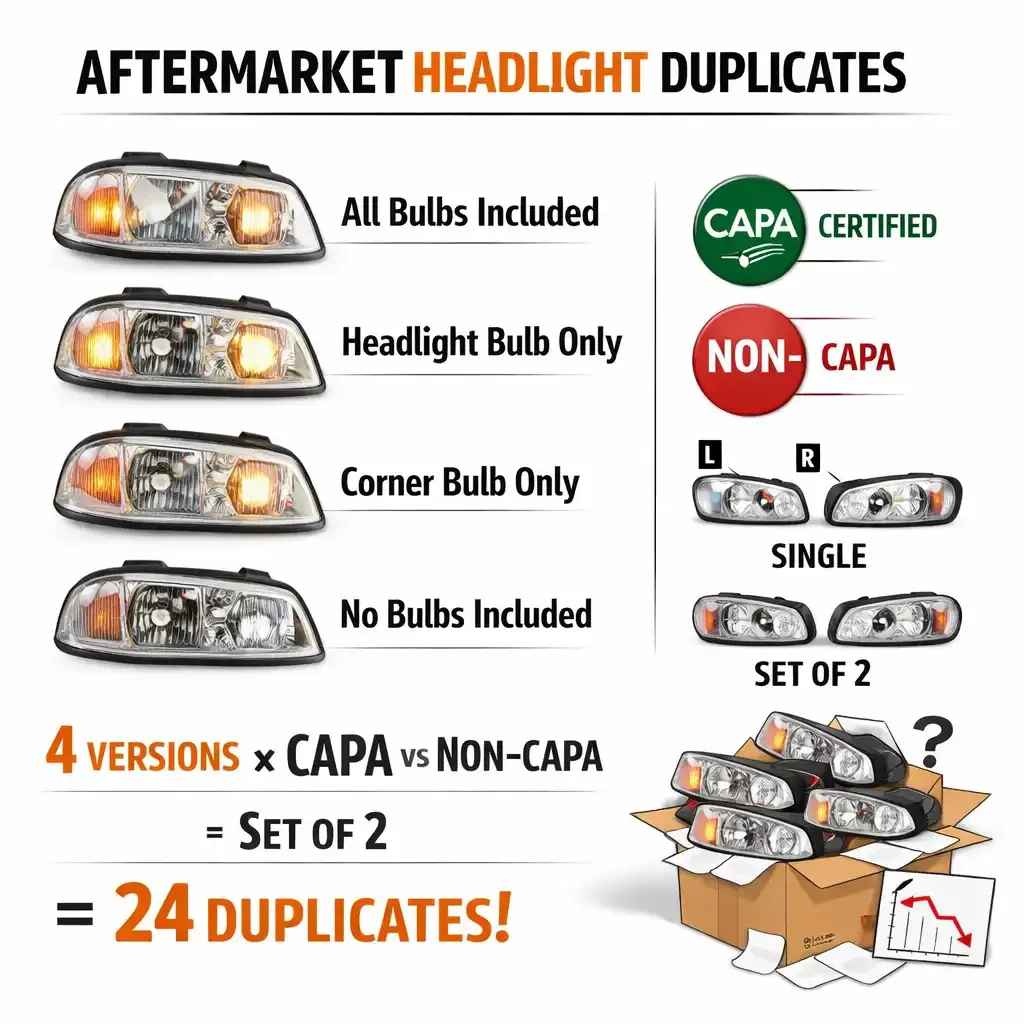
The core duplicate: one headlight assembly, four “versions” that are not real products
I’m talking about one unit headlight assembly where the corner/parking/turn socket is part of the same housing.
Same housing. Same fitment. Same connector. Same optics.
But the market submits it like it’s four different products:
Headlight bulb included + corner bulb included
Headlight bulb included only (corner bulb not included)
Corner bulb included only (headlight bulb not included)
No bulbs included (assembly only)
That is not four products.
That is one product with four “box contents” configurations.
If you let this become four SKUs, you’re not adding coverage. You’re creating duplicates that:
split sales history
confuse customers (photos look identical)
spike “missing bulb” returns
cause internal price wars between your own SKUs
Rule: bulb inclusion is an attribute, not a new SKU.
Where it gets dangerous: multiplying the same “variation” across CAPA vs Non-CAPA and Single vs Set
Now take that same headlight and multiply it by the two most common catalog splitters:
Splitter #1: CAPA vs Non-CAPA
Now your one headlight becomes:
CAPA
Non-CAPA
Splitter #2: One side vs Set of 2
Now it becomes:
Left
Right
Set of 2 (Left + Right)
So that “one headlight” is already turning into multiple sellable forms.
Now apply the four bulb-inclusion “versions” to each of those.
Let’s do the math in plain terms:
Bulb configurations: 4
Certification states: 2 (CAPA / Non-CAPA)
Pack sizes: 3 (Left / Right / Pair)
That’s 4 × 2 × 3 = 24 SKUs… for what most customers still think is “a headlight.”
And that’s before you stack the other common splits:
black vs chrome housing
halogen vs HID vs LED
projector vs reflector
with DRL vs without
with leveling motor vs without
This is how a normal headlight category becomes a warehouse full of “choice” that doesn’t convert.
The warehouse effect: why you stop selling more even though SKU count is growing
This is the part that makes people scratch their heads.
You look at your system and think:
“We added a bunch of new headlight SKUs.”
“Our selection is bigger.”
“So why aren’t we selling more headlights?”
Because you didn’t add meaningful selection. You added fragmentation.
What fragmentation does:
Demand gets split across near-identical SKUs
None of them builds strong sales velocity
Your inventory gets spread thin across duplicates
You run out of the “real winner” while sitting on slow movers
Your marketplace listings compete with each other and steal impressions
So you end up with:
higher carrying cost
worse in-stock rate on the best version
lower total sales per vehicle application
more returns and more customer confusion
SKU count goes up. Conversion goes down. Velocity breaks.
The clean way to model this: separate “core identity” from “packaging”
Step 1: Define the core headlight SKU
A core headlight SKU is defined by things that actually change the product:
CAPA vs Non-CAPA (if you truly stock both)
left vs right
technology (halogen / HID / LED)
projector vs reflector
housing finish (black/chrome)
key features (DRL, leveling motor, etc.)
connector differences
If any of those change, it may be a real SKU.
Step 2: Treat bulb inclusion as Included Components attributes
Bulb inclusion should be stored like this:
Headlight bulb included: Yes/No
Corner bulb included: Yes/No
This data must flow into:
PDP bullets
marketplace bullets
item specifics (where possible)
Do not let “bulbs included” create new SKUs unless you have a hard operational reason.
Step 3: Handle Set of 2 as a bundle/kit, not a competing duplicate
Your “set of 2” should be a bundle SKU linked to:
Left core SKU
Right core SKU
This keeps sales history clean and prevents your pair SKU from becoming a random third competitor with mismatched content.
The duplicate gate: the rule I use before allowing a new headlight SKU
Before you create a new SKU, answer these in order:
Is the housing identity different?
Connector, optics, tech, features, finish, CAPA status, true design changes.
If yes → real SKU candidate
If no → continue
Is the only difference what’s included in the box (bulbs/harness)?
If yes → same SKU, store it as attributes
If no → continue
Is this a set/pair?
If yes → create it as a bundle linked to the single units
If no → continue
This gate alone prevents the “24 SKUs for one headlight” explosion.
Marketplace reality: why sellers keep doing this (and why you can’t copy them)
Sellers create bulb-based “versions” because:
“Includes bulbs” sounds like a value add
it helps win buy box or improve conversion
it makes the listing look more complete
But if you copy that into your internal SKU structure, you pay for it forever:
in warehouse space
in replenishment complexity
in demand splitting
in returns
in content maintenance
Your catalog should model product identity, not marketing tactics.
Closing: more SKUs is not more selection
If your headlight SKU count is growing but sales are flat, you probably have a duplication problem, not a demand problem.
One headlight assembly should not turn into:
4 bulb “versions”
multiplied by CAPA / Non-CAPA
multiplied by single side / set of two
That is how you end up with shelves full of “inventory” and no velocity.
The fix is simple:
lock core identity
treat bulb inclusion as attributes
treat sets as bundles
stop creating SKUs for packaging differences
That’s how you grow headlight sales without growing warehouse clutter.