
Cross-Selling Auto Parts
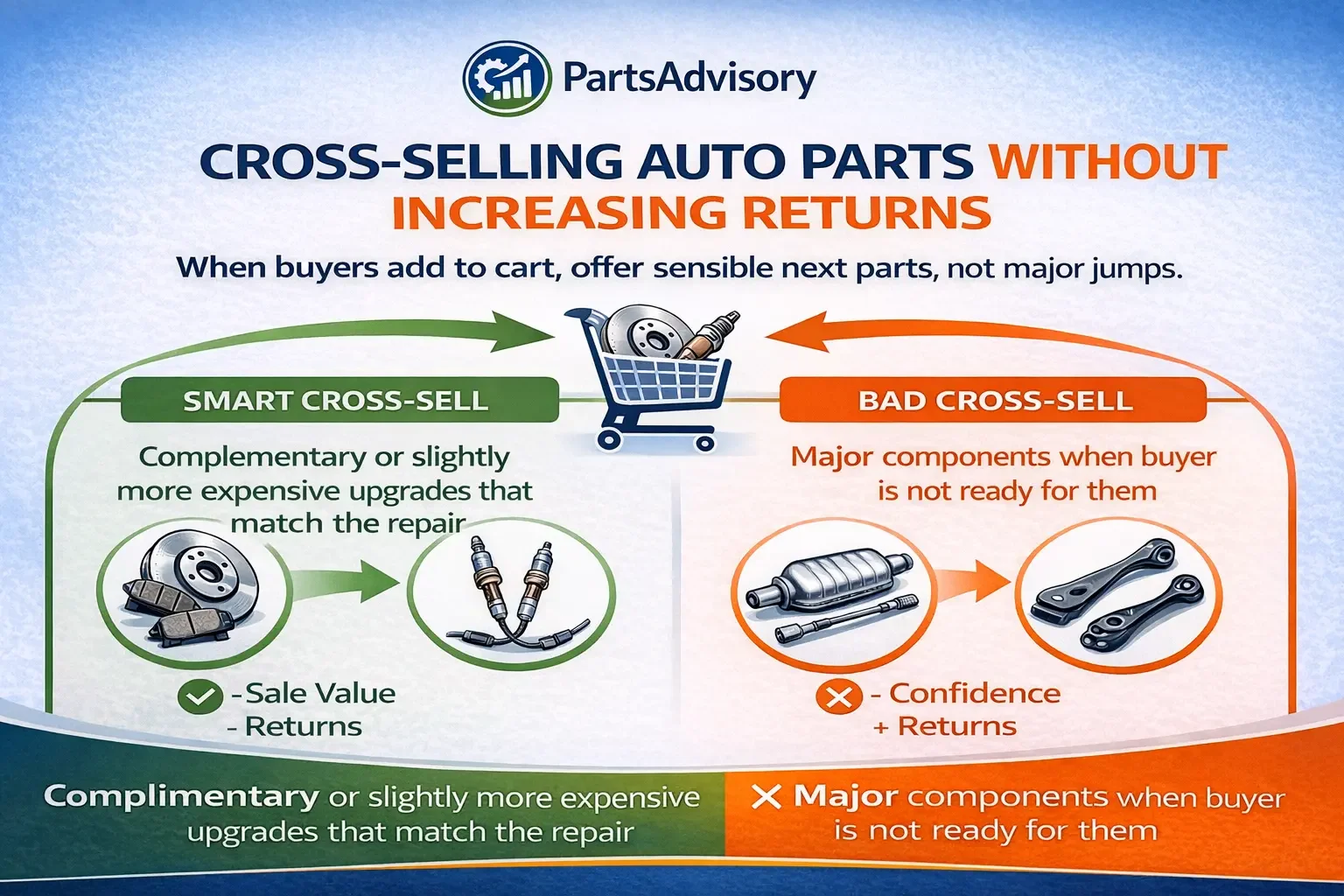
Bundles, Kits, and Smarter Cart Decisions That Actually Work
Cross-selling in auto parts is not about selling more items.
It is about selling the right next item at the right moment.
Most cross-sell programs fail because they are copied from general ecommerce playbooks. In auto parts, the wrong recommendation does not just reduce conversion. It creates returns, cancellations, negative feedback, and long-term trust issues.
I have seen cross-sell work extremely well when it follows repair logic, fitment discipline, and buyer intent. I have also seen it quietly destroy margin when it ignores those rules.
This article explains how to cross-sell auto parts across marketplaces and ecommerce sites without increasing returns, based on real-world operator experience.
Why cross-selling fails in auto parts
In apparel, a bad cross-sell is harmless.
In auto parts, it is expensive.
Common failure patterns look like this:
recommending parts that do not match the repair being done
pushing expensive upgrades too early in the decision
offering add-ons that introduce fitment ambiguity
treating cross-sell like a marketing tactic instead of a catalog and operations problem
When this happens, buyers guess. Guessing leads to wrong orders. Wrong orders lead to returns. Returns hurt visibility, metrics, and profitability.
The goal of cross-sell in auto parts is not higher cart value at any cost.
The goal is higher cart value with equal or lower return rates.
The two types of cross-sell that actually work
1) Same-job cross-sell
These are parts that are replaced together during the same repair. This is the safest and highest-performing cross-sell category.
Examples:
brake pads with rotors
struts with mounts
control arms with sway bar links
ignition coils with spark plugs
radiator with hoses and coolant
wheel hubs with axle nuts or hardware kits
Same-job cross-sells work because they reduce repeat labor and incomplete repairs. They also reduce the chance of a second order later.
2) Preventive add-on cross-sell
These are parts that reduce future failure or improve longevity. They work best when fitment is simple and the value is obvious.
Examples:
serpentine belt with tensioner
thermostat with coolant
cabin air filter with disinfectant spray
wiper blades with washer fluid
Preventive add-ons should never create a second decision tree. If the buyer has to think too hard, conversion drops and returns increase.
Direction matters more than relationship
One of the most important lessons we learned is that cross-sell is directional.
Just because two parts are related does not mean you should recommend them both ways.
Example: catalytic converters and oxygen sensors
When a customer is shopping for a catalytic converter, they are already committed to a major repair. In that moment, offering oxygen sensors makes sense. It is a common do-it-once job and the incremental cost feels reasonable compared to the total repair.
But the reverse does not work.
If a customer is shopping for a single oxygen sensor, they are usually troubleshooting a check engine light. They are not ready to jump to a catalytic converter. Offering one at that moment often reduces confidence and hurts conversion.
The correct cross-sell when someone buys an oxygen sensor is:
the correct upstream or downstream sensor
related hardware if applicable
simple install items when relevant
Big repairs can suggest smaller related items.
Small diagnostic purchases should not escalate into major replacements.
Example: ball joints and control arms
Ball joints are another common trap.
If a customer is buying a ball joint, they are usually replacing one side. The best cross-sell is the matching left or right ball joint, or the opposite side if they are doing both.
Control arms can be a great offer when the customer is already shopping for control arms, especially if the upgraded version includes ball joints or bushings.
But offering a full control arm to someone buying a single ball joint often feels unnecessary and lowers conversion.
When we aligned cross-sell direction with repair logic, attach rate increased and returns stayed flat. When we ignored direction, performance suffered.
The fitment gate rule that prevents most returns
Here is the rule we lived by:
If a shopper can choose the wrong version without noticing, the cross-sell must be gated or explained clearly.
This applies to parts with:
left and right sides
front and rear positions
engine or drivetrain variations
trim or towing package differences
different connector types
Cross-sell should remove uncertainty, not add another way to make a mistake.
Bundles are not a merchandising idea
You can create a bundle listing quickly.
You cannot scale bundles without operational support.
True bundles require:
component-level inventory logic
pick and pack workflows that treat the set as one unit
clear rules for partial returns and damage claims
policies for orphan components
Without this, bundles eventually break under volume.
The safer path for most teams is to start with virtual kits and graduate to physical bundles only when systems and processes are ready.
The cart moment is where ecommerce sites win
Marketplaces have limits. Your own ecommerce site has an advantage.
When a customer adds an item to cart, intent is high. This is the moment to provide clarity, not pressure.
There are three cart offers that work extremely well when done correctly.
Offer a cheaper option that still fits
Sometimes the buyer is price constrained. Offering a validated lower-cost option can reduce abandonment.
Examples:
standard brake pads versus premium pads
non-heated mirror versus heated mirror
basic wiper blades versus premium beam blades
The key is transparency. The buyer should understand exactly what changes and what stays the same.
Offer a slightly higher-cost option that changes the value equation
This is the most profitable and least risky cross-sell when done right.
Examples:
control arm upgrade that includes two ball joints for a small price difference
brake kit that includes hardware clips
strut assembly that includes mount and spring
wheel hub that includes the ABS sensor
headlight sold as a matched pair
These upgrades work because the math is simple. A small increase buys less labor, fewer surprises, and lower risk.
Offer a complete repair kit
Incomplete repairs drive returns and second orders.
Examples:
brake pads, rotors, and hardware
spark plugs, coils, and grease
suspension components with hardware kits
radiator with hoses and coolant
Always show what is included clearly, ideally with a single image.
The cross-sell ladder you should follow
Not every cross-sell needs a physical bundle SKU.
Level 1: frequently bought together
Level 2: virtual kits
Level 3: true bundle SKUs
Most teams should spend much more time at levels one and two than they think.
The two metrics that must be tracked together
Never track attach rate alone.
Track:
attach rate or AOV lift
return rate and defect rate on the combined order
If attach rate goes up and returns increase, the cross-sell did not create value.
A practical way to start this week
If you want a fast, low-risk win:
pick 20 high-volume SKUs with stable supply
map the top two same-job add-ons for each
add one clear fitment notes bullet
add one what’s-included image for kits
add one upgrade offer with obvious value
measure attach rate and returns together
This is how you build cross-sell that scales.
Want help building a cross-sell engine that does not create returns
If you send me your top categories and top SKUs, I can map:
the best same-job and directional cross-sells
which offers should be virtual kits versus true bundles
the fitment gates needed to protect conversion
and the cart structure that raises AOV without increasing returns
Contact PartsAdvisory and I will share next steps.