
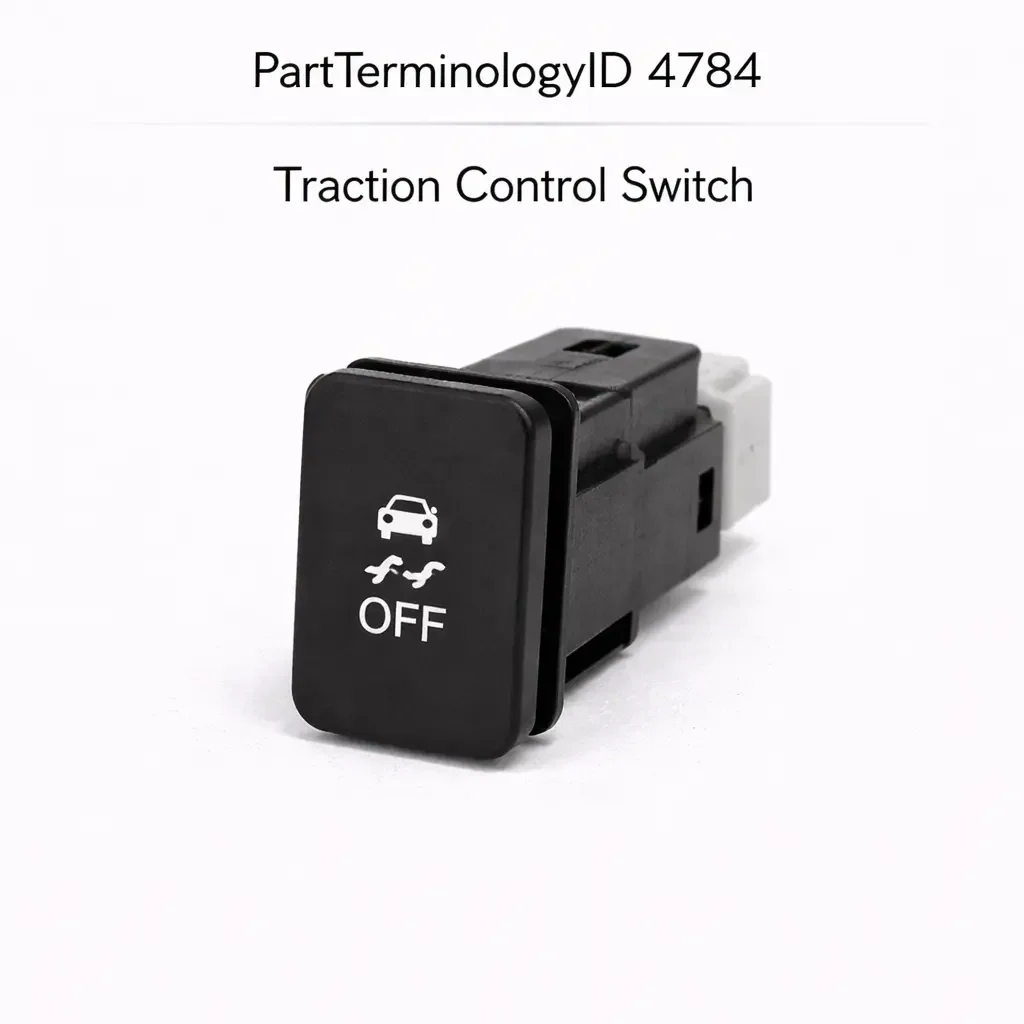
Traction Control Switch (PartTerminologyID 4784): Signal Output Type, System Integration Architecture, and ABS Module Compatibility
Written by Arthur Simitian | PartsAdvisory
Introduction
The traction control switch is the driver-operated control that allows temporary defeat or modification of the vehicle's traction control system. Pressing the switch signals the traction control module, the ABS module, or the body control module that the driver is intentionally requesting reduced or disabled traction intervention, allowing greater wheel slip than the system would normally permit. This function is useful in conditions where controlled wheel slip improves vehicle progress, such as rocking a vehicle stuck in snow, driving on a dynamometer, or navigating loose surfaces where traction control intervention would reduce momentum rather than improve safety.
The traction control switch is one of the more frequently misunderstood components in the switch category from a catalog compatibility standpoint because it appears to be a simple push button but integrates with multiple vehicle safety systems simultaneously. A switch that is not compatible with the specific traction control and ABS architecture of the vehicle will either fail to communicate the driver's request, generate fault codes in the safety module, or produce partial system behavior where traction control is suppressed but related systems such as electronic stability control are not modified as intended.
This guide covers what the traction control switch does across different system architectures, how it integrates with the ABS module, electronic stability control, and the instrument cluster warning system, how it fails, and what catalog attributes must be confirmed to prevent returns.
What the Traction Control Switch Does
Traction Control Defeat Request
The primary function of the traction control switch is to send a defeat or modification request to the traction control system. The traction control system monitors wheel speed sensors and uses engine torque reduction or individual brake application to prevent driven wheel slip beyond a calibrated threshold. When the driver presses the traction control switch, the system either partially reduces the intervention threshold, allows more slip before intervening, or disables the system entirely depending on the platform's software calibration and any regulatory requirements for the market.
The switch sends this request as an electrical signal to the module that manages traction control, which on most modern vehicles is the ABS and stability control module. The module processes the request and changes its intervention behavior accordingly. The traction control off indicator in the instrument cluster illuminates to confirm the system has responded to the switch input.
Electronic Stability Control Integration
On vehicles where traction control is integrated with electronic stability control, a single switch press typically defeats only the traction control function while leaving ESC active. A long press or a second press may defeat both traction control and ESC simultaneously on some platforms. The switch signal format and the module's response to the switch input depend entirely on the software calibration of the stability control module, which varies across platforms and even across trim levels on the same platform.
A replacement switch that produces the correct signal for a traction-control-only defeat on a platform that also requires a separate signal sequence for full ESC defeat will only partially restore the function. The driver may find that a single press defeats traction control but a double press or long press to defeat ESC does not work, because the switch's signal output for those input sequences does not match what the module expects.
Hill Descent Control Interaction
On SUVs and trucks with hill descent control, the traction control switch may also interact with the hill descent control system. Disabling traction control may simultaneously disable or modify hill descent control behavior on some platforms. The switch must communicate correctly with both the traction control module and the hill descent control module or a combined module that manages both functions.
Warning Indicator Circuit
When traction control is defeated, the traction control off indicator illuminates in the instrument cluster. On direct-wired systems the switch output lights the indicator directly. On BCM or module-controlled systems the module drives the indicator based on the switch input signal and the system's response. A replacement switch that produces the correct defeat request signal but does not produce the correct signal to drive the indicator will defeat traction control silently without illuminating the indicator, leaving the driver without confirmation that the system has responded.
Design Variations
Momentary Push Button Design
The most common traction control switch design is a momentary illuminated push button on the instrument panel or center console. A single press sends a brief signal to the traction control module, which toggles the system state. A subsequent press sends another signal that toggles the system back on. The switch itself has no memory of the current state; the module manages the state and drives the indicator to reflect it.
The momentary design requires the switch contact to close cleanly and produce the correct signal level on each press. A switch with worn contacts that produces a partial or double signal on a single press may cause the module to toggle the state twice on one press, appearing to have no effect. This failure mode is distinctive and points to the switch contact set rather than the module.
Resistor-Coded Designs
On platforms where multiple switch functions share a single input wire to the control module, the traction control switch uses a resistor-coded design. Each switch function produces a distinct resistance value on the shared input wire, and the module identifies the function from the resistance level. The resistor values within the traction control switch must exactly match the module's calibration. A switch with different resistor values will produce a resistance level the module maps to a different function or does not recognize, generating no response or an incorrect response.
Integrated Switch Panel Designs
On some vehicles the traction control switch is part of an integrated switch panel that also includes other driver-selectable functions such as hill descent control, off-road mode, or terrain management system selection. The switch panel communicates with the relevant modules through a shared bus or through a module integrated within the panel itself. Replacing only the traction control function within an integrated panel may require replacing the complete panel assembly rather than a discrete switch component.
Common Failure Modes
Contact Wear
The traction control switch contact set wears from repeated actuation. As contact resistance increases, the module receives a weaker signal that falls below its valid command threshold on some presses. The symptom is a switch that works correctly most of the time but occasionally requires a second press to produce a response, before eventually failing to produce any response regardless of press force.
Illumination Failure
The indicator lamp within the switch body can fail independently of the contact mechanism. On platforms where the switch includes its own indicator that reflects the current traction control state, a failed lamp leaves the switch face dark regardless of whether traction control is active or defeated. On BCM-monitored lamp circuits a failed switch lamp may generate a DTC in addition to the cosmetic complaint.
Connector Corrosion on Elevated Panel Locations
The traction control switch is often located in areas of the interior that are subject to drink spills from the center console cup holders. Liquid that reaches the switch connector can corrode the terminals and produce intermittent or absent switch communication. The connector should be inspected before the switch is condemned on an intermittent complaint.
Signal Format Mismatch After Replacement
This is the failure mode unique to module-controlled systems with resistor-coded inputs. A replacement switch that appears identical to the original but has been updated with different resistor values to match a revised module calibration will produce a signal the original module does not recognize. Conversely, a switch with the original resistor values installed on a vehicle whose module has been updated will produce the same problem. This is a calibration mismatch rather than a component failure, and it produces a symptom identical to a failed switch even when both the switch and the module are physically functional.
Symptoms of a Failing Traction Control Switch
Traction Control Cannot Be Defeated
If pressing the traction control switch produces no response, the traction control off indicator does not illuminate, and the system continues to intervene normally, the switch contact has failed open or the signal circuit has an open fault. Confirm supply voltage and ground at the switch connector before testing the switch contact.
Traction Control Indicator Illuminates Continuously
If the traction control off indicator illuminates from startup and remains on regardless of switch state, the switch contact has failed in the closed position or the signal circuit has a short. The module is receiving a continuous defeat request signal. Disconnect the switch connector and confirm whether the indicator extinguishes. If it does, the switch has failed closed. If it remains on, the module has a fault or the wiring has a short.
Traction Control Defeats but ESC Does Not on Long Press
If a single press correctly defeats traction control but a long press or double press intended to defeat ESC as well produces no additional response, the switch may not be generating the correct signal sequence for the ESC defeat input. This can be a switch fault or a signal format incompatibility between the switch and the module's expectations for the extended input sequence.
Module Fault Codes for Traction Control Switch Input
Retrieve DTCs from the ABS or stability control module. Codes referencing the traction control switch input circuit confirm the switch or its wiring as the fault source. Codes indicating an open circuit, short to ground, or signal out of range each direct the diagnosis to the specific fault type.
Diagnostic Process
Step One: Retrieve Module DTCs
Scan the ABS module, stability control module, and BCM for DTCs. Traction control switch input codes confirm the switch circuit as a fault area before any physical testing begins.
Step Two: Observe Module Live Data
Use a scan tool capable of accessing ABS or stability control module live data to observe the traction control switch input parameter while pressing the switch. The parameter should change state when the switch is pressed. No change confirms the module is not receiving the switch signal. A parameter that shows the switch in the pressed state continuously confirms a stuck-closed fault.
Step Three: Test Switch Contact Directly
With the switch connector disconnected, test continuity between the switch terminals while pressing the switch. The contact should close when pressed and open when released on a momentary design. For resistor-coded designs, measure resistance between the appropriate terminals in the pressed and released positions and compare to specification.
Step Four: Test Signal Circuit
With the switch connected to the harness but not pressing the switch, confirm the signal voltage at the switch output terminal is within the module's valid range for the released state. Press the switch and confirm the voltage changes to the valid pressed-state range. A signal that does not change when the switch is pressed confirms a switch or wiring fault. A signal that changes correctly but the module still does not respond points to a module input fault.
Step Five: Confirm No Resistor Mismatch on Coded Systems
On resistor-coded applications, measure the resistance value at each switch state with a calibrated multimeter and compare to the OE specification. A resistance that is correct confirms the switch calibration matches the module. A resistance that differs from the specification confirms a resistor mismatch that requires a correctly specified replacement.
Cataloging Attributes: What to Confirm Before Listing
Signal output type: State momentary contact, switched ground, switched voltage, or resistor-coded with resistance values. This is the most critical compatibility attribute. A resistor-coded switch with incorrect resistor values will not communicate with the module regardless of physical fit.
Resistor values for coded applications: For resistor-coded applications, state the resistance value in the pressed state and the released state. Include any intermediate resistance values if the switch has additional functions on shared signal wires.
System integration depth: State whether the switch communicates only with the traction control function or also with the ESC and hill descent control functions. A switch that covers only the traction control function on a platform where the switch must also communicate with ESC will leave the ESC defeat function non-operational.
Illumination type and circuit: State whether the switch includes a status indicator, whether the indicator reflects the current traction control state, and whether the lamp circuit is driven by the switch or by the module. A switch with a self-driven indicator installed on a module-driven indicator platform will show the indicator state based on the switch position rather than the module's actual system state.
Connector pin count and body type: State the pin count. Traction control switches range from two pins on simple contact designs to six or more pins on designs with separate signal, ground, lamp supply, and lamp return terminals.
Panel integration: State whether the switch is available as a standalone component or only as part of an integrated switch panel assembly.
Common Cataloging Mistakes
The most common mistake is listing traction control switches without stating the signal output type. On platforms that transitioned from a direct contact design to a resistor-coded module input design mid-production, both circuit types share the same vehicle application range. A direct contact switch installed in a resistor-coded application will produce a signal the module does not recognize as a valid traction control defeat request.
The second mistake is omitting resistor values for coded applications. Without resistor values, the buyer cannot confirm that the replacement switch's calibration matches the module. On platforms where the module was revised mid-production with a different resistor calibration, two switches listing the same vehicle application but with different resistor values will produce opposite outcomes: one communicates correctly and one does not.
The third mistake is not stating system integration depth. On platforms where the traction control switch defeats only the traction control function on a single press and requires a specific hold sequence for ESC defeat, a switch that only performs the single-press function will appear to work correctly for basic traction control defeat but will not support the full range of driver-selectable stability options. This partial functionality complaint is difficult to diagnose without knowing the original switch's integration depth.
Related Components and Systems
ABS and Stability Control Module
The ABS and stability control module is the primary recipient of the traction control switch signal on most modern vehicles. A failed module input circuit produces symptoms identical to a failed switch. Scan tool bidirectional control that can toggle traction control defeat from the scan tool interface confirms module function before the switch is replaced. If the module can defeat traction control through the scan tool but not through the switch, the fault is in the switch or its circuit.
Body Control Module
On vehicles where the BCM acts as an intermediary between the switch and the stability control module, a BCM input fault or a BCM-to-stability-module communication fault can produce symptoms that mimic a switch failure. If the switch tests correctly and the wiring is intact but the stability module does not respond, investigate the BCM's processing of the switch input before condemning the stability module.
Instrument Cluster Warning Indicators
The traction control off indicator confirms to the driver that the system has responded to the switch input. On module-driven indicator circuits, the indicator provides indirect confirmation that the module has processed the switch signal. If the indicator does not respond to switch input but live data confirms the module is receiving the signal, the indicator circuit within the module or the cluster has a fault independent of the switch.
Frequently Asked Questions
Does pressing the traction control switch affect the ABS system?
Defeating traction control does not typically disable ABS. The ABS hydraulic control function, which prevents wheel lock during braking, remains active regardless of the traction control defeat switch state. Traction control defeat only affects the system's ability to limit wheel spin during acceleration. This distinction is important for buyers who are concerned about reducing safety system function.
My traction control switch worked yesterday and does not work today. What changed?
An abrupt failure from one day to the next with no intermediate intermittent behavior is most commonly caused by a connector issue rather than a switch contact failure. A connector that was marginally seated or had a terminal at the edge of corrosion failure can transition from functioning to non-functioning without the gradual intermittent phase typical of contact wear. Inspect and reseat the connector before replacing the switch.
Will a traction control switch from a different trim level work on my vehicle?
Only if the signal output type and resistor values match the module calibration. On platforms where higher trim levels have a more comprehensive stability management system, the switch for the higher trim may send signals that the base trim module does not recognize. On platforms where the base and higher trim share the same stability module with different software calibrations, the switch resistor values must match the specific module calibration for the vehicle's trim level.
Installation Overview
Traction control switch replacement is typically a straightforward panel switch service, but the steps surrounding installation require attention on module-controlled platforms.
Access and Removal
The traction control switch on most vehicles is mounted in the instrument panel, center console, or steering wheel spoke. Instrument panel and console switches typically require prying the switch or the surrounding trim panel with a trim tool to release the retention clips, then disconnecting the wiring connector from behind. Steering wheel-mounted switches require partial disassembly of the steering wheel trim, which on airbag-equipped steering wheels requires restraint system deactivation before touching any component near the airbag module.
On integrated switch panel designs where the traction control switch is one element of a larger panel assembly, the entire panel must be removed. The replacement switch may be a discrete module that clips into the panel, or it may require the complete panel replacement depending on the platform.
Connector Inspection
Before installing the replacement switch, inspect the connector terminals for corrosion, bent pins, and correct retention. Clean corroded terminals with electrical contact cleaner and a terminal cleaning tool. A small amount of dielectric grease applied to the terminal faces after cleaning helps prevent future corrosion without interfering with the electrical connection.
On platforms with a resistor-coded input, confirm the connector pin assignment matches between the old and new switch before seating the connector. A mis-oriented connector on a resistor-coded switch will connect the ground pin to the signal pin, potentially shorting the module input to ground.
Post-Installation Verification
After installation, cycle the ignition and press the traction control switch. Observe the traction control off indicator in the instrument cluster. It should illuminate on the first press and extinguish on the second press, or vice versa depending on the initial system state at startup. On platforms where the traction control system resets to the active state each time the ignition is cycled, confirm the defeat function by pressing the switch once and confirming the indicator illuminates.
Retrieve any DTCs from the stability control module and BCM after the first few drive cycles to confirm no new codes have been set by the replacement switch. A correctly specified and installed switch will not generate any new codes.
Frequently Asked Questions
Does pressing the traction control switch affect the ABS system?
Defeating traction control does not typically disable ABS. The ABS hydraulic control function, which prevents wheel lock during braking, remains active regardless of the traction control defeat switch state. Traction control defeat only affects the system's ability to limit wheel spin during acceleration. This distinction is important for buyers who are concerned about reducing safety system function when defeating traction control for specific driving conditions.
My traction control switch worked yesterday and does not work today. What changed?
An abrupt failure from one day to the next with no intermediate intermittent behavior is most commonly caused by a connector issue rather than a switch contact failure. A connector that was marginally seated or had a terminal at the edge of corrosion failure can transition from functioning to non-functioning without the gradual intermittent phase typical of contact wear. Inspect and reseat the connector before replacing the switch, and test the switch contact directly before ordering a replacement.
Will a traction control switch from a different trim level work on my vehicle?
Only if the signal output type and resistor values match the module calibration for the specific vehicle. On platforms where higher trim levels have a more comprehensive stability management system, the switch for the higher trim may send signals that the base trim module does not recognize as valid commands. On platforms where the base and higher trim share the same stability module with different software calibrations, the switch resistor values must match the specific module calibration for the vehicle's trim. Trim level substitution is not recommended without confirming signal compatibility.
Can a faulty traction control switch cause the ABS or stability control warning light to illuminate?
Yes. On module-controlled systems, a switch that produces an out-of-range signal or a continuously asserted defeat request may cause the stability control module to log a DTC referencing the switch input circuit. Depending on the platform's fault response calibration, this DTC may illuminate the ABS warning lamp, the stability control warning lamp, or both. If either of these warning lamps is on and a traction control switch complaint is also present, retrieve module DTCs before replacing either the switch or the module.
Does the traction control system reset automatically after the ignition is turned off?
On most passenger vehicle platforms, yes. The traction control system returns to its default active state each time the ignition is cycled. The driver must press the switch again to defeat the system after each start. On some commercial and off-road platforms, the system may retain the defeated state across ignition cycles, which is useful for applications where the driver routinely operates without traction intervention. Confirming the reset behavior for the specific platform prevents unexpected behavior from a buyer who assumes the defeated state persists.
Status in New Databases
PIES/PCdb: PartTerminologyID 4784, Traction Control Switch
PIES 8.0 / PCdb 2.0: No change in PartTerminologyID or terminology label
Summary
The traction control switch is a driver-interface component that communicates a traction control defeat request to the vehicle's stability control system. Its return rate is driven by signal output type mismatch, missing resistor values on coded applications, and failure to specify system integration depth for platforms where the switch interacts with both traction control and electronic stability control. Every listing must state the signal output type, resistor values for coded applications, system integration scope, illumination circuit type, and connector pin count. A traction control switch listing that provides only vehicle fitment will generate returns from every buyer whose vehicle has a resistor-coded input or a multi-function system integration requirement that the listing did not address.