
Seat Belt Switch (PartTerminologyID 4680): Buckle Contact Configuration, Warning System Integration, and Restraint Module Compatibility
Written by Arthur Simitian | PartsAdvisory
Introduction
The seat belt switch is a safety-critical electrical component embedded in the seat belt buckle assembly. Its function is to detect whether the seat belt is fastened or unfastened and communicate that status to the vehicle's restraint control module, instrument cluster, and in many applications the occupant classification system and advanced airbag control logic. When the switch operates correctly, the seat belt warning indicator illuminates when an occupant is detected and the belt is unbuckled, and extinguishes when the belt is fastened. When it fails, the warning system may behave incorrectly, the restraint module may log a fault, and on vehicles where the seat belt status is used as an input to airbag deployment logic, the safety system may not function as designed.
The seat belt switch is one of the parts categories where incorrect replacement has the most serious potential consequences. It is not a component where a functionally incorrect but physically fitting part can be accepted as an adequate substitution. A switch that produces the wrong contact state, the wrong resistance value, or an incorrect signal format for the restraint module input will compromise the warning system at minimum and may affect airbag deployment timing and force calibration on systems where belt status is an airbag input.
This matters beyond the immediate vehicle owner or technician. Vehicle manufacturers spend significant engineering resources calibrating the interaction between belt status, occupant size, and airbag deployment parameters. The seat belt switch is the component that provides the belt status input to that calibrated system. When a replacement switch is specified and installed correctly, it restores the system to its designed operating state. When it is specified incorrectly, it introduces a variable the calibration did not account for.
The frequency with which seat belt switch replacements are driven by catalog attribute omissions rather than part quality issues makes this a particularly important PartTerminologyID to get right. A switch with the correct switch type, correct resistance values, and correct pretensioner and OCS compatibility produces no complaints. A switch with any one of those attributes incorrect produces a restraint module fault on installation, and on some platforms the fault requires dealer-level scan tools to clear after the correct part is installed. The cost of that service visit, attributable directly to the incorrect catalog listing, is a return scenario that proper attribute completeness eliminates entirely.
This guide covers the complete picture for PartTerminologyID 4680: how the switch works, how it integrates with the restraint system, how it fails, how to diagnose it accurately, and what catalog attributes must be confirmed before a replacement is ordered.
What the Seat Belt Switch Does
Buckle Status Detection
The seat belt switch is integrated into the buckle assembly at the point where the tongue of the belt engages the buckle latch mechanism. When the tongue is inserted and the latch engages, a mechanical actuator within the buckle depresses the switch plunger or moves a magnetic element, changing the switch state. When the tongue is released and the latch opens, the switch returns to its unbuckled state.
The switch must detect the buckle state reliably across the full temperature range the vehicle will experience, from extreme cold where buckle mechanisms can be stiff from lubricant thickening to extreme heat where housing materials are at the limit of their dimensional stability. It must also maintain accurate detection through the vibration environment of normal road use, which can cause intermittent contact if the switch mechanism has wear or loose components.
Seat Belt Warning System Input
The primary output of the seat belt switch is a signal to the instrument cluster warning system. On older vehicles this signal travels directly to the warning indicator lamp circuit. When the belt is unbuckled, the switch closes or opens a circuit that illuminates the seat belt reminder lamp. When the belt is fastened, the switch changes state and the lamp extinguishes.
On modern vehicles the signal is processed by the body control module or the restraint control module, which evaluates the seat belt status in context with other inputs including vehicle speed and occupant presence before activating the warning chime and indicator. A seat belt that is unbuckled at vehicle speeds above a calibrated threshold typically triggers both the visual indicator and an audible chime. The restraint module uses the switch signal as the primary input for both.
Airbag System Integration
On vehicles with advanced airbag systems, the seat belt status is one of several inputs used by the airbag control module to calibrate the airbag deployment response. When the occupant is detected as belted, the airbag module may reduce deployment force on the assumption that the seat belt is providing initial restraint and the occupant will not travel as far toward the airbag before deceleration begins. When the occupant is detected as unbelted, the module may increase deployment force to compensate for the additional travel distance the unbelted occupant will cover before reaching the airbag.
This integration means that a seat belt switch producing an incorrect buckled signal when the belt is actually unfastened is not merely a warning system annoyance. It is a safety system input error that can cause the airbag module to deploy with reduced force for an unbelted occupant, reducing the airbag's protective effect at the moment it is most needed.
The integration also runs in the other direction. On vehicles where the airbag warning lamp is driven by the restraint control module rather than a dedicated belt warning circuit, a seat belt switch fault that generates a restraint module DTC will illuminate the airbag warning lamp. Drivers who see an airbag warning lamp and bring the vehicle in for service will have a restraint module scan performed, which will reveal the seat belt switch DTC. The subsequent diagnosis and repair are straightforward if the technician knows to look for a seat belt switch fault as the cause of an airbag lamp complaint. Without that knowledge, time may be spent investigating the airbag system itself before the seat belt switch is identified.
Understanding this interaction prevents misdiagnosis and helps technicians work efficiently from the DTC to the correct component on the first attempt.
Occupant Classification System Interface
On vehicles with an occupant classification system in the front passenger seat, the seat belt switch for the front passenger position is integrated with the OCS to provide a combined occupant detection and belt status input to the airbag module. The OCS detects whether an adult, child, or no occupant is present, and the seat belt switch indicates whether that occupant is belted. The airbag module uses both inputs together to determine whether and how to deploy the front passenger airbag.
A failed seat belt switch in the front passenger position on an OCS-equipped vehicle can affect airbag deployment decisions for the front passenger in a collision, making correct replacement with the exact specified component mandatory rather than optional.
Design and Construction
Buckle-Integrated Switch Design
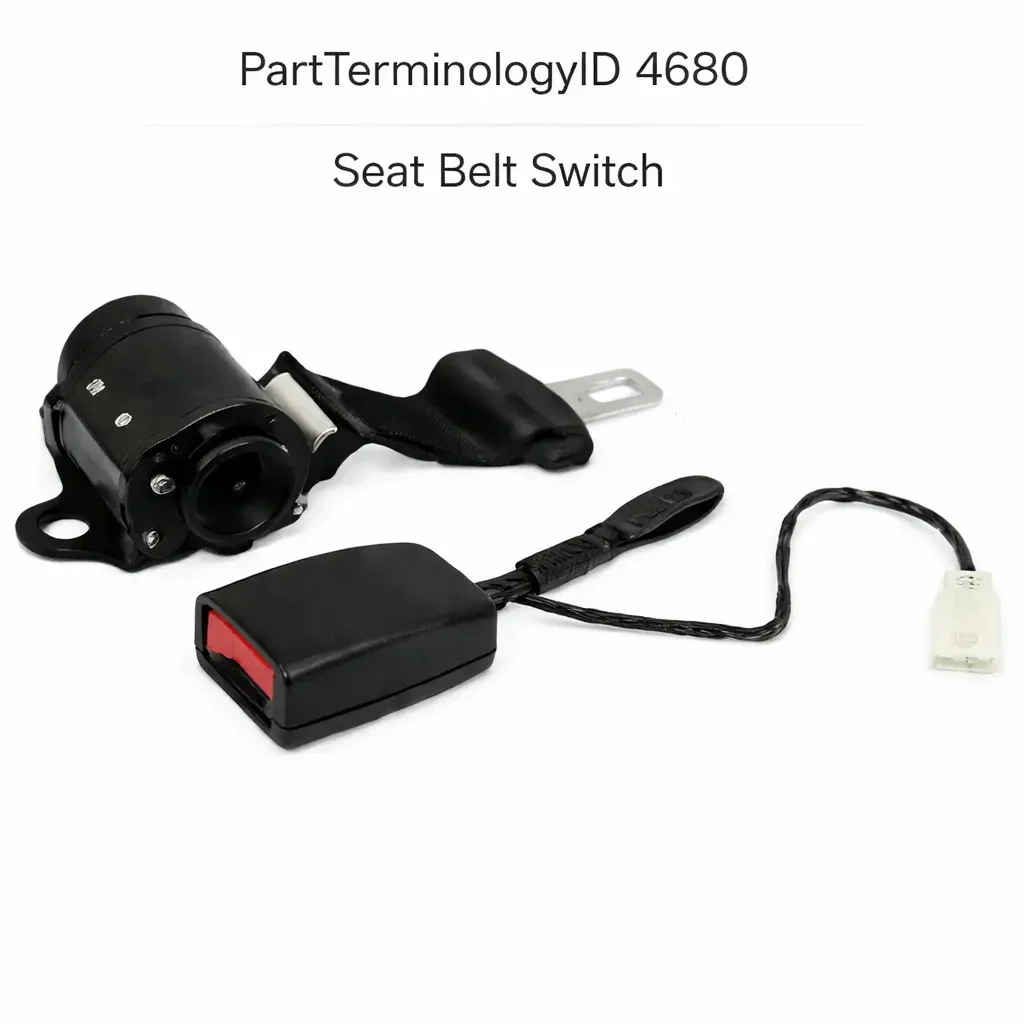
The seat belt switch is not a standalone component in the traditional sense. It is integrated into the buckle assembly and is typically not serviceable independently of the buckle on most modern applications. When the switch fails, the buckle assembly is replaced as a complete unit. This is an important distinction for parts catalog listings: the component being ordered is in most cases a complete buckle assembly that includes the switch, not a switch that is installed into an existing buckle.
On some older applications the switch is a discrete component that can be accessed and replaced within the buckle housing. These applications are increasingly rare on current vehicles. Confirm serviceability before ordering a standalone switch for a modern application.
Contact Mechanism Types
Seat belt switches use several contact mechanism designs. The most common is a simple plunger-actuated contact set where the buckle latch mechanism directly depresses the switch plunger when the tongue is inserted. This design is reliable under normal conditions but is vulnerable to contamination from debris that enters the buckle slot, which can hold the plunger partially depressed and produce an ambiguous signal.
Hall effect sensor designs replace the mechanical contact with a non-contact magnetic sensing element. A magnet on the latch mechanism moves into or out of the sensor's detection range when the tongue is inserted or released. Hall effect designs are more resistant to contamination and wear than contact designs but require a power supply to the sensor and produce an active signal output rather than a simple switched circuit. Hall effect belt switches must be replaced with Hall effect units; a contact switch replacement in a Hall effect application will not produce the correct signal format.
Resistor-coded designs include a resistor element within the switch circuit that produces a unique resistance value in the buckled and unbuckled states. The restraint module or BCM measures the resistance rather than simply detecting a switched circuit. Resistor values must match the module calibration. A switch with different resistor values will produce resistance levels the module maps to fault states rather than valid buckled or unbuckled states, generating a DTC even when the physical buckle mechanism is working correctly.
Pretensioner Integration
On vehicles with seat belt pretensioners, the buckle assembly includes both the switch and the pretensioner firing circuit connector. The pretensioner is a pyrotechnic device that tightens the seat belt against the occupant at the moment of a collision, reducing slack before the airbag deploys. The buckle assembly connector carries both the switch signal circuit and the pretensioner firing circuit. Replacing the buckle assembly requires handling the pretensioner connector with the same precautions applied to airbag connectors, including deactivating the restraint system by disconnecting the battery and observing the required wait time before disconnecting the connector.
A buckle assembly ordered for a pretensioner-equipped vehicle must include the pretensioner firing circuit connector and be compatible with the pretensioner firing module. A buckle assembly without the pretensioner connector installed in a pretensioner-equipped application leaves the pretensioner without a firing circuit, rendering it non-functional in a collision.
Common Failure Modes
Contact Contamination
Debris entering the buckle slot is the most common cause of seat belt switch failure. Crumbs, coins, dirt, and other small objects that fall into the buckle slot can lodge between the latch mechanism and the switch plunger, holding the plunger in an indeterminate position. The switch may produce an intermittent or ambiguous signal that the restraint module cannot reliably interpret as buckled or unbuckled. The warning lamp may flicker or remain on even when the belt appears to be fastened.
Cleaning the buckle slot with compressed air can sometimes restore correct operation without switch replacement. If debris contamination is the suspected cause, cleaning should be attempted before ordering a replacement assembly.
Contact Wear
On high-mileage vehicles where the seat belt is buckled and unbuckled thousands of times over the vehicle's lifetime, the switch contacts develop increased resistance from wear and oxidation. The switch may continue to change state but produce a signal that the restraint module interprets as a fault rather than a valid buckled or unbuckled state because the signal level falls outside the valid command window.
Wiring Harness Damage
The buckle assembly wiring pigtail is subject to repeated flexing and compression as the buckle is used and the front seat is adjusted. On high-mileage vehicles the wires in the pigtail can develop fatigue breaks that produce intermittent open circuits. A seat belt warning that flickers or behaves differently when the seat position is adjusted often indicates a pigtail wiring fault rather than a switch contact fault.
Corrosion from Liquid Exposure
Beverages spilled into the seat area can reach the buckle assembly and introduce corrosive liquids to the switch contacts and connector terminals. Sugary liquids are particularly damaging because they leave a residue that increases contact resistance and can cause contacts to stick. A buckle assembly that has been exposed to a significant liquid spill typically requires replacement rather than cleaning.
Connector Terminal Damage
The buckle assembly connector is disconnected and reconnected during seat removal, which is required for seat replacement, upholstery work, and some floorpan repairs. Each connector disconnection and reconnection cycle risks terminal damage if the connector is not released correctly. Damaged connector terminals can produce intermittent connections that generate DTCs even when the buckle mechanism and switch contacts are in good condition.
Symptoms of a Failing Seat Belt Switch
Seat Belt Warning Lamp Does Not Extinguish When Belt Is Fastened
This is the most common and most immediately noticed symptom. The warning lamp remains illuminated and the warning chime may continue to sound even after the belt is fastened. Before concluding the switch has failed, verify the belt tongue is fully engaging the buckle latch. A partial engagement from a worn latch that does not fully seat the tongue can hold the switch in an intermediate position.
Seat Belt Warning Lamp Does Not Illuminate When Belt Is Unfastened
A switch that has failed in the buckled state will suppress the warning lamp even when the belt is not fastened. This is the more dangerous failure mode because it removes the warning that prompts the driver or passenger to fasten the belt. This failure is less likely to be noticed because the driver typically focuses on buckling the belt rather than observing whether the warning lamp extinguishes.
Warning Lamp Flickers or Behaves Intermittently
Intermittent warning lamp behavior that correlates with road vibration, seat position adjustment, or temperature changes points to a wiring fault in the buckle assembly pigtail or a connector terminal issue rather than a failed switch contact. Flex the pigtail wiring manually while observing the warning lamp to identify wire fatigue.
Restraint Module Fault Codes
The restraint module monitors the seat belt switch input for circuit continuity and signal plausibility. An open circuit, a short to ground, a short to voltage, or a signal outside the valid range for the application will generate a DTC. Restraint module DTCs referencing the seat belt switch input circuit are the most definitive diagnostic indicator before any physical testing begins.
Airbag Warning Lamp Illumination
On vehicles where the seat belt switch is an input to the airbag control module, a failed switch that produces an out-of-range signal may illuminate the airbag warning lamp in addition to or instead of the seat belt warning lamp. This can cause the driver to focus on the airbag system when the root cause is the seat belt switch. Any airbag warning lamp complaint should include a scan of the restraint module for seat belt switch input DTCs as part of the initial diagnosis.
Diagnostic Process
Step One: Retrieve All Restraint Module DTCs
Before any physical inspection, retrieve DTCs from the restraint control module and the BCM. Document all codes. Seat belt switch input codes confirm the switch circuit as the fault area and indicate the specific fault type, whether open circuit, short, or signal out of range.
Step Two: Inspect the Buckle and Connector
Visually inspect the buckle slot for debris contamination. Attempt cleaning with compressed air. Inspect the buckle assembly connector for terminal damage, corrosion, and secure seating. Disconnect and reseat the connector to confirm it is fully engaged. Recheck the DTC after reseating the connector to confirm whether the fault persists.
Step Three: Test the Switch Circuit
With the buckle connector disconnected, measure the resistance between the switch signal terminals in the buckled and unbuckled positions. For resistor-coded applications, compare the measured resistance in each state to the OE specification. For contact switch applications, confirm continuity changes correctly between the buckled and unbuckled states. Any reading that does not match the specification confirms a switch fault.
Step Four: Inspect the Pigtail Wiring
Flex the buckle assembly pigtail through its full range of motion while monitoring circuit continuity with a multimeter. A circuit that opens during flexing confirms wire fatigue in the pigtail. Pigtail wiring repairs on seat belt assemblies are not recommended on pretensioner-equipped vehicles due to the safety implications of any modification to the restraint system wiring. Replace the buckle assembly rather than attempting a pigtail repair on these applications.
Step Five: Clear DTCs and Verify
After replacement, clear all restraint module DTCs and verify the warning lamp behavior through several buckle and unbuckle cycles. Confirm the lamp illuminates when the belt is unfastened and extinguishes when it is fastened. On vehicles with an OCS, confirm the front passenger airbag status indicator reflects the correct occupant and belt status. Confirm no new DTCs are present after a short drive cycle.
Cataloging Attributes: What to Confirm Before Listing
Switch type: State whether the switch uses a mechanical contact design, a Hall effect sensor design, or a resistor-coded design. These three types are not interchangeable and the switch type must be confirmed from the OE specification before ordering.
Resistance values for coded applications: For resistor-coded switches, state the resistance value in the buckled state and the unbuckled state. These values must match the restraint module calibration. A switch with incorrect resistance values will generate a DTC even when physically installed and functioning correctly.
Pretensioner compatibility: State explicitly whether the buckle assembly includes a pretensioner firing circuit connector and whether it is compatible with the vehicle's pretensioner firing module. This is a mandatory attribute for all pretensioner-equipped applications.
OCS interface: State whether the buckle assembly includes the occupant classification system interface for front passenger applications. A buckle assembly without the OCS interface installed in an OCS-equipped front passenger position will disable the OCS function and generate a restraint module fault.
Buckle assembly versus standalone switch: State explicitly whether the listing covers a complete buckle assembly or a standalone switch component. Most modern applications require the complete buckle assembly. A listing that does not make this distinction will generate returns from buyers who receive a component they cannot install.
Connector pin count and harness pigtail length: State the connector pin count and the pigtail length. Buckle assemblies with a short pigtail may not reach the floor harness connector if the seat is in the full forward position on vehicles where the buckle mounts to the seat frame rather than the floor.
Webbing color and hardware finish: For direct-to-consumer listings, state the webbing color and buckle hardware finish. Seat belt buckle assemblies are visible components and buyers expect the replacement to match the vehicle interior. This is a secondary attribute that does not affect safety function but affects return rate on consumer-facing listings.
Common Cataloging Mistakes
The most common mistake is listing seat belt buckle assemblies without stating the switch type. On platforms where both a mechanical contact buckle and a resistor-coded buckle were used across different trim levels or production periods, both configurations share the same vehicle application data. A listing that does not state the switch type will route mechanical contact buckles to resistor-coded applications and vice versa, generating a restraint module fault on every installation.
The second most common mistake is not stating pretensioner compatibility. On platforms where both pretensioner-equipped and non-pretensioner buckles are available, a non-pretensioner buckle installed in a pretensioner-equipped position renders the pretensioner non-functional. This is a safety-critical omission that must be addressed by stating pretensioner compatibility as a mandatory attribute on every listing for affected platforms.
The third mistake is treating the seat belt switch as a standalone component when the application requires a complete buckle assembly. Listings that describe the component as a switch without clarifying that the switch is integrated into and only available as part of the complete buckle assembly will generate returns from buyers who expect a discrete switch component they can install into their existing buckle.
The fourth mistake is omitting the OCS interface designation for front passenger applications. On vehicles with an OCS, the front passenger buckle assembly includes additional wiring or connector elements for the OCS interface. A standard buckle assembly without the OCS interface will not satisfy the OCS circuit requirements and will generate a restraint module fault referencing the OCS input rather than the seat belt switch input, potentially misdirecting the follow-up diagnosis.
Installation Overview
Seat belt buckle assembly replacement involves disconnecting a safety-critical pyrotechnic circuit on pretensioner-equipped vehicles and must follow the restraint system service precautions defined in the vehicle service manual before any connector is touched.
Restraint System Deactivation
On all vehicles with seat belt pretensioners or airbags, the restraint system must be deactivated before any restraint system connector is disconnected. The standard procedure is to turn the ignition off, disconnect the negative battery cable, and wait the time specified in the service manual, typically one to ten minutes depending on the vehicle, for the restraint module backup capacitor to discharge. Failure to observe this wait time can result in inadvertent pretensioner deployment or airbag deployment during service.
Do not rely on simply turning the ignition off without disconnecting the battery. The restraint module backup capacitor retains enough energy to fire a pretensioner or airbag even after the ignition is off. The wait time after battery disconnection is mandatory, not optional.
Buckle Assembly Removal
With the restraint system deactivated, the buckle assembly can be disconnected from the floor or seat frame anchor bolt and unplugged from the harness connector. Most buckle assemblies are retained by a single anchor bolt that also serves as the structural attachment point for the belt load. This bolt must be torqued to the specification in the service manual on installation. Under-torqued anchor bolts can pull free under belt loading in a collision, which defeats the restraint function of the belt entirely.
The harness connector on the buckle assembly pigtail is a safety-related connector that uses a secondary lock to prevent accidental disconnection. The secondary lock must be released before the primary connector retention tab is pressed. Attempting to release the connector without first releasing the secondary lock risks bending or breaking the connector terminals.
Post-Installation Verification
After installation, reconnect the battery and perform a restraint system initialization by cycling the ignition through the startup sequence. The airbag and seat belt warning lamps should illuminate briefly during the self-test and then extinguish. If either lamp remains on, retrieve restraint module DTCs before driving the vehicle. Buckle and unbuckle the belt several times and confirm the warning lamp behavior is correct at each state. On vehicles with an OCS, confirm the front passenger airbag status indicator reflects the correct status for both the occupied and unoccupied conditions.
Torque verification of the anchor bolt is a required step that should not be skipped. The anchor bolt torque specification is typically in the range of 35 to 45 Newton-meters for most passenger car applications, but the exact specification must be confirmed from the vehicle service manual.
Related Components and Systems
Restraint Control Module
The restraint control module processes all seat belt switch inputs and manages airbag deployment decisions. A failed restraint module can produce symptoms identical to a failed seat belt switch, including incorrect warning lamp behavior and restraint system DTCs. If the buckle assembly and wiring test correctly but the restraint module continues to report a fault, the module input circuit should be tested before the module is replaced. Restraint module replacement requires programming and in some cases VIN coding and is significantly more complex and expensive than buckle assembly replacement.
Occupant Classification System
On vehicles with a front passenger OCS, the seat sensor mat in the seat cushion and the OCS control module work together with the seat belt switch to provide a complete occupant status picture to the airbag module. A failed OCS sensor or control module can produce symptoms that overlap with a seat belt switch fault. Confirm the OCS is functioning correctly before concluding the seat belt switch is the sole fault source on a front passenger airbag system complaint.
Seat Belt Pretensioner
The pretensioner is the pyrotechnic element within the buckle assembly or retractor that fires in a collision to tighten the belt against the occupant. It shares the buckle assembly connector with the seat belt switch on buckle-integrated pretensioner designs. A pretensioner that has fired in a previous collision renders the buckle assembly non-reusable regardless of switch condition. Any vehicle that has been in a collision significant enough to deploy the pretensioner requires a new buckle assembly before the restraint system is returned to service.
Seat Belt Retractor
The retractor is the mechanism that manages belt webbing extension and retraction. On vehicles with retractor-mounted pretensioners, the retractor assembly has its own pyrotechnic element and harness connector. A retractor fault can produce a seat belt warning if the retractor is equipped with a webbing position sensor, and this may be misidentified as a buckle switch fault. Confirm the fault source is the buckle switch circuit rather than the retractor circuit before ordering a replacement buckle assembly.
Frequently Asked Questions
Can I replace just the switch inside the buckle, or do I need the whole assembly?
On most vehicles from the mid-2000s onward, the seat belt switch is integrated into the buckle assembly and is not available or serviceable as a standalone component. The complete buckle assembly is the replacement unit. On older vehicles and some commercial applications, the switch may be accessible within the buckle housing and replaceable independently. Confirm the service procedure for the specific vehicle and model year before ordering.
Will a failed seat belt switch prevent the airbags from deploying?
Not necessarily, but it can affect how the airbags deploy. On vehicles with advanced airbag systems that use belt status as an input to deployment calibration, an incorrect belt status signal can cause the airbag module to select an incorrect deployment force level. It does not typically prevent airbag deployment entirely, but it can reduce the airbag's effectiveness for an unbelted occupant if the module has been given a false buckled signal.
My seat belt warning is on but the belt is fastened. Is it definitely the switch?
Not necessarily. Before replacing the buckle assembly, check for debris in the buckle slot, confirm the tongue is fully engaging the latch, inspect the connector and pigtail for damage, and retrieve restraint module DTCs to confirm the fault type. A debris obstruction is a common cause of this symptom that can be resolved without parts replacement.
Does the replacement buckle assembly need to be programmed?
On most applications no programming is required. The buckle assembly is a passive input device. The exception is vehicles where the OCS interface within the buckle assembly requires initialization or calibration through the OCS control module after replacement. Confirm whether OCS initialization is required for the specific application before completing the installation.
Is a used seat belt buckle assembly acceptable as a replacement?
Used buckle assemblies should only be installed if their complete service history is known and confirmed, including that the vehicle was never in a collision that deployed the pretensioner or airbags. A buckle assembly from a vehicle that was in a collision may have a fired pretensioner, damaged switch contacts from impact loading, or compromised wiring that is not visible externally. For a safety-critical component like the seat belt buckle assembly, a new OE or quality aftermarket replacement is the appropriate choice.
Status in New Databases
PIES/PCdb: PartTerminologyID 4680, Seat Belt Switch
PIES 8.0 / PCdb 2.0: No change in PartTerminologyID or terminology label
Summary
The seat belt switch is a safety-critical input to the vehicle's restraint system, warning system, and in many applications the airbag deployment calibration logic. It is integrated into the buckle assembly on most modern vehicles and is available and serviceable only as part of the complete buckle assembly rather than as a standalone switch component. Failure modes include contact contamination from buckle slot debris, contact wear, pigtail wiring fatigue, and connector terminal damage, all of which produce characteristic symptoms that can be distinguished through systematic diagnosis before replacement is ordered.
Catalog listings for PartTerminologyID 4680 must state the switch type, resistance values for coded applications, pretensioner compatibility, OCS interface requirements, and whether the listing covers a complete buckle assembly or a standalone switch. These attributes are mandatory, not optional, because an incorrect replacement in this category affects safety system function rather than merely causing a warning lamp complaint. A seat belt buckle assembly listing that relies on vehicle fitment alone without these attributes will generate returns and, more importantly, may route safety-incompatible components to applications where the consequences extend beyond inconvenience.
PartTerminologyID 4680, Seat Belt Switch, requires more diligence in catalog attribute completeness than most switch categories precisely because the component it covers is part of a system designed to protect occupant lives. Every attribute listed in this guide must be present and accurate for every listing in this category.