
Written by Arthur Simitian | PartsAdvisory
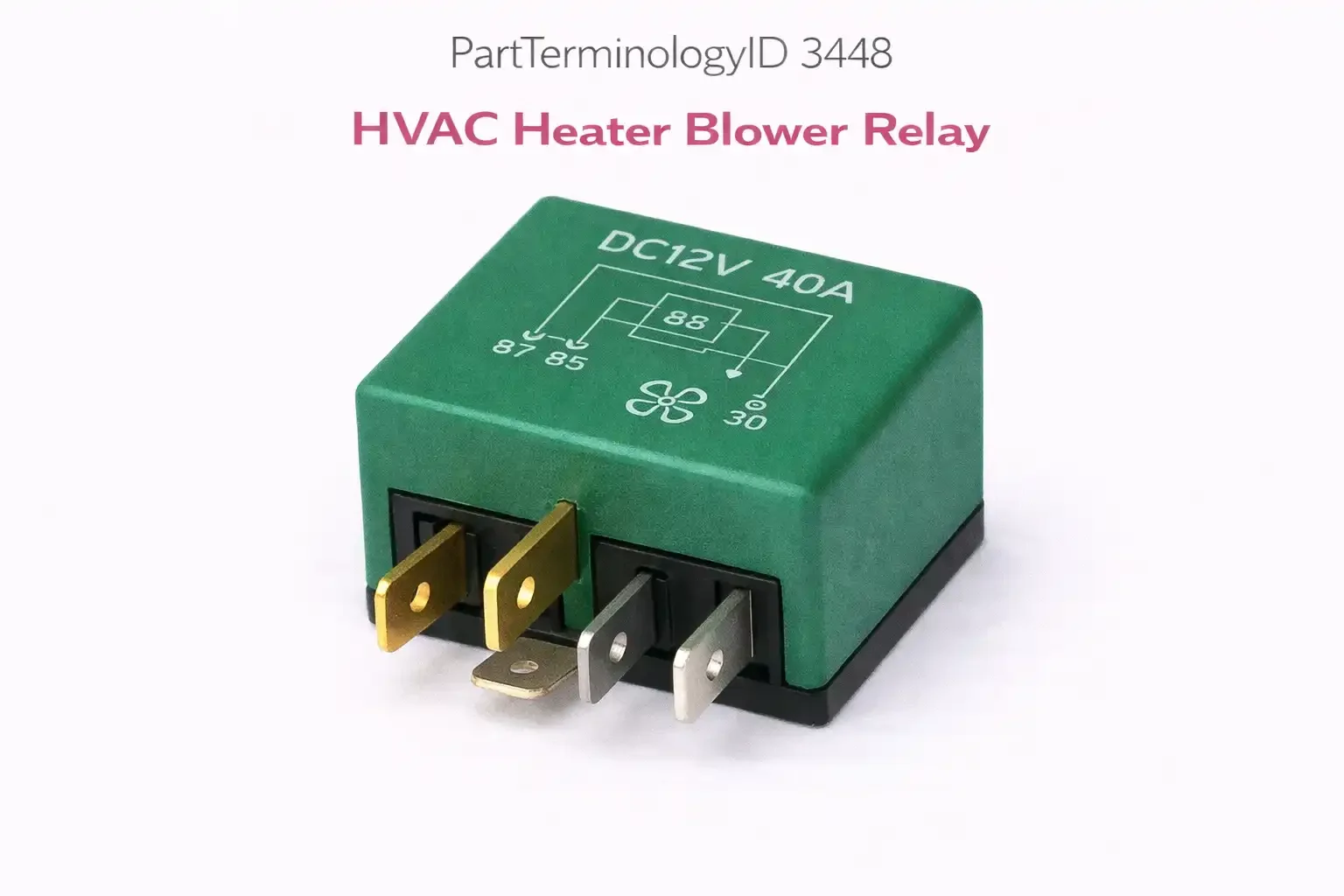
PartTerminologyID 3448, HVAC Heater Blower Relay, is the relay that supplies battery voltage to the HVAC blower motor, which circulates air through the HVAC housing and delivers it to the cabin vents at the speed selected by the driver. The relay is in the main power supply path to the blower motor and controls whether the motor receives power at all, independent of the blower speed resistor or blower motor control module that governs how much of that power reaches the motor at each fan speed setting. The three attributes that determine correct fitment are the contact current rating relative to the blower motor's full-speed current draw, which is the highest current the motor will ever demand and the rating the relay contact must sustain; the relay's position in the blower circuit relative to the resistor pack or blower control module; and the symptom differentiation between a blower relay fault, a blower resistor fault, and an HVAC heater relay fault, which present with similar no-airflow or reduced-airflow complaints from different circuit locations.
What the HVAC Heater Blower Relay Does
Blower motor supply and full-speed current demand
The blower motor relay supplies the main power feed to the blower motor circuit. On resistor-controlled blower systems, the relay output connects to the input of the blower resistor pack, which drops voltage to reduce motor speed at low and medium fan settings. At the highest fan speed setting, the HVAC control switch typically bypasses the resistor pack entirely and routes full battery voltage directly to the blower motor, producing the motor's maximum current draw. This maximum current is the contact rating requirement for the blower relay, since the relay must handle the motor's full inrush and running current at high speed without contact overheating. Blower motors on passenger vehicles draw between 15 and 30 amperes at full speed depending on motor size and design, and the relay contact must be rated at or above this full-speed current.
Resistor pack interaction and speed-selective fault patterns
On resistor-controlled blower systems, a blower relay fault that produces a complete loss of blower operation at all fan speed settings is distinct from a blower resistor fault that typically produces loss of operation only at specific fan speeds. A failed blower relay removes the power supply to the entire blower circuit, so the motor does not run at any speed setting. A failed blower resistor removes one or more resistance steps from the speed control circuit, so the motor continues to operate at the speeds whose circuit paths do not pass through the failed resistor element, while failing at the speeds that require the failed element. The most common resistor fault pattern is loss of all speeds except high speed, because the high-speed circuit typically bypasses the resistor pack entirely and the motor continues to run at high speed after the resistor fails. A blower that works only on high speed has a resistor fault, not a relay fault. A blower that does not work at any speed has either a relay fault or a motor fault.
Differentiation from HVAC Heater Relay (PartTerminologyID 3444)
The HVAC Heater Relay (3444) controls the heat source supply, whether a coolant valve solenoid or a PTC heating element. The HVAC Heater Blower Relay (3448) controls the blower motor that moves air through the housing. A failed heater relay produces airflow from the vents with no warmth: the blower runs normally and delivers air, but the air is cold because the heat source is not receiving power. A failed blower relay produces no airflow from the vents at any fan speed setting: the motor is receiving no supply voltage regardless of the heat source state. The presence or absence of airflow is the single observation that definitively separates the two relay fault presentations without any electrical testing, and this differentiation must appear in every listing under both PartTerminologyIDs so that buyers presenting either symptom are directed to the correct relay before ordering.
Top Return Scenarios
Scenario 1: "No air from any vent at any fan speed setting"
Complete loss of blower operation at all speeds is either a blower relay fault or a blower motor fault. Test for relay contact output voltage at the blower motor supply terminal with the fan switch set to high speed. Voltage present at the motor terminal with no blower operation confirms a failed blower motor. No voltage at the motor terminal with the relay coil confirmed active indicates a failed relay contact. Confirming coil activation before testing contact output prevents replacing the relay when the HVAC control switch has failed to send the coil activation signal.
Prevention language: "No blower operation at any fan speed points to the blower relay or blower motor, not the heater relay. Test relay coil activation voltage first, then relay contact output at the motor terminal. No coil activation points to the switch or BCM. Coil activation with no contact output confirms relay contact failure. Contact output present with no motor operation confirms a failed motor."
Scenario 2: "Blower works only on high speed, not on low or medium"
The blower relay is functioning correctly. High speed operation uses the full relay contact output voltage bypassing the resistor pack, and the relay supplies this correctly. The blower resistor pack has failed and is no longer providing the reduced voltage steps required for low and medium speed operation. Replacing the blower relay will not restore low and medium speed operation. The blower resistor pack or blower motor control module is the correct replacement target for this symptom.
Prevention language: "A blower that works on high speed but not on low or medium speeds has a failed blower resistor, not a failed blower relay. The relay supplies the motor correctly at high speed. Replace the blower resistor pack to restore low and medium speed operation."
Scenario 3: "Blower runs continuously at full speed with fan switch off"
The relay contact is stuck closed and the blower motor runs at full speed regardless of the fan switch position. Removing the relay from its socket should stop the blower immediately if the stuck contact is the fault. If the blower continues after relay removal, the HVAC control switch or BCM is holding the motor supply through a separate circuit path. A blower relay contact stuck closed does not produce a safety hazard but will drain the battery if the vehicle is parked with the relay contact held closed and the ignition off, since the motor draws full current continuously.
Listing Requirements
PartTerminologyID: 3448
controlled circuit: blower motor main power supply (mandatory)
contact current rating vs. blower motor full-speed draw (mandatory)
resistor pack interaction and speed-selective fault pattern differentiation (mandatory)
differentiation from HVAC Heater Relay (3444) by airflow symptom (mandatory)
complete loss of all speeds vs. loss of specific speeds diagnostic (mandatory)
OEM part number cross-reference (mandatory)
FAQ (Buyer Language)
My heater blows air but the air is cold. Is this the blower relay?
No. Air blowing from the vents confirms the blower relay is functioning and the blower motor is running. Cold air output with normal airflow indicates the heat source is not receiving power, which points to the HVAC Heater Relay (PartTerminologyID 3444) or the heat source component itself. The blower relay controls air movement only; it has no effect on the temperature of the air being delivered.
My blower stopped working completely after I replaced the resistor pack. Could I have damaged the relay?
Resistor pack replacement typically does not damage the blower relay, but inspect the blower circuit connectors for damage or pushed-back terminals during the resistor pack installation that may have interrupted the relay output wiring. Test for relay contact output voltage at the blower motor supply terminal with the fan switch on high speed. Voltage present at the terminal with no blower operation confirms the motor or motor connector is the fault. No voltage at the terminal with confirmed relay coil activation indicates an open circuit between the relay output and the motor terminal, likely in the wiring disturbed during the resistor replacement.
What Sellers Get Wrong About PartTerminologyID 3448
The most common listing error is omitting the resistor fault symptom differentiation. Buyers whose blower works only on high speed will search for a blower relay, find the listing, and order the relay based on a general blower complaint without the specific high-speed-only pattern being identified as a resistor fault. Every listing under PartTerminologyID 3448 must state that loss of all speeds points to the relay while high-speed-only operation points to the resistor pack, so buyers can identify their specific symptom pattern and confirm the relay is the correct component before ordering. The second error is omitting the heater relay differentiation. Cold air with normal airflow is a presenting symptom that generates heater relay searches and blower relay searches simultaneously, since both relay names appear in general HVAC relay searches. The airflow test observation separates the two presentations at zero cost and prevents half of the wrong-relay orders this category generates.
Cross-Sell Logic
HVAC Heater Relay (PartTerminologyID 3444): controls the heat source supply independently of the blower relay; cold air with normal airflow points to the heater relay, not the blower relay
Blower Motor Resistor Pack: controls blower speed by introducing resistance steps into the motor supply circuit; high-speed-only blower operation is a resistor fault, not a relay fault
Blower Motor Control Module: on applications with electronic blower speed control rather than a resistor pack, the control module governs motor speed; all-speeds-inoperative faults on these applications may indicate a module fault after relay contact output is confirmed present
Blower Motor: if relay contact output voltage is confirmed at the motor terminal at all speed settings but the motor does not run, the motor has failed electrically and is the replacement target
Final Take for PartTerminologyID 3448
HVAC Heater Blower Relay (PartTerminologyID 3448) is the blower motor supply relay where contact current rating, resistor pack speed-selective fault differentiation, and HVAC heater relay symptom differentiation are the three listing attributes that prevent the most common wrong-component orders in the HVAC relay category. The resistor fault note prevents orders from buyers whose blower works on high speed only. The heater relay differentiation prevents orders from buyers whose blower is delivering cold air normally. Both differentiations are single-observation tests requiring no tools, and including both in the listing gives every buyer the self-check that confirms whether the blower relay is the correct starting point for their specific HVAC complaint before the order is placed.