
Written by Arthur Simitian | PartsAdvisory
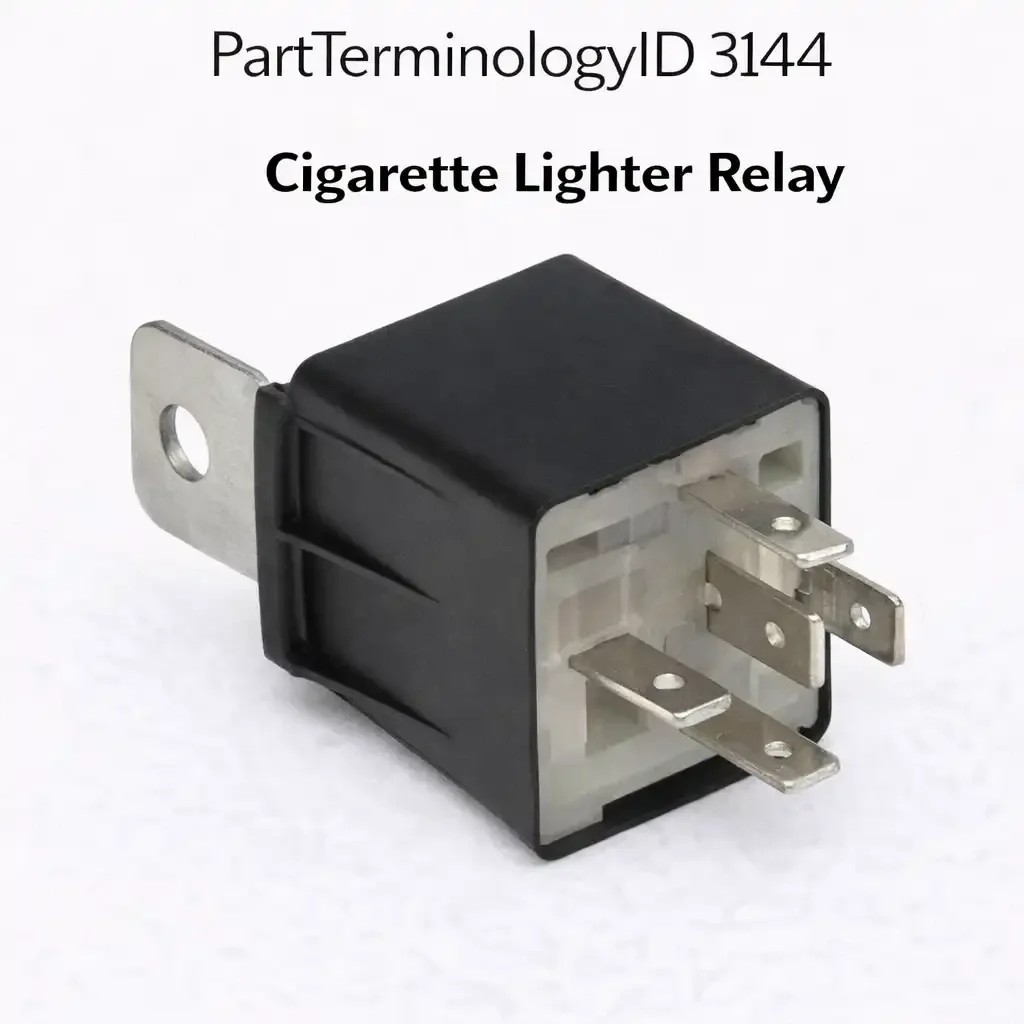
PartTerminologyID 3144, Cigarette Lighter Relay, is the relay that switches power to the vehicle's cigarette lighter socket or 12-volt accessory power outlet, enabling the BCM or the ignition switch circuit to supply current to the socket when the ignition is in the accessory or run position and to de-energize the socket when the ignition is off or when the vehicle enters a battery protection mode. That definition covers the lighter socket power switching function correctly and leaves unresolved whether the relay is activated from the accessory position only, the run position only, or both, whether the socket remains energized with the ignition off on vehicles where the lighter is wired for continuous battery power, the contact current rating relative to the maximum rated load for the socket which is typically 180 to 240 watts corresponding to 15 to 20 amperes at 12 volts, whether the vehicle has a single relay for all lighter and power outlet sockets or separate relays for individual socket groups, and whether the relay is a standalone component or is shared with the accessory power relay function under PartTerminologyID 2944.
For sellers, PartTerminologyID 3144 is the power outlet relay PartTerminologyID where the boundary between the cigarette lighter relay and the accessory power relay is most frequently blurred. On many vehicles the lighter socket is powered through the same relay that powers all accessory-position circuits, making PartTerminologyID 3144 a subset of PartTerminologyID 2944 rather than a distinct relay. On others a dedicated lighter relay provides separately fused and switched power for the lighter circuit independent of the main accessory relay. The listing must verify and state whether a dedicated lighter relay exists on the vehicle or whether the lighter circuit is served by the accessory power relay.
What the Cigarette Lighter Relay Does
The lighter relay provides a switched power supply to the socket that is protected by a dedicated fuse rated for the socket's maximum current. The socket is designed to accept plugs from cigarette lighters, phone chargers, tire inflators, portable inverters, and other 12-volt accessories. The relay ensures the socket is de-energized when the ignition is off to prevent parasitic drain from accessories left plugged in, and re-energizes the socket when the ignition returns to the accessory or run position.
High-draw accessories such as tire inflators drawing 15 amperes or small inverters drawing 20 amperes push the socket and relay near or at their rated limits. A relay with a 15-amp contact rating supplying a 15-amp tire inflator will be at 100 percent of its contact rating during operation. Sustained operation at the contact limit accelerates contact erosion. The listing must note the socket's maximum rated load and must recommend a relay rated above the maximum socket current with an appropriate safety margin for high-draw accessory users.
Socket current limit and high-draw accessory use
The cigarette lighter socket is rated for 180 to 240 watts, corresponding to 15 to 20 amperes at 12 volts. High-draw accessories including tire inflators, portable jump starters, inverters for laptop charging, and 12-volt coolers push the socket toward its rated limit during sustained use. The relay contact carries the full socket current during accessory operation. A relay rated for 15 amperes used with a tire inflator drawing 14 amperes is at 93 percent of its contact rating during every inflation event. Accumulated use at near-rated contact current produces contact erosion that increases resistance and reduces voltage at the socket terminals, which may cause accessories to operate below their rated capacity before the relay fails completely.
Multiple socket architecture and the single relay coverage question
Many vehicles have two or more 12-volt accessory sockets in different locations: one in the center console, one in the rear passenger area, and one in the cargo area on SUVs and wagons. On some vehicles all sockets are powered through a single relay, meaning a single relay failure disables all socket locations simultaneously. On others each socket or socket group has its own relay, meaning a relay failure affects only the socket or group served by that relay. Identifying how many sockets are non-functional and whether they share a single relay or have separate relays determines whether one relay replacement restores all sockets or whether each needs individual diagnosis.
Ignition position coverage and the all-on versus run-only distinction
Lighter sockets may be powered in all ignition positions including off, or only in the accessory and run positions, or only in the run position, depending on the manufacturer's design intent. The relay activation source and the ignition position coverage determine which positions supply power to the socket. A buyer who plugs a device into the lighter socket with the ignition off and finds no power, then orders a relay because the socket appears dead, may have a vehicle where the socket is intentionally powered only in the run position and no relay fault exists. The ignition position coverage must be disclosed in the listing to prevent orders from buyers whose socket is operating exactly as designed but in a position where power is intentionally absent.
USB and 12V outlet circuit commonality on modern vehicles
On modern vehicles the legacy cigarette lighter socket has been replaced or supplemented by USB charging outlets and multiple 12-volt accessory sockets in different interior locations. All of these outlets may share a single accessory power relay under PartTerminologyID 2944 rather than having individual dedicated relays. A dead USB outlet and a dead 12-volt socket in the same vehicle may both be caused by the single shared accessory relay rather than by individual socket relays. Confirming whether all powered outlets in the vehicle are dead simultaneously versus a single outlet type narrows the diagnosis toward the correct relay before ordering.
Why This Part Generates Returns
Buyers return cigarette lighter relays because the lighter socket is served by the accessory power relay and no separate lighter relay exists on this vehicle, the relay is activated only from the run position and the buyer uses the lighter in accessory position expecting it to work without engine running, and the dedicated lighter relay fuse is blown rather than the relay itself and replacing the relay without checking the fuse produces no change in socket behavior.
Status in New Databases
PIES/PCdb: PartTerminologyID 3144, Cigarette Lighter Relay
PIES 8.0 / PCdb 2.0: No change.
Listing Requirements
PartTerminologyID: 3144
dedicated relay existence verification: confirm separate relay before listing (mandatory)
ignition position activation: accessory, run, or both (mandatory)
contact current rating: continuous at socket maximum load (mandatory)
socket maximum rated load note (mandatory)
fuse fault diagnosis note before relay replacement (mandatory)
differentiation from Accessory Power Relay (PartTerminologyID 2944): verify separate relay exists (mandatory)
OEM part number cross-reference (mandatory)
FAQ (Buyer Language)
Why does my lighter socket not work in accessory position?
The relay is likely activated only from the run position on this vehicle. The socket has no power in accessory position because the relay coil activation circuit is wired to the run output, not the accessory output. Verify the relay's activation circuit position before assuming the relay is failed.
Should I check the fuse before replacing the relay?
Yes. The lighter circuit fuse is the most common cause of a dead lighter socket. A failed relay and a blown fuse produce identical symptoms. Check the fuse first. A blown fuse that recurs after replacement indicates an overcurrent fault in the socket circuit rather than a relay fault.
How do I confirm whether the fault is the relay or the fuse?
Remove the lighter circuit fuse and inspect it visually. A blown fuse has a visibly open filament or a charred appearance inside the fuse body. Replace the fuse with the correct amperage rating. If the socket restores and the fuse holds under normal accessory use, the fuse was the fault. If the socket remains dead after fuse replacement, proceed to relay testing. If the fuse blows immediately after replacement, an overcurrent fault in the socket circuit requires diagnosis before either the fuse or the relay is replaced again.
Top Return Scenarios
Scenario 1: "Socket dead, relay replaced, socket still dead, fuse was blown"
The buyer's cigarette lighter socket is dead. The relay is replaced. The socket remains dead. Inspection reveals the lighter circuit fuse is blown. The blown fuse was the original fault. The relay replacement had no effect because the fuse was interrupting the circuit upstream of the relay. The fuse is replaced for a fraction of the relay's cost and the socket restores immediately.
Prevention language: "Check the lighter circuit fuse before replacing the relay. A blown fuse produces an identical dead socket symptom at a fraction of the repair cost. The fuse is the most common cause of a dead lighter socket and should be the first component inspected."
Scenario 2: "Dedicated relay does not exist on this vehicle, socket is accessory relay circuit"
The buyer searches for a dedicated cigarette lighter relay. No discrete lighter relay exists in the fuse center. The lighter socket is powered through the main accessory power relay alongside all other accessory-position circuits. Replacing a non-existent dedicated lighter relay produces no change in socket function. The accessory power relay under PartTerminologyID 2944 is the relevant component when the lighter circuit shares the main accessory relay.
Prevention language: "Verify a separate lighter relay exists on the vehicle before ordering. On many vehicles the lighter socket is powered through the main accessory relay with no dedicated lighter relay. Check the fuse center layout diagram in the owner's manual or service manual to confirm a lighter-specific relay position exists before ordering."
Cross-Sell Logic
Accessory Power Relay (PartTerminologyID 2944): for buyers where no dedicated lighter relay exists and the socket is powered through the main accessory relay
Lighter Socket: for buyers where the relay is confirmed functional but the socket itself has failed from repeated plug insertion wear or heat damage
Fuse: for buyers where the lighter circuit fuse is blown and requires replacement rather than relay replacement
Catalog Checklist for ACES/PIES Teams
PartTerminologyID = 3144
require dedicated relay existence verification before listing (mandatory)
require ignition position activation: accessory, run, or all positions (mandatory)
require contact current rating for socket maximum rated load (mandatory)
require fuse fault diagnosis note before relay replacement (mandatory)
prevent relay order before fuse inspection: blown fuse is most common cause of dead socket
prevent relay listing where dedicated relay does not exist: socket may be powered through Accessory Power Relay PartTerminologyID 2944
differentiate from Accessory Power Relay PartTerminologyID 2944: verify a separate lighter relay socket exists in the vehicle fuse center before listing under PartTerminologyID 3144; on vehicles where the lighter socket is powered through the main accessory relay the correct PartTerminologyID is 2944 and no dedicated lighter relay exists to replace under PartTerminologyID 3144
Final Take for PartTerminologyID 3144
Cigarette Lighter Relay (PartTerminologyID 3144) is the power outlet relay where the fuse-first diagnostic redirect and the dedicated relay existence verification prevent the two most common incorrect orders. A lighter socket that is dead because of a blown fuse does not need a relay. A lighter circuit served by the accessory power relay does not have a dedicated lighter relay to replace. Both diagnostic steps must be completed before the buyer orders under this PartTerminologyID, and both must be stated in the listing as explicit pre-order actions. The ignition position activation, whether accessory-only, run-only, or both, is the third attribute that determines whether the replacement relay matches the original circuit behavior for the vehicle's socket use pattern.