
Written by Arthur Simitian | PartsAdvisory
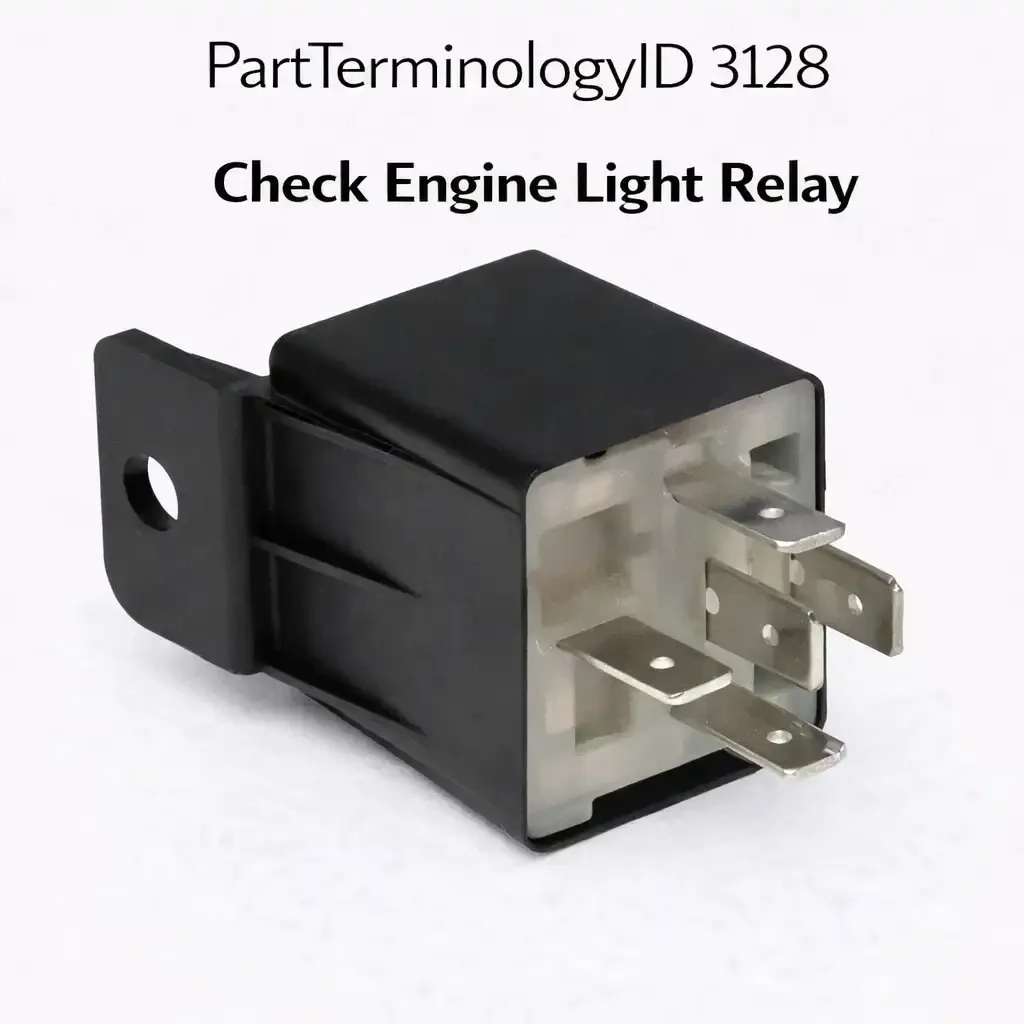
PartTerminologyID 3128, Check Engine Light Relay, is the relay that provides the power supply switching function for the malfunction indicator lamp circuit, enabling the PCM or ECM to illuminate the check engine light when a monitored emissions or engine management parameter falls outside the acceptable range and to extinguish the lamp when the monitored parameter returns to normal range for the required number of consecutive drive cycles. That definition covers the MIL circuit switching function correctly and leaves unresolved whether the check engine light relay is a standalone component in the vehicle's fuse center, whether it is integrated into the PCM's internal circuit making external replacement impossible, whether the relay switches the lamp supply voltage or controls the lamp's ground path, whether a failed relay produces a permanently illuminated check engine light, a check engine light that never illuminates even during genuine emissions faults, or no impact on the check engine light if the lamp circuit is connected directly to the PCM output without a relay on some architectures, and whether the vehicle's OBD II readiness monitors pass or fail with the relay circuit compromised.
For sellers, PartTerminologyID 3128 is the check engine light relay PartTerminologyID with the highest inapplicability rate of any relay in this series, because the vast majority of post-OBD II vehicles produced after 1996 connect the MIL directly to a PCM output pin without a separate relay, making a standalone check engine light relay inapplicable to most modern vehicles in the catalog. A listing that covers modern OBD II vehicles under PartTerminologyID 3128 will consistently deliver a component that does not exist as a separate replaceable item on those vehicles. The separate check engine light relay exists primarily on OBD I and pre-OBD vehicles where the indicator lamp circuit required a relay to amplify the ECM's low-current indicator output before the ECM's internal driver circuitry could switch the lamp directly.
What the Check Engine Light Relay Does
OBD I versus OBD II MIL circuit architecture
On OBD I vehicles the ECM's indicator output terminal provides a signal voltage that is insufficient to directly drive an incandescent MIL lamp at the current required for adequate visibility. The relay amplifies this low-current signal into the lamp supply current. The ECM output drives the relay coil, and the relay contact drives the lamp. This architecture requires the relay as an intermediary between the ECM's weak output and the lamp's current demand.
On OBD II vehicles the PCM's MIL driver output is designed to directly switch the lamp supply or ground without an intermediary relay. The PCM internal driver transistor handles the full lamp current. No external relay is required and none is present in the fuse center for the MIL circuit. On these vehicles, a check engine light that stays on permanently is a PCM output fault, a lamp socket corrosion fault, or an active fault code rather than a relay fault. The listing must state the OBD I application window explicitly and must include the OBD II inapplicability note to prevent a buyer with a 2005 vehicle from ordering a relay that does not exist in their car.
Permanently illuminated check engine light diagnostic context
The permanently illuminated check engine light is the symptom that drives most buyers to search for a check engine light relay, and it is the symptom that in almost all modern vehicles reflects an active fault code rather than a relay fault. A permanently illuminated MIL on an OBD II vehicle requires scan tool retrieval of the stored fault code as the first diagnostic step. The fault code identifies the specific monitored parameter that is out of range. Replacing a relay that does not exist in the circuit will not extinguish the lamp. The listing must include this diagnostic note as a mandatory buyer redirect that prevents the most common misorder in the MIL circuit segment: a relay ordered by a modern vehicle buyer who does not understand that their check engine light is an OBD II fault code indication rather than a relay malfunction.
Check engine light that never illuminates and the open relay consequence
On OBD I vehicles with a separate MIL relay, a relay that fails open prevents the check engine light from illuminating during genuine emissions or engine management faults. Federal OBD regulations require the MIL to illuminate when a fault that affects vehicle emissions is detected. A vehicle with a failed-open MIL relay is not compliant with OBD requirements and will fail a visual inspection at emissions testing even if no engine management faults are present, because the inspector verifies the MIL illuminates during the ignition-on bulb test. The bulb test requires the lamp to illuminate briefly at ignition-on before the engine starts. A failed-open relay prevents this test illumination. The listing must note the OBD compliance consequence of a failed-open MIL relay for OBD I applications.
Why This Part Generates Returns
Buyers return check engine light relays because the vehicle is OBD II and no separate MIL relay exists, the check engine light stays on after relay replacement because an active fault code is still present and the relay replacement did not address the fault, the check engine light stays off after relay replacement because the PCM's MIL driver output transistor has failed and the relay is receiving no coil activation signal, and the relay is the correct OBD I application but the engine management fault that activated the MIL is still present and continues to illuminate the lamp through the now-functional relay.
Status in New Databases
PIES/PCdb: PartTerminologyID 3128, Check Engine Light Relay
PIES 8.0 / PCdb 2.0: No change.
Top Return Scenarios
Scenario 1: "OBD II vehicle, no separate relay exists, relay cannot be installed"
The buyer has a 2002 vehicle with a permanently illuminated check engine light. The listing covers the model year without distinguishing OBD I from OBD II. The buyer orders the relay. No MIL relay socket exists in the fuse center. The check engine light is on because of an active OBD II fault code. The relay cannot be installed and the code cannot be cleared by relay replacement.
Prevention language: "Application: OBD I vehicles only, approximately 1982 through 1995 depending on manufacturer. OBD II vehicles produced after 1996 do not use a separate check engine light relay. On OBD II vehicles, a check engine light indicates an active fault code that requires scan tool diagnosis and fault resolution. Relay replacement does not affect OBD II MIL operation."
Scenario 2: "Active fault code, check engine light stays on after relay replacement"
The buyer has an OBD I vehicle. The relay is replaced. The check engine light remains on. The original fault that activated the MIL is still present. The relay was functioning correctly by illuminating the lamp in response to the ECM's fault signal. The relay replacement was unnecessary. The fault must be diagnosed and resolved.
Prevention language: "Check engine light diagnosis: A check engine light that remains on after relay replacement indicates an active engine management fault that the relay replacement did not address. The relay illuminates the lamp in response to the ECM fault signal. Diagnose and resolve the underlying fault to extinguish the lamp."
Listing Requirements
PartTerminologyID: 3128
OBD I application window with specific year range (mandatory, in title)
OBD II inapplicability note (mandatory)
permanently illuminated MIL diagnostic note: scan tool first (mandatory)
open relay OBD compliance consequence (mandatory)
lamp circuit switched: supply or ground (mandatory)
OEM part number cross-reference (mandatory)
Catalog Checklist for ACES/PIES Teams
PartTerminologyID = 3128
require OBD I application window in title (mandatory)
require OBD II inapplicability note as first content item (mandatory)
require scan-tool-first diagnostic redirect for permanently illuminated lamp (mandatory)
require lamp circuit direction: supply-switched or ground-switched (mandatory)
prevent OBD II vehicle orders: no relay exists on these vehicles; the MIL is driven directly by the PCM; this note must be prominent enough to intercept buyers with modern vehicles before they complete the order
prevent relay-first diagnosis for illuminated CEL: the relay illuminates the lamp correctly when the ECM commands it; a illuminated CEL is the relay working, not the relay failing
Scenario 3: "Supply-switched relay ordered for ground-switched application, lamp stays on after replacement"
The replacement relay switches the lamp supply circuit. The original relay switched the lamp ground circuit. On the ground-switched architecture the ECM pulls the lamp ground through the relay. On the supply-switched architecture the ECM provides a positive coil signal to close the relay against a fused supply. The two architectures use different relay pin functions and different ECM output logic. A supply-switched relay installed in a ground-switched socket will not control the lamp correctly regardless of ECM command state.
Prevention language: "Lamp circuit: [supply-switched: relay provides positive supply to lamp / ground-switched: relay completes lamp ground path]. This relay covers the [direction] circuit. Supply-switched and ground-switched MIL relays are not interchangeable even when physical dimensions and coil specifications match."
Scenario 4: "Lamp inoperative at key-on bulb test, relay failed open, emissions test failure"
The OBD I vehicle's check engine light does not illuminate during the key-on bulb test. The MIL relay has failed open. On OBD I vehicles subject to visual emissions inspection, a MIL that does not illuminate during the bulb test is an automatic inspection failure regardless of actual engine fault status because the inspector cannot confirm the warning system is functional. The relay must be replaced and the key-on bulb test confirmed before the vehicle can pass a visual emissions inspection.
Prevention language: "Key-on bulb test: The check engine light should illuminate briefly at key-on as part of the instrument cluster bulb test. A lamp that does not illuminate at key-on indicates a failed-open relay or a burned out lamp. Replace the relay and confirm the bulb test before submitting the vehicle for emissions inspection."
FAQ (Buyer Language)
Does my vehicle have a check engine light relay?
Probably not if it was produced after 1996. OBD II vehicles connect the MIL directly to the PCM without a relay. Only OBD I vehicles from approximately 1982 through 1995 use a separate MIL relay. Verify the vehicle's OBD generation before ordering.
Why is my check engine light still on after I replaced the relay?
An active engine management fault is illuminating the lamp through the now-functional relay. The relay was not the cause of the check engine light. Diagnose and resolve the underlying fault with a scan tool to extinguish the light.
Will replacing the relay fix my check engine light?
Only if the relay has failed open on an OBD I vehicle where the lamp is dark and the bulb test at ignition-on fails. A permanently illuminated check engine light is almost always an active fault code, not a relay fault. Scan for codes before replacing any hardware.
What is the difference between OBD I and OBD II for this relay?
OBD I systems from approximately 1982 through 1995 use a relay to switch the check engine light circuit. OBD II systems produced after 1996 drive the MIL directly from the PCM output without a relay. There is no relay to replace on OBD II vehicles. A check engine light on an OBD II vehicle indicates a stored diagnostic trouble code that requires scan tool retrieval and fault diagnosis, not relay replacement.
Can I clear a check engine light by replacing the relay?
No. The relay switches power to the lamp in response to the ECM's fault command. Replacing the relay does not clear the fault code that commands the lamp to illuminate. On OBD I vehicles, removing the relay silences the lamp but does not clear the underlying fault. On OBD II vehicles, no relay exists and the lamp is cleared only by clearing the fault code with a scan tool or by resolving the underlying fault and allowing the monitors to complete.
What Sellers Get Wrong About PartTerminologyID 3128
The most common error is publishing a year, make, and model fitment range that includes OBD II vehicles without an OBD II inapplicability note. The check engine light relay does not exist on OBD II vehicles. A listing for a model that spans the OBD I to OBD II transition, such as a model that was produced from 1993 through 1998, includes three years of OBD I vehicles and three years of OBD II vehicles. Buyers with the 1997 and 1998 vehicles have no relay to replace. Every order from an OBD II vehicle buyer in the fitment range generates a return from a buyer who found no relay socket to install the part into. The year range in the listing must be capped at the OBD II transition year for the specific model, and the OBD II inapplicability note must be prominent enough to intercept buyers who search the fitment table without reading the description.
The second error is omitting the scan-tool-first diagnostic redirect. The check engine light relay illuminates the lamp when it is working correctly, in response to the ECM's fault output. A permanently illuminated check engine light on an OBD I vehicle is almost always an active fault that the relay is correctly displaying. A buyer who replaces the relay expecting to extinguish the light will find the light still on after installation because the fault is still present. The relay replacement was unnecessary, and the fault remains undiagnosed. The scan-tool-first note redirects this buyer toward diagnosis before hardware replacement and prevents the return.
My OBD I vehicle has a check engine light that is off when it should be on. Is this the relay?
Yes. A failed-open check engine light relay on an OBD I vehicle prevents the MIL from illuminating during genuine engine management faults. The ECM output commands the relay to close, but the open relay contact prevents the lamp circuit from completing. The lamp stays dark regardless of fault code status. Replace the relay and verify the MIL illuminates at key-on bulb test before confirming the vehicle has no active faults.
Application Range and Fitment Guidance for PartTerminologyID 3128
The check engine light relay application window is narrow and precisely bounded by federal OBD regulation history. The Clean Air Act Amendments of 1990 mandated OBD II for all light-duty vehicles sold in the United States beginning with the 1996 model year. California adopted OBD II requirements for model year 1994 for a portion of its market. OBD I vehicles, which used manufacturer-proprietary diagnostic systems without standardized scan protocols or MIL relay architecture requirements, span approximately 1982 through 1995 for most domestic manufacturers and 1982 through 1993 for California vehicles subject to early OBD II adoption.
The exact year at which a specific manufacturer transitioned from OBD I to OBD II varies by manufacturer and sometimes by model line. Ford transitioned to OBD II on most models for 1996. General Motors transitioned most models for 1996 as well, with some models transitioning in 1994 and 1995. Chrysler, Honda, Toyota, and other manufacturers have model-specific transition years within the 1994 through 1996 window. A listing for PartTerminologyID 3128 that uses 1996 as a blanket OBD II cutoff without verifying the specific model's transition year may incorrectly include early-OBD-II-adopting 1994 and 1995 models in the fitment range and deliver a relay that does not exist in those vehicles.
Final Take for PartTerminologyID 3128
Check Engine Light Relay (PartTerminologyID 3128) is the relay PartTerminologyID with the highest inapplicability rate in this series. The OBD II inapplicability note and the scan-tool-first diagnostic redirect are the two most important attributes in any listing under this ID because they redirect the vast majority of buyers who land on this listing away from an incorrect part order toward the correct diagnostic path for their OBD II vehicle. The application window for this relay is narrow, specific, and must be stated before any fitment claim is made. OBD I vehicles from approximately 1982 through 1995 depending on manufacturer are the only applications where this relay exists as a discrete replaceable component. Every buyer outside this window who reaches this listing is a potential incorrect order. The listing's job is to identify these buyers before they order, not after they receive the part.
The OBD I application window note and the OBD II inapplicability note together define the functional scope of this PartTerminologyID more completely than any other attribute pair in this series. A listing that states only the OBD I application window year range does the first half of the job. A listing that also states explicitly that OBD II vehicles produced after the transition year do not use a relay and that a check engine light on those vehicles requires scan tool diagnosis does the complete job. The complete listing eliminates the return from the OBD II buyer. The incomplete listing generates it on every order cycle from every OBD II buyer in the stated year range.
The OBD I relay is a legacy component with a narrow application window, and every listing that correctly bounds that window and redirects modern vehicle buyers to scan tool diagnosis serves both the buyer and the seller's return rate simultaneously. The two-sentence OBD II redirect is the highest-yield content investment available under this PartTerminologyID.
No other relay PartTerminologyID in this series has a higher proportion of inapplicable vehicle buyers reaching the listing, and no other PartTerminologyID has a simpler two-sentence listing fix that eliminates those buyers before they order.