
Suspension Ride Height Control Relay (PartTerminologyID 3048): Where System Type and Motor Inrush Rating Determine Whether the Relay Survives Air Suspension Compressor Cycling
Written by Arthur Simitian | PartsAdvisory
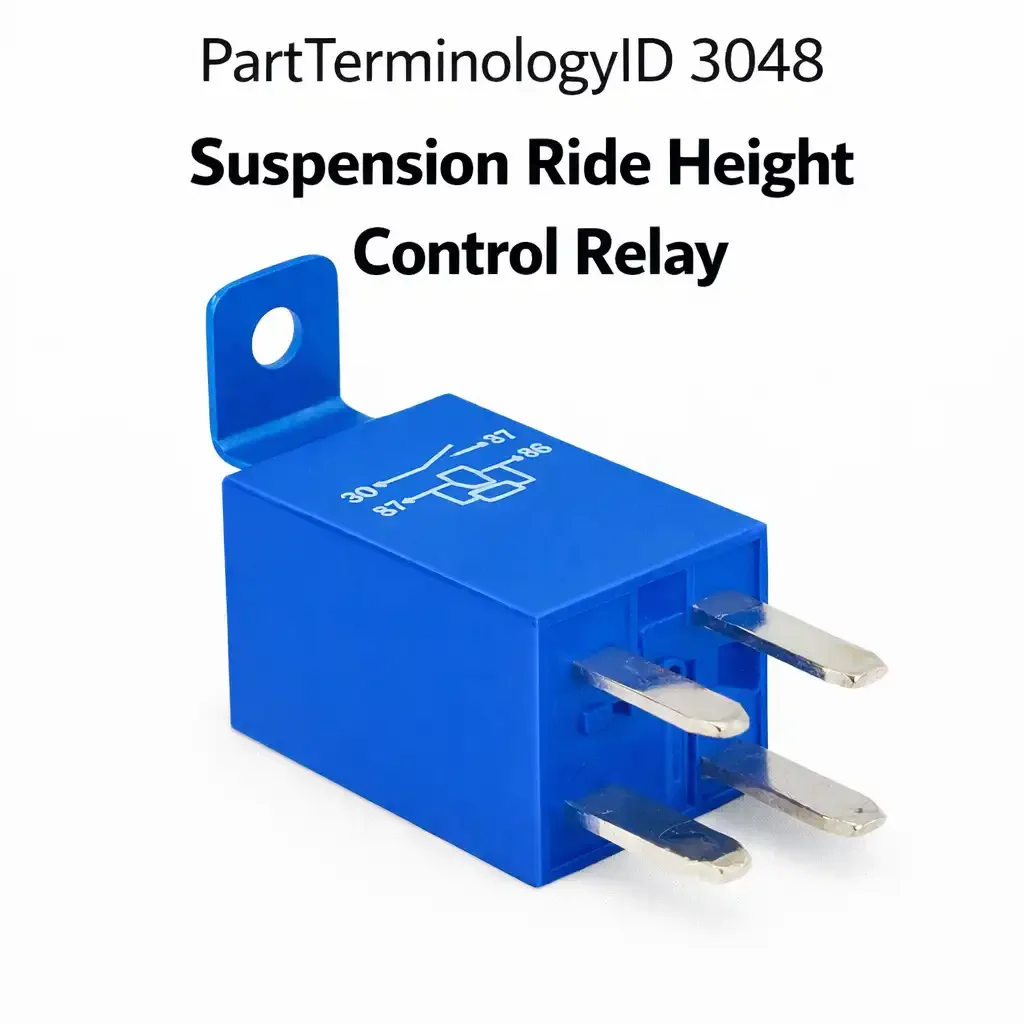
PartTerminologyID 3048, Suspension Ride Height Control Relay, is the relay that switches power to the air suspension compressor motor or the hydraulic leveling pump motor, enabling the ride height control module to raise or lower the vehicle's suspension to the target ride height based on load sensor or ride height sensor inputs. That definition covers the ride height actuator power switching function correctly and leaves unresolved the suspension system type the relay serves, whether air spring, hydraulic self-leveling, or electronically controlled air suspension with multiple ride height modes, the contact current rating relative to the compressor or pump motor inrush current, whether the relay switches the motor directly or enables a secondary contactor that handles the full motor current, and the ride height module's relay coil resistance tolerance.
For sellers, PartTerminologyID 3048 is the ride height control relay PartTerminologyID where the suspension system type determines the current requirements more than any other attribute. A rear self-leveling shock absorber compressor relay for a light passenger car may carry 10 to 20 amperes at motor startup. A full air suspension compressor relay for a full-size SUV or luxury vehicle may carry 25 to 45 amperes. These are not interchangeable current requirements and the relay specified for the lighter application will fail under the heavier compressor's inrush current within weeks of installation on the heavier system.
What the Suspension Ride Height Control Relay Does
The ride height control module activates the relay when the height sensors report a ride height below the target level, which occurs when passengers or cargo load compresses the suspension below the design ride height. The compressor or pump motor runs until the sensors report the target height has been restored, at which point the module de-energizes the relay and stops the motor. The relay must handle the motor startup inrush at each leveling cycle, which on a frequently loaded vehicle such as a delivery vehicle or a family hauler may occur dozens of times per day.
High cycle frequency accelerates contact erosion from the repeated make-and-break switching events under inrush current. A relay with a contact life rating of 100,000 switching operations at rated current may reach end-of-life in two to three years on a high-use vehicle. The listing should note the expected switching frequency for the application and recommend a relay with an appropriate contact life rating for the duty cycle, because a replacement relay with a lower contact life rating will fail significantly sooner than the original on high-use applications.
Height sensor fault diagnosis before relay replacement
The ride height control relay activates when height sensors report the vehicle is below target ride height. A height sensor that has failed and continuously reports below-target height causes the relay to close and the compressor to run continuously until the compressor overheats or the high-pressure cutout trips. On vehicles with electronic height sensors, the suspension control module stores a fault code for the sensor fault that is retrievable by scan tool before any component replacement. Retrieving suspension module fault codes as the first diagnostic step prevents relay replacement when the actual fault is a height sensor producing a false-low signal.
Compressor motor seized inspection protocol
Before installing the replacement relay, the compressor motor must be confirmed free-turning. Apply 12 volts directly to the compressor motor terminals and confirm the motor runs without excessive current draw. A current draw above the motor's specification indicates a bearing seizure beginning. A motor that does not turn at all has fully seized. Installing the replacement relay on a seized compressor motor draws locked-rotor current through the new relay contact immediately at the first relay closure, welding the contact within seconds. The compressor motor inspection takes less than one minute and prevents the replacement relay from immediately failing on a seized motor.
Suspension control module self-test and relay command verification
The suspension control module performs a self-test at ignition-on that includes commanding the height control relay closed briefly to verify the relay circuit is intact. On some platforms the module stores a relay circuit fault code if the relay contact does not close within the expected time window during the self-test command. This fault code illuminates the suspension warning lamp and inhibits subsequent relay activation until the fault is cleared. A buyer who retrieves a relay circuit fault code and replaces the relay should verify the new relay coil resistance is within the module's driver tolerance before installation, because a relay with a coil resistance outside tolerance produces the same fault code as a failed relay even though the relay itself is physically sound.
Dual-compressor architecture and relay identification
Some four-corner air suspension systems use separate compressors for the front and rear axle circuits, each with its own relay. A buyer who finds the front suspension corners at normal height but the rear corners sagging may incorrectly order a relay for the wrong axle. Identifying the failed relay from the suspension control module's fault code, which typically identifies the specific axle circuit with the fault, prevents ordering a relay for the functional axle.
Why This Part Generates Returns
Buyers return suspension ride height control relays because the contact current rating is sized for a rear self-leveling application and the vehicle has a full air suspension whose compressor draws substantially more current, the relay coil resistance is outside the ride height module's tolerance generating a relay circuit fault while the suspension remains inoperative, and the compressor motor itself has failed and relay replacement does not restore leveling because the motor is seized and draws locked-rotor current that destroys the replacement relay contact within minutes.
Status in New Databases
PIES/PCdb: PartTerminologyID 3048, Suspension Ride Height Control Relay
PIES 8.0 / PCdb 2.0: No change.
Listing Requirements
PartTerminologyID: 3048
suspension system type: rear self-leveling, full air suspension, or hydraulic leveling (mandatory, in title)
contact current rating: continuous and inrush (mandatory)
contact life rating in switching cycles (mandatory for high-use applications)
coil resistance within ride height module tolerance (mandatory)
compressor motor fault diagnosis note: confirm motor is not seized before relay replacement (mandatory)
OEM part number cross-reference (mandatory)
FAQ (Buyer Language)
How do I know if the relay or the compressor has failed?
Apply 12 volts directly to the compressor motor terminals. If the motor runs, the relay is the fault. If the motor draws high current and does not spin, the motor is seized. Installing a new relay with a seized motor will destroy the relay contact from locked-rotor current within minutes.
Why does the ride height light stay on after relay replacement?
The ride height module may have stored a fault code from the relay failure event that requires a scan tool clear procedure. A persistent light after fault code clearing indicates a remaining system fault such as a height sensor fault or a compressor performance fault separate from the relay.
What current rating do I need for a full air suspension compressor relay?
A full air suspension compressor relay on a full-size SUV or luxury vehicle requires a contact rating of at least 40 amperes continuous with an inrush tolerance above 60 amperes to handle motor startup current. The relay's inrush rating is as important as its continuous rating because the compressor motor's startup current may reach two to three times the running current for the first 200 milliseconds of each activation cycle. A relay with an adequate continuous rating but an insufficient inrush tolerance will experience contact stress at every compressor startup even if the continuous current is within rating.
Why does ride height control relay failure affect vehicle handling?
A failed relay that leaves the compressor unable to maintain target ride height causes the air suspension to progressively lose pressure over the first few drive cycles after failure. The vehicle settles to a lower ride height that reduces suspension travel, changes the front-to-rear weight distribution, and alters the steering geometry relative to the design specification. Cornering stability and braking balance are affected before the height difference is visually obvious to the driver. The earliest symptom is often a change in steering feel or a softening of the suspension character rather than a visually obvious height difference.
Top Return Scenarios
Scenario 1: "Ride height light on, relay replaced, compressor still does not run"
The buyer replaces the ride height relay. The compressor does not activate. Testing confirms the relay coil receives no activation voltage from the suspension control module. The suspension module has stored a height sensor fault code and inhibited relay activation until the sensor fault is resolved. The relay replacement had no effect because the relay was correctly non-activated by the module's fault inhibit logic.
Prevention language: "Retrieve suspension module fault codes before replacing the relay. A ride height warning light with the compressor not running may indicate a height sensor fault that inhibits relay activation rather than a relay fault. Confirm the relay coil receives activation voltage before ordering a replacement."
Scenario 2: "New relay installed, compressor welds relay contact immediately"
The buyer installs the replacement relay. The compressor activates but does not shut off and the relay contact welds closed within minutes. The compressor motor has seized and is drawing locked-rotor current. The original relay failed for the same reason. The motor seizure was the original fault and must be resolved before any relay replacement will survive the first activation cycle.
Prevention language: "Apply 12 volts directly to the compressor motor terminals before installing the replacement relay. A motor that does not run from direct supply or draws more than its rated current has seized and will weld the replacement relay contact under locked-rotor current. Replace the compressor motor before the relay."
Cross-Sell Logic
Air Suspension Compressor: for buyers where the relay is confirmed functional but the compressor motor has seized and requires replacement
Height Sensor: for buyers where the suspension module fault code identifies a height sensor fault inhibiting relay activation
Suspension Control Module: for buyers where the relay coil receives no activation voltage indicating a module output driver fault rather than a relay contact fault
Catalog Checklist for ACES/PIES Teams
PartTerminologyID = 3048
require suspension system type: air, hydraulic, electromagnetic (mandatory)
require contact current rating for compressor motor inrush (mandatory)
require back-EMF suppression specification (mandatory)
require coil resistance within suspension module driver tolerance (mandatory)
require axle identification on dual-compressor systems: front versus rear (mandatory)
prevent relay order before compressor motor inspection: seized compressor welds replacement relay immediately
prevent relay order before height sensor fault code retrieval: sensor fault inhibits relay activation command from the suspension control module and a replacement relay will not activate until the sensor fault is identified and resolved because the module correctly withholds the relay command when sensor data is invalid
Final Take for PartTerminologyID 3048
Suspension Ride Height Control Relay (PartTerminologyID 3048) is the air suspension relay where suspension system type, motor inrush current rating, and compressor motor fault diagnosis before relay replacement are the three attributes that prevent the three most common return scenarios. A relay sized for a self-leveling rear suspension compressor will fail under the inrush current of a full air suspension compressor that serves all four corners of the vehicle. A relay replaced without inspecting the compressor motor for seizure will fail within minutes of installation on a locked-rotor motor drawing fault current continuously. A relay installed on a vehicle whose suspension control module driver output has failed will exhibit the same no-activation symptom as the original failed relay because the module is not commanding activation regardless of relay condition. All three scenarios have distinct diagnostic steps that must appear in the listing to be actionable before the buyer places the order.