
Written by Arthur Simitian | PartsAdvisory
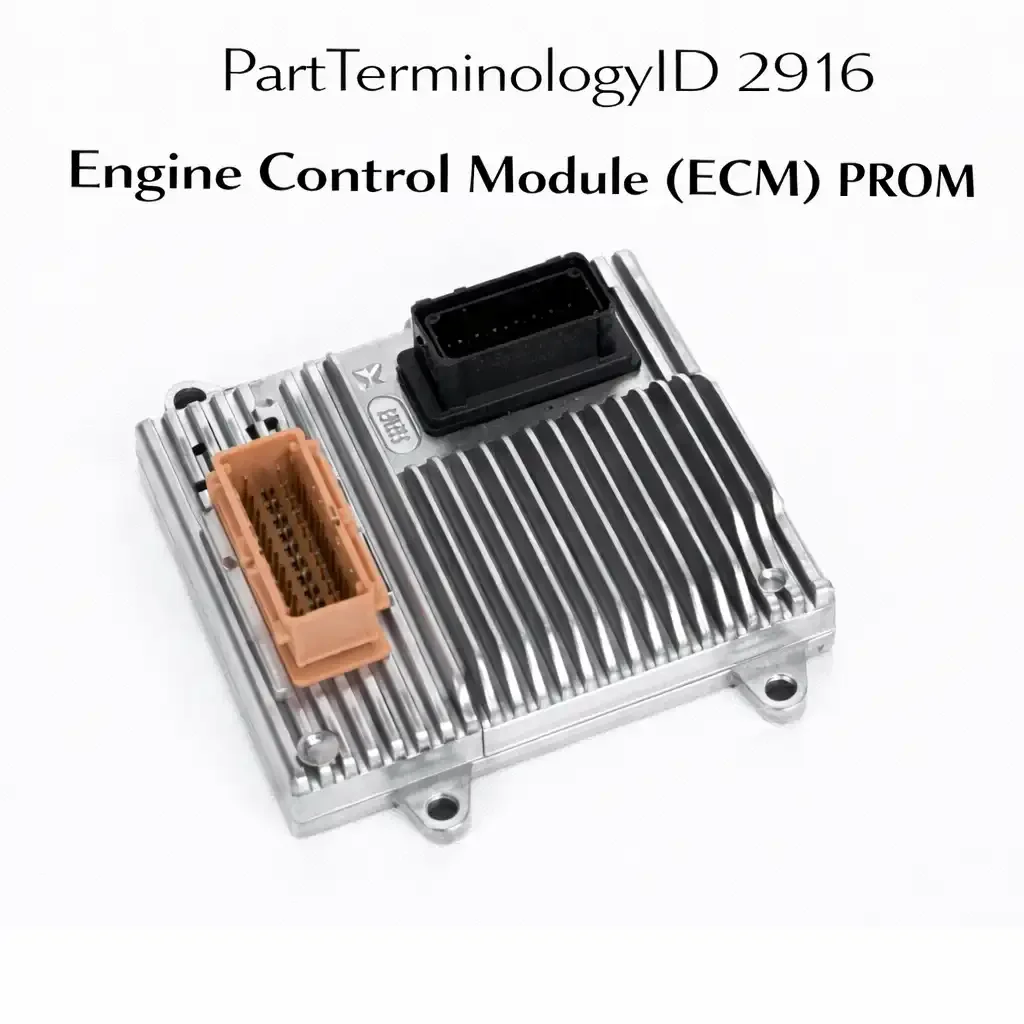
PartTerminologyID 2916, Engine Control Module PROM, is the removable programmable read-only memory chip installed in the engine control module that contains the vehicle-specific calibration data governing fuel injection pulse width, ignition advance curves, idle speed targets, emissions control thresholds, torque converter lockup logic, and transmission shift schedules. That definition covers the calibration storage function correctly and leaves unresolved the calibration code that must exactly match the vehicle's engine, transmission, fuel system, and emissions equipment, the ECM hardware part number the PROM is compatible with, and whether the buyer's vehicle uses the removable PROM architecture at all or has a later flash-based ECM updated through OBD II scan tool programming rather than chip replacement.
For sellers, PartTerminologyID 2916 covers a part with a well-defined application window: primarily GM vehicles from approximately 1982 through 1995 using C3I, TBI, TPI, and LT1 engine management systems, with the MEMCAL assembly as the most widely recognized form. Every listing must state the calibration code, the compatible ECM hardware part number, the engine and transmission combination, and the emissions certification level. A PROM with the wrong calibration code installed in a correct ECM hardware produces incorrect air-fuel ratios, incorrect ignition timing, and failed emissions tests with no visible external indication that the wrong chip is installed.
What the ECM PROM Does
The ECM PROM separates calibration data from ECM processing hardware, allowing the same ECM circuit board to serve multiple engine and transmission combinations by swapping the PROM chip. The ECM provides the processor and output drivers. The PROM provides the lookup tables and threshold values that tell the ECM how to interpret sensor inputs and generate output commands for the specific application.
A worn or failed PROM chip corrupts calibration data, causing the ECM to command incorrect fuel delivery or ignition timing. Symptoms include rough idle, poor fuel economy, hesitation under load, and emissions failures at RPM and load ranges corresponding to the corrupted calibration table regions. Confirming a PROM failure requires substituting a known-good chip of the correct calibration code, since PROM-era ECMs typically store generic fault codes that do not specifically identify the PROM as the fault source.
Calibration code as the primary matching attribute
The calibration code stamped on the PROM body is the primary matching attribute and must appear in the listing title before any year, make, or model claim. The same vehicle model year may have been produced with multiple calibration codes depending on engine output variant, transmission pairing, axle ratio, evaporative emissions equipment, and geographic market certification. Federal emissions certification and California emissions certification require different calibration codes on the same engine because California's stricter air-fuel targets require adjusted fuel and timing tables. Installing a federal calibration chip on a California-certified vehicle produces an emissions test failure at the California IM240 standard even though the engine runs normally by feel. The calibration code eliminates all of this ambiguity in a single attribute.
Post-1996 inapplicability
Vehicles produced after approximately 1996 with OBD II systems store calibration in flash memory soldered to the ECM circuit board. Calibration updates on these vehicles are performed through scan tool reprogramming at a dealership or authorized programming station. There is no chip to remove or replace. A listing under PartTerminologyID 2916 that does not explicitly exclude post-1996 vehicles will consistently receive orders from buyers with flash-based ECMs whose vehicles have no PROM socket and require a programming service rather than a physical chip. The inapplicability note is not optional context. It is a mandatory order prevention tool.
Listing Requirements
PartTerminologyID: 2916
calibration code (mandatory, in title)
compatible ECM hardware part number (mandatory)
engine code and displacement (mandatory)
transmission type: automatic or manual (mandatory)
emissions certification: federal or California (mandatory)
model year range (mandatory)
inapplicability note for post-1996 flash-based ECM vehicles (mandatory)
OEM part number cross-reference (mandatory)
FAQ (Buyer Language)
What is the ECM PROM?
It is the removable calibration chip inside the engine control module that stores the fuel, ignition, and transmission calibration data specific to the vehicle's engine and emissions equipment. The same ECM hardware serves different applications by swapping the PROM chip to the correct calibration for each combination.
Does my vehicle use a PROM?
Primarily GM vehicles from 1982 through approximately 1995. Vehicles produced after 1996 with OBD II systems store calibration in flash memory updated through scan tool programming. A PROM chip listing does not apply to post-1996 flash-based ECMs.
Why does the calibration code matter if the ECM part number matches?
The ECM hardware part number confirms the processor board is compatible. The calibration code confirms the chip contains the correct fuel, ignition, and transmission tables for the specific engine, transmission, axle, and emissions certification of the vehicle. A wrong calibration code in a correct ECM produces incorrect engine operation with no external indication that the chip is mismatched.
Why This Part Generates Returns
Buyers return ECM PROMs because the calibration code in the listing matches the ECM hardware part number but not the specific engine and transmission combination installed in the vehicle, the emissions certification level is not specified and a federal-calibration chip is delivered to a California-certified vehicle producing an immediate emissions test failure, the buyer's vehicle is a post-1996 OBD II vehicle with a flash-based ECM and no PROM socket exists to receive the chip, and the PROM is the correct calibration but the ECM hardware itself has also failed and the PROM replacement alone does not restore correct engine operation because the processor board requires replacement alongside it.
Final Take for PartTerminologyID 2916
ECM PROM (PartTerminologyID 2916) is a narrow-application PartTerminologyID covering the removable-chip ECM era from approximately 1982 through 1995. The calibration code is the primary matching attribute and must be in the title ahead of any year, make, or model claim. The compatible ECM hardware part number, engine and transmission combination, and emissions certification level are the three supporting attributes that together eliminate every return scenario in the PROM replacement segment. The post-1996 flash ECM inapplicability note is a mandatory order prevention tool that redirects the majority of buyers who land on a PROM listing to the correct diagnosis that their vehicle requires scan tool reprogramming, not a physical chip replacement.