
Written by Arthur Simitian | PartsAdvisory
PartTerminologyID 1868, Parking Brake Lever, has a naming problem that starts at the category level. "Parking brake lever" can refer to two completely different components depending on who is searching and what they are looking at.
Interpretation one: The lever inside the rear drum brake assembly (or at the rear caliper) that the parking brake cable pulls to mechanically apply the rear brakes. This is a small stamped steel lever, roughly the size of a hand, that pivots on a pin and spreads the brake shoes against the drum or pushes the caliper piston against the rotor.
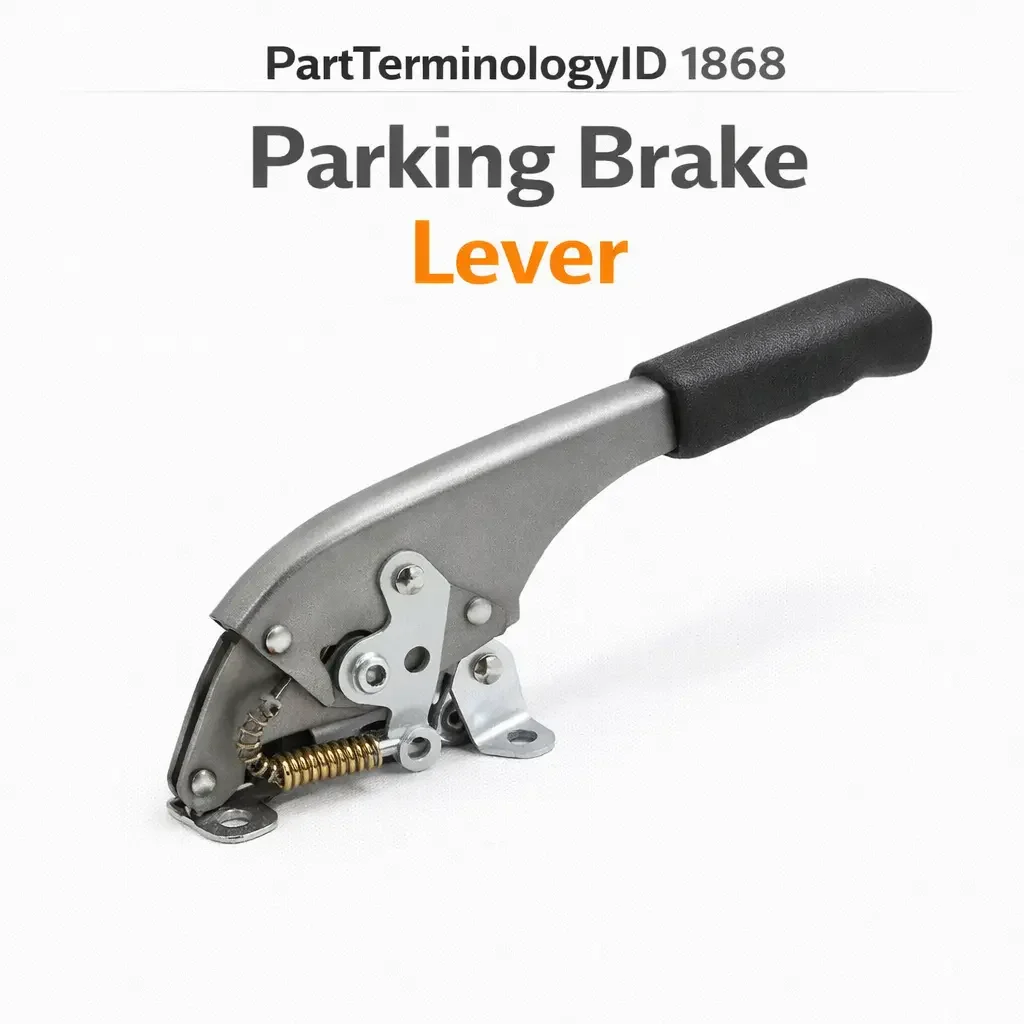
Interpretation two: The lever or handle inside the cabin that the driver pulls, pushes, or steps on to engage the parking brake. This is the console-mounted hand lever, the floor-mounted stick lever, or the foot-operated pedal assembly that tensions the parking brake cable.
Both are called "parking brake lever." Both appear in search results for PartTerminologyID 1868. Both generate returns when the buyer gets the one they did not expect.
This post covers both interpretations, because a seller listing parts under this PartTerminologyID must decide which component the listing describes and must communicate that decision clearly enough that the buyer does not have to guess.
Why This Part Generates Returns
Buyers order the wrong parking brake lever because:
they search "parking brake lever" expecting the cabin handle and receive the drum brake internal lever, or vice versa
they do not verify left vs. right on the internal drum brake lever (the lever is typically side-specific)
they do not verify whether their vehicle uses a hand lever, foot pedal, or electronic parking brake switch in the cabin (electronic systems have no mechanical lever at all)
they miss drum brake vs. disc brake parking brake differences on the internal lever (different pivot geometry, strut interface, and cable attachment)
they do not verify the cable attachment point style on the internal lever (hook, clevis pin, self-adjusting mechanism)
they confuse the internal parking brake lever with the parking brake strut, the parking brake actuator arm, or the parking brake toggle lever, all of which are separate components in certain drum brake designs
Sellers get caught because the listing says "parking brake lever" without specifying whether the product is the cabin control lever or the wheel-end actuating lever. The buyer fills in the blank with whichever interpretation matches their need, orders, and receives the wrong part.
Status in New Databases
PIES/PCdb: PartTerminologyID 1868, Parking Brake Lever
PIES 8.0 / PCdb 2.0: No change
The Internal Lever (Wheel End)
What it is
The internal parking brake lever is a stamped steel arm that pivots inside the rear brake assembly. On drum brake systems, it is attached to one of the brake shoes (usually the rear shoe in a leading/trailing configuration) and interfaces with a strut or linkage that spans across to the opposite shoe. When the parking brake cable pulls the lever, the lever pivots and pushes the strut outward, forcing both shoes into contact with the drum.
On disc brake systems with caliper-integrated parking brakes, the lever is mounted on the back of the rear caliper. The cable pulls the lever, which rotates a mechanism inside the caliper that pushes the piston against the inboard pad.
Why it varies
The internal lever varies by drum diameter, shoe width, cable attachment style (hook end, clevis pin, ball end), pivot hole diameter, lever arm length, and strut interface geometry. On some vehicles, the lever includes an integrated self-adjuster mechanism that automatically takes up slack as the brake shoes wear. On others, the adjuster is a separate component.
Left and right sides are typically mirror images. The lever arm, cable attachment point, and pivot orientation are reversed. A left lever installed on the right side will have the cable attachment pointing the wrong direction, and the strut interface will not align.
The disc brake version
On rear disc calipers with integrated parking brakes, the lever is a smaller component that bolts to or clips onto the caliper body. Its shape, mounting, and cable interface are completely different from the drum brake version. A vehicle that switched from rear drums to rear discs across model years (or across trim levels within the same year) has two non-interchangeable parking brake levers.
The Cabin Lever (Driver Interface)
What it is
The cabin parking brake lever is the control the driver operates to engage the parking brake. It comes in several forms:
Center console hand lever: A lever mounted between the front seats that the driver pulls upward. A ratchet mechanism holds the lever in the engaged position. A release button on the lever tip disengages the ratchet.
Floor-mounted stick lever: A lever mounted to the floor, typically near the driver's seat, that pulls upward or rearward. Similar ratchet mechanism.
Foot pedal: A pedal assembly on the far left of the driver's footwell that the driver pushes with their foot. A separate release handle (often under the dashboard or on the pedal itself) disengages it.
Electronic parking brake switch: A button or toggle on the console that activates an electric motor at each rear caliper. There is no mechanical lever, no cable, and no ratchet. Vehicles with electronic parking brakes do not have a PartTerminologyID 1868 component in the cabin.
Why it varies
The cabin lever varies by mounting location, lever length, ratchet tooth count, cable attachment (single cable, dual cable, equalizer interface), handle grip material and shape, release button mechanism, and the warning light switch integrated into the lever assembly.
Trim level matters. Some vehicles used different lever handle materials (leather-wrapped vs. plastic) or different lever colors between base and premium trims. While the mechanical function is the same, a buyer who cares about interior appearance will return a black plastic lever when their vehicle has a leather-wrapped one.
Top Return Scenarios
Scenario 1: "I ordered a parking brake lever and got a small metal piece"
Buyer expected the cabin hand lever and received the internal drum brake actuating lever.
Prevention language: "This is the [internal drum brake actuating lever at the rear wheel / cabin-mounted parking brake control lever]. Verify which component you need."
Scenario 2: "Wrong side"
Internal lever is for the opposite wheel.
Prevention language: "Position: [left (driver side) / right (passenger side)]. Internal parking brake levers are side-specific. Verify which side you are servicing."
Scenario 3: "Cable doesn't attach to this lever"
Cable end style (hook, clevis, ball) does not match the lever's cable attachment point.
Prevention language: "Cable attachment: [hook end / clevis pin / ball end socket]. Verify your parking brake cable end style matches this lever."
Scenario 4: "My car has electronic parking brake, there is no lever"
Buyer's vehicle uses an electronic parking brake with no mechanical cabin lever.
Prevention language: "For vehicles with manual (cable-operated) parking brake only. Not for vehicles equipped with electronic parking brake (EPB)."
Scenario 5: "Lever is drum brake style, my car has rear discs"
Internal lever design does not match the buyer's rear brake type.
Prevention language: "Designed for vehicles with [rear drum brakes / rear disc brakes with caliper-integrated parking brake]. Verify your rear brake configuration."
What to Include in the Listing
Core essentials
PartTerminologyID: 1868
component: Parking Brake Lever
location: internal (wheel end) or cabin (driver interface)
quantity: 1
Fitment essentials
year/make/model/submodel
rear brake type (drum, disc with caliper-integrated, disc with drum-in-hat)
parking brake type (cable-operated manual, electronic)
position: left, right, or center console (cabin levers)
trim level (if cabin lever differs by trim)
Dimensional and interface essentials (internal lever)
lever arm length
pivot hole diameter
cable attachment type (hook, clevis, ball)
strut interface style
self-adjuster integrated: yes/no
Dimensional and interface essentials (cabin lever)
mounting location (console, floor, footwell pedal)
cable attachment (single, dual, equalizer)
ratchet type and tooth count
handle material and color
warning light switch included: yes/no
release mechanism type (button, pull handle, pedal re-push)
Image essentials
full lever with cable attachment point visible
pivot or mounting interface visible
for internal levers: installed position reference showing shoe/caliper context
for cabin levers: mounting bracket and cable routing visible
Catalog Checklist for ACES/PIES Teams
PartTerminologyID = 1868
require location attribute (internal wheel-end or cabin driver-interface) as the primary differentiator
require position attribute (left/right for internal, mounting location for cabin)
require rear brake type for internal levers
require parking brake system type (cable/mechanical vs. electronic)
require cable attachment type for internal levers
differentiate from parking brake strut, parking brake actuator, parking brake toggle, and parking brake shoe lever (related but distinct components)
flag vehicles with electronic parking brakes where no mechanical lever exists
FAQ (Buyer Language)
Is this the handle inside the car or the piece inside the brake?
Check the listing. PartTerminologyID 1868 can refer to either the cabin-mounted control lever or the internal actuating lever at the rear brake. The listing should specify which component is being sold.
My parking brake doesn't hold. Is the lever the problem?
Usually not. A parking brake that does not hold is more commonly caused by a stretched or seized cable, worn brake shoes or pads, a misadjusted self-adjuster, or contaminated friction material. The lever itself rarely fails unless it is physically broken, bent, or the pivot is worn out.
Does this come with the return spring?
Usually not. The parking brake lever return spring (PartTerminologyID 1832) is typically sold separately. Check the listing for included components and order the spring separately if needed.
Cross-Sell Logic
Parking Brake Lever Return Spring (PartTerminologyID 1832)
Parking Brake Cable
Parking Brake Shoe Set (for drum-in-hat applications)
Drum Brake Hardware Kit (PartTerminologyID 1772)
Parking Brake Strut
Rear Brake Shoe Set
Frame as "commonly inspected or replaced together during parking brake service."
Final Take for PartTerminologyID 1868
Parking Brake Lever (PartTerminologyID 1868) is a part with an identity problem. The same name describes two components in two different locations doing two different jobs. The internal lever actuates the brake at the wheel. The cabin lever is what the driver touches.
State which one the listing is for. That single attribute, location, eliminates the largest share of returns. Then add the position (left/right for internal, mounting type for cabin), the rear brake type, the cable attachment style, and whether the vehicle even has a mechanical parking brake in the first place. That is the full return prevention stack for a part whose biggest problem is that the name does not narrow it down enough.