
Written by Arthur Simitian | PartsAdvisory
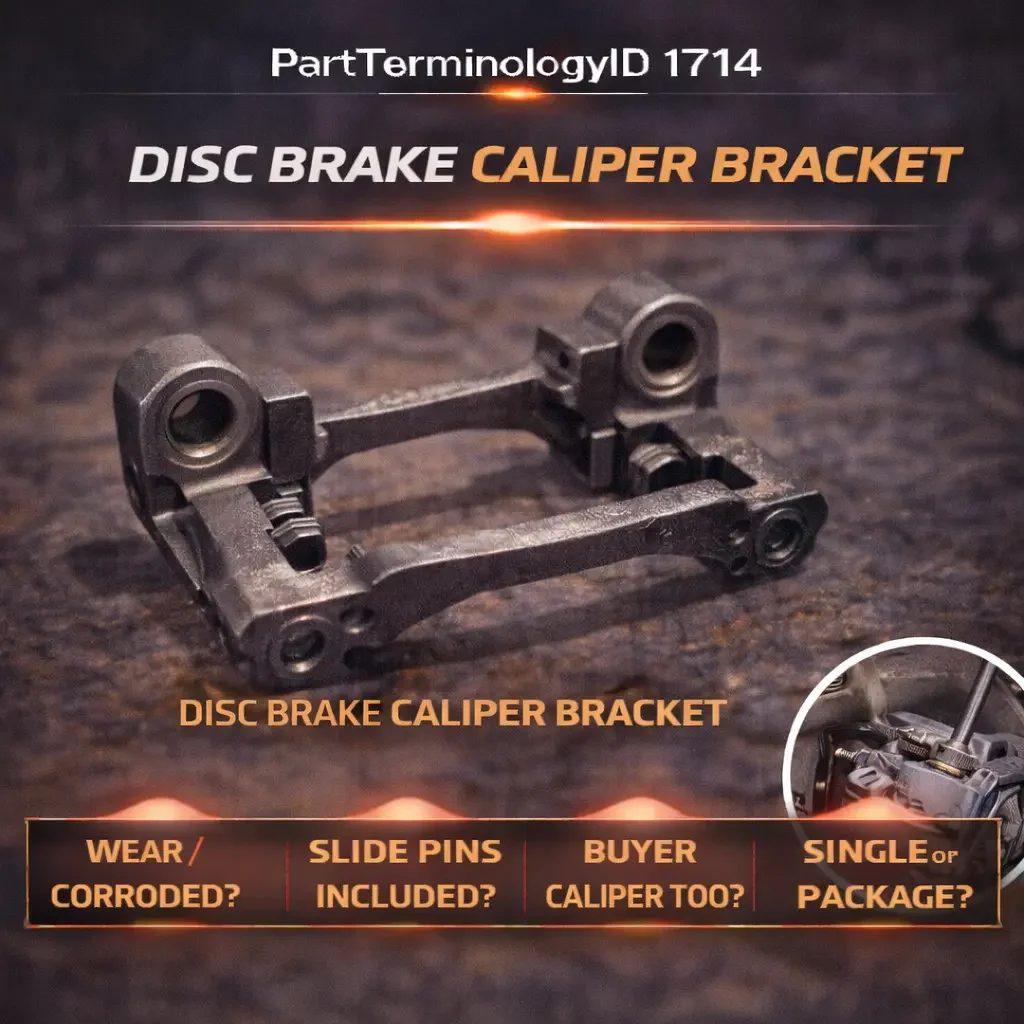
The disc brake caliper bracket (also called the caliper anchor, caliper support, caliper carrier, or caliper adapter) is the stationary mounting component that bolts to the steering knuckle or axle flange and holds the floating caliper assembly in position over the brake rotor. The brake pads sit in the bracket, resting on machined abutment surfaces (ledges) with their ears held by stainless steel abutment clips. The caliper body slides on guide pins (slide pins) that are pressed into or threaded into the bracket. When the brakes are applied, the caliper clamps the pads against the rotor while the bracket anchors the entire assembly to the vehicle's suspension.
The bracket is the most overlooked wear component in the disc brake system. Technicians and DIY buyers routinely replace pads, rotors, and calipers while transferring the old bracket to the new caliper without inspection. The bracket's pad abutment surfaces wear into grooves from thousands of brake applications. Its slide pin bores corrode internally from moisture intrusion through torn pin boots. Its bolt holes elongate from repeated torque cycling. And its mounting surfaces corrode where they contact the knuckle, creating a gap that allows the bracket to shift microscopically under braking load. Every one of these wear conditions causes symptoms - noise, uneven pad wear, brake drag, reduced braking - that the buyer attributes to the pads or the caliper rather than the bracket.
This product exists as a standalone PartTerminologyID because brackets do wear out, they are frequently damaged during caliper service, and the aftermarket now sells them separately for buyers who need the bracket without a new caliper. It also exists because some caliper listings (PartTerminologyID 1704) include the bracket and others do not, creating a need for buyers to order the bracket independently.
PIES/PCdb: PartTerminologyID 1714 - Disc Brake Caliper Bracket
PIES 8.0 / PCdb 2.0: No change
What Disc Brake Caliper Bracket Means in the Aftermarket
The bracket's role in braking performance
The bracket is not just a mounting fixture. It is a precision component with several functional surfaces that directly affect braking performance:
Pad abutment surfaces. The machined ledges where the brake pad ears rest and slide during braking. When the pads are pushed against the rotor, they transfer braking force through their ears to these abutment surfaces, and from the surfaces through the bracket to the knuckle. If the abutment surfaces are grooved, corroded, or have debris buildup, the pads cannot slide freely. Pads that cannot slide bind in the bracket, causing uneven wear (one end of the pad wears faster than the other), noise (the pad vibrates against the worn surface), and reduced braking (the pad does not make full contact with the rotor).
Slide pin bores. The cylindrical holes in the bracket where the caliper slide pins ride. The pins must slide freely in these bores with minimal clearance (typically 0.001 to 0.003 inches). If the bores corrode internally, the pins bind and the caliper cannot center itself over the rotor. This causes the inner pad (piston side) to wear dramatically faster than the outer pad - the most common symptom of slide pin seizure documented in PartTerminologyID 1704 (Disc Brake Caliper).
Knuckle mounting surfaces. The flat surfaces where the bracket contacts the steering knuckle. Corrosion or debris between these surfaces prevents the bracket from sitting flush, which can allow the bracket to shift under braking loads and may cause the rotor-to-pad alignment to be off, resulting in tapered pad wear.
Bolt holes. The through-holes for the bracket-to-knuckle bolts (PartTerminologyID 1710/1712). These holes can elongate from repeated bolt torque cycling or from the bracket shifting under braking load on corroded mounting surfaces.
Why the bracket wears out
Abutment surface grooving. Every brake application pushes the pad ears across the abutment surfaces. Over tens of thousands of brake applications, the pad ears (which are hardened steel) cut grooves into the bracket's abutment surfaces (which are cast iron or aluminum). These grooves trap the pad ears, preventing the pads from retracting when the brakes are released, causing drag. The grooves also allow the pads to cock sideways, creating uneven contact with the rotor.
Slide pin bore corrosion. When the rubber pin boots tear (from age, heat cycling, road debris, or careless pad replacement), moisture and road salt enter the pin bore. The bore corrodes, creating a rough surface that binds the slide pin. Even after cleaning and re-greasing, a bore that has been corroded may have dimensional changes that prevent the pin from sliding freely. At that point, the bracket must be replaced.
Corrosion buildup on abutment surfaces. In salt-belt climates, iron oxide corrosion builds up on the abutment surfaces and in the pad ear channels. This buildup prevents the pad ears from seating flush and restricts pad movement. Cleaning the corrosion and installing new abutment clips can restore function temporarily, but on heavily corroded brackets, the underlying metal has been consumed and the abutment geometry is permanently altered.
Physical damage. The bracket can crack from impact (road debris, curb strike), warp from extreme heat (dragging brakes, aggressive downhill braking with seized caliper), or break at the slide pin bore if a seized pin is forced out with excessive mechanical force.
Product Configurations
Bracket only
The bare bracket casting with machined abutment surfaces, slide pin bores, and bolt holes. No slide pins, no pin boots, no abutment clips, no pads. The buyer must transfer the slide pins, boots, and hardware from the old bracket or purchase them separately. This is the most common listing configuration.
Bracket with slide pins and boots
The bracket with new slide pins pre-installed (or packaged separately), new pin boots, and pin grease. This is the preferred configuration because the buyer is replacing the bracket specifically because the old bracket's pin bores are corroded - so the old pins are also likely corroded and should not be reused.
Bracket with abutment clips (hardware)
The bracket with new stainless steel abutment clips pre-installed or included in the package. Since abutment clips should be replaced with every pad change (and certainly with every bracket replacement), including them eliminates one more separate purchase.
Top Return Causes
1) Bracket already included with the caliper
The buyer orders a caliper (PartTerminologyID 1704) that includes the bracket, then separately orders a bracket (PartTerminologyID 1714). The bracket is a duplicate purchase.
Prevention: Cross-reference with the caliper listing. "Verify whether your replacement caliper includes the mounting bracket before ordering this bracket separately. Calipers listed as 'loaded with bracket' include this component."
2) Wrong brake package or caliper type
The vehicle has multiple caliper/bracket options (standard versus heavy-duty, single-piston versus dual-piston, standard versus performance package). The bracket's pad abutment width, slide pin spacing, bolt hole pattern, or overall dimensions do not match the buyer's caliper.
Prevention: Brake package in the fitment details. Bracket dimensions (pad abutment width, slide pin bore spacing, bolt hole spacing) in the specifications. "Fits vehicles with [standard / heavy-duty / performance] brake package. Verify your caliper type before ordering."
3) Slide pins not included, buyer cannot complete the job
The buyer orders a bracket-only listing expecting slide pins and boots to be included. The pins from the old bracket are corroded and cannot be reused. The buyer cannot assemble the caliper without pins.
Prevention: Included components clearly listed: "Bracket only - slide pins, pin boots, and pin grease NOT included" or "Includes bracket with pre-installed slide pins, pin boots, and silicone grease." Cross-reference the slide pin kit if pins are not included.
4) Left versus right side confusion
On some vehicles, the bracket is side-specific (the brake hose routing, ABS sensor bracket, or pad wear sensor mounting differs between left and right). The buyer orders the wrong side.
Prevention: Side specified in the title if application-specific: "Left (Driver Side)" or "Right (Passenger Side)." If the bracket is the same for both sides: "Fits both left and right."
5) Bracket does not match aftermarket caliper
The buyer has a non-OE caliper (aftermarket upgrade, different brand reman) and orders an OE-spec bracket. The pin bore spacing, pad abutment geometry, or mounting bolt pattern does not match the non-OE caliper. This is particularly common with brake upgrade kits where the caliper and bracket are designed as a matched pair.
Prevention: "This bracket is designed for OE-specification calipers. If you have an aftermarket or upgraded caliper, verify that the bracket dimensions match your caliper's slide pin spacing and pad abutment width."
Catalog Checklist for Attributes
Core taxonomy: Component type: caliper mounting bracket (anchor/support/carrier). Position: front, rear. Side: left, right, universal. Configuration: bracket only, bracket with slide pins and boots, bracket with hardware. Separate from disc brake caliper (PartTerminologyID 1704 - may include bracket), caliper bolt kit (PartTerminologyID 1710), caliper slide pin kit (different PartTerminologyID), brake pad set (PartTerminologyID 1684).
Fitment: Year, make, model, submodel, trim, engine. Brake package (standard, heavy-duty, performance). Position (front/rear). Side (left/right/universal). Caliper manufacturer compatibility (OE, Akebono, TRW, Brembo, etc.).
Specifications: Material (cast iron, aluminum). Pad abutment width. Slide pin bore diameter and spacing. Knuckle bolt hole spacing and size. Overall bracket dimensions. Weight.
Included components: Bracket casting. Slide pins (yes/no). Pin boots (yes/no). Pin grease (yes/no). Abutment clips (yes/no). Mounting bolts (yes/no, usually no).
Installation notes: Clean knuckle mounting surfaces before installation. Lubricate slide pins with brake-specific silicone grease. Install new abutment clips. Torque bracket bolts to specification with threadlocker. Verify caliper slides freely on pins after assembly. Verify pad ears slide freely on abutment surfaces.
Images: Bracket showing abutment surfaces, slide pin bores, and bolt holes. Bracket with pins installed (if included). Reference showing bracket position on knuckle. Abutment surface detail.
FAQ
When should I replace the caliper bracket?
Replace the bracket when the pad abutment surfaces are grooved or corroded beyond cleaning, when the slide pin bores are corroded or scored internally (pins bind even after cleaning and re-greasing), when the bracket is cracked or warped, or when the bolt holes are elongated. If you are replacing the caliper for slide pin seizure and the pin bores are the root cause, replacing the caliper without replacing the bracket will result in the same seizure on the new caliper.
Is the caliper bracket the same as the caliper?
No. The bracket is the stationary part that bolts to the knuckle. The caliper is the hydraulic part (with the piston) that slides on the bracket. On floating caliper designs, the bracket and caliper are separate components. Some caliper listings include the bracket; others do not. Verify what is included before ordering.
Can I just clean the old bracket instead of replacing it?
If the abutment surfaces are lightly corroded but not grooved, and the slide pin bores are smooth and dimensionally correct after cleaning, the bracket can be reused. Clean the abutment surfaces with a wire brush or file, apply fresh abutment clips, clean and re-grease the slide pin bores, and inspect for smooth pin movement. If grooves are present in the abutment surfaces or if the pins still bind after cleaning, replacement is the correct repair.
Final Take for Aftermarket Teams
Disc Brake Caliper Bracket (PartTerminologyID 1714) is the most overlooked wear component in the disc brake system. It generates returns primarily through duplicate purchases (buyer orders bracket separately when it was already included with the caliper), wrong brake package, and missing slide pins. The catalog teams that handle this product well do three things: they cross-reference with the caliper listing (PartTerminologyID 1704) to prevent duplicate purchases, they specify whether slide pins and boots are included, and they list the bracket dimensions so the buyer can verify compatibility with their caliper. The broader opportunity is educating the market that the bracket is a wear component, not a lifetime part, and that replacing pads and calipers on a worn bracket is like putting new tires on bent rims.