
Window Film (PartTerminologyID 1327): Tint Laws, Film Types, and the Catalog Complexity Behind a Roll of Film
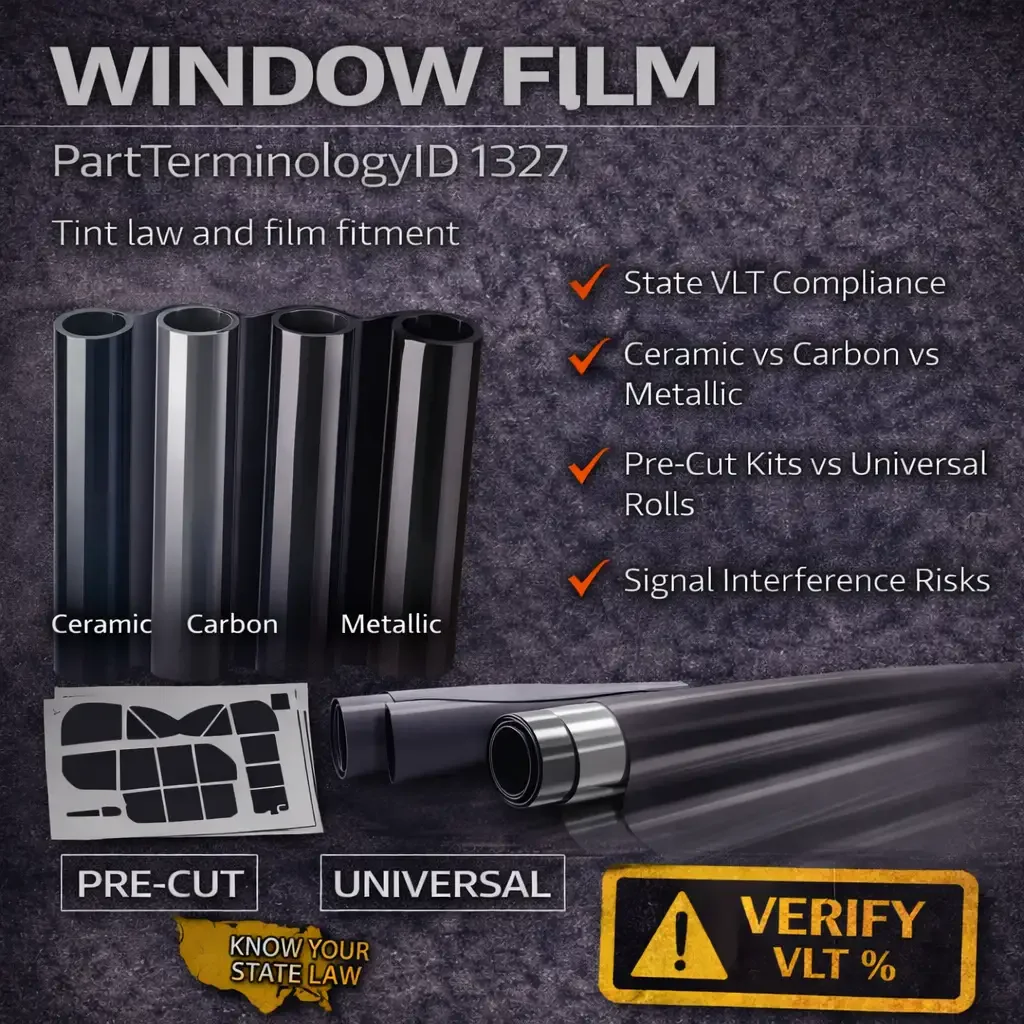
Window Film looks like one of the simplest products in the aftermarket. It is a roll or sheet of tinted material applied to vehicle glass. But from a catalog and return perspective, it is one of the most regulation-sensitive, specification-dense, and buyer-confusion-prone categories in the Oil, Fluids, and Chemicals section of PCdb.
The core problem is that window tint legality varies by state, by window position, and by vehicle type. A film that is perfectly legal on the rear windows in California is illegal on the front side windows. A film that passes inspection in Texas fails in New York. Every catalog listing for Window Film carries an implicit legal compliance question that the buyer may not know to ask and the seller may not think to answer.
Add to that the technical complexity of film types (dyed, metallic, ceramic, carbon, hybrid), the VLT (visible light transmission) percentage system, UV and infrared rejection ratings, and the difference between pre-cut vehicle-specific kits and universal rolls, and you have a category that generates avoidable returns at a rate far higher than its simple appearance suggests.
This post is built for aftermarket catalog teams, marketplace sellers, and buyers who want fewer mistakes and fewer returns.
Status in New Databases
Status in New Databases
Current: PIES 7.2 + PCdb Future: PIES 8.0 + PCdb 2.0 Status: No change
What Window Film Means in the Aftermarket
Window Film in the aftermarket refers to any adhesive film applied to vehicle glass for tinting, UV protection, heat rejection, or privacy purposes. In catalog reality, this covers several distinct product types:
Pre-cut window tint kits (computer-cut to fit specific vehicle windows by year, make, model)
Universal window tint rolls (sold by width and length, buyer cuts to fit)
Ceramic window film (premium heat rejection, no signal interference)
Carbon window film (matte finish, good heat rejection)
Metallic window film (reflective, strong heat rejection, may interfere with radio/GPS/cellular signals)
Dyed window film (budget option, primarily cosmetic, limited heat rejection)
Hybrid window film (combination of dyed and metallic layers)
Clear UV-rejection film (no visible tint, UV protection only)
Security/safety film (thicker film designed to hold shattered glass together)
Decorative or colored film (non-standard tint colors for show vehicles)
This is where catalogs go wrong first. Buyers use "window tint" as a generic term but have very different needs. Some want the darkest legal tint for privacy. Some want maximum heat rejection for comfort. Some want UV protection to prevent interior fading. Some want a clear film for UV blocking without any visible tint. Some want security film to protect against break-ins. If the listing does not clearly define the film type, VLT percentage, and intended purpose, buyers will order the wrong product.
Why This Category Creates Returns
State tint laws and VLT compliance
This is the number one issue in the Window Film category. Every US state has different regulations for how dark window tint can be on different windows:
Windshield: most states allow a tint strip at the top only (typically the top 4 to 6 inches), some allow none
Front side windows: VLT requirements range from 24% to 70% depending on the state; some states prohibit any aftermarket tint
Rear side windows: generally more permissive, some states allow any darkness
Rear window: generally more permissive, some states allow any darkness
SUVs and vans: some states allow darker tint on rear windows for multi-purpose vehicles than for sedans
A buyer in one state may legally install 20% VLT film on their rear windows but face a citation if they apply the same film to their front side windows. If the catalog listing does not clearly state the VLT percentage and does not include a note about checking local regulations, the buyer may install the film, fail a vehicle inspection, and return the product blaming the seller.
VLT percentage confusion
VLT (Visible Light Transmission) is the percentage of visible light that passes through the film. Lower VLT means darker tint. 5% VLT is very dark (limo tint). 50% VLT is a light tint. 70% VLT is barely visible. Buyers often confuse the numbers. Some think a higher number means darker. Some do not understand that VLT is measured including the factory glass tint, so a 35% VLT film applied to factory glass that already has 75% VLT results in a combined VLT of roughly 26%. If the listing does not explain this clearly, buyers end up with tint that is darker or lighter than they expected.
Film type and performance expectations
A buyer who wants maximum heat rejection but orders a dyed film (the cheapest type) will be disappointed because dyed film provides minimal heat rejection. A buyer who orders metallic film for heat rejection may find that it interferes with their GPS, cellular signal, toll transponder, or Bluetooth. A buyer who orders carbon film expecting the same heat rejection as ceramic will be disappointed. These are specification mismatches that proper catalog content can prevent.
Pre-cut kits vs. universal rolls
Pre-cut kits are computer-cut from a pattern database to fit specific windows on a specific vehicle. They require no trimming and minimize waste. Universal rolls require the installer to cut the film to fit, which requires skill, tools, and experience. Buyers who order a universal roll expecting a pre-cut kit will be frustrated by the installation complexity. Buyers who order a pre-cut kit for the wrong vehicle year or body style will receive pieces that do not fit their windows.
Installation skill level
Window film installation is not beginner-friendly. Even pre-cut kits require a clean environment, proper tools (squeegees, heat guns, slip solution), and technique to avoid bubbles, creases, and contamination. Buyers who expect a simple peel-and-stick experience often produce poor results and blame the product. This is not strictly a catalog problem, but listings that do not set installation expectations contribute to returns.
Naming Confusion That Causes Buyer Mistakes
Window Film vs. Window Tint
These terms are largely interchangeable in buyer language. "Window tint" is the more common search term. "Window film" is the formal product name. Listings should use both terms for search discoverability.
Window Film vs. Paint Protection Film (PPF)
Paint protection film is a thick, clear urethane film applied to exterior painted surfaces to protect against rock chips and scratches. It is not window film. But buyers searching "car film" may find either product type. These are completely different categories and should be clearly separated.
Window Film vs. Windshield Sun Shade
Some buyers searching for UV or heat protection may confuse window film with removable windshield sun shades. These are different product categories entirely.
Tint Percentage Terminology
Sellers use various terms inconsistently: "20% tint," "20% VLT," "80% shade." These can mean different things if not clearly defined. Always use VLT percentage with a clear definition in the listing.
Compatibility Checklist for Buyers
1) Check your state's tint laws before ordering. Confirm the legal VLT percentage for each window position (windshield, front side, rear side, rear) for your vehicle type (sedan, SUV, van) in your state.
2) Understand VLT percentage. Lower number means darker tint. Factory glass already blocks some light (typically 70% to 80% VLT). Aftermarket film combined with factory glass produces a darker result than the film's rated VLT alone.
3) Choose the right film type for your goal. Ceramic for maximum heat rejection without signal interference. Carbon for good heat rejection and matte appearance. Metallic for strong heat rejection but potential signal interference. Dyed for budget cosmetic tinting with minimal heat rejection. Clear for UV protection without visible tint.
4) Pre-cut or universal roll. Pre-cut kits require exact year, make, model, and body style. Universal rolls require cutting skill and tools. Choose based on your installation capability.
5) For pre-cut kits, confirm exact vehicle details. Year, make, model, body style (sedan, coupe, wagon, hatchback), and sometimes trim level (panoramic roof vs. standard roof). A kit cut for a sedan will not fit the coupe of the same model.
6) Confirm what is included. Number of window pieces, application tools, slip solution, squeegee, instructions. Some kits include all tools. Some include film only.
7) Set installation expectations. Even pre-cut film requires skill to apply without bubbles. Consider professional installation if you are not experienced.
Catalog Checklist for Attributes
Core taxonomy: Film type (ceramic, carbon, metallic, dyed, hybrid, clear UV, security). Fit type (pre-cut vehicle-specific or universal roll).
Optical specs: VLT percentage, UV rejection percentage, infrared rejection percentage, total solar energy rejection (TSER) if available.
Physical specs: Film thickness (mil), roll width and length (universal), number of pieces and window positions covered (pre-cut).
Fitment (pre-cut): Year, make, model, body style. Window positions included (front sides, rear sides, rear, windshield strip, full vehicle).
Signal transparency: GPS/cellular/Bluetooth/toll transponder compatible yes or no. Metallic films should carry a signal interference warning.
Legal: Include a visible note: "Buyer is responsible for verifying compliance with local and state window tint regulations before installation." Never state or imply that a specific VLT is "legal everywhere."
Package contents: Film pieces or roll, application tools, instructions, warranty card.
Images: Film on vehicle showing tint level, VLT comparison chart, package contents, installed interior view showing visibility level.
FAQ
Is window tint legal?
Legality depends on the VLT percentage, the window position, the vehicle type, and the state. Every state has different regulations. Always check your local laws before purchasing or installing window film.
What VLT should I choose?
That depends on your goal and your state's laws. For maximum privacy where legal, 5% to 20% on rear windows. For a balanced look, 35%. For heat and UV rejection with minimal appearance change, 50% to 70%. For UV only with no visible tint, clear UV film.
Will metallic window film affect my GPS or phone signal?
Yes, metallic films can interfere with GPS, cellular, Bluetooth, toll transponder, and satellite radio signals. If signal transparency matters, choose ceramic or carbon film instead.
What is the difference between pre-cut and universal window film?
Pre-cut kits are computer-cut to fit your specific vehicle's windows with no trimming required. Universal rolls require you to cut the film to fit, which demands tools and installation skill.
Final Take for Aftermarket Teams
Window Film (PartTerminologyID 1327) is a regulation-sensitive category where the biggest return driver is not physical fitment but legal compliance and specification mismatch. Catalog teams that win here clearly state VLT percentage and film type in every title, include a tint law compliance disclaimer, separate pre-cut kits from universal rolls, flag metallic film signal interference, and set realistic installation expectations. The product is simple. The catalog requirements are not.