
Floor Liner (PartTerminologyID 1297): Row Coverage, Smart Bundles, and the Details That Stop Returns
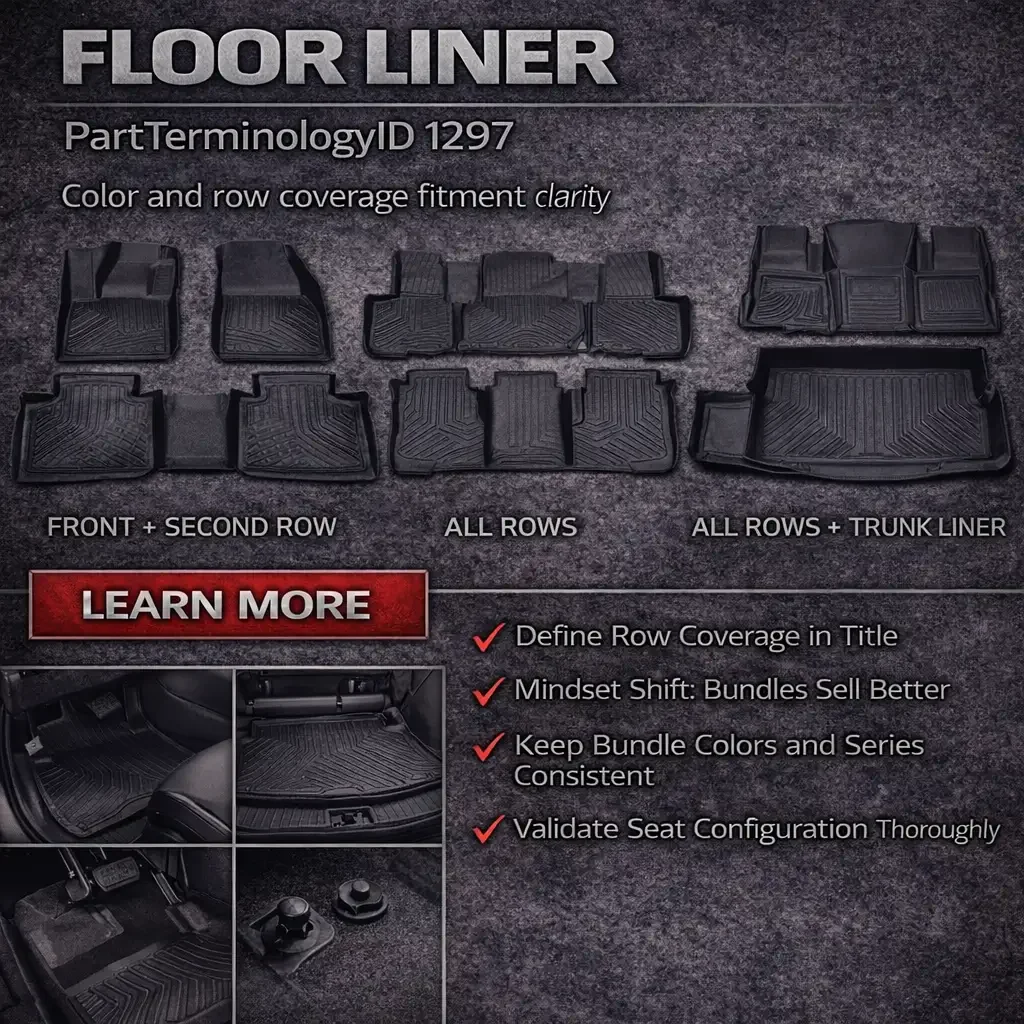
Floor Liner is one of the biggest categories in the aftermarket because it solves a real buyer problem fast. Mud. Snow. Rain. Work boots. Kids. Pets. Spills. A liner protects carpet, reduces cleanup, and keeps the interior feeling new.
That same demand also produces predictable returns. Most returns in this category are not because the product is bad. They happen because listings are unclear about row coverage, vehicle configuration, and retention compatibility.
And there is another layer that separates average sellers from top performers.
Floor liners are often sold by row. That creates a bundling opportunity that can raise conversion and AOV immediately, but only if bundles are built correctly.
If you bundle the wrong way, you do not just lose margin. You create returns.
This post covers both: how to catalog floor liners cleanly and how to build bundles that sell, without creating a mismatch trap.
Status in New Databases
Status in New Databases
Current: PIES 7.2 + PCdb
Future: PIES 8.0 + PCdb 2.0
Status: No change
What a Floor Liner Actually Is
A Floor Liner is an interior floor protection product designed to sit on top of carpet and provide:
contoured coverage matched to the floor pan
raised edges for containment
easier cleaning compared to carpet mats
protection against liquids, salt, mud, and debris
Buyers usually expect liners to behave like a tray. When you sell something that behaves like a flat mat and call it a liner, you invite dissatisfaction.
Naming Confusion That Causes Wrong Orders
Floor Liner vs Floor Mat
A floor mat is typically flatter and offers less side-wall coverage. A floor liner is typically contoured with raised edges.
Buyer expectation problem:
If a listing says liner, the buyer expects containment.
Floor Liner vs All-Weather Mat
“All-weather” is a marketing label. It can describe true molded liners or simple rubber mats.
Catalog rule:
Do not rely on “all-weather” to define product form. Define product form explicitly.
Floor Liner vs Cargo Liner
Cargo liner protects the cargo area. Floor liner protects cabin footwells.
Bundling opportunity exists here, but the product types must stay clear.
Floor Liner vs Universal Trim-to-Fit
Universal products can be good value, but they must be labeled clearly. Buyers ordering universal liners often still expect molded fit unless you make it obvious.
Why Fitment Is Harder Than It Looks
Floor liners interact with vehicle geometry in ways buyers do not think about.
Cab and body configuration matters
A truck’s crew cab and extended cab can share a model name and still have different rear floor shapes.
Seating configuration matters
Rear liner fit changes with:
bench vs captain’s chairs
rear console presence
60/40 vs 40/20/40 splits
third-row fold design
Retention compatibility matters
If the liner does not lock onto factory retention posts or hooks, the buyer complains about movement. Driver-side movement becomes a safety concern.
Coverage expectations differ
Some buyers want deep walls and maximum coverage. Others prefer easier entry and removal. If you do not show edge height clearly, buyers assume.
Major Variants You Must Separate
1) Vehicle-Specific Molded Liners
Best fit, highest containment, highest buyer expectation.
2) Semi-Universal Contoured Liners
Good value, but requires clear measurement expectations.
3) Universal Trim-to-Fit Liners
Budget solution, but trimming and fit realism must be stated upfront.
4) Front Only vs Multi-Row Kits
This is the biggest listing trap. Buyers often assume sets include more rows than they do.
Floor Liners Are Sold by Row and That Creates a Bundle Advantage
This is the piece many catalogs underuse.
Many brands sell liners as:
Front row only
Second row only
Third row only
Cargo or trunk liner only
That row-based selling structure is a natural opening for bundles that increase conversion.
Why bundles sell better than single-row sets
Buyers rarely want to protect only one row long-term. Many start with the front row, then come back for the second row later. Bundles capture that demand in one purchase and reduce the second decision.
Bundles also help in climates and use cases where the whole interior gets exposed:
snow and salt
beach sand
muddy job sites
kids and pets
Bundle formats that work
Front + Second Row Bundle
This is the most common value bundle. It fits most buyer intent and usually has the least configuration complexity.
All Rows Bundle
Front + second + third row where applicable. High AOV, strong conversion when row coverage is clearly stated.
Front + Second + Cargo Liner Bundle
This is the premium interior protection kit. It often outsells single pieces when presented as “complete interior protection.”
All Rows + Cargo Liner Bundle
For three-row SUVs, this is the top-tier kit, but it must be fitment-mapped carefully.
Bundling rules that prevent returns
This is the most important part.
Rule 1: Same color across the entire bundle
You cannot bundle front black and rear gray. Even if both “fit,” the buyer sees it as wrong and returns it.
Rule 2: Same material and same series across the entire bundle
Do not mix product lines. Do not bundle a premium molded front liner with a cheaper universal rear liner. That creates mismatch in texture, height, and look.
Rule 3: Same brand line where possible
Buyers expect a matched set. A mixed-brand bundle looks like an error.
Rule 4: Make row coverage explicit in the bundle name and bullets
Say exactly what is included:
Front row liners
Second row liner pieces
Third row liner pieces
Cargo liner included or not
Rule 5: Validate configuration compatibility for every included row
Third row coverage is where bundles break most often. If the vehicle has multiple third-row layouts, you need correct mapping and exclusions.
Rule 6: Keep piece count visible
A bundle listing should clearly state the number of pieces and which area each piece covers.
If you do bundling right, you increase AOV and reduce future repurchase friction. If you do it wrong, you create returns that are completely avoidable.
Pros and Cons
Pros
High-value protection
Liners protect carpet and interior resale value.
Strong buyer demand
This is one of the most searched interior accessory categories.
Bundling increases conversion and AOV
Front plus second row and full kits often sell better than single-row pieces.
Clear upsell path
Cargo liner bundles are a natural add-on.
Cons
Row coverage confusion is constant
Front-only vs full kit misunderstandings drive returns.
Retention mismatch creates movement complaints
Especially on driver side.
Configuration errors break bundles
Wrong third-row mapping or wrong rear layout creates immediate returns.
Mixing color or material in bundles creates instant dissatisfaction
Even if everything fits, the buyer sees it as wrong.
Compatibility Checklist for Buyers
Compatibility Checklist
1) Confirm your vehicle details
Year, make, model, submodel, and body style or cab configuration.
2) Confirm how many rows you need
Front, second, third, and cargo area.
3) Confirm seating layout
Bench vs captain’s chairs and any rear console.
4) Confirm retention system
Factory retention post compatibility and whether clips are included.
5) Confirm driver-side clearance
No pedal interference and liner sits flat.
6) Confirm liner depth
Raised edge height matches your containment needs.
7) Confirm material preference
Flexible vs rigid tray feel.
8) Confirm color
Black, gray, tan, and interior tones vary. Match your interior expectations.
9) If buying a bundle, confirm all pieces match
Same color, same material, same series.
10) Confirm what is included
Row coverage, piece count, and whether cargo liner is included.
Catalog Checklist for Attributes and Structured Data
Catalog Checklist for PartTerminologyID 1297 Floor Liner
Product form
Vehicle-specific molded, semi-universal contoured, universal trim-to-fit.
Row coverage fields
Front row included, second row included, third row included, cargo liner included.
Seating configuration
Bench vs captain’s chairs, rear console yes or no, third-row layout notes.
Body style and cab type
Required where floor pan differs.
Retention system
Factory retention compatible yes or no, clips included yes or no, anti-slip backing yes or no.
Safety
Driver pedal clearance verified yes or no.
Material and series
Material type, product series name, flexibility, texture.
Color
Color family plus supplier color name. Color should be required.
Bundle discipline fields
Bundle yes or no
Bundle components list
Bundle series match enforced yes or no
Bundle color match enforced yes or no
These bundle discipline fields are how you stop accidental mix-and-match bundles at scale.
Package contents
Piece count, instructions, hardware.
Return prevention notes
Row coverage callout, configuration callout, retention callout, universal trimming expectations.
Common Buyer Scenarios
Scenario 1: Buyer orders front liners and expects full set
Fix: Row coverage in title and first bullet, piece count visible.
Scenario 2: Buyer has captain’s chairs but listing mapped for bench
Fix: Seating configuration required and visible.
Scenario 3: Driver liner moves and buyer complains about safety
Fix: Retention compatibility and clip details plus driver clearance note.
Scenario 4: Buyer buys a bundle and receives mixed color or series
Fix: Bundle rules enforced. Same color, same material, same series.
Scenario 5: Buyer wants full interior protection and would pay for it
Fix: Offer bundles:
Front + second
All rows
Front + second + cargo
All rows + cargo
Present them as complete solutions, not as random add-ons.
FAQ
Are floor liners sold by row?
Often yes. Many brands sell front, second, third row, and cargo liners separately. That also creates a great opportunity for matched bundles.
Why do bundles sell better?
Because buyers typically want full protection and prefer one purchase. Bundles reduce the second decision and improve perceived value.
What is the biggest bundling mistake?
Mixing colors or mixing series. A front black liner bundled with a rear gray liner is a return waiting to happen.
Can I bundle a molded front liner with a universal rear liner?
You can, but you should not if you care about returns and reviews. Material and fit mismatch will create dissatisfaction even if it technically fits.
How do I reduce returns in this category?
Define row coverage, validate configuration mapping, enforce retention compatibility, and use consistent color and series in bundles.
Final Take for Aftermarket Teams
Floor Liner (PartTerminologyID 1297) is high-volume, high-intent, and highly bundle-friendly.
The sellers who win here do two things well:
They enforce clarity in fitment and row coverage.
They build smart bundles that buyers actually want.
Bundling is the lever that can lift AOV and conversion, but only if you keep bundles clean:
same color
same material
same series
correct configuration mapping
Do that, and floor liners stop being a return-prone accessory and become a predictable, scalable profit category.