
Tonneau Cover (PartTerminologyID 1188): Fold Types, Materials, Locking Options, and Catalog Setup
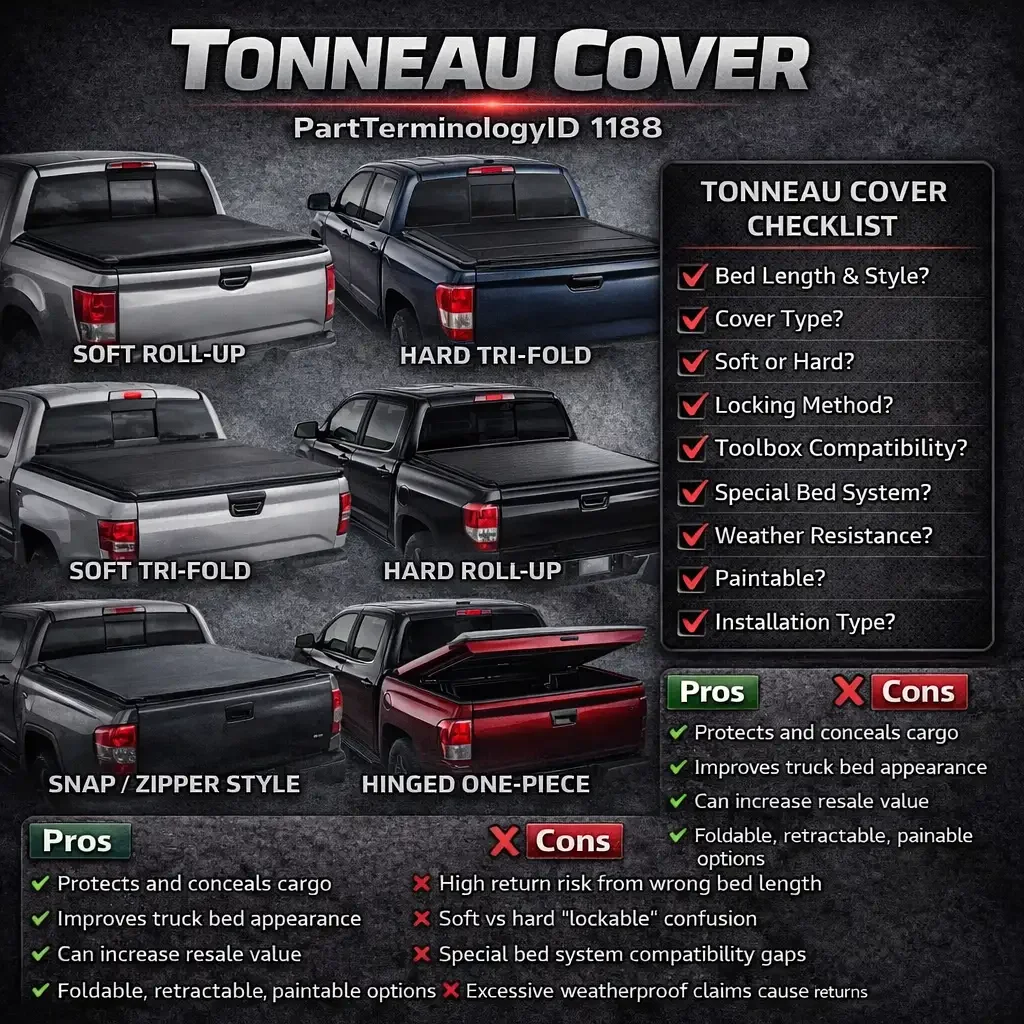
Tonneau Cover is one of the biggest and most error-prone accessory categories in the truck aftermarket.
It is also one of the most profitable categories when the catalog is done correctly.
That is why PartTerminologyID 1188 matters so much.
This is not a simple yes or no fitment part. It is a multi-variable category with major differences in bed length, bed style, rail design, cover construction, folding style, installation method, locking behavior, and feature compatibility. Buyers often shop by appearance first, then price, then security claims. The catalog team needs to make sure the product data holds up when the buyer gets serious and compares details.
When Tonneau Cover data is thin, the same problems show up over and over:
Buyer orders the wrong bed length
Buyer has a special bed system that blocks installation
Buyer expected a hard lockable cover but gets a soft roll-up
Buyer expected flush low profile rails but gets taller side rails
Buyer expected toolbox compatibility but the cover does not support it
Buyer expected paintable fiberglass but ordered an aluminum folding cover
Buyer expected full weather sealing but the product design has normal edge gaps
Buyer expects the cover to work with a multi-function tailgate and it does not
This is exactly the kind of category where a clean catalog creates a better buyer experience and a measurable reduction in returns, install complaints, and customer service traffic.
This PartsAdvisory guide is built for aftermarket catalog teams, truck accessory sellers, marketplace teams, and e-commerce operators who want to classify, map, and sell Tonneau Covers accurately.
What a Tonneau Cover Usually Means
A Tonneau Cover is a bed cover for a pickup truck. It is designed to cover the truck bed cargo area for protection, appearance, cargo management, and in some cases added security.
That sounds basic, but the category is broad.
A Tonneau Cover may be:
Soft roll-up cover
Soft tri-fold cover
Hard tri-fold cover
Hard roll-up cover
Retractable cover
Hinged one-piece cover
Snap cover
Zipper style cover
Toolbox-compatible cover
Low profile cover
Painted fiberglass one-piece cover
Matte black textured hard cover
Cover with integrated rails or accessory tracks
It is usually not:
A bed cap or camper shell
A bed liner
A bed mat
A tailgate liner
A cargo net
A bed rack system by itself
A hard shell topper enclosure
The first job of the catalog is to make sure the buyer understands they are looking at a bed cover category, then quickly narrow the exact style and bed fitment.
Why Tonneau Cover Is a High-Complexity Catalog Category
Tonneau Cover is one of the most complex truck accessory categories because the part type is broad and the fitment is not only based on year, make, and model.
Tonneau Cover fitment commonly depends on all of the following:
Bed length
Bed type and bed rail shape
Side storage bed systems
Factory utility tracks
OE bed rail caps
Existing bed liner type
Tailgate style
Toolbox presence
Cab style in some catalogs
Cover rail design and clamp location
Whether the cover sits on top of the rails or inside the rails
That means two buyers with the same truck model year can still need different Tonneau Cover products.
This is also a category where marketing language often causes trouble. Terms like low profile, flush fit, lockable, weatherproof, no drill, and heavy duty are not enough by themselves. They need supporting details.
A Tonneau Cover listing that looks great but hides bed details will convert fast and return fast.
Status in New Databases
Status in New Databases
PartTerminologyID: 1188
Terminology Name: Tonneau Cover
Current: PIES 7.2 + PCdb
Future: PIES 8.0 + PCdb 2.0
Status: No change
The terminology remains stable, which is useful for catalog continuity. The real improvement opportunity is not the term itself. It is the data depth around cover type, bed compatibility, materials, and feature qualifiers.
Why Buyers Get Tonneau Covers Wrong
Most Tonneau Cover returns are not caused by defects. They are caused by assumptions.
Buyers assume:
Their bed is the common bed length
A “lockable” cover means true independent lock security
All tri-fold covers are hard
A product photo shown on one trim means all trims are the same
“No drill” means no adjustments and no setup effort
Their spray-in or drop-in liner will not affect fit
Their truck’s bed utility track system works with any cover
A “paintable” product means it comes painted
Their toolbox will fit with any cover that looks similar
Your catalog and listing content need to actively prevent these assumptions.
This is one of the strongest examples in the aftermarket where structured data and plain language must work together.
Core Tonneau Cover Types and Why They Must Be Cataloged Separately
This is the heart of the category. If your product setup mixes these styles in one generic family without strict attributes, buyer confusion becomes guaranteed.
1) Soft Roll-Up Tonneau Covers
These are flexible covers that roll toward the cab and usually mount with side rails.
Common features:
Vinyl or fabric top surface
Aluminum rails
Clamp-on installation in many applications
Lightweight and lower cost
Easy full-bed access when rolled open
Common confusion:
Buyer expects hard security
Buyer expects totally flat flush look
Buyer assumes all soft covers are interchangeable
Catalog notes that matter:
Material type
Rail style
Hook/strap hold-open system
Tailgate seal design
Bed rail compatibility
Locking description (usually tailgate-dependent, not true independent lock)
2) Soft Tri-Fold and Multi-Fold Covers
These fold in sections and are usually easier to open quickly than some roll-up styles.
Common features:
Soft outer surface
Folding panel structure
Quick clamp systems
Partial bed access without full roll-up
Common confusion:
Buyer assumes all folding covers are hard
Buyer expects flush mount rails when the design sits higher
Buyer assumes all tri-fold covers can be removed tool free
Catalog notes that matter:
Soft vs hard classification must be explicit
Fold count and panel design
Rail profile
Removal process
Water management details
3) Hard Tri-Fold and Hard Folding Covers
These are a major category and often a high-value segment.
Common features:
Hard panels made from aluminum, composite, or FRP-related construction
Better security perception than soft covers
Folding access by panel sections
Matte black or painted top finishes depending on brand and product line
Common confusion:
Buyer assumes all hard folding covers are fully lockable by themselves
Buyer expects fully weather-sealed trunk-like performance
Buyer assumes panel thickness and material are the same across brands
Catalog notes that matter:
Material and panel construction
Top finish
Locking mechanism style
Tailgate lock dependency
Weight rating if manufacturer provides it
Open position support and visibility notes
4) Hard Roll-Up Covers
These combine rolling operation with hard slats or segmented rigid materials.
Common features:
Slatted construction
Roll-up operation
Side rail track system
Better security and durability positioning
Common confusion:
Buyer thinks “roll-up” means soft vinyl
Buyer expects no canister storage when product uses front storage housing
Buyer assumes all hard roll-up covers support the same bed rail accessories
Catalog notes that matter:
Hard roll-up classification in title
Slat material
Track style
Canister or no canister design
Drainage needs
Installation space requirements near cab
5) Retractable Tonneau Covers
This is another large segment and one of the most fitment-sensitive.
Common features:
Cover retracts into a front canister near the cab
Track-guided operation
Hard slat or panel design
Often premium pricing
Common “lockable” marketing positioning
Common confusion:
Buyer does not realize canister takes bed space
Buyer expects full bed floor length to remain unchanged
Buyer assumes any bed rack or toolbox will still fit
Buyer assumes power retractable and manual retractable are the same family
Catalog notes that matter:
Manual vs power retractable
Canister dimensions and bed space impact
Drain tube requirements
Track profile
Rail height
Tailgate operation compatibility
Security and lock behavior
6) Hinged One-Piece Covers
Often fiberglass or composite style covers, including paintable versions.
Common features:
One-piece shell style
Hinged opening
Struts for lift support
Premium appearance
Paintable options in some lines
Common confusion:
Buyer expects foldable behavior
Buyer assumes “paintable” means already paint matched
Buyer expects compatibility with bed racks or toolbox add-ons
Buyer assumes lightweight installation because it looks simple
Catalog notes that matter:
Paintable yes or no
Primer or gel-coat finish status
Material type (fiberglass, composite)
Hinge and strut hardware included
Open angle and cargo access notes
Shipping and handling considerations
Install complexity
7) Snap and Zipper Style Covers
These are still relevant in certain vehicle and price segments.
Common features:
Soft material
Snap or zipper perimeter retention
Lower cost options
Classic truck applications in some cases
Common confusion:
Buyer expects modern clamp-on rail convenience
Buyer assumes universal fit
Buyer underestimates fit sensitivity around bed rails
Catalog notes that matter:
Fastener system type
Frame and bows included
Hardware kit contents
Vehicle-specific requirement
Installation instructions clarity
Pros and Cons for Buyers and Sellers
Because Tonneau Cover is an accessory category with major style variation, this section is essential for setting expectations.
Pros
Protects cargo from weather, dust, and road grime exposure
Improves truck bed appearance and can increase perceived vehicle value
Provides cargo concealment and varying levels of security depending on design
Large range of styles supports different budgets and use cases
Strong upsell category with bed mats, tailgate seals, lighting, and bed organization accessories
Many no-drill or low-drill options make installation accessible for DIY buyers
Premium segments such as hard folding and retractable covers support strong margins
Cons
High return risk when bed length or bed style is not confirmed
Buyers often misunderstand soft vs hard and “lockable” claims
Toolbox, utility track, and special bed systems create compatibility issues
Weather sealing expectations are often unrealistic if listing copy is vague
Retractable and premium covers have more install details and more support questions
Paintable covers require clear finish and prep guidance to avoid disappointment
For this category, the Pros and Cons section does not just educate the buyer. It protects your team from avoidable post-sale confusion.
Materials and Construction Types That Must Be Clear in the Catalog
The user specifically called out foldable, material, lockable, and paintable, which is exactly right for Tonneau Cover. These are not optional details. They are core catalog data.
Soft cover materials
Most soft covers use vinyl or fabric-based constructions with reinforcement layers.
What buyers care about:
Surface texture
Thickness or durability language
UV resistance
Cold weather flexibility
Tear resistance
How the cover is tensioned
Catalog best practice:
Use consistent material naming from the supplier, but translate vague terms into buyer-readable language in the description. If the brand says premium marine-grade vinyl, keep that wording if accurate, then add practical notes on weather exposure and care.
Hard cover materials
Hard covers vary a lot by brand and segment:
Aluminum panels
Composite panels
Fiberglass or FRP-style construction
Polymer or mixed-material systems
What buyers care about:
Security level
Weight
Finish appearance
Strength perception
Dent resistance
Heat and weather behavior
Catalog best practice:
Do not use generic “hard cover” wording only. Include the actual panel or shell material if available. This helps prevent wrong expectations and improves search relevance.
Paintable covers
This is a major source of confusion.
“Paintable” typically means:
The cover surface can be prepped and painted
It is not already color-matched
Paint work is usually a separate process after purchase
Common return trigger:
Buyer assumes paintable means the cover arrives painted to match the truck.
Catalog best practice:
State this clearly:
“Paintable surface, ships unpainted”
“Primer-ready” only if the supplier specifically confirms that finish state
Include prep expectations if the manufacturer provides them
Finish types
Finish matters more than many teams realize. For Tonneau Covers, finish can drive both conversion and returns.
Common finishes:
Matte black
Textured black
Smooth black
Gloss black
Raw aluminum accents on rails
Paintable fiberglass shell
Catalog best practice:
Finish should appear in:
Structured attributes
Listing title if it helps conversion
Product bullets
Variant images
Lockable Tonneau Covers and Why “Lockable” Must Be Explained
Lockable is one of the most overused and least explained terms in Tonneau Cover listings.
Different products use “lockable” in different ways:
Some rely on the locked tailgate to prevent opening the cover
Some have latch systems but no independent keyed lock
Some premium covers have integrated keyed locking
Some retractable covers lock at multiple positions
Some covers can be opened quickly if the tailgate is down
If you list all of these simply as “lockable,” you create buyer confusion.
Catalog best practice for locking language
Use a clear locking style field or buyer note such as:
Tailgate lock dependent security
Latching design, no independent cover lock
Integrated keyed lock
Lockable in multiple open positions (if manufacturer states this)
Common buyer misunderstanding
A buyer may compare a soft roll-up cover and a retractable hard cover because both listings say lockable. They are not buying the same security outcome.
Your catalog content should make this difference obvious.
Fitment Details That Make or Break Tonneau Cover Accuracy
This is the biggest operational section for PartTerminologyID 1188.
1) Bed length is mandatory, not optional
The most common Tonneau Cover return is the wrong bed length.
Catalog teams should never rely only on:
Short bed
Standard bed
Long bed
Those labels vary by make and sometimes by model line.
Best practice:
Use the precise bed length fitment mapping provided by your fitment source and also present buyer-friendly wording in the listing. If possible, include both manufacturer fitment language and a plain note to confirm the bed length.
2) Bed style and special bed systems
Some trucks have bed systems that change rail compatibility:
Side storage bed designs
Utility track systems
OE cargo rail systems
Specialty bed cap trims
Factory accessory rails
These can block clamp locations or rail fitment.
Best practice:
Add fitment qualifiers and exclusion notes. Do not hide these only in long descriptions. Put them in the visible bullets or compatibility notes.
3) Drop-in bed liner vs spray-in bed liner
This is one of the most frequent install complaints.
Some covers fit fine with spray-in liners but not with drop-in liners unless trimming is done. Other covers are compatible with both, but only if the liner does not cover clamp areas.
Best practice:
Use an installation compatibility note field if possible:
Compatible with most spray-in liners
Drop-in liner may require trimming
Not compatible with over-rail drop-in liner (example style note, only if supplier confirms)
4) Bed rail caps and over-rail vs under-rail designs
Covers mount in different ways:
Inside bed rails
On top of bed rails
Clamp-on rails
Track systems with specific edge requirements
A buyer can have a truck with bed rail caps or trim that changes the mounting geometry.
Best practice:
Capture rail mount style in structured data and buyer-facing copy. This reduces install surprises.
5) Tailgate style and multi-function tailgates
Modern trucks introduced more tailgate complexity:
Multi-function tailgates
Split-opening designs
Tailgate steps
Special handle and camera layouts
Tailgate spoilers in some trims
Not every Tonneau Cover supports every tailgate variation.
Best practice:
Treat tailgate compatibility as a first-class fitment note, not a small print item.
6) Toolbox compatibility
A lot of buyers want both a toolbox and a tonneau cover. This is a major filter in the category.
Common issues:
Cover rails interfere with cross-bed toolboxes
Folding covers cannot close over a toolbox
Toolbox-compatible models are a separate product family
Buyer assumes a low-profile cover will fit under toolbox clearance
Best practice:
Create a clear attribute:
Toolbox compatible yes or no
If yes, specify toolbox style compatibility if available.
7) Bed racks and accessory track systems
This is growing fast in truck accessories. Buyers want racks, crossbars, and covers together.
Many Tonneau Covers are not compatible with bed racks. Some brands offer systems with integrated T-slot rails. Others require brand-specific adapter kits.
Best practice:
Add attributes for:
Rack compatible yes or no
Integrated accessory track yes or no
Adapter required yes or no (if known)
8) Bed access and canister space impact
Retractable covers often use a front canister that takes bed space.
A buyer who hauls long cargo may care more about lost bed length than style.
Best practice:
Show the canister area in images and call out bed space impact if dimensions are available.
Compatibility Checklist for Tonneau Cover Buyers
Use this checklist in product pages, bullets, and marketplace descriptions. This is one of the highest value content blocks for this category.
Compatibility Checklist
Confirm year, make, and model
Confirm bed length using the actual truck bed size
Confirm bed style and any special bed system (side storage, utility rails, factory track)
Confirm cover type: soft roll-up, soft fold, hard fold, hard roll-up, retractable, or hinged one-piece
Confirm whether you want low profile rails or a raised rail design
Confirm material (vinyl, aluminum, composite, fiberglass, etc.)
Confirm locking style (tailgate-dependent, integrated lock, latch only)
Confirm toolbox compatibility if you use a cross-bed toolbox
Confirm bed rack or accessory rail compatibility if you use racks or crossbars
Confirm bed liner compatibility (spray-in, drop-in, over-rail liner)
Confirm installation type and whether drilling is required
Confirm hardware included and drain tubes included when applicable
Confirm finish (matte black, textured black, gloss, paintable)
Confirm paintable means unpainted if you are choosing a fiberglass shell style
Read all fitment and install notes before ordering
This checklist dramatically reduces the most common Tonneau Cover returns because it forces the buyer to verify the exact truck bed setup.
Catalog Checklist for Structured Data and Attributes
For PartTerminologyID 1188, this section is the difference between a scalable catalog and a support-heavy catalog.
Catalog Checklist
Use PartTerminologyID 1188 and exact terminology Tonneau Cover
Do not merge with bed caps, camper shells, or unrelated bed accessories
Classify cover type clearly:
Soft Roll-Up
Soft Folding
Hard Folding
Hard Roll-Up
Retractable
Hinged One-Piece
Snap
Zipper
Populate bed length fitment accurately and consistently
Add bed style / special bed system compatibility notes
Populate material and panel or shell construction
Populate finish and color
Populate locking style with clear language
Populate installation type and drill / no-drill status
Populate hardware included yes or no
Populate drainage components included for retractable systems when applicable
Add toolbox compatibility yes or no
Add rack compatibility and accessory track support where applicable
Add bed liner compatibility notes (spray-in, drop-in, over-rail)
Add canister present yes or no for retractable designs
Add paintable yes or no, and note if product ships unpainted
Add contents included in plain language
Use variant-specific images for each style and finish
Include installed-view images and close-up hardware images
Add a buyer-facing fitment note that calls out bed length and special bed restrictions
A strong internal QA rule for Tonneau Covers is simple. If bed length, cover type, and installation style are missing, the listing should not publish.
Naming Confusion and How to Standardize It
Tonneau Cover is the correct catalog term, but supplier and marketplace language can vary.
Common naming variants buyers search
Truck bed cover
Tonneau
Tonneau cover
Folding bed cover
Roll-up bed cover
Retractable bed cover
Hard tonneau
Soft tonneau
These are useful for discoverability, but they should not replace the catalog term.
Best practice for naming
In your catalog record:
Use Tonneau Cover
In your listing title:
Add the style, material, and fitment language buyers need
Example structure:
Tonneau Cover, Hard Tri-Fold, Fits [Bed Length], Matte Black
Tonneau Cover, Soft Roll-Up, No-Drill, [Truck] [Bed Size]
Retractable Tonneau Cover, Lockable, Aluminum Slat, [Bed Length]
In your bullets and description:
Clarify lock style
Clarify toolbox or rack compatibility
Clarify if cover is paintable and ships unpainted
Clarify if bed space is reduced by canister
This keeps the catalog clean while still matching buyer search behavior.
Common Buyer Scenarios and How to Prevent Returns
This section is where most teams can improve quickly.
Scenario 1: Wrong bed length ordered
Buyer selected the correct truck model but did not confirm bed size.
Prevention: Put bed length in the title and first bullet. Add a plain note telling the buyer to verify bed length before ordering.
Scenario 2: Buyer wanted a hard lockable cover and ordered a soft fold cover
The listing used “secure” and “lockable” language without explaining the locking method.
Prevention: Add a locking style bullet and explain tailgate-dependent security versus integrated lock.
Scenario 3: Buyer has a factory utility rail system and the cover does not clamp
This happens often on truck trims with bed track features.
Prevention: Add a visible compatibility note for utility rail systems and special bed hardware.
Scenario 4: Buyer has a drop-in liner and cover clamps do not fit
The buyer assumes all liners are compatible.
Prevention: Add bed liner compatibility notes and mention trimming requirements only if the manufacturer supports that guidance.
Scenario 5: Buyer expected toolbox compatibility
The product image did not show a toolbox, but the buyer assumed a standard setup would work.
Prevention: Add a Toolbox Compatible attribute and show it clearly in bullets.
Scenario 6: Buyer ordered a retractable cover and did not expect bed space loss
They install it and realize the canister reduces usable bed space near the cab.
Prevention: Call out canister presence and show installed images from the side or top.
Scenario 7: Buyer expected paint-matched fiberglass
They saw “paintable” and expected a color-matched finish out of the box.
Prevention: Clearly state “Paintable, ships unpainted” in title or first bullets for those models.
Scenario 8: Buyer expected full weatherproof sealing
They compare the cover to a trunk and are disappointed by normal edge water intrusion in severe conditions.
Prevention: Use practical weather language and avoid overpromising. Set realistic expectations based on manufacturer wording.
Scenario 9: Buyer expected easy full-bed access but chose a panel style that blocks cab-side cargo access
They picked the wrong cover type for their use case.
Prevention: Add “best for” use guidance in descriptions:
Daily secure storage
Frequent full bed access
Premium appearance
Toolbox setups
Rack-compatible setups
Buyer-Facing Content Tips That Reduce Support Tickets
Catalog accuracy is the foundation, but content placement matters too.
For Tonneau Covers, the most important details should appear high on the page:
Bed length
Cover type
Soft vs hard
Locking style
Toolbox compatibility
Installation type
Special bed exclusions
Do not hide these in long descriptions.
Good listing bullet style example
Tonneau Cover, Hard Tri-Fold, fits 5 ft 7 in bed
Aluminum panel design with matte black finish
Tailgate lock dependent latching system
Clamp-on install, no drilling for most applications
Not compatible with factory utility rail system (if applicable)
That format answers most pre-sale questions before the buyer even scrolls.
FAQ
Is Tonneau Cover the same as a truck bed cover?
Yes, in most aftermarket usage, Tonneau Cover is the catalog term for a truck bed cover. The key is to identify the exact style and fitment.
What is the biggest cause of Tonneau Cover returns?
Wrong bed length is the most common issue, followed by soft versus hard cover confusion and compatibility problems with special bed systems.
Are all folding tonneau covers hard?
No. Folding covers can be soft or hard. The listing should clearly state which type it is.
What does lockable mean on a tonneau cover?
It depends on the design. Some covers rely on the locked tailgate, some have latches only, and some include integrated keyed locks. Listings should explain the locking method.
What does paintable mean for a tonneau cover?
Paintable usually means the cover can be painted after prep. It does not usually mean it arrives color-matched. Paintable covers often ship unpainted.
Can I use a tonneau cover with a toolbox?
Only if the product is specifically toolbox-compatible. Many covers will not fit with a cross-bed toolbox.
Will a tonneau cover work with a spray-in or drop-in liner?
Some will and some will not. Spray-in liners are often easier for compatibility. Drop-in liners may interfere with clamps or rails depending on the cover design.
Are retractable covers better than folding covers?
They serve different use cases. Retractable covers often offer premium operation and security options but usually include a canister that takes some bed space. Folding covers may be simpler and lower cost.
What attributes matter most in a tonneau cover catalog?
Cover type, bed length, material, locking style, installation type, toolbox compatibility, and bed system compatibility are the most important.
Should I list bed length only, or full fitment notes too?
Use both. Bed length is critical, but you also need notes for special bed systems, liners, rails, and tailgate compatibility when relevant.
Final Takeaway for Catalog Teams and Sellers
PartTerminologyID 1188 Tonneau Cover is a high-opportunity category with high complexity. That makes it a perfect test of catalog discipline.
Teams that treat Tonneau Covers like a basic one-line truck accessory usually create the same problems:
Wrong orders
Install complaints
Security expectation mismatches
Returns from bed system incompatibility
Teams that win in this category do something different. They build listings around the real decision points buyers care about:
Bed length
Cover type
Material
Locking method
Compatibility with liners, toolboxes, rails, and tailgate setups
If your catalog captures those details in structured attributes and your listings repeat them in plain language, Tonneau Cover becomes one of the strongest truck accessory categories for conversion and repeat buyer trust.