
Spare Tire Cover (PartTerminologyID 1184): Naming, Fitment, and Catalog Best Practices
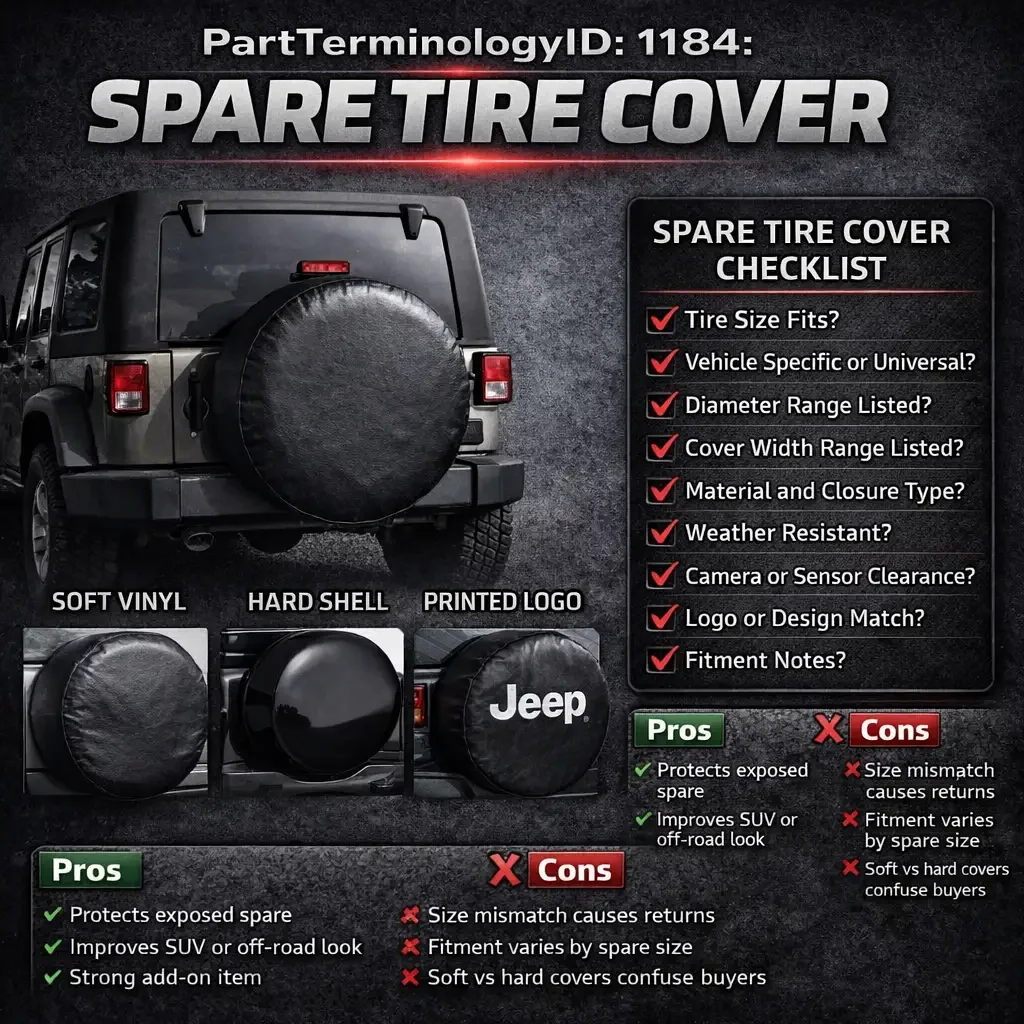
Spare Tire Cover looks like a basic accessory category. In practice, it is one of the easiest ways to create returns if your catalog data is thin.
Why? Because buyers usually shop this part by appearance first and sizing second. They see a style they like, order quickly, and only later realize the cover does not fit their spare tire diameter, width, or mounting setup.
That makes PartTerminologyID 1184 a catalog discipline problem, not just a merchandising problem.
If your team sells truck, SUV, Jeep, trailer, RV, or off road accessories, Spare Tire Cover can perform well when sizing and construction details are clear. If not, you get the usual issues:
Too loose
Too tight
Wrong tire size
Wrong style for rear mounted spare
Buyer expected hard shell, received soft vinyl cover
Buyer expected camera or logo opening support
This guide shows how to set up Spare Tire Cover correctly in a PartsAdvisory style catalog and listing flow.
What a Spare Tire Cover Usually Means
A Spare Tire Cover is a protective or decorative cover designed to fit over an exposed spare tire. It is commonly used on rear mounted spares for SUVs, Jeeps, and some trucks, plus trailers and RVs.
It may be:
Soft vinyl or fabric cover
Hard shell cover
Elastic edge cover
Drawstring or zipper style cover
Vehicle specific cover
Universal size based cover
Plain black cover
Printed or branded cover
It is usually not:
A spare tire carrier
A spare tire mount
A wheel cover for the road wheel
A tire storage bag for garage use
A tire repair kit
That distinction matters because many buyers search with broad terms like tire cover, wheel cover, or spare cover. Your catalog needs to classify the product correctly and then guide the buyer to the right size.
Why Spare Tire Cover Creates Catalog Confusion
Naming confusion
Spare Tire Cover is often mixed up with:
Tire cover
Spare wheel cover
Wheel cover
Tire bag
Spare tire carrier cover
Soft top rear cover accessories
Some supplier feeds use loose naming. One brand may call it a spare tire cover. Another may call it a tire cover. Another may use wheel cover even though it is not a wheel trim piece. If your team imports those labels without review, your listings become inconsistent.
Fitment and sizing confusion
This is the bigger issue.
A Spare Tire Cover can fail fitment even when the vehicle is correct because the actual spare tire size varies by:
Trim level
Wheel size
Tire size
Factory vs aftermarket tire
Oversized off road tire upgrades
That means year, make, and model alone is not always enough. This category often needs tire size or cover dimensions to prevent returns.
Status in New Databases
Status in New Databases
PartTerminologyID: 1184
Terminology Name: Spare Tire Cover
Current: PIES 7.2 + PCdb
Future: PIES 8.0 + PCdb 2.0
Status: No change
The term stays the same across current and future database versions. That is helpful for continuity. The real improvement opportunity is in attributes and sizing clarity.
Pros and Cons for Buyers and Sellers
Spare Tire Cover is an accessory type part, so this section helps buyers make the right choice and helps sellers reduce avoidable returns.
Pros
Protects exposed spare tires from sun, rain, dirt, and cracking
Improves appearance for SUVs, Jeeps, trailers, and RVs
Good add on category with exterior accessories and off road gear
Available in many materials, finishes, and styles
Can be an easy upsell with strong size guidance
Cons
High return risk if size guidance is vague
Universal fit claims can be misleading without dimensions
Buyers often confuse soft covers with hard shell covers
Tire size changes after aftermarket upgrades can break fitment
Camera, backup sensor, or logo clearance can create compatibility issues on some applications
This is a category where buyer expectation is everything. Clear content usually matters more than aggressive keyword stuffing.
Compatibility Checklist for Spare Tire Cover
Use this checklist in your product page bullets or marketplace copy.
Compatibility Checklist
Confirm vehicle and spare tire location (rear mounted, external mount, trailer mount)
Confirm whether the cover is vehicle specific or universal size
Check the actual tire size on the sidewall, not just vehicle year and model
Confirm cover diameter and width range
Confirm soft cover or hard shell style
Confirm material and weather resistance
Confirm closure type (elastic, drawstring, zipper)
Check for camera or center opening compatibility if applicable
Verify logo or printed design if appearance matters
Read fitment notes before ordering
For this category, the sidewall tire size is often the deciding factor. A clean listing should tell the buyer exactly where to look.
Catalog Checklist for Structured Data and Attributes
Spare Tire Cover needs strong attribute coverage. This is not a title-only category.
Catalog Checklist
Use PartTerminologyID 1184 and exact term Spare Tire Cover
Keep it separate from wheel covers, spare tire carriers, and tire storage bags
Add a clear Vehicle Specific or Universal Fit flag
Populate Supported Tire Size or Cover Dimensions fields
Populate Material (vinyl, PVC, fabric, hard shell, etc.)
Populate Color and Finish
Populate Closure Type (elastic, drawstring, zipper)
Populate Weather Resistance or UV protection details if supplied
Add Camera Opening or center access compatibility when applicable
Add Contents Included text so buyers know if it is cover only
Use images that show installed fit and close up material texture
Add a sizing guide note in the description, not only in hidden attributes
A simple internal QA rule works well here. If the part is a Spare Tire Cover, do not publish until size or dimensions are populated.
Common Buyer Scenarios and How to Prevent Returns
Scenario 1: Buyer ordered by vehicle only
They assumed all trims of the same vehicle use the same spare size.
Prevention: Add a clear note in the first bullet: "Confirm tire size on sidewall before ordering."
Scenario 2: Buyer expected a hard cover
The image looked rigid, but the product is a soft vinyl cover.
Prevention: Put material and style in the title and bullets. Example: "Soft Vinyl Spare Tire Cover."
Scenario 3: Buyer has an oversized aftermarket spare
Their off road tire is larger than stock.
Prevention: Use cover dimensions and size ranges, and add a note that aftermarket tire sizes may require a different cover size.
Scenario 4: Buyer expected camera compatibility
They have a rear mounted spare with camera or center feature.
Prevention: Add a compatibility note and image if the cover supports a center opening or camera access.
Scenario 5: Buyer expected a logo printed cover
They saw a generic image and assumed the printed version was included.
Prevention: Be explicit about design. "Plain black cover" or "Printed logo cover" should be clear in the title and images.
Naming Best Practices for Listings
In the catalog record
Use the exact term:
Spare Tire Cover
In listing titles
Add the details that buyers need to see fast:
Spare Tire Cover, Soft Vinyl, Fits 30 to 31 Inch Tire
Spare Tire Cover, Hard Shell, Rear Mounted Spare
Spare Tire Cover, Universal, Black, Drawstring Closure
In the product description
Add an expectation setting line:
"This listing is for a spare tire cover only. Please confirm the actual spare tire size before ordering."
That line prevents a large share of avoidable returns.
FAQ
Is a Spare Tire Cover vehicle specific?
Some are vehicle specific, but many are universal by tire size. The most important step is checking the actual spare tire size.
Can I buy a Spare Tire Cover using only year, make, and model?
Sometimes, but it is safer to confirm the tire sidewall size. Trim levels and aftermarket tires can change the fit.
Is a Spare Tire Cover the same as a wheel cover?
No. A Spare Tire Cover protects an exposed spare tire. A wheel cover usually refers to a trim piece for the wheel itself.
Do Spare Tire Covers fit oversized off road tires?
Only if the cover size range matches the tire dimensions. Oversized tires are a common reason for returns.
What is the biggest catalog mistake with Spare Tire Cover?
The biggest mistake is listing the part without tire size guidance or cover dimensions.
What attributes matter most besides fitment?
Supported tire size, cover dimensions, material, closure type, and weather resistance are the most important fields.
Final Takeaway for Catalog Teams and Sellers
PartTerminologyID 1184 Spare Tire Cover is a strong accessory category when your catalog makes sizing easy.
The best setup is simple:
Classify it correctly as Spare Tire Cover
Separate it from wheel covers and spare tire carriers
Publish tire size support and cover dimensions clearly
Use buyer-facing copy that tells customers to check the sidewall size
Do that well, and you get fewer returns, better buyer confidence, and cleaner marketplace performance.