
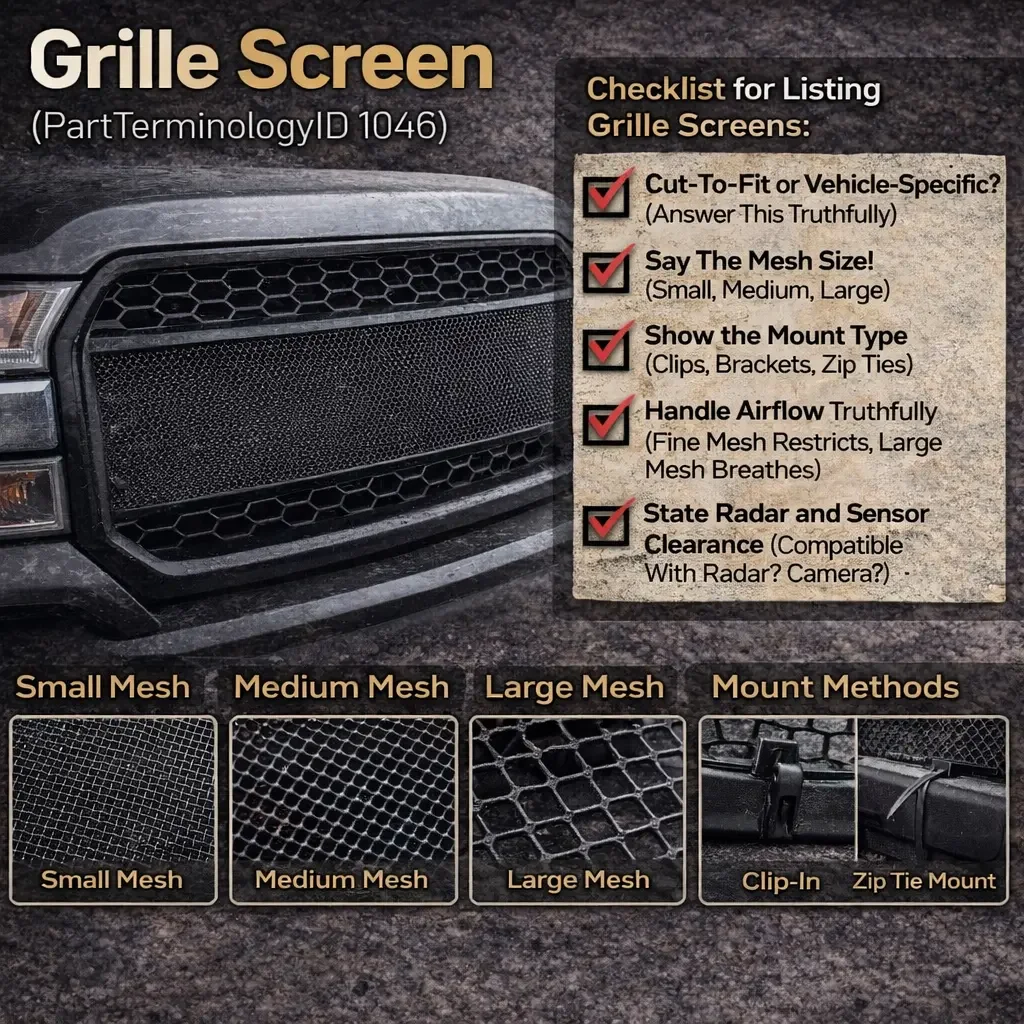
Grille screens are a “small part” that create big problems when listings are vague.
Customers buy them to protect what’s behind the grille:
radiator
A/C condenser
intercooler
oil cooler
But they return them for the exact same reasons every time:
it doesn’t fit the trim
it blocks airflow more than expected
it doesn’t clear sensors
it’s universal when they expected vehicle-specific
it requires cutting or drilling and nobody said so
This is the practical guide for Grille Screen in PCdb PartTerminologyID 1046.
Status in New Databases (ID 1046)
Feature: Current (PIES 7.2 / PCdb) -> Future (PIES 8.0 / PCdb 2.0)
PartTerminologyID: 1046 -> 1046 (No change)
Terminology Name: Grille Screen -> Grille Screen
All the names people use for this item
Buyers search for what they want to prevent, not the part name:
Grille screen
Grille mesh
Mesh grille insert
Grille insert screen
Bug screen
Rock screen
Radiator screen
Debris screen
Front mesh screen
Intercooler screen (performance crowd)
Lower grille screen
Upper grille screen
Important: customers also confuse this with a decorative grille insert. A grille screen is a protective mesh, not a replacement grille design, unless it’s sold as a full insert assembly.
What a grille screen actually does
A grille screen is a protective barrier that reduces impact damage and punctures to cooling components while trying not to restrict airflow.
That is the tension in the category:
Protection vs airflow.
Good listings tell the truth about both.
Mesh types and materials
Common materials
Aluminum mesh
Stainless steel mesh
Coated steel mesh
ABS or nylon composite mesh (often molded)
Expanded metal mesh (strong, heavier)
Finish types
Black powder coat
Matte black
Gloss black
Bare metal
Anodized aluminum (less common)
Why buyers care
Aluminum is light and easy to cut, can bend easier
Stainless resists corrosion, can be harder to cut
Coated steel can rust if coating chips
Plastic composite can look OEM but can warp or crack depending on heat
Mesh size: the number one missing attribute
Mesh size is what determines:
how much debris it blocks
how much airflow it restricts
how visible it is
Listings should state one of these:
small mesh (bug-focused)
medium mesh (balanced)
large mesh (rock-focused with best airflow)
If you can quantify it, even better:
opening size in mm
pattern type: hex, diamond, square
Mounting styles and install reality
This category splits into two worlds: vehicle-specific vs universal cut-to-fit.
1) Vehicle-specific insert screens
pre-cut for the grille opening
sometimes includes a frame
cleanest look, best buyer confidence
Mounting methods:
clip-in to factory points
bracket kit included
uses factory screws
snaps behind grille
2) Universal cut-to-fit mesh
buyer trims it with snips
often uses zip ties, clips, or adhesive
Mounting methods:
zip ties (common, not premium)
push clips
bracket strips
adhesive pads or tape
screw-in points (rare, more permanent)
Important listing truth:
cutting required yes or no
hardware included yes or no
removal process simple or not
Airflow and overheating concerns
This is the trust issue.
A grille screen can restrict airflow if:
mesh is too fine
screen is double-layered
it’s installed too close to the radiator
it blocks active grille shutter movement
Good listings include:
“Designed to maintain airflow” only if true
mesh size positioning (small, medium, large)
warnings for extreme heat, towing, or track use (if applicable)
Most buyers are not overheating their car, but they fear it. Speak to it directly.
Sensor, camera, and shutter compatibility
Modern vehicles have front-end tech that can conflict with screens:
adaptive cruise radar behind emblem or grille
front camera view
parking sensors
active grille shutters (open and close)
Screens can cause:
radar interference
camera obstruction
shutter binding if mounted in the wrong plane
Listing should clearly state:
radar safe yes or no
camera safe yes or no
active grille shutter clearance yes or no
“not compatible with” notes where applicable
Placement options buyers shop for
Many vehicles have multiple openings:
upper grille screen
lower grille screen
side openings or “air curtains”
intercooler-only screen on performance models
Make sure the listing clarifies:
which opening it covers
single piece vs multi-piece set
Catalog fields that matter for PartTerminologyID 1046
If you want fewer returns, capture these:
Vehicle-specific vs universal cut-to-fit
Location: upper, lower, multi-piece
Material: aluminum, stainless, plastic, steel
Finish: powder coated, bare, anodized
Mesh size: small, medium, large or measured
Cutting required: yes or no
Mount method: clips, brackets, zip ties, adhesive, screws
Hardware included: yes or no
Radar/camera compatibility notes
Active grille shutter clearance notes
Listing checklist for Grille Screens
Say if it is vehicle-specific or cut-to-fit
This alone prevents half the returns.State mesh size and intent
Bug screen vs rock screen vs balanced.Define mount type and what’s included
Clips, brackets, zip ties, instructions.Call out cutting required
Do not let buyers discover it at install.Address airflow honestly
Fine mesh blocks more, large mesh breathes more.Handle sensors and shutters
If the vehicle has radar behind the emblem, you must note compatibility.
The most common listing mistakes
“fits” but it’s universal cut-to-fit and buyer expected pre-cut
mesh too fine, customer fears overheating
no mention of active grille shutters
missing hardware or vague “hardware included”
wrong opening (upper vs lower)
radar interference complaints