
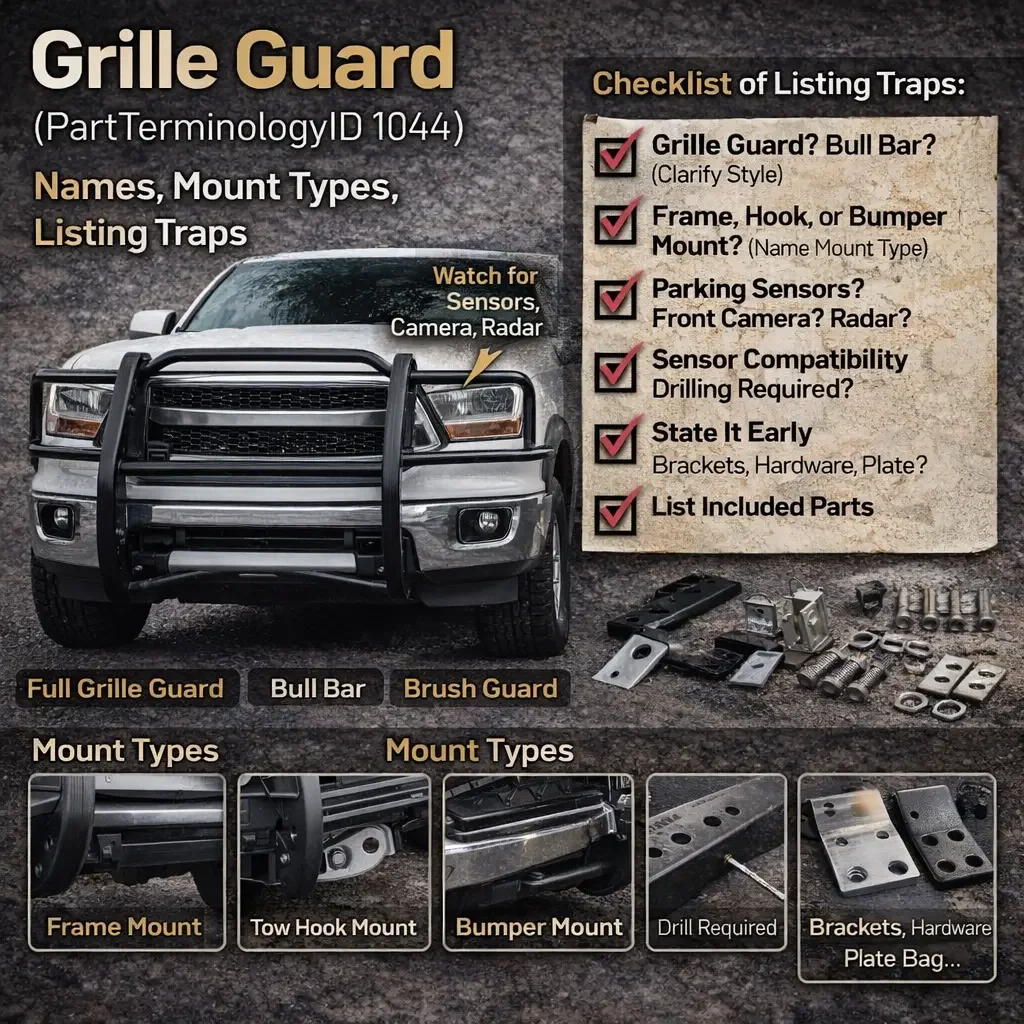
Grille guards sell because they look like protection.
They also return fast when the buyer discovers the guard blocks a sensor, interferes with a tow hook, does not clear a front camera, or mounts differently than the listing implied.
This category is not “one bar fits all.” It is a front-end system that touches styling, safety, sensors, and mounting geometry.
This post is the practical guide for Grille Guard in PCdb PartTerminologyID 1044.
Status in New Databases (ID 1044)
Feature: Current (PIES 7.2 / PCdb) -> Future (PIES 8.0 / PCdb 2.0)
PartTerminologyID: 1044 -> 1044 (No change)
Terminology Name: Grille Guard -> Grille Guard
All the names people use for this item
Customers search by vibe, not terminology. You will see all of these for the same intent:
Grille guard
Grill guard
Brush guard
Bull bar
Push bar
Push bumper
Ranch hand style guard (used generically)
Front bumper guard
Front protection bar
Light bar guard (when it has tabs)
Headlight guard (when it wraps)
Hoop guard (single hoop style)
Important nuance: some shoppers call a bull bar a grille guard, but many bull bars are smaller and mount differently. If you sell both, your listings need to say which one it is.
What a grille guard actually is
A grille guard is an external front-end guard designed to protect one or more of these areas:
grille
bumper face
headlights (on larger wrap designs)
radiator opening area (indirect protection)
It may also serve as a mounting platform for:
auxiliary lights
antenna mounts
winch accessories (only on certain designs)
recovery points (rare, and should not be implied)
The biggest catalog mistake is letting “guard” imply capabilities that the product does not have.
The big variant groups
1) Full grille guards
Larger, multi-tube designs that cover grille and often headlights.
2) Bull bars
Typically smaller, one main hoop with a skid plate area.
Less coverage, simpler look, different mount points.
3) Push bars
Often used on fleet and enforcement vehicles.
Sometimes designed for “push” use, but many are not rated for that. Be careful with claims.
4) Brush guards and headlight wrap guards
Designed to wrap around headlight corners.
High fitment sensitivity and high return risk if the trim is wrong.
Pros and cons, the honest version
Pros
Real protection from minor bumps, brush, and debris
Changes the truck or SUV stance, aggressive look
Gives a clean mounting spot for auxiliary lights on many designs
Helps protect grille and bumper from parking lot contact
Cons
Can block sensors, cameras, radar, and adaptive cruise systems
Can reduce airflow depending on design
Can create vibration noise if mounting is loose or hardware is missing
Can interfere with tow hooks, skid plates, and front recovery points
Adds weight and changes approach angle on some vehicles
If fitment is wrong, it looks wrong immediately
If you want fewer returns, your listing needs to be more honest than the marketing photo.
Mounting types and what buyers need to know
This category is all about how it mounts. These are the main connection types you will see.
Bolt-on frame mount
Most stable
Often uses existing frame holes
Usually vehicle-specific bracket kit
What to state:
bracket kit included or not
reuses factory mounting points or requires drilling
hardware included or not
Bumper mount
Mounts to bumper brackets or bumper structure
Can vary heavily by trim and bumper style
What to state:
compatible bumper type
reinforcement or bracket requirements
any cutting or trimming required
Tow hook mount
Uses tow hook locations or replaces tow hook bolts
Fitment depends on tow hook presence and bumper trim
What to state:
requires factory tow hooks yes or no
tow hooks retained or removed
compatible with tow hook covers yes or no
Drill required installs
Some kits require drilling. Some do not. Buyers filter on this hard.
What to state:
drilling required yes or no
cutting or trimming required yes or no
Materials, finishes, and why customers return them
Common materials
steel tube
stainless steel tube
aluminum (less common, lighter, different strength expectations)
Finish types
black powder coat (most common)
textured powder coat
polished stainless
brushed stainless
e-coat plus powder coat (often used for corrosion resistance)
chrome (less common, high expectation for finish quality)
Finish mismatch causes returns because the guard is front and center. If it is glossy and the truck has matte trim, it will look off.
Corrosion complaints are also common. If it is not stainless, the coating quality matters a lot in wet and salty climates.
Sensor, camera, and radar compatibility
This is now the #1 modern fitment landmine.
Possible conflicts:
parking sensors in bumper
front camera systems
adaptive cruise radar behind grille emblem
lane assist radar modules
active grille shutters behind the grille
headlight washers
forward collision sensors
Your listing should treat this as a core compatibility field, not a footnote.
Good listing language is direct:
compatible with front camera yes or no
compatible with adaptive cruise radar yes or no
parking sensor compatible yes or no
may block sensor functionality, if applicable
Do not let customers find out after install.
The catalog fields that matter most for PartTerminologyID 1044
If you want fewer returns, these are the must-haves.
Coverage and style
grille only, grille plus headlights, bull bar style, push bar style
number of hoops or wraps if relevant
skid plate section yes or no
Mounting and install
mount type: frame, bumper, tow hook, mixed
drilling required yes or no
cutting required yes or no
bracket kit included yes or no
hardware included yes or no
Vehicle configuration constraints
trim package notes
with tow hooks or without
with front camera or without
with radar or without
parking sensor notes
Build and finish
material
finish type
corrosion protection notes
weight if provided by brand
Functional add-ons
light mounting tabs yes or no
winch compatible yes or no (only if explicitly designed)
license plate mount included yes or no
Catalog checklist for PartTerminologyID 1044
Name the style correctly
Grille guard vs bull bar vs push bar. Do not let photos do all the talking.Make mounting method unavoidable
Frame mount, bumper mount, tow hook mount. Include drilling and cutting truth.Lock down sensor and camera constraints
Modern front ends punish vague listings.List what is included
Brackets, hardware, light tabs, skid plate section, license plate mount.State finish and material clearly
Powder coat, textured, stainless, polished. Customers care.Call out tow hook and skid plate conflicts
If the vehicle has tow hooks, buyers want to know if they keep them.
The most common listing mistakes
calling a bull bar a grille guard
not stating drilling required
ignoring trim level sensor packages
not clarifying tow hook retention
implying recovery or winch capability without product support
missing hardware or bracket kit details
Quick FAQ
Will a grille guard work with adaptive cruise control?
Sometimes. Often no. If the radar is behind the emblem or grille, the guard design matters. Your listing should say it clearly.
Do I need to drill?
Some kits are no-drill. Some require drilling. Buyers treat this as a hard filter, so say it early.
Is a grille guard the same as a bull bar?
Not always. Bull bars are usually smaller with less coverage. Customers use the terms interchangeably, but fitment and coverage differ.