
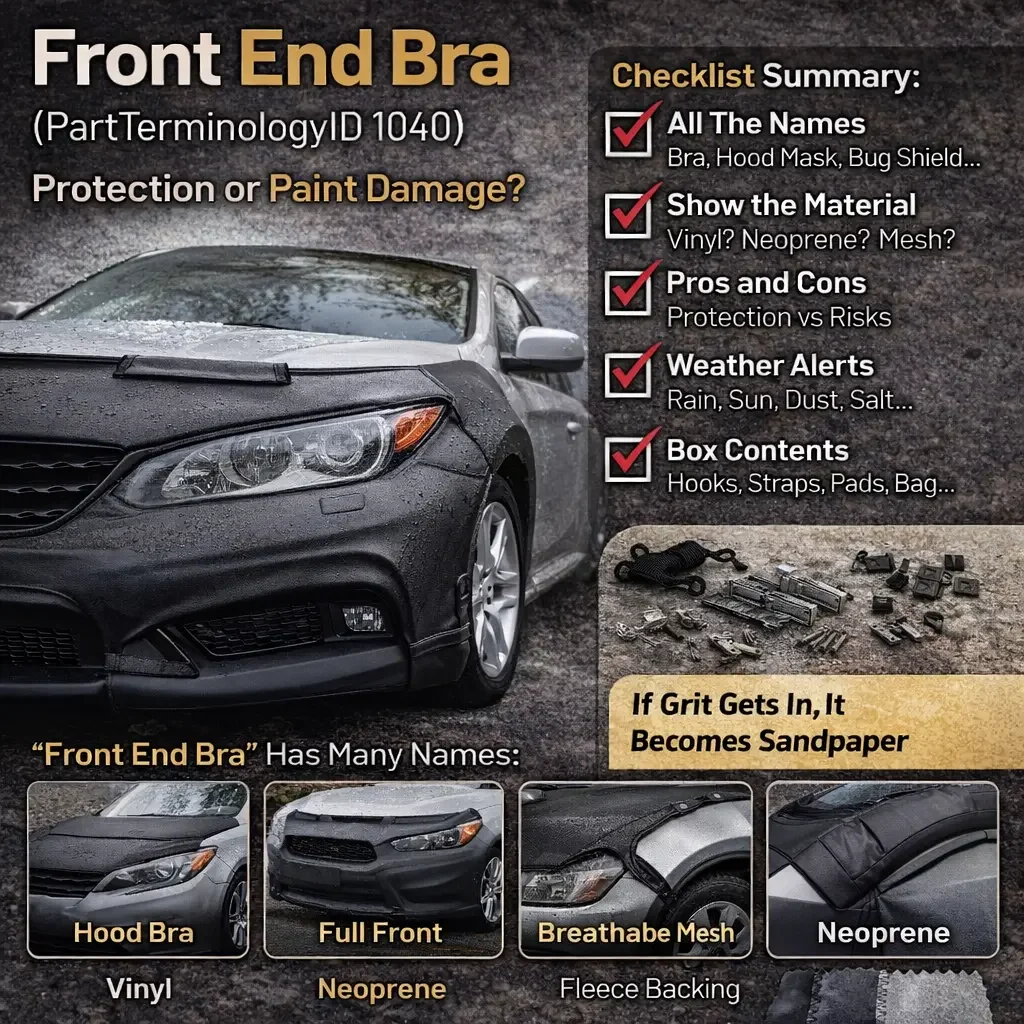
Front end bras sell for one reason: fear of chips.
A buyer has a road trip, a new paint job, or a fresh bumper. They want protection now, no appointment, no installer, no film shop. The bra feels like the quick answer.
And it can be.
But this category also creates some of the most emotional returns because the failure modes are personal: scuffs, trapped grit, paint haze, water spots, and rub marks.
This post maps the real world of Front End Bra for PCdb PartTerminologyID 1040 so listings stop creating guesswork.
Status in New Databases (ID 1040)
Feature: Current (PIES 7.2 / PCdb) -> Future (PIES 8.0 / PCdb 2.0)
PartTerminologyID: 1040 -> 1040 (No change)
Terminology Name: Front End Bra -> Front End Bra
All the names people use for this item
Buyers rarely type “front end bra” first. They search what they heard.
Common names:
Front end bra
Car bra
Hood bra
Hood mask
Nose bra
Nose mask
Front mask
Bumper bra
Bug bra
Stone guard bra
Road trip bra
Temporary paint protection cover
Important: buyers also confuse this with clear paint protection film (PPF) and sometimes call both “bra.” Your listing should clarify: fabric or vinyl cover, not clear film.
What a front end bra actually is
A front end bra is a removable cover that protects high-impact painted surfaces from:
rock chips
bugs and tar
minor scuffs from road debris
Depending on design, it may cover:
hood edge only
bumper only
hood plus bumper (2-piece kit)
headlights and grille areas on some designs
It is not just a cosmetic accessory. It is a contact system that touches paint.
The major types of front end bras
1) Hood bra
Covers the leading edge of the hood. Often stops chip damage at the front lip.
2) Bumper bra
Covers the bumper face, sometimes includes fog light openings or grille sections.
3) Full front bra
A multi-piece kit that covers hood and bumper, sometimes more. More coverage, more fitment sensitivity.
4) “T” style or partial bra
Smaller coverage area. Often marketed as simpler and less intrusive.
5) Track, tow, or travel covers
More temporary use positioning. Some are meant to be installed just for highway runs.
The pros and cons, the honest version
Pros
Fast protection with no installer
Great for road trips, long commutes, and winter gravel conditions
Can prevent bug etching on the front bumper and hood edge
Cheaper than many PPF installs
Removable, so the vehicle can be shown without it later
Cons
If grit gets underneath, it becomes sandpaper
If moisture gets trapped, it can haze paint or stain clear coat
Can rub at edges and create wear spots
Can interfere with sensors, cameras, and radar depending on vehicle
Can cause uneven fading if left on for long periods in sun
Poor fit or overtensioning can crease paint-contact edges
Front end bras reward disciplined use. They punish set-and-forget behavior.
Materials and what they mean in real life
This category has huge material variation. Buyers feel the difference immediately.
Vinyl leatherette style
Classic bra material, durable, strong
Typically has a soft backing
Good wind stability
Can trap moisture if not ventilated
Can get stiff in cold weather depending on formulation
Neoprene style
Softer and more flexible
Often conforms better to curves
Can hold moisture longer, needs drying discipline
Good for temporary use, but not ideal for long wet storage
Mesh or breathable fabrics
Better airflow, reduces moisture trap risk
Often less “sealed” against water and grime
Great in humid climates if designed well
Fleece-backed materials
Softer contact layer, lower scratch risk when clean
Still not safe if dirt is trapped under it
Needs careful cleaning before install
Multi-layer and padded versions
More protection from impacts
More bulk, more edge rub risk
More difficult to install cleanly
Weather friendliness, the part most listings ignore
Front end bras have a climate story. If you ignore it, you get returns.
Rain and moisture
A bra can trap water behind it. That is not a defect, it is physics.
What matters is whether it:
drains
breathes
dries
Best practice messaging:
remove periodically
dry the bra and the painted surface
do not store wet
Heat and sun
Heat softens adhesives and finishes, and UV can create uneven fade lines over time.
If a buyer leaves a bra on for months:
the protected paint can look different than exposed paint
edges can leave witness lines
Best practice messaging:
temporary use, not permanent wear
remove and wash regularly
Snow, salt, winter slush
This is where bras can help and hurt.
They can protect against gravel and salt spray, but they also trap salty moisture.
Best practice messaging:
frequent removal and rinse
never leave it on a salt soaked surface for long periods
Dust and off-road
Dust is the silent paint killer because it turns vibration into abrasion.
Best practice messaging:
clean paint before install
do not install over dusty surfaces
Fitment traps that matter on modern vehicles
This category used to be simpler. Modern front ends add complications:
Parking sensors
Forward cameras
Adaptive cruise radar behind grille emblems
Active grille shutters
Headlight washers
Tow hooks, tow hook covers
Split bumper designs, sport trims
Aftermarket lips or body kits
A bra that blocks radar or covers sensor areas can trigger warnings or disable features. That needs to be called out if applicable.
Mounting and attachment types
Buyers care about two things: will it flap in wind, and will it scratch paint.
Common attachment methods:
Hooks and straps inside hood seams
Elastic hems
Clips that grab edge seams
Lace or tension cords
Multi-piece designs that reduce tension in one spot
Listing should state:
no drill install, yes or no
hardware included, yes or no
two-piece kit or one-piece
install difficulty level
any special notes about sensors or trim
The catalog fields that actually reduce returns for PartTerminologyID 1040
If you only capture a few structured fields, capture these:
Coverage and configuration
Hood only, bumper only, full kit
Number of pieces included
Headlight or grille coverage, yes or no
Vehicle and trim
Exact fitment coverage
Notes for sport trims, sensors, radar, cameras
Material and finish
Material type
Backing type
Breathable, yes or no
Cold weather flexibility note if provided
Weather and usage positioning
Temporary travel use vs long-term use positioning
Cleaning and drying guidance
Box contents
Straps, hooks, pads included
Storage bag included, yes or no
Catalog checklist for PartTerminologyID 1040
Define the coverage clearly
Hood only, bumper only, or full kit. Do not make the buyer decode photos.State the material in plain English
Vinyl, neoprene, mesh breathable. Add backing type.Make weather guidance unavoidable
Especially moisture and grit. This prevents “it scratched my paint” reviews.Call out sensor and radar constraints
If the vehicle has radar behind a grille emblem, do not let buyers guess.List the box contents like a bill of materials
Straps, hooks, pads, storage bag. If it is not included, say so.Set the expectation for use duration
This is protection for trips and seasons, not a permanent skin for most users.
The three biggest listing mistakes
Mistake 1: Selling it like permanent protection
Long-term wear without maintenance is where paint issues show up.
Mistake 2: Not naming the material and breathability
Customers expect waterproof, but they receive moisture trapping vinyl.
Mistake 3: Fitment notes missing for modern sensors and trims
The bra fits physically but causes warnings, or does not clear trim pieces.
Quick FAQ
Is a front end bra better than PPF?
They are different. PPF is a bonded film and usually a cleaner long-term solution. A bra is removable and faster, but it requires maintenance discipline.
Will it scratch my paint?
It can if installed over dirt, or if grit gets trapped underneath. Clean surface, correct tension, and periodic removal matter.
Can I leave it on all winter?
You can, but expect you will need to remove and rinse regularly to avoid trapped salt and moisture.