
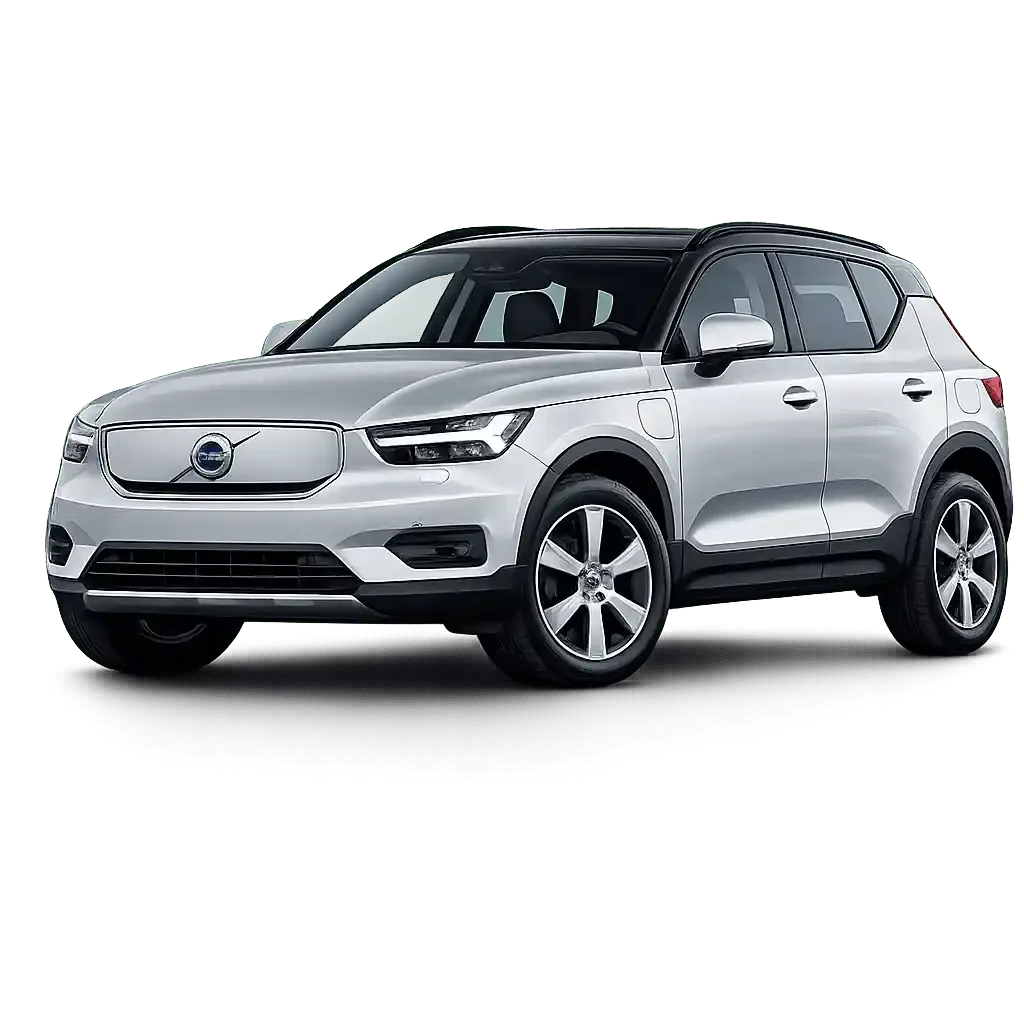
The XC40 Recharge Pure Electric is Volvo's first fully battery-electric vehicle, launched for the 2021 model year on the CMA (Compact Modular Architecture) platform shared with the Polestar 2 and Volvo C40 Recharge. Over its four model years (2021-2024), this vehicle underwent significant changes to its motor configurations, battery sizes, drive layouts, charging hardware, and exterior styling - before being renamed the Volvo EX40 for 2025. For parts sellers, the critical fitment splits are: the 2021-2022 vs. 2023-2024 body era (facelift), the three different motor/battery combinations (P8 Twin, Single Motor FWD, and 2024 revised Single/Twin), the FWD vs. RWD vs. AWD drive configuration, and the two battery sizes (69 kWh and 78/82 kWh). Getting any one of these wrong guarantees a return. This guide maps every split.
Brand and Platform Background
The XC40 Recharge Pure Electric was revealed in October 2019 and went on sale in late 2020 as a 2021 model year vehicle. It was Volvo's first fully electric car and was named one of the most significant EV launches of its era. Built on the CMA platform jointly developed by Volvo Cars and Geely, the XC40 Recharge shares its underpinnings with the Polestar 2 sedan, the Volvo C40 Recharge coupe-SUV (from 2022), and several Geely/Lynk & Co models. The CMA platform was originally designed for conventional powertrains but was engineered from the start to accept a fully electric drivetrain.
The XC40 Recharge was produced at Volvo's Ghent plant in Belgium for global markets and at a Geely facility in China for the Chinese market. For the 2024 model year, it received significantly updated motors, a new battery option, and a switch from front-wheel drive to rear-wheel drive on single-motor models. For 2025, the XC40 Recharge Pure Electric was renamed the Volvo EX40 as part of Volvo's new EV naming convention (EX30, EX40, EX90, etc.).
For this guide, we cover only the fully electric (BEV) XC40 Recharge models sold in the US market under the XC40 Recharge name (model years 2021-2024). We do not cover the ICE/mild-hybrid/PHEV XC40 models, which share the same body but use completely different powertrains. We also do not cover the C40 Recharge coupe variant, though it shares nearly all drivetrain and chassis components with the XC40 Recharge.
Complete Powertrain Reference (US Market)
2021 Model Year: P8 Twin Motor AWD (Only Configuration)
P8 Twin Motor AWD
• Configuration: Dual permanent magnet synchronous motors (PMSM), one front, one rear
• Motor output: 150 kW (201 hp) each, 330 Nm (243 lb-ft) each
• Total system output: 300 kW (402 hp), 660 Nm (487 lb-ft)
• Battery: 78 kWh gross (75 kWh usable), LG Chem pouch cells
• EPA range: 208 miles (later improved to 223 miles via OTA software update 1.8)
• DC fast charge: 150 kW max, 10-80% in approximately 40 minutes
• On-board charger: 11 kW AC
• Drive: AWD (dual motor, all-wheel drive)
• 0-60 mph: 4.7 seconds
• Curb weight: 4,823 lbs (2,188 kg)
• Notes: The only configuration available in the US for 2021. Badged P8 AWD on the vehicle. Both motors are identical 150 kW permanent magnet units. The OTA update 1.8 improved energy management and thermal management, boosting EPA range from 208 to 223 miles without any hardware changes.
2022-2023 Model Years: Twin Motor AWD (US Market)
Twin Motor AWD (2022-2023)
• Configuration: Dual permanent magnet synchronous motors (PMSM), one front, one rear
• Motor output: 150 kW (201 hp) each, 330 Nm (243 lb-ft) each
• Total system output: 300 kW (402 hp), 660 Nm (487 lb-ft)
• Battery: 78 kWh gross (75 kWh usable), LG Chem pouch cells
• EPA range: 223 miles (2022), 223 miles (2023)
• DC fast charge: 150 kW max, 10-80% in approximately 37 minutes
• On-board charger: 11 kW AC
• Drive: AWD (dual motor)
• Notes: Renamed from P8 to Twin Motor for 2022. Identical powertrain hardware to the 2021 P8 after OTA updates. The 2023 model year received a facelift (see Body Style Eras below) but the US market continued with the same twin-motor AWD configuration. Some international markets received a single-motor FWD option for 2022-2023 with a 170 kW front motor and 69 kWh battery - this was NOT offered in the US.
2024 Model Year: Single Motor RWD and Twin Motor AWD (Major Powertrain Revision)
Single Motor Extended Range RWD (New for 2024 US)
• Configuration: Single rear-mounted permanent magnet synchronous motor (PMSM), Volvo second-generation in-house design
• Motor output: 185 kW (248 hp), 420 Nm (310 lb-ft)
• Battery: 82 kWh gross (79 kWh usable), CATL prismatic cells
• EPA range: 293 miles
• DC fast charge: 200 kW max, 10-80% in approximately 28 minutes
• On-board charger: 11 kW AC
• Drive: RWD (rear-wheel drive) - first RWD Volvo in 25 years
• 0-60 mph: 6.9 seconds
• Notes: Entirely new motor designed in-house by Volvo (not carried over from 2021-2023). New 82 kWh battery pack with CATL prismatic cells (different chemistry and form factor from the 78 kWh LG Chem pouch cells in earlier models). The 200 kW DC fast charge rate is a significant upgrade from the 150 kW maximum on 2021-2023 models. This is a rear-drive vehicle - the motor is on the rear axle only. No front motor.
Twin Motor AWD (Revised for 2024)
• Configuration: Dual motors - 183 kW (245 hp) rear permanent magnet motor + 117 kW (156 hp) front asynchronous motor
• Total system output: 300 kW (402 hp), 670 Nm (494 lb-ft)
• Battery: 78 kWh gross (75 kWh usable)
• EPA range: 254 miles (up from 223 in 2023)
• DC fast charge: 200 kW max, 10-80% in approximately 28 minutes
• On-board charger: 11 kW AC
• Drive: AWD (dual motor)
• Notes: Completely revised motor setup for 2024. The previous dual 150 kW permanent magnet motors are replaced with an asymmetric configuration: a 183 kW permanent magnet rear motor and a 117 kW asynchronous front motor. The asynchronous front motor can disengage when not needed, improving efficiency (it does not require constant electrical charge when coasting). Despite using the same 78 kWh battery as 2021-2023, the new motors deliver 31 more miles of EPA range. DC fast charge improved to 200 kW (from 150 kW).
Powertrain Summary by Year (US Market)
• 2021: P8 Twin Motor AWD only. Dual 150 kW PMSM. 78 kWh battery. 150 kW DC fast charge. 208/223 miles EPA.
• 2022: Twin Motor AWD only (renamed from P8). Same hardware as updated 2021. 78 kWh. 150 kW DC. 223 miles EPA.
• 2023: Twin Motor AWD only (facelift body, same powertrain). 78 kWh. 150 kW DC. 223 miles EPA.
• 2024: Single Motor Extended Range RWD (new 185 kW rear PMSM, 82 kWh CATL battery, 200 kW DC, 293 miles EPA) OR Twin Motor AWD (revised 183 kW rear PMSM + 117 kW front ASM, 78 kWh, 200 kW DC, 254 miles EPA).
No motor or battery components interchange between the 2021-2023 powertrain era and the 2024 powertrain era. The motors are completely different designs. The 82 kWh battery pack (2024 Single Motor) uses different cell chemistry and form factor from the 78 kWh pack (2021-2024 Twin Motor).
Battery Packs
78 kWh Pack (2021-2024 Twin Motor)
• Capacity: 78 kWh gross, 75 kWh usable
• Cell type: LG Chem (LG Energy Solution) pouch cells
• DC fast charge max: 150 kW (2021-2023), 200 kW (2024 Twin Motor)
• Used in: All Twin Motor AWD models (2021-2024)
82 kWh Pack (2024 Single Motor Extended Range)
• Capacity: 82 kWh gross, 79 kWh usable
• Cell type: CATL prismatic cells
• DC fast charge max: 200 kW
• Used in: 2024 Single Motor Extended Range RWD only
The 78 kWh and 82 kWh battery packs are NOT interchangeable. They use different cell chemistry (LG pouch vs. CATL prismatic), different physical dimensions, different BMS (battery management system) calibrations, and different cooling configurations. Battery modules, BMS controllers, and high-voltage junction boxes from one pack do not fit the other.
Note: Some international markets also received a 69 kWh battery with a single front motor (FWD) for 2022-2023. This configuration was NOT sold in the US market and is not covered in this guide. However, if sourcing parts internationally, be aware that this third battery size exists.
Drive Configuration
AWD - Dual Motor All-Wheel Drive (2021-2024)
• Motor on each axle drives front and rear wheels independently.
• No mechanical driveshaft connecting front and rear axles (purely electric AWD).
• 2021-2023: Two identical 150 kW PMSM motors.
• 2024: Asymmetric - 183 kW rear PMSM + 117 kW front ASM.
RWD - Rear-Wheel Drive (2024 Only, US Market)
• Single 185 kW motor on the rear axle only.
• No front motor installed. No front motor mount, no front motor wiring harness.
• Different subframe configuration at the front compared to AWD models.
Critical: RWD and AWD models have fundamentally different front subframe/cradle assemblies. AWD models have a front motor, front motor mount, front motor cooling lines, and front motor wiring harness that do not exist on RWD models. Suspension components and steering systems may be shared, but always verify before assuming cross-compatibility between RWD and AWD.
Body Style Eras
Pre-Facelift (2021-2022)
• Original XC40 front end design with traditional Thor's Hammer LED headlights.
• Slightly protruding grille panel (sealed/blanked off on Recharge).
• Original front bumper design with angular fog light surrounds.
• Original taillight LED graphics.
• Android-based infotainment with Google built-in, 9-inch portrait touchscreen (standard on Recharge from launch).
• 12.3-inch digital instrument cluster.
Post-Facelift (2023-2024)
• Reshaped Thor's Hammer LED headlights aligned with C40 Recharge design language.
• Available Pixel LED headlight technology (84 individually controllable LEDs per headlight) on Ultimate trim.
• Redesigned front bumper with frameless grille plate (closer to C40 styling).
• Reshaped fog light surrounds (T-shaped plastic surrounds shared with C40).
• Slightly updated taillight LED graphics.
• New ADAS sensor platform (updated radar and camera hardware).
• New exterior colors: Sage Green, Fjord Blue (2023); Cloud Blue, Vapour Grey (2024).
• New wheel designs (aerodynamic 19-inch standard on Core/Plus; 20-inch on Ultimate).
• Leather-free interior with wool/polyester blend upholstery (no leather option).
• Black headliner standard.
The practical split for body panel fitment is: 2021-2022 (pre-facelift) vs. 2023-2024 (post-facelift). Headlights, front bumper, grille panel, and fog light surrounds do not interchange between these eras. The ADAS sensor platform also changed with the facelift, meaning radar and camera modules from 2021-2022 do not fit 2023-2024 vehicles. Taillights received minor changes; always verify part number before cross-referencing.
Charging Hardware
2021-2023 Charging System
• Charge port: CCS1 (Combined Charging System, Type 1)
• DC fast charge: 150 kW maximum
• On-board AC charger: 11 kW
• Charge port location: Left rear quarter panel
2024 Charging System
• Charge port: CCS1 (Combined Charging System, Type 1)
• DC fast charge: 200 kW maximum (both Single Motor and Twin Motor)
• On-board AC charger: 11 kW
• Charge port location: Left rear quarter panel
The DC fast charge hardware changed for 2024 to support 200 kW (up from 150 kW). The charge port connector type remained CCS1 throughout. Charge port door, charge port assembly, and charge port wiring may differ between the 150 kW and 200 kW configurations. Always verify model year when sourcing charge port components.
Step-by-Step Fitment Splits
Split 1: Powertrain Era (2021-2023 vs. 2024)
• 2021-2023: Dual 150 kW PMSM motors (identical front and rear). 78 kWh LG pouch battery. 150 kW DC fast charge.
• 2024 Single Motor: Single 185 kW rear PMSM (new Volvo in-house design). 82 kWh CATL prismatic battery. 200 kW DC fast charge.
• 2024 Twin Motor: 183 kW rear PMSM + 117 kW front ASM (new designs). 78 kWh LG pouch battery. 200 kW DC fast charge.
No motor assemblies, motor controllers/inverters, or battery packs interchange between the 2021-2023 era and 2024. Even the 2024 Twin Motor, which retains the 78 kWh battery size, uses updated DC charging hardware rated at 200 kW.
Split 2: Drive Configuration (AWD vs. RWD)
• AWD (2021-2024 Twin Motor): Front and rear motors. Front subframe accommodates front motor assembly. Front motor cooling lines. Front motor wiring harness.
• RWD (2024 Single Motor only): Rear motor only. No front motor, no front motor mount, no front motor cooling, no front motor wiring. Different front subframe/cradle.
Front subframe assemblies, axle components, and cooling system layouts differ between AWD and RWD. Rear suspension and rear motor mounting may also differ due to different motor sizes (150 kW vs. 183 kW vs. 185 kW).
Split 3: Battery Pack (78 kWh vs. 82 kWh)
• 78 kWh (all 2021-2024 Twin Motor): LG Chem/LG Energy Solution pouch cells. Shared across all Twin Motor models.
• 82 kWh (2024 Single Motor only): CATL prismatic cells. Different pack dimensions, BMS, and cooling configuration.
Battery packs, BMS modules, high-voltage junction boxes, and battery cooling components are NOT interchangeable between the 78 kWh and 82 kWh configurations.
Split 4: Body Era (Pre-Facelift vs. Post-Facelift)
• 2021-2022: Pre-facelift. Original headlights, grille panel, bumpers, ADAS sensors.
• 2023-2024: Post-facelift. Reshaped headlights, frameless grille, redesigned bumper, updated ADAS sensor platform, Pixel LED option.
Headlights, grille panel, front bumper, fog light surrounds, and ADAS modules (radar, camera) do not interchange between pre-facelift and post-facelift.
Split 5: DC Fast Charge Hardware (150 kW vs. 200 kW)
• 2021-2023: 150 kW maximum DC fast charge.
• 2024: 200 kW maximum DC fast charge (both Single Motor and Twin Motor).
The DC charging hardware (including the charge inlet, high-voltage contactors, and thermal management for fast charging) was upgraded for 2024. Verify model year before sourcing any charge port or high-voltage DC charging component.
Split 6: Headlight Technology (Standard LED vs. Pixel LED)
• Standard LED: Available on Core and Plus trims across all years.
• Pixel LED: Available on Ultimate trim, 2023-2024 only. 84 individually controllable LEDs per headlight.
Standard LED and Pixel LED headlights are physically different units with different wiring and control modules. They do not interchange. Always confirm trim level and headlight type before shipping.
Biggest Return Traps
Trap 1: 2024 Motors Listed for 2021-2023 (or Vice Versa)
Why they get returned: The 2024 model year received completely new motor designs (185 kW in-house PMSM for Single Motor; 183 kW PMSM + 117 kW ASM for Twin Motor). These are not the same as the 2021-2023 dual 150 kW PMSM motors. Motor assemblies, inverters, and motor controllers are not interchangeable.
How to stop returns: Always specify: 2021-2023 (dual 150 kW PMSM) or 2024 Single Motor (185 kW rear PMSM) or 2024 Twin Motor (183 kW rear PMSM + 117 kW front ASM).
Trap 2: 82 kWh Battery Parts for 78 kWh (or Vice Versa)
Why they get returned: The 2024 Single Motor uses an 82 kWh CATL prismatic battery pack. All Twin Motor models (2021-2024) use a 78 kWh LG pouch battery pack. Different cell chemistry, different pack dimensions, different BMS.
How to stop returns: Always specify: 78 kWh (Twin Motor, all years) or 82 kWh (2024 Single Motor Extended Range only). Never assume battery compatibility based on model year alone.
Trap 3: AWD Front Subframe/Motor Parts for RWD Model (or Vice Versa)
Why they get returned: The 2024 RWD Single Motor has no front motor, no front motor mount, and a different front subframe configuration. Shipping a front motor assembly or AWD front subframe to a 2024 RWD owner is a guaranteed return.
How to stop returns: Always confirm: AWD (Twin Motor) or RWD (Single Motor). This applies to front subframe assemblies, cooling system components, and all front drivetrain parts.
Trap 4: Pre-Facelift Body Parts for Post-Facelift (or Vice Versa)
Why they get returned: The 2023 facelift changed the headlights, grille panel, front bumper, fog light surrounds, and ADAS sensor hardware. None of these parts interchange between 2021-2022 and 2023-2024.
How to stop returns: Always specify: 2021-2022 (pre-facelift) or 2023-2024 (post-facelift) for any front-end body panel, headlight, or ADAS component.
Trap 5: Standard LED Headlights Shipped for Pixel LED Vehicle (or Vice Versa)
Why they get returned: Pixel LED headlights (2023-2024 Ultimate trim) are a completely different unit from standard LED headlights. Different housing, different LED array, different control module, different wiring connector.
How to stop returns: Always confirm: Standard LED or Pixel LED. Ask the buyer for their trim level (Core/Plus = standard LED, Ultimate 2023-2024 = Pixel LED).
Trap 6: ICE/Hybrid XC40 Parts Listed for XC40 Recharge (or Vice Versa)
Why they get returned: The XC40 Recharge Pure Electric shares the CMA platform and exterior body with the ICE/mild-hybrid/PHEV XC40, but the powertrain, floor structure (battery pack location), cooling system, front structure (frunk vs. engine bay), and high-voltage wiring are completely different. Even some body panels differ (sealed grille vs. open grille on ICE models).
How to stop returns: Always specify: XC40 Recharge Pure Electric (BEV) or XC40 (ICE/hybrid). Do not cross-reference powertrain, cooling, front structure, or grille components between BEV and ICE/hybrid models.
Trap 7: 150 kW Charge Port/DC Components for 2024 200 kW Vehicle
Why they get returned: The 2024 model year upgraded DC fast charging from 150 kW to 200 kW. The charge port assembly and high-voltage DC charging components were updated to handle the higher power.
How to stop returns: Always specify model year for any charge port, charge inlet, or DC fast charging component: 2021-2023 (150 kW) or 2024 (200 kW).
Fitment Rules Block
Required attributes for every XC40 Recharge Pure Electric parts listing:
• Model year(s)
• Powertrain: P8 Twin Motor (2021) / Twin Motor (2022-2023) / Single Motor Extended Range RWD (2024) / Twin Motor AWD (2024)
• Drive: AWD (all Twin Motor) / RWD (2024 Single Motor only)
• Battery: 78 kWh (Twin Motor, all years) / 82 kWh (2024 Single Motor)
• Body era: Pre-facelift (2021-2022) / Post-facelift (2023-2024)
• Headlight type: Standard LED / Pixel LED (2023-2024 Ultimate only)
• DC charge rate: 150 kW (2021-2023) / 200 kW (2024)
• Vehicle type: XC40 Recharge Pure Electric (BEV) - NOT ICE/hybrid XC40
Buyer Confirmation Prompts
Before shipping any part for an XC40 Recharge Pure Electric, confirm:
• "What is your exact model year? (2021, 2022, 2023, or 2024)"
• "Is your vehicle the fully electric XC40 Recharge, or the gas/hybrid XC40?"
• "Is your vehicle Single Motor (rear-wheel drive) or Twin Motor (all-wheel drive)?"
• "For headlights: Do you have standard LED headlights or Pixel LED headlights?"
• "For 2024 models: Is your vehicle the Single Motor Extended Range or Twin Motor?"
Quick Identification Guide
Powertrain Identification
• 2021 P8 Twin Motor: P8 AWD badge on rear. Dual motor. 78 kWh battery. Only BEV XC40 Recharge available in 2021.
• 2022-2023 Twin Motor: Twin badge (or Twin Motor). Dual motor. 78 kWh battery. AWD.
• 2024 Single Motor: Single Motor badge. RWD. 82 kWh battery. 293-mile EPA range on window sticker.
• 2024 Twin Motor: Twin Motor badge. AWD. 78 kWh battery. 254-mile EPA range on window sticker.
Body Era Identification
• 2021-2022 (pre-facelift): Traditional XC40 headlight shape. Protruding sealed grille panel. Angular fog light surrounds.
• 2023-2024 (post-facelift): Reshaped headlights matching C40 design. Frameless flush grille plate. T-shaped fog light surrounds. New ADAS sensor locations.
BEV vs. ICE/Hybrid from Outside
• XC40 Recharge (BEV): Sealed/blanked grille (no airflow needed for engine). No exhaust pipes. Charge port on left rear quarter panel. Recharge badging.
• XC40 ICE/Hybrid: Open grille with visible air intake. Exhaust pipe(s) visible at rear. Fuel filler on right rear quarter panel.
AWD vs. RWD from Underneath
• AWD (Twin Motor): Motor visible on both front and rear axles. Front motor cooling lines routed to front.
• RWD (2024 Single Motor): Motor visible on rear axle only. No motor or motor mount on front axle. Simpler front subframe.
Parts Cross-Reference Notes
CMA platform cross-references: The XC40 Recharge shares the CMA platform with the Volvo C40 Recharge (from 2022), the Polestar 2, and several Geely/Lynk & Co models. Chassis and suspension components (struts, control arms, tie rods, sway bar links, wheel bearings) cross-reference broadly between XC40 Recharge and C40 Recharge of the same model year, as the C40 is essentially an XC40 with a different roofline and rear hatch. Polestar 2 shares many CMA suspension components but has different ride height and calibration - verify part numbers before cross-referencing.
Motor cross-references: The 2021-2023 dual 150 kW motors are shared with the C40 Recharge Twin Motor of the same years. The 2024 revised motors (185 kW rear PMSM, 183 kW rear PMSM, 117 kW front ASM) are shared with the 2024 C40 Recharge of matching configuration. The Polestar 2 shares some motor hardware with the XC40 Recharge but may have different tuning - always verify by part number.
Battery cross-references: The 78 kWh battery pack is shared across XC40 Recharge Twin Motor and C40 Recharge Twin Motor models of the same generation. The 82 kWh battery pack is shared with the 2024 C40 Recharge Single Motor Extended Range. Battery modules, BMS, and cooling hardware cross-reference between XC40 and C40 of matching battery size and year.
Body panel cross-references: The XC40 Recharge shares front doors and front fenders with the ICE/hybrid XC40 of the same body era. Headlights, grille panels, and front bumpers may differ between BEV and ICE/hybrid (sealed grille vs. open grille). The C40 Recharge shares the front end, front doors, and interior with the XC40 Recharge but has a different roof, rear hatch, rear bumper, and taillights.
Brake and suspension: Standard brake components (rotors, pads, calipers) cross-reference between XC40 Recharge, C40 Recharge, and potentially the ICE/hybrid XC40 of similar weight class. Verify brake size by trim level and wheel size, as larger wheels may use larger brake components.
Specialist sources: FCP Euro carries extensive XC40 Recharge inventory with lifetime replacement warranty. SwedeSpeed and Volvo forums maintain BEV technical databases. Volvo Parts Webstore (parts.volvocars.com) provides OE part number lookup by VIN.
Disclaimer: This guide is based on publicly available specifications, Volvo press materials, and independent research. Part interchangeability should always be confirmed via VINand OEM part number lookup. Specifications may change without notice. This document does not constitute official Volvo parts catalog data. Visuals and illustrations in this article were generated using AI for representative purposes and may not reflect exact technical schematics.