
Volvo S40 (P1 Platform) 2005-2012 US Market Second Generation
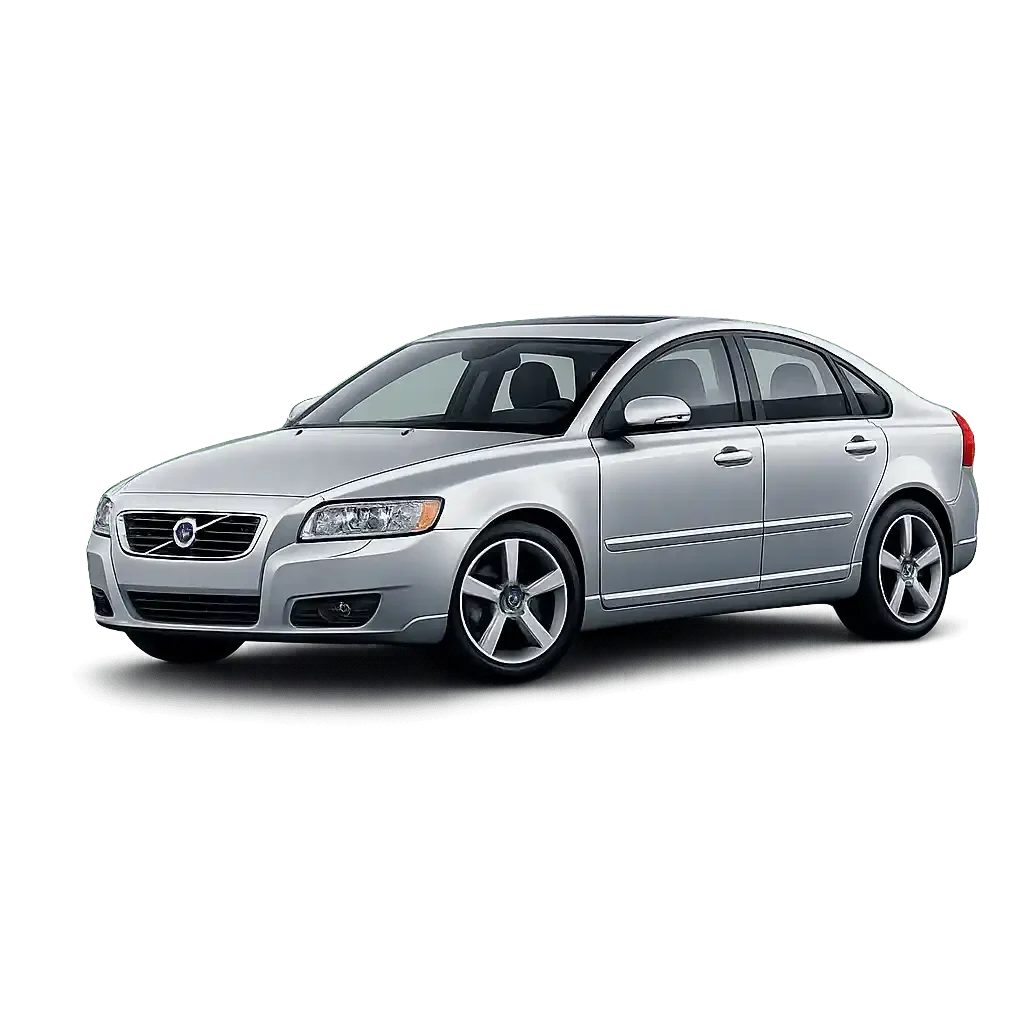
The Complete Fitment Guide
Returns destroy margins. The Volvo S40 (P1 platform, 2005-2011 US market) is Volvo’s compact sedan built on the Ford C1/P1 platform shared with the V50 wagon, C30 hatchback, and C70 convertible. In the US, it was offered with two engines - the naturally aspirated 2.4i and the turbocharged T5 - but these are completely different powerplants from different engine families with different displacements, different aspiration, and different performance characteristics. The 2008 facelift brought revised exterior styling and an updated T5 engine code (B5254T3 to B5254T7). Drive configuration varied: the 2.4i was FWD-only, while the T5 was available in both FWD and AWD (Haldex). For the final 2011 US model year, AWD, the 2.4i, and all manual transmissions were dropped, leaving only the T5 FWD automatic. The S40 carries an additional catalog hazard that the V50 does not: the S40 nameplate was used for two completely unrelated generations that overlapped in 2004 showrooms. This guide maps every fitment split required to prevent returns on one of Volvo’s most cross-referenced compact platforms.
Generation Overview (2005-2011 US Market)
The S40 was the sedan variant of Volvo’s compact P1 platform family, which also included the V50 wagon, C30 three-door hatchback (2008-2013), and C70 convertible (2006-2013). The P1 platform was co-developed with Ford (known as the Ford C1 platform) and Mazda (as the Mazda BK platform) at Ford’s Cologne, Germany development center. While the underpinnings were shared with the Mazda 3 and European Ford Focus, the powertrains fitted to US-market Volvos were uniquely Volvo - the RNC-generation Whiteblock inline-5 engines.
The second-generation S40 debuted in mid-2004 (sometimes labeled 2004.5 or 2004½) at the Frankfurt Motor Show, with production commencing at Volvo’s Ghent, Belgium factory. It replaced the NedCar-built first-generation S40 (2000-2004), which used inline-4 engines and shared a platform with the Mitsubishi Carisma. The second-generation S40 and its NedCar predecessor overlapped briefly in 2004 showrooms - a persistent source of catalog confusion.
The S40 received a facelift for the 2008 model year with revised front and rear styling, new headlights and taillights, updated interior, and the availability of optional active xenon headlights. US availability progressively narrowed: the 2.4i was dropped for 2011, AWD was dropped for 2011, and manual transmissions were dropped for 2011, leaving only the T5 FWD automatic in base and R-Design trims. The S40 was discontinued after 2011 in the US. Volvo did not offer a direct compact sedan replacement until the S60 was repositioned.
Key Platform Facts
• Platform: P1 (Volvo designation) / C1 (Ford designation)
• US model years: 2004.5-2011 (2011 was the final US year)
• Assembly: Ghent, Belgium
• Engine family: Volvo Modular Engine (“Whiteblock”) inline-5 exclusively in US
• Transmissions: 5-speed AW55-51 automatic, 5-speed M56 manual (2.4i), 6-speed M66 manual (T5)
• Drive: FWD standard; AWD optional on T5 (Haldex)
• P1 siblings: V50 (wagon), C30 (hatchback, 2008+), C70 (convertible, 2006+)
Why the S40 Causes Catalog Errors
• Two different engines under one nameplate: The 2.4i (naturally aspirated 2.4L, B5244S7, 168 hp) and T5 (turbocharged 2.5L, B5254T3/T7, 218-227 hp) are different displacements with different aspiration, different turbo/intake hardware, and different output levels.
• T5 engine code change at facelift: Pre-facelift T5 (2005-2007) used the B5254T3. Post-facelift T5 (2008-2011) used the B5254T7. These share the same basic architecture but have a different turbocharger design (integrated exhaust manifold/turbo on T7), revised engine management, and slightly different output.
• Three transmission types: 5-speed AW55-51 automatic (2.4i and T5), 5-speed M56 manual (2.4i), and 6-speed M66 manual (T5 only). The M66 in the S40 is a compact variant shared with the S60R/V70R.
• FWD vs. AWD: AWD was only available on the T5 (not the 2.4i). The Haldex coupling, rear driveshaft, rear differential, and associated hardware are absent on all FWD models.
• Pre-facelift vs. post-facelift body: The 2008 facelift changed headlights, taillights, grille, bumpers, and some interior trim. Pre-facelift (2005-2007) and post-facelift (2008-2011) exterior panels do not interchange.
• P1 sibling confusion: The S40 shares most of its mechanical components with the V50 wagon, C30, and C70. However, the S40’s sedan trunk, rear bumper, taillights, and rear quarter panels are unique to the sedan and do not interchange with the V50 wagon hatch, C30 hatchback rear, or C70 convertible.
• NedCar vs. P1 first-generation overlap: The NedCar-built first-generation S40 (2000-2004, inline-4) and the P1-built second-generation S40 (2004.5-2011, inline-5) overlapped during the 2004 model year. These share a nameplate and nothing else - different platform, different factory, different engine architecture, different transmission, different body. A “2004 S40” could be either generation.
• PCV system as maintenance item: The RNC 5-cylinder PCV (Positive Crankcase Ventilation) system is a known failure point. PCV valve/flame trap kits differ between the 2.4i and T5 engines.
Complete Powertrain Reference (US Market)
2.4i - Naturally Aspirated 2.4L Inline-5 (2005-2010)
• Engine code: B5244S7
• Displacement: 2.4L (2,435cc) inline-5
• Block material: Cast iron block, aluminum head
• Aspiration: Naturally aspirated (no turbo)
• Output: 168 hp at 6,000 rpm, 170 lb-ft at 4,400 rpm
• Timing: Timing BELT (interference engine) - scheduled replacement at approximately 105,000 miles
• Transmission options: 5-speed AW55-51 automatic OR 5-speed M56 manual
• Drive: FWD only (no AWD option)
• US availability: 2005-2010 (dropped for 2011)
• PCV: Known failure item - crankcase vent valve/flame trap requires periodic replacement. PCV kit differs from T5.
• PZEV: PZEV (Partial Zero Emissions Vehicle) versions sold in certain states had SULEV emissions equipment.
• Notes: The B5244S7 is the naturally aspirated variant of the Whiteblock 5-cylinder. No turbocharger, no intercooler, no boost-related components. Shared with V50 2.4i of the same era.
T5 Pre-Facelift - Turbocharged 2.5L Inline-5 (2005-2007)
• Engine code: B5254T3
• Displacement: 2.5L (2,521cc) inline-5
• Block material: Cast iron block, aluminum head
• Aspiration: Turbocharged (low-pressure turbo)
• Output: 218 hp (220 PS) at 5,000 rpm, 236 lb-ft (320 Nm) at 1,500-5,000 rpm
• Timing: Timing BELT (interference engine) - scheduled replacement at approximately 105,000 miles
• Transmission options: 5-speed AW55-51 automatic OR 6-speed M66 manual (compact variant)
• Drive: FWD or AWD (Haldex)
• US availability: 2005-2007 (replaced by B5254T7 at 2008 facelift)
• PCV: Known failure item - PCV kit specific to turbo engine (differs from 2.4i).
• Notes: The B5254T3 uses a conventional separate exhaust manifold and turbocharger assembly. This differs from the post-facelift B5254T7 which has an integrated manifold/turbo design. Shared with V50 T5 of the same era.
T5 Post-Facelift - Turbocharged 2.5L Inline-5 (2008-2011)
• Engine code: B5254T7
• Displacement: 2.5L (2,521cc) inline-5
• Block material: Cast iron block, aluminum head
• Aspiration: Turbocharged (integrated manifold turbo, different design from B5254T3)
• Output: 227 hp (230 PS) at 5,000 rpm, 236 lb-ft (320 Nm) at 1,500-5,000 rpm
• Timing: Timing BELT (interference engine) - scheduled replacement at approximately 105,000 miles
• Transmission options: 5-speed AW55-51 automatic OR 6-speed M66 manual (T5 AWD); for 2011: automatic only, FWD only
• Drive: FWD or AWD (Haldex) - 2008-2010; FWD only for 2011
• Engine management: Bosch ME9 Motronic
• US availability: 2008-2011
• Notes: The B5254T7 has an integrated exhaust manifold/turbocharger design that is physically different from the B5254T3’s separate manifold + turbo assembly. Turbocharger, exhaust manifold, and related heat shielding are NOT interchangeable between T3 and T7. Shared with V50 T5, C30 T5, C70 T5 of the same era. A Polestar performance package was available, boosting output to approximately 250 hp via ECU calibration.
Powertrain Availability by Year (US Market)
• 2004.5-2007: 2.4i FWD (168 hp, B5244S7) + T5 FWD/AWD (218 hp, B5254T3)
• 2008-2010: 2.4i FWD (168 hp, B5244S7) + T5 FWD/AWD (227 hp, B5254T7)
• 2011: T5 FWD only (227 hp, B5254T7, automatic only) - 2.4i discontinued, AWD discontinued, manual discontinued
Body Style Eras
Pre-Facelift (2005-2007)
• Original P1 S40 sedan body design.
• Tear-shaped headlights swept back onto front fenders.
• Silver grille surround.
• Sedan-specific trunk lid, rear bumper, and vertically oriented taillights.
• “Floating” center console with Volvo’s thin-film-transistor display.
Post-Facelift (2008-2011)
• Revised headlights with available active xenon option.
• Black grille surround (replacing silver).
• Modified front and rear bumpers.
• Revised taillights with updated design.
• R-Design trim package available (sport bumper lip, rocker panels, interior trim).
• Larger circular Volvo logo on front grille from 2010.
• 2009+: Wider-spaced “VOLVO” lettering on trunk lid with larger characters.
Exterior panels that changed at the 2007/2008 facelift boundary include headlights, taillights, front grille, and front/rear bumper covers. These do not interchange between pre-facelift and post-facelift models.
P1 Platform Family: What Interchanges and What Does Not
Components That Cross-Reference Across P1 Siblings
• Engine and transmission: The same B5244S7 (2.4i) and B5254T3/T7 (T5) engines and AW55-51/M56/M66 transmissions are shared across S40, V50, C30, and C70 for the same model year and engine code.
• Front suspension: MacPherson strut front suspension components (struts, control arms, tie rods, wheel bearings) are shared across all P1 models.
• Brakes: Brake calipers, rotors, and pads are generally shared across P1 siblings for the same wheel size.
• Interior forward of B-pillar: Dashboard, steering wheel, front seats, front door panels are shared between S40 and V50 (C30 and C70 have unique interiors).
• Electrical: Engine wiring harness, ECU, sensor suite are shared for the same engine code and model year.
Components That Do NOT Interchange
• Body panels behind B-pillar: The S40’s sedan rear (trunk lid, rear bumper, taillights, rear quarter panels, rear window, C-pillar) is unique to the S40 sedan and does not interchange with the V50 wagon hatch, C30 hatchback, or C70 convertible.
• Rear suspension tuning: While the rear suspension architecture (Multilink) is shared, spring rates and damper calibrations may differ between the S40 sedan and V50 wagon due to weight distribution differences.
• Trunk/cargo area: Trunk lid, trunk lining, trunk floor, and related trim are S40-specific. The V50 wagon hatch and cargo systems are completely different.
Components That Do NOT Interchange with NedCar S40 (2000-2004)
Nothing. The NedCar-platform first-generation S40 (2000-2004) and the P1-platform second-generation S40 (2004.5+) share zero interchangeable components. Different platform, different factory, different engine family (inline-4 vs. inline-5), different transmission family, different suspension architecture, different body, different electrical systems. The VIN distinguishes them: NedCar cars have a “YV1VS” prefix while P1 cars have a “YV1MS” prefix.
Catalog Accuracy - The Fitment Splits That Matter
Split 1: 2.4i (B5244S7) vs. T5 (B5254T3/T7)
Different displacement (2.4L vs. 2.5L), different aspiration (NA vs. turbo), different engine code. All turbocharger-related components (turbo, intercooler, boost piping, wastegate) are absent on the 2.4i. PCV kits differ between engines. Oil filter housings and gaskets may differ. Ignition coils and spark plugs may differ between naturally aspirated and turbocharged applications.
Split 2: T5 Pre-Facelift (B5254T3) vs. T5 Post-Facelift (B5254T7)
The B5254T3 (2005-2007) has a separate exhaust manifold and turbocharger. The B5254T7 (2008-2011) has an integrated exhaust manifold/turbocharger assembly. The turbocharger unit, exhaust manifold, and related heat shielding are NOT interchangeable between the two engine codes. Engine internals (pistons, rods, crank, timing belt) are generally compatible, but turbo-specific external components differ.
Split 3: FWD vs. AWD
AWD was available only on the T5 (not the 2.4i). AWD models have a Haldex coupling, rear driveshaft, rear differential, and modified exhaust routing. FWD models have none of these components. Haldex coupling service kits only apply to AWD models.
Split 4: Pre-Facelift (2005-2007) vs. Post-Facelift (2008-2011) Body
Headlights, taillights, front grille, and front/rear bumper covers changed at the 2008 facelift. These exterior panels do not interchange across the facelift boundary.
Split 5: Transmission Type
Three transmissions were offered: 5-speed AW55-51 automatic (both engines), 5-speed M56 manual (2.4i only), and 6-speed M66 manual (T5 only). Clutch kits, flywheel, shift cables, and transmission-specific parts differ between all three units. For 2011, only the automatic was offered.
Split 6: S40 Sedan vs. V50 Wagon
All body panels behind the B-pillar differ: the S40 sedan trunk lid, rear quarter panels, C-pillar, rear bumper, rear window, and taillights are unique. Suspension tuning may differ due to weight distribution. Always specify S40 (sedan) or V50 (wagon) for body and rear suspension components.
Split 7: P1 S40 (2004.5-2011) vs. NedCar S40 (2000-2004)
These are completely different vehicles sharing only a nameplate. Different platform, different factory, different engine family (inline-5 vs. inline-4), different transmission family. The 2004 model year is especially dangerous: a “2004 Volvo S40” could be either generation. VIN prefix is the definitive identifier: YV1VS = NedCar, YV1MS = P1.
Biggest Return Traps and How to Prevent Them
Trap 1: Turbo Components Shipped to 2.4i Owner
What happens: Turbocharger, intercooler, or boost piping listed for “S40” ships to a 2.4i owner. The 2.4i is naturally aspirated - no turbo components exist on this engine.
Prevention: Always specify engine: 2.4i (B5244S7, naturally aspirated) or T5 (B5254T3/T7, turbocharged).
Trap 2: B5254T3 Turbo for B5254T7 Engine (or Vice Versa)
What happens: A turbocharger assembly for the pre-facelift B5254T3 (separate exhaust manifold + turbo) ships to a post-facelift B5254T7 owner (integrated manifold/turbo). The physical mounting and design are different.
Prevention: Always specify engine code: B5254T3 (2005-2007) or B5254T7 (2008-2011). The turbo and exhaust manifold differ.
Trap 3: Pre-Facelift Headlights/Taillights for Post-Facelift
What happens: Headlights or taillights from a 2005-2007 S40 ship to a 2008+ owner. The facelift changed both units.
Prevention: Always split at the 2007/2008 facelift boundary for exterior lighting and bumpers.
Trap 4: AWD Components for FWD Vehicle
What happens: Haldex coupling service kit, rear driveshaft, or rear differential ships to an FWD S40 owner. FWD models have no AWD hardware. Or exhaust components for FWD ship to AWD (different routing).
Prevention: Always specify: FWD or AWD. Note: 2.4i = always FWD. T5 = FWD or AWD (2005-2010). 2011 T5 = FWD only.
Trap 5: V50 Wagon Rear Body Parts for S40 Sedan
What happens: V50 wagon taillights, rear bumper, or hatch ship to an S40 sedan owner. These are completely different body configurations behind the B-pillar.
Prevention: Always specify: S40 (sedan) or V50 (wagon). Front body panels are shared, but everything behind the B-pillar differs.
Trap 6: NedCar First-Generation S40 Parts for P1 Second-Generation S40
What happens: Parts for the 2000-2004 S40 (NedCar platform, inline-4) ship to a 2004.5-2011 S40 (P1 platform, inline-5) owner, or vice versa, because both are “Volvo S40.” Nothing fits.
Prevention: Always specify platform generation: S40 NedCar (2000-2004, inline-4) or S40 P1 (2004.5-2011, inline-5). VIN prefix YV1VS = NedCar, YV1MS = P1.
Trap 7: Wrong PCV Kit for Engine
What happens: A T5 PCV (flame trap/crankcase vent) kit ships to a 2.4i owner, or vice versa. The PCV system configuration differs between naturally aspirated and turbocharged engines.
Prevention: Always specify engine: 2.4i or T5 for PCV/crankcase ventilation components.
Aftermarket Parts Cross-Reference Notes
P1 platform cross-references: The S40 shares the P1/C1 platform with the V50, C30, and C70. Front suspension, brakes, engine, transmission, and many electrical components cross-reference across all four models for the same engine code and model year. The C30 was not sold in the US until 2008.
Engine cross-references: The B5244S7 (2.4i) is shared with V50 2.4i. The B5254T3 is shared with V50 T5 (2005-2007) and early C30 T5 (2008). The B5254T7 is shared with V50 T5, C30 T5, and C70 T5 (2008-2012). The B5254T7 was also used in the Ford Focus ST, S-Max, and Mondeo in other markets, though Volvo-specific calibration and accessories may differ.
Transmission cross-references: The AW55-51 5-speed automatic is shared across P1 models and was also used in some P2 Volvos (S60, V70, XC70, XC90 with inline-5). The M66 6-speed manual in the S40 is a compact variant related to the unit in the S60R/V70R. The M56 5-speed manual was also used in P2 Volvos.
NedCar cross-reference warning: No components interchange between the first-generation NedCar S40 (2000-2004, inline-4, built in Netherlands) and the second-generation P1 S40 (2004.5-2011, inline-5, built in Belgium). This is the single most important cross-reference firewall in the S40 catalog.
Known maintenance items: PCV system (crankcase vent valve/flame trap), timing belt and tensioners (105,000-mile interval), automatic transmission fluid and filter (40,000-mile interval), and engine mounts are the highest-volume parts orders for the S40. Each item is engine-specific.
Specialist sources: FCP Euro carries extensive P1 S40 inventory with lifetime replacement warranty. IPD stocks performance and maintenance parts with detailed engine identification guides and explicitly separates NedCar from P1 S40 parts. SwedeSpeed and MatthewsVolvoSite forums maintain detailed P1 parts interchange databases. Volvo Parts Webstore (parts.volvocars.com) provides OE part number lookup by VIN.
Data Quality Checklist for Catalog Managers
Required attributes for every P1 S40 parts listing:
• Model year(s)
• Engine: 2.4i (B5244S7) or T5 (B5254T3 for 2005-2007, B5254T7 for 2008-2011)
• Facelift era: Pre-facelift (2005-2007) or post-facelift (2008-2011) for body/lighting
• Transmission: 5-speed auto (AW55-51), 5-speed manual (M56, 2.4i), or 6-speed manual (M66, T5)
• Drive type: FWD or AWD (Haldex, T5 only, 2005-2010)
• Body type: S40 (sedan) - distinguish from V50 (wagon), C30 (hatchback), C70 (convertible)
• Platform generation: P1 (second-gen, 2004.5-2011, inline-5) - distinguish from NedCar (first-gen, 2000-2004, inline-4)
Buyer Confirmation Prompts
Before shipping any part for an S40, confirm:
• “What is your exact model year?” - Critical for facelift boundary (2007/2008), engine code, and generation identification
• “Is your engine the 2.4i (naturally aspirated) or the T5 (turbo)?”
• “Is your vehicle FWD or AWD?” - AWD only on T5, only through 2010
• “Do you have an automatic or manual transmission?” - Three different gearboxes were offered
• “Is your S40 a 2000-2004 model (4-cylinder) or a 2005-2011 model (5-cylinder)?” - Two completely different platforms share this nameplate
The Business Case: Why Fitment Data Pays for Itself
The P1 S40 is now 14-21 years old and firmly in the deep aftermarket maintenance window. Timing belt kits, PCV systems, engine mounts, and transmission services are the highest-volume parts orders. The 2.4i vs. T5 engine split is the most important fitment attribute: a timing belt kit for the wrong displacement, or a turbo component shipped to a naturally aspirated owner, is an automatic return. The facelift boundary (2007/2008) matters for exterior body panels and lighting. The FWD/AWD split matters for drivetrain and exhaust components.
The S40 carries an additional catalog hazard that the V50 does not: the S40 nameplate was used for two completely unrelated generations that overlapped in 2004 showrooms. The NedCar first-generation S40 (2000-2004, inline-4, built in Netherlands) and the P1 second-generation S40 (2004.5-2011, inline-5, built in Belgium) share a name and nothing else. Any catalog that does not enforce a hard platform-generation boundary between these two vehicles is generating returns on every ambiguous “2004 S40” listing.
The P1 S40’s two engines (2.4i vs. T5), the T5 engine code change (B5254T3 vs. B5254T7), the facelift boundary (2007/2008), the FWD/AWD split, the S40/V50 body distinction, the three transmission types, and the absolute NedCar-to-P1 generation firewall are the minimum fitment attributes required. If your catalog does not capture engine, facelift era, drive type, body variant, transmission type, and platform generation, you are shipping wrong parts to a knowledgeable Volvo ownership community that will return them.
Disclaimer: This guide is based on publicly available specifications, Volvo press materials, and independent research. Part interchangeability should always be confirmed via VINand OEM part number lookup. Specifications may change without notice. This document does not constitute official Volvo parts catalog data. Visuals and illustrations in this article were generated using AI for representative purposes and may not reflect exact technical schematics.