
Volvo 960 (Original Version) 1992 to 1994 Fitment Guide
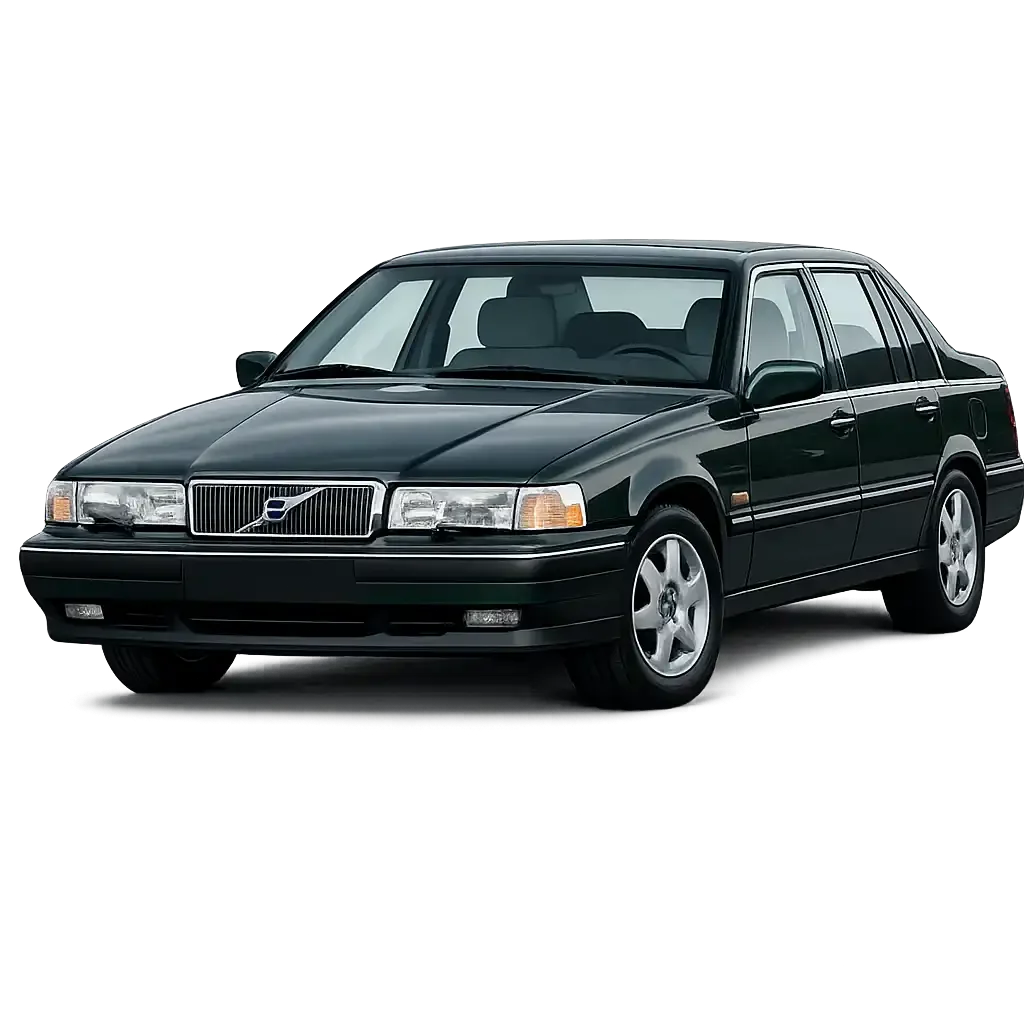
The Volvo 960 (1990 to 1998) is a 4-door rear-wheel-drive executive sedan and 5-door wagon that replaced the Volvo 760 as the flagship of Volvo's lineup. Built on the P80/900 platform, the 960 shares its basic architecture with the Volvo 940 but is distinguished by its all-aluminum DOHC inline-6 engine, independent multi-link rear suspension (sedans), unique dashboard, and exclusive front-end sheetmetal from the A-pillar forward. This guide covers the original (pre-facelift) 960 for the 1992 to 1994 US model years. In North America, the 960 debuted as a 1992 model, with the first US-market car rolling off the Kalmar, Sweden assembly line on August 12, 1991. The 1992 model year was the first to receive Volvo's new B6304F "Whiteblock" 2.9L DOHC inline-6 for the US market (earlier 1991 models in some markets still carried the PRV V6 from the 760). The 960 received incremental updates through 1992, 1993, and 1994, but no major platform or body changes. For the 1995 model year, the 960 received a significant facelift with revised exterior styling, a redesigned front suspension, an entirely new multi-link rear suspension with a fiberglass transverse leaf spring, and the addition of a smaller 2.5L inline-6 option. This guide maps every fitment split required to prevent returns on Volvo's flagship sedan and wagon in its original, pre-facelift form.
Generation Overview (Original, 1992 to 1994)
The Volvo 960 was launched globally in the autumn of 1990 for the 1991 model year as the replacement for the 760. The 960 was an evolutionary progression of the 760, featuring the work of British designer Peter Horbury. In most global markets, the 1991 960 introduced Volvo's all-new aluminum 24-valve DOHC inline-6 engine, co-developed with engineering input from Porsche. However, in the United States, the 1991 model year carried over the PRV (Peugeot-Renault-Volvo) B280 V6 from the 760 due to emissions certification timelines. The new inline-6 arrived in the US for the 1992 model year, making 1992 the effective start of the "modern" 960 in North America.
The 960 was offered in two body styles throughout its production: a 4-door sedan and a 5-door wagon (estate). Both shared the same 109.1-inch (2,770 mm) wheelbase. The sedan featured a multi-link independent rear suspension, while the 1992 to 1994 wagon retained a solid (live) rear axle from the 760, a critical fitment distinction. The sedan's rear featured a steeper-raked rear windscreen and revised trunk compared to the 760, while the wagon carried over the 760 estate rear body largely unchanged.
Visible exterior differences from the outgoing 760 included a more aerodynamic grille and headlights, different taillights, and slightly softened body lines, though the overall boxy Volvo silhouette remained unmistakable. The 960 was packed with safety features for its era, including SIPS (Side Impact Protection System) integrated into the B-pillars and door panels, a driver's airbag as standard equipment, and a reinforced body cage designed to transfer side-impact energy around occupants.
Year-by-Year Changes (1992 to 1994)
1992 Model Year
First US model year with the B6304F 2.9L inline-6 engine. New seats with improved ergonomic shaping. Redesigned seat belts with hydraulic pretensioners. SIPS standard. Driver's airbag standard. Available as sedan and wagon. The 1992 model used a narrower (21mm) timing belt with a 50,000-mile replacement interval. MSRP: approximately $33,975 (sedan), $34,655 (wagon).
1993 Model Year
New more ergonomic shifter for the automatic transmission. Continued with the narrow 21mm timing belt and 50,000-mile interval. Running production changes may have introduced the wider timing belt setup mid-year (from engine serial number 131035 onward). EGR system present on 1992 to 1994 models. Minor interior trim updates.
1994 Model Year
Dual front airbags introduced (previously only driver's airbag). The opaque sunroof was replaced by a sliding sunshade with a glass panel. The US version of the 3.0L inline-6 was retuned for 1994: output was adjusted to 181 hp at 5,200 rpm and 199 lb-ft at 4,100 rpm (versus the previous 204 hp at 6,000 rpm and 197 lb-ft at 4,300 rpm configuration used in other markets). This retune favored lower-rpm torque delivery and US emissions compliance. The 1994 model received the wider timing belt (shared with the 850), larger tensioner, and idler pulleys, extending the replacement interval to approximately 70,000 miles. This is the final year of the pre-facelift 960. Production of 1995 facelift models began on June 27, 1994.
Platform and Engineering
The 960 is built on Volvo's rear-wheel-drive P80/900 platform, an evolution of the 700-series architecture. It is a longitudinally-mounted engine, rear-wheel-drive car. The 960 shares its basic platform with the 940 but differs in several critical areas: the 960 has unique front sheetmetal (hood, fenders, grille, bumper, headlights) from the A-pillar forward, a unique dashboard and interior, and (on sedans) multi-link independent rear suspension instead of the 940's solid rear axle. The 1992 to 1994 960 was assembled at Volvo's Kalmar, Sweden factory.
Key Platform Facts
• Platform: P80/900 series. Rear-engine (longitudinal), rear-wheel drive. Evolution of the 760/700-series architecture.
• Assembly: Kalmar, Sweden (1992 to 1994). Facelift models (1995+) moved to Gothenburg (Torslanda).
• Body styles: 4-door sedan, 5-door wagon (estate)
• US engine (1992 to 1993): B6304F 2.9L (2,922 cc) DOHC 24-valve inline-6. Aluminum block and head. 204 hp at 6,000 rpm, 197 lb-ft at 4,300 rpm. Compression ratio 10.7:1. Bosch Motronic engine management. Naturally aspirated.
• US engine (1994): B6304FS 2.9L (2,922 cc) DOHC 24-valve inline-6. Retuned for US emissions: 181 hp at 5,200 rpm, 199 lb-ft at 4,100 rpm. Different cam profile and ECU calibration from 1992 to 1993.
• Transmission: AW30-43LE (Aisin-Warner) 4-speed automatic with electronically controlled overdrive. Eco, Sport, and Winter shift programs. Automatic only in the US market.
• Front suspension: MacPherson struts with coil springs, rack-and-pinion steering.
• Rear suspension (sedan): Multi-link independent with coil springs and Nivomat self-leveling shock absorbers. Subframe-mounted differential with CV-joint half-shafts.
• Rear suspension (wagon): Solid (live) rear axle with trailing arms, coil springs, and self-leveling shock absorbers. Track rod. Torque rods connected to rubber-insulated subframe. NOT independent.
• Brakes: 4-wheel disc brakes with ABS. Ventilated front discs, solid rear discs.
• Wheelbase: 109.1 inches (2,770 mm)
• Overall length: 191.7 inches (4,869 mm)
• Width: 68.9 inches (1,750 mm)
• Height: 56.1 inches (1,425 mm)
• Curb weight: Approximately 3,400 to 3,500 lbs depending on body style and equipment
• Rear axle fluid: SAE 80W-90 API GL-5 (standard). SAE 90 API GL-5 with limited slip additive (if equipped with LSD).
• Wheel bolt pattern: 5x10⁸, same as 700-series and later P80 models
• Fuel capacity: Approximately 21.1 gallons (sedan)
• Oil capacity: 5.9 quarts including filter
Engine Reference (Detailed)
B6304F / B6304FS: 2.9L DOHC 24-Valve Inline-6
The B6304F is the founding member of Volvo's Modular Engine family, commonly known as the "Whiteblock" due to its bare aluminum block. Displacement is 2,922 cc (2.9L) from an 83 mm bore and 90 mm stroke. DOHC with 4 valves per cylinder (24 total). All-aluminum construction: aluminum block, aluminum cylinder head, forged steel connecting rods, aluminum pistons. Compression ratio is 10.7:1 (1992 to 1993). The engine is naturally aspirated with Bosch Motronic sequential fuel injection. Firing order is 1-5-3-6-2-4. The engine was developed as part of Volvo's "Project Galaxy" program that began in the late 1970s, with engineering assistance from Porsche on the cylinder head design.
For the 1994 US model year, the engine was designated B6304FS (the "S" suffix indicates the US-specific calibration). Output was reduced to 181 hp at 5,200 rpm and 199 lb-ft at 4,100 rpm through revised camshaft profiles favoring low-end torque and revised ECU mapping for US emissions compliance. The B6304FS uses the same block, head, and bottom end as the B6304F, but the camshafts, ECU calibration, and possibly exhaust components differ. When ordering engine-specific parts (cams, ECU, exhaust manifold), always confirm the specific engine code and model year.
Known Engine Issue: Porous Blocks
The B6304F aluminum block is known for developing porosity over time, leading to external coolant weepage through the block casting itself. This issue primarily affects 1992 to 1994 model year engines. The root cause is believed to be a chemical reaction between the coolant and the aluminum casting, exacerbated by infrequent coolant changes. Volvo issued two Technical Service Bulletins (221943 in March 1997 and 221945 in June 1997, superseded by an internal service bulletin in November 1998) covering 960s from 1992 through 1994. The factory remedy was a block replacement with the engine internals swapped over. If purchasing a used 1992 to 1994 960, inspect the block carefully for signs of coolant weeping along the cylinder walls. Regular coolant changes with the correct Volvo-specified coolant are critical for prevention.
Timing Belt: Critical Service Differences by Year
1992 to 1993 models use a narrower 21mm timing belt (TB217) with a 50,000-mile (or less) replacement interval. The tensioner pulley bushing on 1992 to 1993 models requires lubrication during timing belt service. The tensioner and idler pulleys are smaller than later models. This is a critical fitment split: 1992 to 1993 timing belt components (belt, tensioner, idler pulley, hydraulic damper) are NOT interchangeable with 1994+ components without performing the full width conversion.
1994 models received the wider timing belt (TB252, shared with the Volvo 850), larger tensioner, and larger idler pulley. The replacement interval extended to approximately 70,000 miles. Some late-production 1993 models (from engine serial number 131035 onward) may have been built with the wider belt setup. Always verify which belt system is installed before ordering parts.
CRITICAL: The B6304F is an interference engine. If the timing belt fails, the valves will contact the pistons, resulting in multiple bent valves, cracked valve guides, possible piston damage, and extensive cylinder head repair. Timing belt service on the 960 should always include replacement of the belt, tensioner pulley, idler pulley, hydraulic damper, and water pump. Do not defer this service.
Transmission Reference
AW30-43LE (Aisin-Warner) 4-Speed Automatic
The AW30-43LE is the sole transmission available on US-market 1992 to 1994 960 models. It is an Aisin-Warner 4-speed automatic with electronic controls, a lock-up torque converter, and selectable shift programs (Eco, Sport, Winter). The transmission uses an electronically controlled valve body with four solenoids, governed by a Transmission Control Module (TCM). Lock-up engagement is temperature-dependent: 4th gear lock-up above 86°F (30°C) transmission fluid temp, 3rd gear lock-up above 140°F (60°C), and 2nd gear lock-up above 257°F (125°C) on the AW30-43 variant. Stall speed specification is approximately 2,100 rpm.
The AW30-43LE was also used in the 940 SE (which used the 960 body with a 4-cylinder engine) and later 960/S90/V90 models. TCM calibration is model-specific and must be matched when replacing or reflashing. The transmission fluid specification is Dexron-IIE ATF. No manual transmission was offered in the US-market 960 for 1992 to 1994. A manual gearbox (M90) did become available in some European markets from 1995 onward.
Catalog Accuracy: The Fitment Splits That Matter
Split 1: Pre-Facelift (1992 to 1994) vs. Facelift (1995 to 1997/S90/V90)
This is the most important split in the 960 lineup. The 1995 facelift changed the car substantially, far more than the C30 facelift discussed in the companion guide. The following components are NOT interchangeable between pre-facelift (1992 to 1994) and facelift (1995+):
• Front grille and headlights: Completely different design. Facelift has slimmer, more angular headlights and a revised grille with body-colored panels. Different mounting points.
• Front bumper: Facelift uses a redesigned wrap-around plastic bumper with different mounting.
• Front fenders: Revised to accommodate new headlight shape.
• Front suspension: Facelift redesigned the front suspension to more closely match the 850. Geometry, subframe, and component specifications differ.
• Rear suspension (sedan): Facelift replaced the coil-spring multi-link system with an entirely new multi-link design using a single fiberglass transverse leaf spring. Completely different subframe, control arms, springs, and shock absorbers. Zero interchange.
• Rear suspension (wagon): Facelift wagon received independent rear suspension (multi-link with leaf spring) for the first time, replacing the pre-facelift wagon's solid axle. Zero interchange.
• Engine: Facelift introduced the 2.5L B6254S inline-6 option alongside the 3.0L. The 3.0L continued but with revised calibrations (B6304FS2 from 1995). Timing belt widths and components also differ.
• Body-colored trim: Facelift added body-colored plastic moldings on doors and fenders.
• Wheel track: Facelift widened the front and rear track. This affects suspension geometry and potentially wheel fitment with spacers.
Parts that DO interchange between pre-facelift and facelift: Interior trim (largely), some engine ancillaries (with verification by part number), glass, some body panels from the A-pillar rearward on sedans (doors, roof), and transmission (AW30-43LE, though TCM calibration may differ). Always confirm by part number.
Split 2: Sedan vs. Wagon
This is the second most critical split and the most common source of fitment errors. The 960 sedan and wagon differ in far more than just the rear body:
• Rear suspension: Sedan has multi-link independent rear suspension with coil springs, Nivomat self-leveling shocks, subframe-mounted differential, and CV-joint half-shafts. Wagon has a solid (live) rear axle with trailing arms, coil springs, self-leveling shocks, and a track rod. These are completely different systems. Zero parts interchange between sedan and wagon rear suspensions for 1992 to 1994.
• Rear brakes: May differ between sedan (IRS) and wagon (solid axle) due to different hub/axle configurations. Always confirm rotor diameter and caliper type by body style.
• Rear body: Wagon has a longer roof, unique rear quarter panels, liftgate/tailgate, different taillights, and different rear bumper. Sedan has a trunk lid, C-pillar, and sedan-specific taillights.
• Rear driveshaft: Sedan uses CV-joint half-shafts from the differential to each wheel. Wagon uses a single-piece driveshaft to the solid rear axle. Different length and configuration.
• Rear differential: Sedan differential is subframe-mounted (part of the IRS assembly). Wagon differential is integral to the solid axle housing.
• Load capacity: Wagon has higher GVWR and different spring rates to accommodate cargo weight.
• Third-row seat: Some wagons were equipped with a rear-facing third-row seat in the cargo area.
Parts that DO interchange between sedan and wagon: Front suspension, front brakes, engine, transmission, front sheetmetal (hood, fenders, grille, bumper, headlights), dashboard and interior (front seats, center console, instrument cluster), all engine ancillaries, and front driveshaft/propeller shaft section.
Split 3: 960 vs. 940 (Shared Platform, Different Cars)
The 940 and 960 share the same basic rear-wheel-drive platform (evolved from the 700 series), but they are NOT the same car. The 940 was more closely related to the 740, sharing similar drivetrain choices and sheetmetal from the A-pillar forward. The 960 was an evolution of the 760. Critical differences:
• Front sheetmetal: The 960 has a unique hood, fenders, grille, bumper, and headlights that do NOT fit the 940 (and vice versa). The 960 front end is exclusive to the 760/960 lineage.
• Dashboard: The 960 has a unique dashboard design, different from the 940. Not interchangeable.
• Engine: US-market 960 uses the B6304F/FS inline-6. The 940 uses Redblock inline-4 engines (B230 series, turbocharged or naturally aspirated). Completely different engine family. Zero engine parts interchange. Exception: the 940 SE used the 960 body with a turbocharged 4-cylinder engine.
• Transmission: 960 uses the AW30-43LE 4-speed auto. 940 uses AW70/71/72 series or ZF 4HP22 automatics, or M46/M47 manuals. Different transmissions, not interchangeable.
• Rear suspension (sedan): 960 sedan has multi-link IRS. 940 sedan has a solid rear axle. Different systems entirely.
Parts that DO interchange between 960 and 940: Some body panels from the A-pillar rearward may interchange on certain configurations. Wheels (same 5x10⁸ bolt pattern). Some interior components (seats may interchange with modifications). Brake components on matching suspension types. Always confirm by part number.
Split 4: 1992 to 1993 vs. 1994 (Timing Belt Width)
Within the 1992 to 1994 pre-facelift range, the single most important mechanical split is the timing belt system:
• 1992 to 1993: Narrow 21mm timing belt (TB217). Smaller tensioner pulley. Smaller idler pulley. Tensioner bushing requires lubrication at service. Replacement interval: 50,000 miles or less. The tensioner pulley bolt uses a smaller diameter.
• 1994: Wider timing belt (TB252, shared with 850). Larger tensioner pulley. Larger idler pulley. Deeper hydraulic tensioner/damper. Replacement interval: approximately 70,000 miles. Requires a larger tensioner pulley bolt.
• Late 1993 production: From engine serial number 131035 onward, some 1993 models may have been built with the 1994-spec wider belt. Always check the physical belt and components before ordering. The belt width is visually obvious: 21mm vs. the significantly wider 1994+ belt.
All other timing belt system components (cam gears, crankshaft gear, water pump) are shared across all 1992 to 1994 models. The upgrade from narrow to wide belt on a 1992 to 1993 engine is possible and commonly performed in the enthusiast community, requiring the 1994 belt, tensioner, idler, hydraulic damper, and a modified tensioner bolt. This is a well-documented modification.
Split 5: 1994 Engine Tune vs. 1992 to 1993 Engine Tune
As noted in the engine section, the 1994 US-market B6304FS has a different power output (181 hp / 199 lb-ft) compared to the 1992 to 1993 B6304F (204 hp / 197 lb-ft). The differences are in the camshaft profiles, ECU calibration, and possibly exhaust tuning. The block, head casting, bottom end, and most ancillaries are the same. When ordering camshafts, ECU modules, or exhaust manifolds, confirm the model year. A 1992 to 1993 ECU installed in a 1994 car (or vice versa) will not provide correct fuel and ignition mapping.
Split 6: US-Market vs. European/Other Market Engines
While the US market received only the B6304F/FS inline-6, other markets offered the 960 with a variety of engines that may appear in the US used/import market:
• B280E/F PRV V6: The Peugeot-Renault-Volvo V6 was used in early (1991) 960s in the US, Japan, and Australia. Completely different engine family from the inline-6. Different engine mounts, exhaust, transmission pairing (AW71 automatic), and wiring. Zero parts interchange with the B6304.
• B204FT 2.0L turbo I4: Available in Italy and Portugal with manual transmission (M46). Different engine family (Redblock-derived), different mounts, different transmission. These were sold as 960s but share the 940's drivetrain.
• D24TIC 2.4L diesel I6: Volkswagen-sourced turbodiesel available in some European markets through 1993. Completely different engine with different mounts, exhaust, and transmission options.
• B6254S 2.5L inline-6: Introduced for the 1995 facelift. Same engine family as the 3.0L but shorter stroke, different displacement. Not available in 1992 to 1994 models. If you encounter a 960 with a 2.5L inline-6, it is a facelift (1995+) car.
Body panels, suspension, brakes, and interior trim generally interchange regardless of engine variant within the same body style and facelift status. Engine, transmission, exhaust, and engine wiring are entirely engine-specific.
Split 7: Nivomat vs. Standard Shocks
The 960 was available with Boge Nivomat self-leveling rear shock absorbers, which were standard on most configurations. Nivomats are a combined spring-and-shock unit that automatically adjusts ride height under load. Some configurations may have been equipped with standard (non-Nivomat) rear shocks with conventional coil springs. When ordering rear suspension components, always confirm whether the car has Nivomat or standard shocks. Nivomats are visually identifiable by their integrated spring assembly and are physically larger than standard shocks. Installing standard shocks on a Nivomat-equipped car (or vice versa) without the correct matching springs will result in incorrect ride height.
Split 8: Limited-Slip Differential (If Equipped)
Some 960 models were equipped with a limited-slip differential. The LSD requires a specific gear oil (SAE 90 API GL-5) with limited-slip additive (Volvo P/N 1161129-0) added before the main fluid. Standard (open) differentials use SAE 80W-90 API GL-5 without the additive. Using the wrong lubricant in an LSD will cause chatter and premature wear of the friction plates. Always confirm whether the car has an LSD before servicing the rear differential.
Common Wear Items and Fitment Notes
• Timing belt and tensioner system: As discussed above, this is the single most critical maintenance item. Failure destroys the engine. Confirm 1992 to 1993 narrow belt vs. 1994 wide belt before ordering. Always replace belt, tensioner, idler, hydraulic damper, and water pump together.
• Porous engine block: Inspect 1992 to 1994 B6304F blocks for coolant weeping. Preventive measure: regular coolant changes with correct Volvo-specified coolant.
• Valve cover gasket oil leaks: The spark plug well seals and upper/lower head gasket can leak oil. The Torx bolts securing the plug covers are known to strip if overtightened. Torque spec is only 13 ft-lbs. Replace with hex bolts for easier future service.
• PCV system: The flame guard, PCV valve, and associated hoses deteriorate and cause vacuum leaks, rough idle, and oil consumption. Replace as a system.
• Vacuum leaks: The intake manifold vacuum block (driver's side, 6 hoses) is a common leak point. The hoses crack with age and the O-ring at the base disintegrates. Check all vacuum hoses and the block O-ring.
• Serpentine/accessory drive belt: Check condition regularly. The 1992 to 1993 models use a different accessory belt tensioner arrangement from the 1994 model. Confirm year before ordering belts and tensioners.
• Nivomat rear shocks: These self-leveling units wear out and the car will sag in the rear. Replacement Nivomats are expensive. Many owners convert to standard shocks with appropriate springs (requires a conversion kit).
• Multi-link rear suspension bushings (sedan): The upper carrier housing bushing is rubber with a plastic housing that cracks over time. Volvo offers a special tool to replace it without removing the entire center housing. All bushings in the multi-link system wear and cause clunking.
• AW30-43LE transmission: Valve body solenoids wear over time causing harsh or delayed shifts. TCM calibration is model-specific. Dexron-IIE ATF is the specified fluid.
• Brake rotors and pads: Always confirm sedan vs. wagon and verify rotor diameter. The sedan (IRS) and wagon (solid axle) may use different rear brake components.
• Ignition coils: The B6304F uses individual coil packs. These fail with age and cause misfires. Shared with other Whiteblock 6-cylinder applications of the same era.
Ordering Quick-Reference Checklist
Before ordering any part for a 1992 to 1994 Volvo 960, confirm all of the following:
• Facelift status: Pre-facelift (1992 to 1994) or facelift (1995+). Exterior, suspension, and many mechanical components changed significantly at the facelift.
• Body style: Sedan or wagon. Rear suspension, rear brakes, rear body, driveshaft, and differential are completely different between sedan and wagon.
• Model year and engine serial number: 1992 to 1993 vs. 1994 for timing belt width. Late 1993 production (engine serial 131035+) may have 1994-spec belt. 1994 has retuned engine output (B6304FS vs. B6304F).
• Engine code: B6304F (1992 to 1993), B6304FS (1994 US), or imported variant (PRV V6, 4-cyl turbo, diesel). Engine and drivetrain parts differ.
• Rear shock type: Nivomat (self-leveling) or standard. Spring and shock components differ.
• Differential type: Standard (open) or limited-slip (LSD). Lubricant specification differs.
• NOT a 940: 960 front sheetmetal, dashboard, engine, and transmission do not interchange with the 940. The 940 SE is a special case (960 body, 940 engine).
• VIN: Always verify by VIN. Running production changes are common, especially around the 1993 to 1994 timing belt transition.
Three Questions to Always Ask
• "Pre-facelift or facelift?" Pre-facelift (1992 to 1994) and facelift (1995+) are fundamentally different cars in terms of suspension, front styling, and many mechanical components. The 1995+ facelift 960 (later renamed S90/V90) shares almost nothing with the pre-facelift car in the front suspension and rear suspension.
• "Sedan or wagon?" The rear suspension is entirely different. Sedan has multi-link IRS. 1992 to 1994 wagon has a solid rear axle. Rear brakes, driveshaft, differential, and rear body are all unique to each body style.
• "Which timing belt system?" 1992 to 1993 narrow belt (50K interval) vs. 1994 wide belt (70K interval). A timing belt failure on the B6304F is catastrophic. Getting this wrong means ordering the wrong belt, tensioner, and idler, and potentially leaving a customer stranded with a destroyed engine.
Disclaimer: This guide is based on publicly available specifications, Volvo press materials, and independent research. Part interchangeability should always be confirmed via VIN and OEM part number lookup. Specifications may change without notice. This document does not constitute official Volvo parts catalog data. Visuals and illustrations in this article were generated using AI for representative purposes and may not reflect exact technical schematics.