
Volkswagen Pointer Truck (2000–2005): Mexico-Market Saveiro G3 Fitment Guide
Written by Arthur Simitian | PartsAdvisory
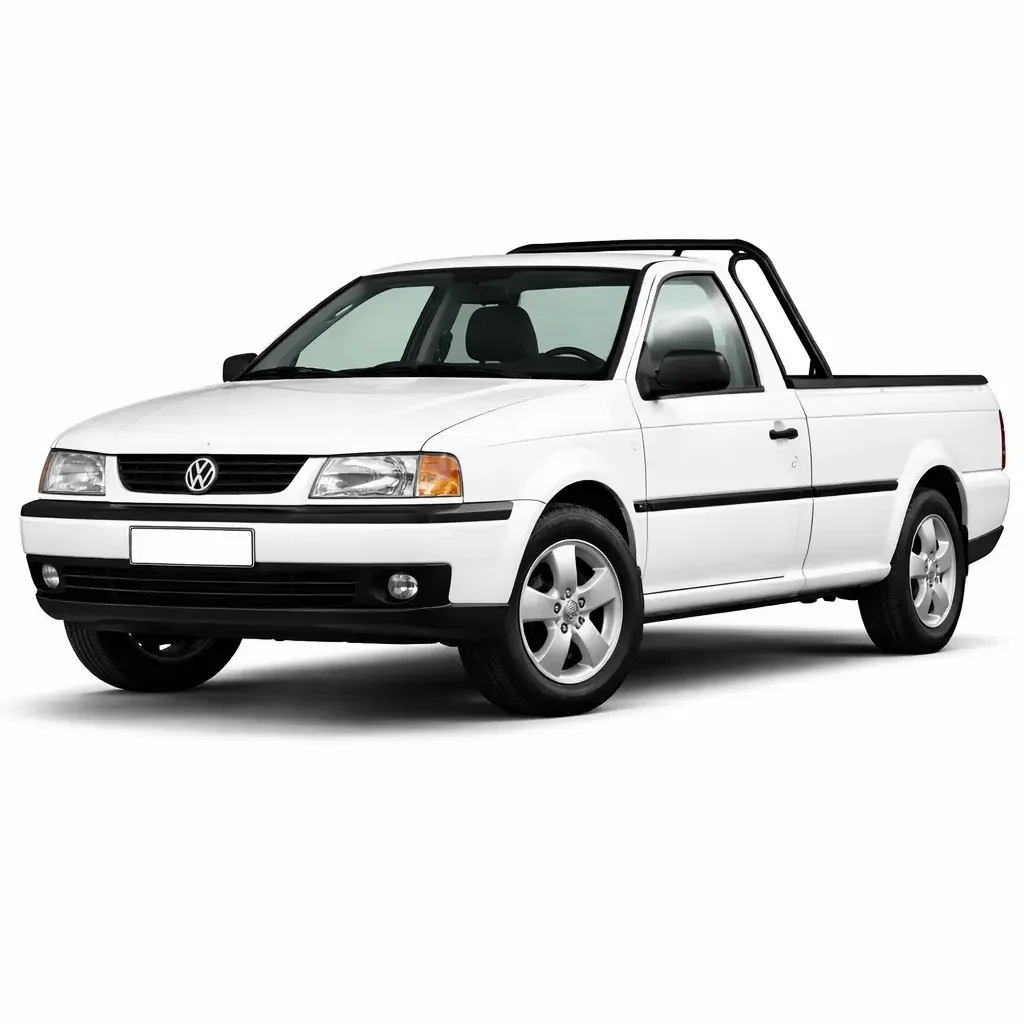
The Volkswagen Pointer Truck for the 2000 through 2005 model years is the Mexican market designation for the Saveiro G3, the third facelift of the Brazilian Gol-derived coupe utility. The G3 facelift was introduced in Brazil in March 2000 and applied to the Mexican Pointer Pick Up at the same time, creating a clean forward body boundary between the 1999 G2 application covered in the companion guide and this G3 window. The BX/AB9 platform, longitudinal AP engine, five-speed manual transmission, and solid rear leaf-spring axle all carry through from the G2 to the G3 unchanged in their fundamental architecture. What changes at the G3 boundary is the entire front end of the vehicle, the interior dashboard, the optional introduction of airbags and ABS, and the Brazilian-market engine range expansion toward the 1.6L AP and eventual flex-fuel variants — though Mexico retained the 1.8L gasoline AP engine throughout this window.
This guide should be read in conjunction with the 1999 Pointer Truck guide, which establishes the platform identity, the nameplate disambiguation across the three distinct Pointer vehicles, the longitudinal engine mounting distinction from European VW applications, and the rear solid axle configuration that separates the Saveiro from every other Gol family body variant. Those foundations are not repeated in full here but remain the primary catalog rules for this window as well.
The G2 to G3 Transition: What Changed in March 2000
The G3 facelift is classified within the Gol platform family as the first of two facelifts applied to the second-generation Gol (the G2 body). The G3 designation is therefore sometimes described as the Gol G2 with the first facelift, rather than a new generation. For parts catalog purposes, the G3 is best treated as a distinct application window because the forward body panel change is comprehensive enough to make G2 and G3 body components non-interchangeable forward of the A-pillar.
The G3 front end drew its styling from the Volkswagen corporate design language of the Golf Mk4/Jetta Bora IV era. The headlamp units changed from the rounded four-lens clusters of the G2 to a single-unit composite design with a more angular character. The hood was reshaped to meet the new headlamps. The front bumper was redesigned. The grille adopted the horizontal-bar treatment consistent with VW's global design vocabulary of that moment. These are all new part numbers relative to the G2, and no G2 front body component crosses to the G3 at the headlamp, hood, bumper, or grille level.
Inside the cab, the G3 received a completely new instrument panel with blue-backlit gauges, new switchgear layout, and a revised center console. The Saveiro G3's Brazilian specification included a steering wheel with a different spoke count and profile depending on whether the airbag option was fitted: four spokes with a more voluminous hub on airbag-equipped vehicles, three spokes without. This means the steering wheel is an equipment-level-specific component within the G3 window, not a universal Pointer Truck G3 item.
Everything aft of the A-pillar is structurally unchanged from the G2. The cab back panel, the cargo bed, the rear axle mounting geometry, the driveshaft tunnel, and all underbody structure behind the firewall carry through without modification. This means that for all undercar components — suspension, brakes, drivetrain, and engine bay hardware — the G3 application crosses freely to the G2 and to the contemporaneous Gol G3 hatchback and Parati G3 wagon within the same engine and specification match.
Platform: BX Family and the AB9 Designation
The Saveiro G3 uses the AB9 platform, which is the internal Volkswagen do Brasil designation for the evolved version of the BX platform introduced with the G3 generation. Brazilian automotive sources including the Notícias Automotivas Saveiro G3 article confirm that the G3 inherited the AB9 platform from its Gol family siblings, describing it as an evolution of the BX. For practical catalog purposes, the BX and AB9 are treated as the same platform family: all Gol family body variants of the G3 generation — the Gol G3 hatchback, the Parati G3 wagon, and the Saveiro G3 pickup — share the AB9 designation and cross-reference freely at the chassis, suspension, and drivetrain level within matching engine specifications.
The AB9 designation does not alter the platform's fundamental character: front-engine, front-wheel-drive, longitudinal engine mounting, MacPherson front struts, solid rear axle on leaf springs for the Saveiro pickup. The evolution from BX to AB9 represents incremental refinements in body rigidity and manufacturing tolerance rather than a structural redesign. The cross-reference rules established for the G2 BX platform apply equally to the G3 AB9.
No European Volkswagen platform application is a valid cross-reference at any level. The AB9 is a Latin American platform development with no engineering relationship to European Volkswagen Group platforms of the same period.
Engine: 1.8L AP in Mexico, Expanding Range in Brazil
The Mexican-market Pointer Truck retained the 1.8L AP gasoline engine throughout the 2000 to 2005 window, producing 99 horsepower at 5,500 rpm. This engine specification is mechanically continuous with the 1.8L AP used in the 1999 G2 Pointer Truck; the AP engine itself did not change at the G3 facelift boundary. Engine service components — timing belt, water pump, spark plugs, fuel filter, oil filter, air filter, and ignition components — carry through from the 1999 application without change.
In Brazil, the Saveiro G3 was offered with a broader engine range that the Mexican market did not receive. The Brazilian range included the 1.6L AP, the 1.8L AP, and the 2.0L AP. Later in the G3 window, the 1.6L AP gained Total Flex capability, making it the world's first flex-fuel vehicle engine when the Gol Total Flex was introduced in 2003. The flex-fuel 1.6L AP can run on pure gasoline, pure ethanol, or any blend of the two, with the engine management system adjusting fuel delivery in real time. This technology was specific to the Brazilian market where ethanol infrastructure existed; it was not introduced to Mexico during this window.
The existence of the flex-fuel variant in Brazil creates a catalog risk for any database that does not explicitly separate Mexican-market and Brazilian-market Saveiro G3 applications. The fuel system components for a flex-fuel AP engine differ from those of the gasoline-only AP: the flex-fuel system uses alcohol-compatible fuel injectors, alcohol-resistant fuel lines and pump components, and an engine management calibration that responds to ethanol content via an alcohol sensor or adaptive mapping. These flex-fuel components do not cross to the gasoline-only Mexican-market application, and gasoline-only fuel system parts do not cross to the flex-fuel Brazilian application. A catalog that merges all Saveiro G3 applications globally under a single engine entry will generate wrong fuel system components for one market or the other on every fuel system order.
The 2.0L AP: Brazil Only, Not Mexico
The 2.0L AP engine was available on the Brazilian Saveiro G3 but was not offered in Mexico on the Pointer Truck. The Notícias Automotivas Saveiro G3 article specifically notes that the Saveiro G3 never received the AP-2000 as a top-spec option in the way that some market observers expected. Any catalog entry that assigns a 2.0L AP application to the Mexican Pointer Truck is applying a Brazilian engine option that was not sold in Mexico.
Airbag and ABS: Optional Equipment Creating Application Sub-Windows
The G3 generation introduced optional airbags and optional ABS brakes to the Saveiro for the first time. The 1999 G2 Pointer Truck did not have airbag or ABS availability; the G3 introduced these as add-on options. This means the 2000 to 2005 Pointer Truck is the first window in which airbag module, airbag clock spring, airbag wiring harness, and ABS pump and modulator listings become relevant for this vehicle.
Because airbag and ABS were options rather than standard equipment, the Pointer Truck G3 fleet is divided between equipped and non-equipped vehicles. Airbag module listings must specify that they apply only to airbag-equipped applications. A catalog that lists airbag components as a standard Pointer Truck G3 fitment will generate wrong orders for the non-airbag-equipped majority of the fleet. The airbag steering wheel (four-spoke with voluminous hub) and the non-airbag steering wheel (three-spoke with slim hub) are different parts; the steering wheel listing must specify the airbag equipment level.
ABS brakes similarly apply only to ABS-equipped vehicles. Non-ABS Pointer Truck G3 applications use a standard brake master cylinder and conventional brake lines without ABS modulator integration. An ABS pump, ABS modulator, and ABS wheel speed sensor listing that is applied to all G3 Pointer Truck entries will generate wrong brake system components for non-ABS vehicles. The brake master cylinder specification also differs between ABS and non-ABS applications.
Body Panels and the G2/G3 Cross-Reference Boundary
The G3 facelift changed every external body panel forward of the A-pillar. The headlamp units, hood, front fenders, front bumper assembly, and front grille are all G3-specific. None of these cross to the 1999 G2 Pointer Truck. Conversely, G2 front body parts do not fit the G3 front end geometry without modification.
Windscreen glass, door glass, door assemblies, and the cab back panel all carry through from G2 to G3 unchanged. The cargo bed, tailgate, and all rear pickup body components are structurally identical to the G2 application and cross to the G2 Pointer Truck at the rear body level. Tail lamp assemblies may have been updated at the G3 facelift on some body configurations within the Gol family; this should be confirmed against G3-specific part numbers for the Saveiro before a G2 tail lamp cross-reference is published.
The G3 headlamp units on the Saveiro/Pointer Truck cross to the contemporaneous Gol G3 hatchback and Parati G3 wagon headlamp assemblies, as these vehicles share the same front end design from the G3 facelift. This makes the Gol G3 hatchback and Parati G3 wagon the correct forward body cross-references for the Pointer Truck G3, replacing the G2 cross-references that applied in the previous window.
Suspension, Brakes, and Rear Axle: Unchanged Through the G3 Window
The front MacPherson strut suspension is unchanged from the G2 specification and crosses to the Gol G3 hatchback and Parati G3 wagon at the strut, spring, control arm, wheel bearing, and front hub level. Front disc brake rotors and calipers cross to the G3 family in the same manner.
The solid rear axle on leaf springs continues unchanged through the G3 window. This remains the most important structural divergence between the Pointer Truck and all other Gol G3 family body variants. The Gol G3 hatchback and Parati G3 wagon use a semi-independent or torsion beam rear setup incompatible with the Saveiro's solid axle. Rear leaf springs, rear shock absorbers, rear axle assembly, rear wheel bearings, and rear drum brake components are all Saveiro-specific and share no cross-reference to the hatchback or wagon rear suspension applications, despite sharing the same platform designation.
The solid rear axle specification carries a payload capacity of 700 kg on the Saveiro G2 and continues into the G3. The leaf spring rate and shock absorber valving are tuned for this commercial payload duty and are not interchangeable with passenger car rear suspension components from the Gol hatchback or Parati wagon, even where dimensional similarities might appear to allow substitution.
Special Editions: Summer, Fun, and Crossover
The Saveiro G3 window in Brazil produced several special edition trim packages that added exterior styling elements without mechanical changes. The Summer series (2000) added decorative side stripes, black-masked headlights, and 14-inch steel wheels with hubcaps. The Fun series (2001) added body-color headlamp surrounds, brighter color options, 14-inch alloy wheels, and fog lights. The Crossover series (2004) added bush bumpers, side steps, and a roll bar.
None of these special editions introduced mechanical changes to the engine, transmission, suspension, or brakes. They are trim packages applied to the standard G3 mechanical specification. Catalog entries for special edition body components — the Crossover's bush bumpers and roll bar, for example — are edition-specific and do not cross to standard G3 body applications. Mechanical component listings are unaffected by the special edition designation.
Whether these Brazilian special editions were offered in Mexico on the Pointer Pick Up is not confirmed in available sources. Catalog entries for special edition trim components should be flagged as Brazil-market confirmed and Mexico-market unconfirmed unless specific market documentation is available.
Cross-Reference Family: Gol G3 Siblings
The correct cross-reference family for the 2000 to 2005 Pointer Truck is the Gol G3 body variant family: the Gol G3 hatchback (sold in Mexico as the Pointer hatchback), and the Parati G3 wagon (sold in Mexico as the Pointer Station Wagon, discontinued in Mexico in 2005). Cross-references from these vehicles are valid for AP engine service components under the same engine specification (1.8L gasoline AP for the Mexican market), front suspension components, front brake components, windscreen glass, door glass, and door assemblies.
The G2 Pointer Truck (1999) remains a valid cross-reference for all mechanical undercar components including the AP engine, front suspension, and driveshaft, as the mechanical architecture is unchanged between G2 and G3. The G2 Pointer Truck is not a valid cross-reference for any forward body panel, headlamp, hood, bumper, or interior dashboard component, as these changed at the G3 facelift.
Brazilian-market Saveiro G3 applications with the 1.6L AP or flex-fuel AP engines are not valid cross-references for the Mexican Pointer Truck's 1.8L gasoline AP fuel system. Engine displacement and fuel system type must both be confirmed before any AP engine fuel system cross-reference is applied across the two markets.
Common ACES/PIES Catalog Mistakes
1. Applying G2 forward body panels to G3 applications or vice versa. The G3 facelift introduced new headlamp units, a new hood, a new front bumper, and a new grille profile aligned with Golf Mk4-era VW corporate styling. None of these cross to the G2 body. A catalog that does not enforce the 1999 G2 and 2000+ G3 boundary at the forward body panel level will generate wrong headlamps, hoods, and bumpers for one generation when the other generation's components are ordered.
2. Assigning flex-fuel AP engine fuel system components to the Mexican-market Pointer Truck. Mexico did not receive the flex-fuel 1.6L AP Total Flex variant offered in Brazil from 2003 onward. Alcohol-compatible fuel injectors, alcohol sensors, and flex-fuel engine management calibrations apply to the Brazilian market only. A globally merged Saveiro G3 catalog entry that includes flex-fuel fuel system components without market qualification will generate these components for Mexican-market Pointer Truck orders where they do not apply.
3. Listing 2.0L AP engine components for the Mexican Pointer Truck. The 2.0L AP was available on the Brazilian Saveiro G3 but was not offered in Mexico. Any catalog entry that includes a 2.0L AP engine application for the Mexican Pointer Truck is assigning a powerplant that was never installed in this vehicle in this market.
4. Applying airbag module and ABS listings as standard equipment for all G3 Pointer Truck applications. Airbag and ABS were optional on the G3, not standard. A unified G3 Pointer Truck application that lists these components without flagging them as equipment-level-specific will generate airbag and ABS components for the non-equipped majority of the fleet. The steering wheel specification also differs between airbag-equipped and non-airbag-equipped vehicles.
5. Treating the AB9 platform designation as a different platform from the BX, warranting different suspension or chassis components. The AB9 is the internal Volkswagen do Brasil designation for the evolved G3-era BX platform. It is not a different platform requiring different suspension geometry or chassis components. Parts research that treats AB9 and BX as separate platforms and declines to apply G2 BX mechanical cross-references to the G3 AB9 will unnecessarily restrict valid cross-references for all undercar service items.
6. Applying Gol G3 hatchback rear suspension listings to the Pointer Truck G3. The Gol G3 hatchback uses a semi-independent or torsion beam rear axle. The Saveiro G3 uses a solid rear axle on leaf springs. This divergence is unchanged from G2 through G3 and carries through the entire Pointer Truck production history. Rear spring, shock, axle, wheel bearing, and drum brake listings for the hatchback will not fit the pickup's solid axle configuration.
7. Extending the G3 window beyond 2005 without acknowledging the G4 platform transition. The Gol G4 facelift was released in August 2005 with Fox-derived styling and a V-grille. The Pointer Truck continued in Mexico beyond 2005, but as a G4-specification vehicle. Catalog entries for 2006 and later Pointer Trucks must reflect G4 front body panels and G4 interior specification, not G3.
Pre-Listing Checklist for the 2000–2005 Pointer Truck
• Generation confirmed as G3 (March 2000 onward) for forward body panels, headlamps, hood, and dashboard; G2 body components excluded forward of the A-pillar
• Platform confirmed as AB9 (evolved BX family), mechanically equivalent to BX for all parts catalog purposes; European VW platforms excluded
• Market confirmed as Mexico; engine confirmed as 1.8L AP gasoline only; 1.6L AP, flex-fuel AP, and 2.0L AP excluded as Brazil-only variants not offered in Mexico
• Engine service items (timing belt, water pump, spark plugs, fuel filter, oil filter, air filter) confirmed as continuous with G2 1.8L AP specification; no change at G3 boundary
• Airbag module, clock spring, and airbag wiring listed as optional equipment, not standard; steering wheel confirmed by airbag equipment level (four-spoke airbag or three-spoke non-airbag)
• ABS pump, modulator, and wheel speed sensors listed as optional equipment, not standard; brake master cylinder confirmed by ABS or non-ABS specification
• Front suspension and front brakes confirmed as crossing to Gol G3 hatchback and Parati G3 wagon within the same engine specification
• Rear suspension confirmed as solid axle on leaf springs, Saveiro-specific; no cross-reference to Gol G3 hatchback or Parati G3 wagon rear suspension
• G3 headlamp, hood, and front bumper confirmed as crossing to Gol G3 hatchback and Parati G3 wagon; not crossing to G2 applications
• Windscreen glass, door glass, and door assemblies confirmed as carrying through from G2 unchanged
• G3 window terminal year confirmed as 2005; G4 facelift (Fox-derived, V-grille) applies from 2006 onward
Final Take
The 2000 to 2005 Pointer Truck window introduces two new catalog complexities relative to the 1999 G2 guide: the G2-to-G3 forward body panel boundary, and the Brazil-versus-Mexico engine market split that emerges when the flex-fuel AP and the 2.0L AP appear in the Brazilian Saveiro G3 but not in the Mexican Pointer Truck. Both of these are straightforward to manage if the market and generation are confirmed before any listing is assigned, but both are invisible to a catalog that treats all Saveiro G3 applications globally without market qualification.
The optional airbag and ABS introduction is the third new element, and it creates a within-window split that is easy to overlook: a 2003 Pointer Truck with airbags and a 2003 Pointer Truck without airbags are the same vehicle in every mechanical respect, but they require different steering wheel, different airbag module, different clock spring, and different brake system listings. Flagging these as equipment-level options rather than standard fitments is the practical way to handle this within a single G3 Pointer Truck application entry.
Disclaimer
This guide is intended for catalog research, fitment analysis, and parts advisory reference. Production specifications, option availability, and regulatory compliance requirements vary by model year, regional market, and assembly date within any given window. Always confirm application data against vehicle identification number decoding, factory build sheets, and OEM parts documentation before finalizing a listing or parts recommendation. PartsAdvisory and its contributors are not responsible for fitment errors arising from catalog data that has not been independently verified against physical vehicle inspection or official OEM sources.