
Volkswagen Nivus (2022-2024): MQB A0 Fitment Guide for Mexico
Written by Arthur Simitian | PartsAdvisory
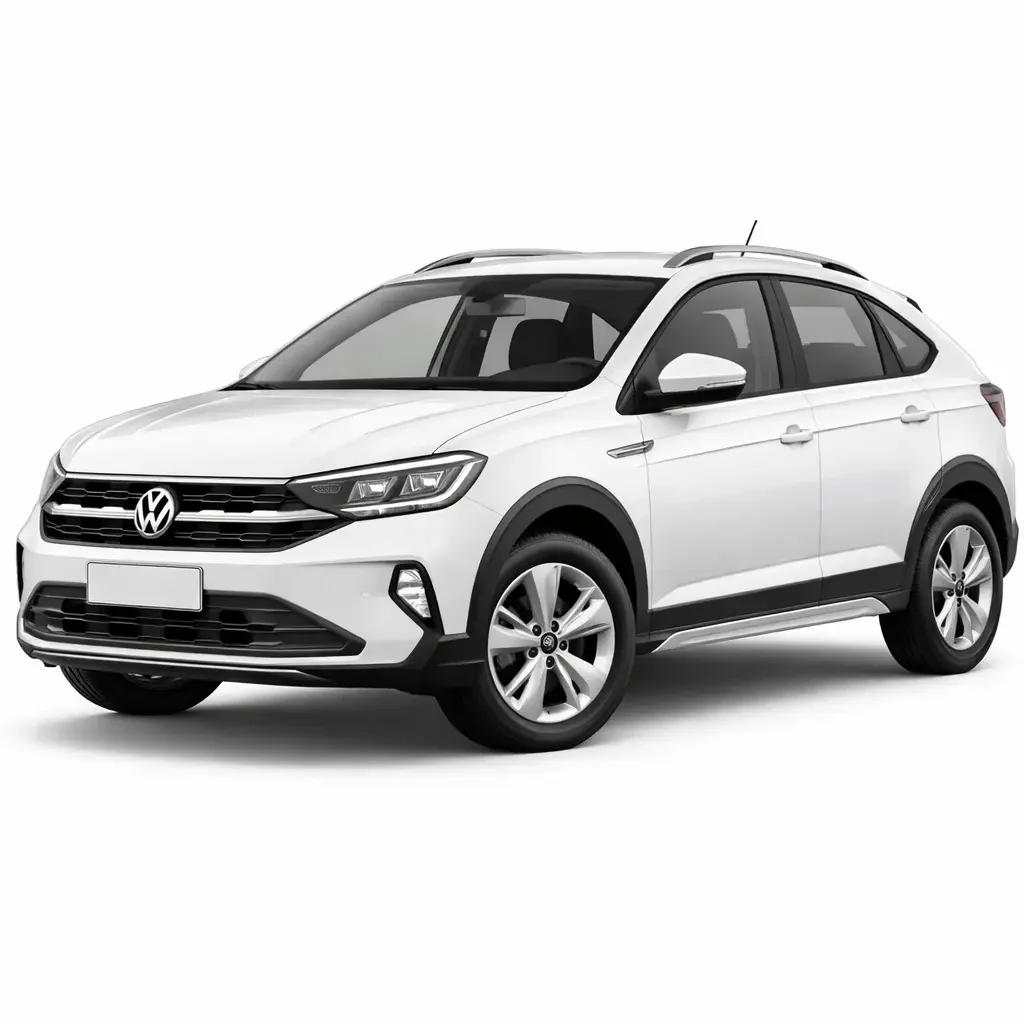
The Volkswagen Nivus sold in Mexico from the 2022 through 2024 model years is a coupe-SUV built on the MQB A0 platform, produced at Volkswagen's Anchieta plant in São Bernardo do Campo, Brazil and imported to Mexico. It was unveiled in Brazil in May 2020 and arrived in Mexico for the 2022 model year, positioned in the lineup between the T-Cross and the Taos. The Nivus occupies a distinct design niche within the VW Mexico SUV family: where the T-Cross uses a conventional upright SUV roofline, the Nivus uses a sloping fastback roofline descending from the B-pillar to a low tailgate, giving it a coupe-SUV silhouette while retaining SUV ride height and ground clearance.
For catalog purposes the Nivus 2022-2024 is a mechanically simple application. A single 1.0-litre three-cylinder TSI engine, a single six-speed Tiptronic automatic transmission, and front-wheel drive are the only mechanical configurations available in Mexico across the entire three-year window. There is no engine variant, no manual transmission option, and no all-wheel-drive application. The only application variable within the window is the trim level, which determines equipment-level component differences but no mechanical differences.
The platform relationship to the T-Cross and Polo creates a cross-reference family that is useful for front suspension, engine service, and transmission service components, but that must be bounded precisely at the rear body because the Nivus uses a unique rear structure from the C-pillar rearward that shares nothing with the T-Cross or Polo rear body. This guide addresses the Mexican market throughout. The Brazilian market Nivus uses a flex-fuel engine calibration compatible with both gasoline and ethanol, creating fuel system specification differences from the Mexican gasoline-only application that must not be bridged in catalog listings without individual confirmation.
Platform: MQB A0, Front Engine, Front-Wheel Drive
The MQB A0 is Volkswagen Group's modular transverse architecture for small vehicles, underpinning the Polo Mk6, the Virtus, the T-Cross, and the Nivus across global markets. In Mexico the MQB A0 family is represented by the Polo, Virtus, T-Cross, and Nivus, all produced in Brazil. The platform uses a transversely mounted front engine driving the front wheels through a conventional transaxle, with MacPherson front suspension and a torsion beam rear axle.
The Nivus on the MQB A0 platform shares with the Polo its side door apertures, windscreen, roof stamping, front suspension geometry, and the majority of interior components. This sharing relationship is the basis for the cross-reference family described later in this guide. However, the Nivus required a unique rear overhang extension beyond the Polo's body to accommodate the fastback roofline and the larger 415-litre boot, resulting in a rear body structure from the C-pillar rearward that is specific to the Nivus and distinct from both the Polo and the T-Cross.
The Nivus is 4,266 mm long, 1,757 mm wide, and 1,493 mm tall, with a wheelbase of 2,566 mm. The T-Cross is 67 mm shorter in overall length than the Nivus, reflecting the extended rear overhang. The wheelbase of the Nivus is shared with the T-Cross, as both vehicles use the same MQB A0 underbody forward of the rear axle. The shared wheelbase means that rear suspension geometry, rear axle track, and rear brake mounting points are the same between the Nivus and T-Cross, even though the external rear body panels differ.
All-wheel drive is not available on the MQB A0 platform as implemented for Latin America. No AWD Nivus was sold in Mexico or any other market in the 2022-2024 window. No rear differential, no rear halfshafts, and no centre coupling applies to any Nivus application.
The Nivus and Its MQB A0 Siblings: Cross-Reference Boundaries
The practical catalog consequence of the MQB A0 platform sharing is a cross-reference family that must be understood in two parts: what crosses and what does not.
Front suspension strut assemblies, front springs, front wheel bearings, and front brake rotors and calipers confirmed for the Mexican-market Polo or T-Cross within matching specifications may cross to the Nivus. These front-axle components share geometry and mounting points across the MQB A0 family in Latin American specification. Cross-references must be confirmed at the part number level rather than assumed from platform membership alone, because market-specific tuning and load ratings differ between models.
Engine service components including spark plugs, ignition coils, oil filters, air filters, timing components, and fuel injectors confirmed for the 1.0-litre 200 TSI in the Mexican T-Cross or Polo may cross to the Nivus within the same engine code and market specification. The engine is mechanically identical across these applications. Brazilian flex-fuel variants of the same engine use different fuel system calibration and must not be used as a source for Mexican gasoline-only cross-references.
Transmission service components for the six-speed Tiptronic automatic may cross between the Nivus, T-Cross, and Polo within matching transmission code and market year specifications, confirmed at the part number level.
Rear body components do not cross between the Nivus and the T-Cross or Polo. The Nivus rear quarter panels, C-pillar structure, fastback tailgate, rear lamp clusters, and rear bumper cover are specific to the Nivus body style and share no application with the T-Cross or Polo rear body. A rear lamp cluster confirmed for the T-Cross does not cross to the Nivus. A tailgate confirmed for the Polo does not cross to the Nivus.
The Nivus must not be cross-referenced to the European Taigo, which is the European market version of the same vehicle produced in Pamplona, Spain rather than São Bernardo do Campo, Brazil. The Taigo carries different engine options, different emissions calibration, and different market-specific component specifications. A European Taigo component must not be applied to a Mexican Nivus application without individual part number verification confirming identical specification.
Engine: 1.0-Litre TSI 200 Three-Cylinder Throughout
A single engine configuration is used across all Mexican Nivus applications from 2022 through 2024: the 1.0-litre turbocharged direct-injection three-cylinder petrol engine designated 200 TSI, producing 114 hp at 5,500 rpm and 200 Nm of torque at 2,000 to 3,500 rpm. The 200 TSI designation refers to the peak torque in Newton-metres, following the VW South American engine naming convention. The engine uses a turbocharger, an intercooler, and direct fuel injection. It has 12 valves, four per cylinder.
This engine is unchanged across all three model years in the Mexican Nivus. Spark plugs, ignition coils, oil filter, air filter, turbocharger, intercooler, and fuel injectors confirmed for any year within the 2022-2024 window apply to all other years within the window without restriction.
The engine uses a timing chain rather than a timing belt. No timing belt, timing belt tensioner, or timing belt idler applies to the 1.0 TSI 200. Any timing belt service component listed for this engine is assigning hardware from a drive system that does not exist on the vehicle. The timing chain requires no scheduled replacement at the service intervals specified for this window.
The Mexican-market 1.0 TSI 200 is calibrated for gasoline only. The Brazilian-market version of the same engine carries flex-fuel calibration compatible with both gasoline and ethanol, which results in different oxygen sensor configuration, different fuel pressure regulation, and different engine management software. Brazilian-market fuel system components for the 1.0 TSI must not be applied to Mexican-market Nivus applications without confirming that the component specification matches the gasoline-only calibration.
The engine uses electromechanical power steering (Servotronic) rather than hydraulic steering. No hydraulic power steering pump, no hydraulic steering rack, and no power steering fluid reservoir applies to any Nivus application. Any hydraulic power steering component listed for the Nivus is assigning hardware from a system that does not exist on this vehicle.
Transmission: Six-Speed Tiptronic Automatic Throughout
A single transmission is used across all Mexican Nivus applications from 2022 through 2024: the six-speed Tiptronic conventional automatic with torque converter. Steering-wheel-mounted paddle shifters are standard, allowing manual gear selection. No manual transmission was offered in Mexico on the Nivus at any point in this window.
The Tiptronic is a conventional hydraulic automatic with a torque converter, not a dual-clutch DSG. Transmission fluid, filter, and internal components are specific to this conventional automatic unit. DSG fluid, DSG filter, and DSG mechatronic components do not apply to any Nivus application. Any DSG component listing for the Nivus is assigning hardware from a transmission architecture that was not installed.
Transmission service components confirmed for the same six-speed Tiptronic in the T-Cross or Polo applications using the 1.0 TSI engine may cross to the Nivus within matching transmission code and year specifications, confirmed at the part number level.
Suspension and Brakes
The front suspension is MacPherson independent throughout the 2022-2024 window. The rear suspension is a torsion beam axle, consistent with the MQB A0 platform implementation for this segment in Latin America. The torsion beam rear is a semi-independent design in which the two trailing arms are connected by a transverse twist-beam, allowing some independent wheel movement while maintaining a simpler structure than a fully independent multi-link rear axle.
Rear spring and rear shock absorber specifications are torsion-beam-specific and must not be confused with multi-link or independent rear axle components from other vehicles. A rear coil spring or rear shock absorber confirmed for a vehicle using a multi-link rear does not cross to the Nivus torsion beam application.
The brake system on the Mexican Nivus is four-wheel disc throughout all three model years. This distinguishes the Nivus from the Nuevo Gol and from some competitors in the B-SUV segment that use rear drum brakes. Front brake rotors and calipers cross within the MQB A0 family at matching specifications. Rear brake rotors and calipers for the Nivus are specific to the torsion beam rear axle configuration and must be confirmed against the Nivus rear axle specification rather than assumed to cross from any multi-link rear application.
ABS, ESC, ASR, and EBD are standard on all Mexican Nivus applications across the full 2022-2024 window. There is no non-ABS Nivus application in Mexico. ABS wheel speed sensors apply to all four corners on all applications.
Trim Structure: Highline and Black Edition
The Mexican Nivus is offered in two trim designations throughout the 2022-2024 window: the Highline and the Black Edition. Both carry identical mechanical and electronic equipment. The distinction between the two is entirely cosmetic and relates to exterior colour treatment.
The Black Edition features a black painted roof, black mirror caps, darkened alloy wheels, black lower door mouldings, and black badging on the tailgate. The Black Edition is restricted to two exterior colours in the Mexican market: Gris Moonstone metallic and Rojo Sunset metallic. No other exterior colours are available in the Black Edition. The Highline is available in the full colour range.
Because the mechanical specification is identical between Highline and Black Edition, no engine, transmission, suspension, brake, or underbody component differs between the two trim designations. Equipment-level interior components including the seat upholstery, audio system, and climate control hardware are also identical between Highline and Black Edition within the same model year. The only component-level distinction is the exterior colour of the roof panel and mirror caps on Black Edition applications, and the darkened alloy wheel finish.
Standard equipment on all Mexican Nivus applications includes six airbags (dual frontal, dual front lateral, and dual curtain), ABS, ESC, ASR, electronic brake force distribution, hill hold assist, electronic differential lock, adaptive cruise control, forward collision warning with autonomous emergency braking, reversing camera, front and rear parking sensors, VW Digital Cockpit 10-inch digital instrument cluster, VW Play 10-inch touchscreen infotainment with wireless App-Connect, wireless smartphone charging, single-zone Climatronic automatic climate control, Keyless Access with push-button start, LED headlamps, LED daytime running lights, LED taillamps, 17-inch alloy wheels, and electrochromic interior rear-view mirror. This full equipment level applies from the first 2022 model year delivery onward, with no standard equipment progression across the window because the Nivus launched in Mexico at a single full-specification level.
The Latin NCAP five-star rating cited in VW Mexico materials for the Nivus was assessed with the full safety equipment specification as standard, including all six airbags and the ESC system. This rating is consistent across the 2022-2024 window because the safety specification did not change.
Body: Coupe-SUV Structure and Shared Components
The Nivus body uses a five-door structure with the standard four passenger doors plus a tailgate. The tailgate is the fastback-style rear opening that covers the sloping rear roofline section from the top of the C-pillar to the lower rear bumper line, incorporating the rear glass in a single assembly. This is distinct from the T-Cross, which uses a more conventional upright rear hatch, and from the Polo, which uses either a conventional hatchback or sedan rear.
The Nivus shares the following body components with the Polo and T-Cross: front doors (all four), front door glass, rear door glass, windscreen, and roof panel. These components are confirmed shared components at the platform level and cross between the Nivus, Polo, and T-Cross within the MQB A0 family in the Latin American market specification, subject to individual part number confirmation.
The following components are Nivus-specific and do not cross to any other model: the rear quarter panels, the C-pillar external structure from the B-pillar rearward, the tailgate assembly, the tailgate glass, the rear lamp clusters, the rear bumper cover, and the rear valance. These rear body components define the coupe-SUV silhouette of the Nivus and were uniquely developed for this model.
The 415-litre boot capacity of the Nivus results from the extended rear overhang that accommodates the fastback design. The boot floor and the rear underbody structure aft of the rear axle are Nivus-specific dimensions reflecting this extension. No T-Cross or Polo rear underbody or boot floor component applies to the Nivus.
The 17-inch alloy wheels are standard on all Mexican Nivus applications across the full 2022-2024 window. No 16-inch wheel application exists for the Mexican Nivus in this window. Wheel bearing specifications are confirmed for the 17-inch application throughout.
Common ACES/PIES Catalog Mistakes
The first error is applying a manual transmission clutch, flywheel, or gearbox component to any Nivus application. No manual transmission was offered on the Mexican Nivus in the 2022-2024 window. Every Mexican Nivus uses the six-speed Tiptronic automatic exclusively.
The second error is applying DSG dual-clutch transmission fluid, DSG filter, or DSG mechatronic to any Nivus application. The Tiptronic is a conventional hydraulic automatic with a torque converter, not a DSG. DSG components do not apply.
The third error is applying a timing belt kit or timing belt tensioner to any Nivus application. The 1.0 TSI 200 uses a timing chain. There is no timing belt in this engine.
The fourth error is applying hydraulic power steering components to any Nivus application. The Nivus uses electromechanical Servotronic steering throughout. No hydraulic pump, hydraulic rack, or power steering fluid reservoir exists on any Nivus application.
The fifth error is applying rear drum brake components to any Nivus application. All Mexican Nivus applications use four-wheel disc brakes. No rear drum brake exists on any Nivus.
The sixth error is applying a Brazilian flex-fuel fuel system component to a Mexican Nivus application. The Brazilian 1.0 TSI 200 uses flex-fuel calibration with different oxygen sensor configuration, fuel pressure regulation, and engine management software from the Mexican gasoline-only specification.
The seventh error is applying T-Cross or Polo rear body components to the Nivus. The rear quarter panels, C-pillar structure, tailgate, tailgate glass, rear lamp clusters, and rear bumper cover are Nivus-specific. A T-Cross rear lamp cluster or tailgate does not cross to the Nivus.
The eighth error is applying European Taigo components to the Mexican Nivus. The Taigo is the European version of the same vehicle, produced in Spain with different engine options and market-specific specifications. European Taigo components must not be assumed to cross to the Mexican Nivus without individual part number confirmation.
The ninth error is applying an AWD drivetrain component to any Nivus application. The MQB A0 does not support AWD in Latin American specification. No rear differential, rear halfshaft, or transfer case exists on any Nivus.
The tenth error is treating the Highline and Black Edition as mechanically distinct applications. The two trim designations are cosmetically differentiated only. No engine, transmission, suspension, brake, or equipment-level interior component differs between Highline and Black Edition within the same model year. A component listing that creates separate mechanical sub-applications by trim designation on the basis of Highline vs Black Edition is wrong.
The eleventh error is applying a non-ABS or partial-ABS specification to any Nivus application. All Mexican Nivus applications carry ABS, ESC, and six airbags as standard from 2022. There is no base specification without these systems.
The twelfth error is applying a rear multi-link or independent rear suspension component to the Nivus torsion beam application. The Nivus uses a torsion beam rear axle. Rear springs, rear shocks, and rear control arm components from a multi-link rear application do not fit the torsion beam geometry.
Pre-Listing Checklist for the 2022-2024 Nivus
Platform confirmed as MQB A0, front-wheel drive, no AWD component applies.
Engine confirmed as 1.0-litre three-cylinder TSI 200, 114 hp, gasoline-only Mexican calibration, timing chain confirmed as present with no timing belt; no flex-fuel Brazilian component applies.
Transmission confirmed as six-speed Tiptronic conventional automatic throughout all trims and all three model years; no manual, no DSG applies.
Electromechanical power steering confirmed; no hydraulic power steering component applies.
Brakes confirmed as four-wheel disc throughout; no rear drum applies; ABS and ESC confirmed as standard on all applications.
Rear suspension confirmed as torsion beam; multi-link rear suspension components do not apply.
Trim confirmed as Highline or Black Edition; confirmed as mechanically identical between the two; no mechanical sub-application by trim designation.
Cross-references to T-Cross and Polo confirmed as valid at front suspension, engine service, and transmission service level within matching specifications; rear body components confirmed as Nivus-specific and not crossed to T-Cross or Polo.
European Taigo components confirmed as requiring individual part number verification before application to Mexican Nivus; not assumed to cross from European specification.
Model year confirmed as 2022, 2023, or 2024; confirmed as mechanically identical across all three years; engine, transmission, and suspension components cross freely across the full 2022-2024 window.
Final Take
The 2022-2024 Mexican Nivus is one of the mechanically simplest catalog applications in this series. A single engine, a single transmission, a single drivetrain, and a single body style with no powertrain change across three years means that the mechanical catalog entry is effectively one uniform application. The only variables that matter for service component assignment are those shared by all MQB A0 Latin American applications — engine code, transmission code, and market specification — rather than model-year or trim-level differences.
The catalog challenge specific to the Nivus is the cross-reference family management. The platform sharing with the Polo and T-Cross creates a temptation to treat the Nivus as a variant of one of those vehicles rather than as a distinct model, and the result of that treatment would be incorrect rear body component assignments. The Nivus rear body from the C-pillar rearward is its defining architectural feature — the fastback roofline and extended rear overhang are what separate it visually and structurally from every other MQB A0 vehicle in the Mexican market — and those components must be listed as Nivus-specific with no cross-reference to the T-Cross or Polo rear body.
The four-wheel disc brake specification is worth noting explicitly because it is a higher brake specification than some competitors and some predecessors in the segment, and a catalog that defaults to rear drum for a B-segment crossover without confirming the Nivus specification would produce wrong rear brake listings for the entire field population.
Disclaimer
This guide is intended for catalog research, fitment analysis, and parts advisory reference. Production specifications, option availability, and regulatory compliance requirements vary by model year, regional market, and assembly date within any given window. Always confirm application data against vehicle identification number decoding, factory build sheets, and OEM parts documentation before finalizing a listing or parts recommendation. PartsAdvisory and its contributors are not responsible for fitment errors arising from catalog data that has not been independently verified against physical vehicle inspection or official OEM sources.