
Volkswagen Multivan 2013 (T5.2): Fitment Guide for the Standard Passenger Van
Written by Arthur Simitian | PartsAdvisory
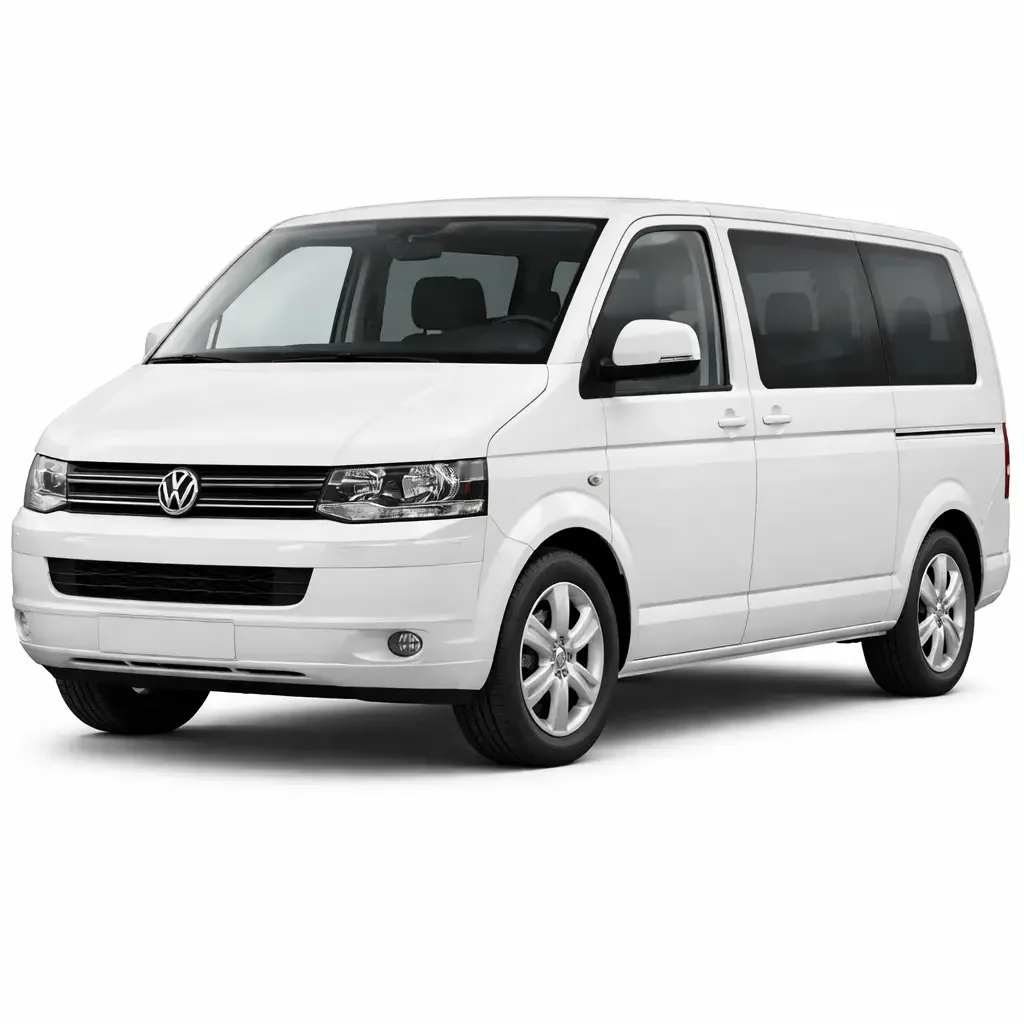
The 2013 Volkswagen Multivan is the range-topping passenger people mover within the T5 Transporter family, built on the 7H/7J platform at Volkswagen Commercial Vehicles' Hanover plant. The 2013 model year falls within the T5.2 generation, which entered production following the 2009 facelift that restyled the front end with sharper angular headlamps and a revised grille in line with Volkswagen's contemporary passenger car design language. The T5.2 designation is the commonly used identifier for this post-facelift generation; it is not an official Volkswagen model designation but is used throughout the catalog and service community to distinguish the 2009-onward T5 from the original 2003-2009 T5.1.
The Multivan sits at the top of the T5 passenger van hierarchy, above the Kombi, Shuttle, and Caravelle in terms of trim content and interior specification. For catalog purposes the critical distinction is that the Multivan is a specific body-and-interior configuration within the T5 Transporter family, not a separate platform. The 7H/7J platform and the same structural body shell are shared across the Transporter panel van, the Kombi, the Shuttle, the Caravelle, and the Multivan. Underbody components, suspension, drivetrain, and engine parts confirmed for the T5.2 platform cross between these body styles at matching specifications. Interior, trim, and body panel components are specific to each variant and must not be assumed to cross between a Multivan and a Caravelle, a Shuttle, or a Transporter.
The 2013 Multivan was not sold in the United States or Canada. The chicken tax, a 25% tariff on imported light trucks, has blocked all T-series Transporter variants from the US and Canadian markets since the end of T4 EuroVan sales in the United States in 2003. No US or Canadian domestic catalog should carry a fitment entry for the 2013 Multivan. The vehicle is sold in Europe, Australia, and other global markets. In Mexico the T5 range is marketed under the Transporter nameplate, with the Multivan configuration available but less prominently marketed than the Transporter and Caravelle.
Platform: 7H/7J, Front Engine, Front-Wheel Drive or 4MOTION
The 7H designation applies to the short-wheelbase body and the 7J designation applies to the long-wheelbase body. Both designations reference the same underlying platform architecture, which uses a front-mounted transversely positioned engine driving either the front wheels alone or all four wheels through the 4MOTION Haldex coupling system. The platform is a ladder-free monocoque construction with MacPherson strut front suspension and a trailing-arm rear suspension. Both front and rear axles use vented disc brakes on most Multivan specifications; some lower-output TDI variants use solid discs at the rear.
The 7H/7J platform is shared unchanged across the full T5.2 range regardless of body variant. A front strut confirmed for a T5.2 Transporter panel van at matching specification crosses to the Multivan. A wheel bearing confirmed for the T5.2 Caravelle crosses to the Multivan at matching drivetrain specification. The platform sharing across the Transporter family in both the 7H and 7J bodies is the single most important catalog relationship for the 2013 Multivan.
The 4MOTION system on the T5.2 uses a Haldex fourth-generation multi-plate clutch coupling at the rear axle. It is an on-demand AWD system that defaults to front-wheel drive under normal conditions and transfers torque rearward as slip is detected. The rear axle on 4MOTION variants carries a rear differential, rear halfshafts, and the Haldex coupling unit, none of which exist on FWD variants. Any rear drivetrain component must be confirmed against the specific FWD or 4MOTION drivetrain application before listing. A rear halfshaft or Haldex coupling listed for a FWD Multivan is a wrong application.
Wheelbase: SWB vs LWB as a Primary Application Variable
The 2013 Multivan is available in two wheelbase lengths. The short-wheelbase body, designated 7H in the VIN and platform code, has a wheelbase of 3,000 mm and an overall length of approximately 4,892 mm. The long-wheelbase body, designated 7J, has a wheelbase of 3,400 mm and an overall length of approximately 5,290 mm. The difference of 400 mm in wheelbase translates directly to different underbody lengths, different rear body structures, and different fuel tank positions on some applications.
For most underbody and running-gear components the wheelbase difference does not create a parts split, because the suspension geometry, engine mounting, and front-axle dimensions are shared between SWB and LWB. The split matters for propshaft length on 4MOTION variants, fuel tank length and capacity on some applications, and rear body panel components. A propshaft confirmed for a SWB 4MOTION application does not cross to an LWB 4MOTION application; the longer wheelbase requires a longer rear propshaft. A fuel tank confirmed for the SWB does not always cross to the LWB.
The Multivan Comfortline and Highline were available in both SWB and LWB in the 2013 model year. The Business trim was configured on the LWB body as a standard specification, reflecting its executive shuttle orientation. Any catalog entry that does not distinguish SWB from LWB for drivetrain-length-sensitive components or for body panels is creating an ambiguous application that will generate wrong listings for a portion of the field population.
Engines: Three Engine Families, Multiple Output Levels, and BMT
The 2013 Multivan offers three engine families: the 2.0 TDI single-turbo diesel, the 2.0 BiTDI twin-turbo diesel, and the 2.0 TSI petrol. All three are two-litre inline-four cylinder designs sharing the same basic external dimensions. This physical similarity is the source of one of the most common catalog errors, which is the substitution of components between engine families that happen to share displacement. Engine code is the definitive differentiator; displacement alone is not.
The 2.0 TDI in the 2013 Multivan is available in two power outputs: 102 PS and 140 PS. The 102 PS variant uses engine code CAAB. The 140 PS variant uses engine code CAAC. Within the T5.2 Multivan in 2013, BMT variants of the TDI were introduced during the 2012 model year and carry the suffix BMT denoting Brake energy recovery Management Technology, which is a belt-driven alternator management system that recovers kinetic energy under deceleration. The BMT variants carry different engine codes from the non-BMT variants: the 140 PS BMT TDI uses code CFCA rather than CAAC. BMT and non-BMT variants of the same output level use different alternators, different battery management hardware, and in some cases different accessory belt routing. A non-BMT alternator does not apply to a BMT variant and vice versa. Any catalog entry that lists a single alternator application covering both BMT and non-BMT TDI variants without distinguishing by engine code is creating an error.
The 2.0 BiTDI uses twin sequential turbochargers to produce 180 PS. In the T5.2 Multivan its engine code is CFCA on BMT variants and CCHA on non-BMT variants. The BiTDI uses a larger turbocharger system and higher-pressure fuel injection than the single-turbo TDI. Intercooler components, charge pipe assemblies, and turbocharger assemblies confirmed for the 2.0 TDI do not apply to the 2.0 BiTDI. A turbocharger listed for the 140 PS TDI does not cross to the BiTDI without individual part number verification.
The 2.0 TSI petrol produces 204 PS and uses engine code CJKB. It is a turbocharged direct-injection petrol engine. The TSI uses a completely different fuel system, ignition system, and oil specification from either of the diesel variants. No diesel fuel filter, diesel injector, diesel glow plug, or diesel-specific turbocharger applies to any TSI application. The TSI is the only petrol engine available in the 2013 Multivan; no naturally aspirated petrol engine exists in this application window.
Transmission: Five-Speed Manual, Six-Speed Manual, and Seven-Speed DSG
Three transmission choices are available in the 2013 Multivan depending on engine and market specification. The five-speed manual gearbox is paired with lower-output TDI variants in some markets. The six-speed manual is the more common manual option across the higher-output TDI and TSI applications. The seven-speed DSG dual-clutch automatic transmission is available across TDI, BiTDI, and TSI applications and is the only automatic transmission offered in this window.
The seven-speed DSG on the T5.2 is a wet dual-clutch unit, distinct from the dry six-speed DQ200 DSG used in smaller VW Group passenger cars. DSG fluid, DSG filter, and DSG mechatronic components for the T5.2 Multivan are specific to the wet seven-speed unit and must not be substituted with components for the dry six-speed DSG used in the Golf or Polo. Any DSG service component listing for the Multivan must be verified against the wet seven-speed DQ500 specification.
No conventional torque-converter automatic transmission was offered in the 2013 Multivan. Any torque-converter automatic component or fluid listed for the 2013 Multivan is assigning hardware from a transmission that was not installed.
4MOTION all-wheel drive is only available with the DSG automatic in the 2013 Multivan. A manual 4MOTION combination did not exist in this model year for the Multivan. Any catalog entry pairing a manual transmission with 4MOTION for the 2013 Multivan is creating a non-existent application.
The Multivan Within the T5.2 Family: Cross-Reference Scope
The correct cross-reference family for the 2013 Multivan encompasses all T5.2 variants sharing the same platform code (7H for SWB, 7J for LWB), the same engine code, and the same drivetrain configuration. This means that underbody service components confirmed for a T5.2 Transporter panel van, Caravelle, or Shuttle at matching engine, drivetrain, and wheelbase specifications may cross to the Multivan.
Interior components do not cross between the Multivan and other T5 body styles. The Multivan's defining interior feature is its longitudinal floor rail system, which runs the length of the passenger cabin floor and allows seats, tables, and accessories to be repositioned along the rails. The Multivan floor structure incorporates the rail mounting points as a load-bearing feature of the floor assembly. The Caravelle, Shuttle, and Kombi use fixed floor structures without this rail system. A Multivan floor panel does not cross to a Caravelle floor panel, and a Caravelle interior trim component does not cross to a Multivan interior trim component.
The Multivan captain seats in the second row are rotating and reclining individual seats mounted on the floor rail system. These seats are specific to the Multivan configuration and do not cross to the fixed bench or fixed individual seats used in the Caravelle. A seat component confirmed for the Caravelle second row does not apply to the Multivan second row captain seat without individual part number verification.
The Multivan also differs from the Caravelle in roof height. In the 2013 model year, the Multivan is available only in the standard roof height on both SWB and LWB bodies. The Caravelle is also standard-roof only, but the Kombi is available in standard, medium-high, and high-roof configurations. Any roof panel, roof seal, or headlining component confirmed for a medium-high or high-roof T5.2 Kombi does not apply to the Multivan.
Trim Structure: Comfortline, Highline, and Business
The 2013 Multivan is offered in three primary trim designations: Comfortline, Highline, and Business. These trim levels create genuine equipment-level component differences that affect catalog listings for interior components, electronics, and some chassis systems.
The Comfortline is the entry trim, available on both SWB and LWB. Standard equipment on the Comfortline includes 17-inch alloy wheels, three-zone Climatronic climate control, an eight-speaker audio system with CD, multifunction steering wheel, iPhone and iPod integration, cruise control, remote central locking, power windows and mirrors, and the full floor rail system with a folding multifunction table. ABS, ESP, ASR, electronic brake force distribution, brake assist, electronic differential lock, dual front airbags, front thorax and head curtain airbags, and rear curtain airbags are all standard.
The Highline adds leather or Alcantara seat upholstery, a DVD satellite navigation system, front fog lights, chrome exterior accents, and adaptive chassis control (DCC) as standard on SWB applications. The Highline is available on the SWB body only in the 2013 model year. An LWB Highline does not exist as a standard production configuration in 2013. Any catalog entry creating an LWB Highline mechanical sub-application for 2013 is assigning a configuration that did not exist in production.
The Business is the executive trim, available on the LWB body only. It is configured as a high-end shuttle with a six-seat 2-2-2 layout rather than the seven-seat 2-2-3 layout of the Comfortline and Highline. The Business features electrically adjustable multi-way front seats with memory function, Nappa leather upholstery, wood trim inserts, and a premium multimedia system. The LWB-only constraint on the Business is a hard production boundary: no SWB Business exists in the 2013 model year.
The trim designation creates a meaningful component split for interior electronics, seating assemblies, and the DCC adaptive damping system. DCC is a Highline-specific feature in 2013 and involves active electronically controlled dampers that differ from the passive dampers on Comfortline and Business applications. A damper confirmed for a Comfortline does not apply to a DCC-equipped Highline. Any shock absorber or damper listing for the 2013 Multivan that does not distinguish DCC from non-DCC applications is creating a split that must be resolved by equipment-level verification.
Suspension and Brakes
The front suspension is MacPherson independent throughout all 2013 Multivan applications. The rear suspension is a trailing-arm axle, semi-independent in design, with the trailing arms connected at the rear crossmember. This rear suspension layout is specific to the T5 platform and is shared across the full T5.2 Transporter family regardless of wheelbase or body variant.
Front brake rotors are vented disc on all 2013 Multivan applications. Rear brake rotors are vented disc on higher-output engines and solid disc on lower-output TDI applications. A rear vented disc confirmed for a BiTDI or TSI application does not necessarily cross to the 102 PS TDI application, which may use a solid rear disc. Brake component listings must be resolved by engine and output specification, not by model name alone.
The T5.2 uses hydraulic power steering on all 2013 Multivan applications. The T6.1, which entered production in 2019 as a mid-cycle refresh of the T6, introduced electromechanical power steering as a headline change. The 2013 T5.2 Multivan does not have electromechanical steering. Any electromechanical steering component from a T6.1 or later application does not apply to the 2013 T5.2 Multivan.
Market Context and North American Catalog Boundaries
The 2013 Multivan was produced exclusively for markets outside the United States and Canada. This is not a market preference issue but a regulatory and tariff barrier: the chicken tax has prevented any T5 or T6 Transporter from entering the US market at any point in this series. The vehicle does not appear in US NHTSA registration data, does not carry US-market VIN sequences, and was not sold through any US VW Commercial Vehicles dealer network.
A US-market ACES catalog that carries a 2013 Volkswagen Multivan Standard Passenger Van entry should be treated with suspicion unless the catalog is explicitly constructed for grey-market or specialist-import service applications. The Multivan is a legitimate catalog entry for European, Australian, and Mexican market databases.
The 2013 model year in Europe corresponds to production year 2012-2013. The T5.2 production run continued from 2009 through 2015, with the T6 launching for the 2015 model year. Within the T5.2 production run, the only significant engineering boundary affecting catalog accuracy for the 2013 Multivan is the BMT introduction in the 2012 model year, which creates the engine code split between BMT and non-BMT TDI variants described in the engine section above. No body change, platform change, or major suspension revision occurred at the 2013 model year within the T5.2 generation.
Common ACES/PIES Catalog Mistakes
The first error is listing the 2013 Multivan in a US or Canadian domestic catalog as a domestic application. The vehicle was not sold in the US or Canada at any point. Any US domestic ACES fitment entry for the 2013 Multivan standard passenger van is a catalog error unless the database is explicitly scoped for import or grey-market service.
The second error is applying a torque-converter automatic transmission component to any 2013 Multivan. The only automatic offered is the seven-speed wet DSG. No conventional automatic exists in this application.
The third error is applying a manual transmission with 4MOTION. The 2013 Multivan 4MOTION is DSG-only. A manual 4MOTION combination is a non-existent application.
The fourth error is applying a single TDI engine code across both BMT and non-BMT variants. BMT and non-BMT TDI variants use different engine codes and different alternator and battery management hardware. An alternator listed across both without engine code distinction is incorrect.
The fifth error is applying components from the 2.0 TDI to the 2.0 BiTDI or vice versa on the basis of shared displacement. The BiTDI uses a twin-turbo system, a larger intercooler, and higher fuel pressure. Turbocharger, intercooler, charge pipe, and fuel system components do not cross between TDI and BiTDI without individual part number verification.
The sixth error is applying TSI petrol engine components to TDI or BiTDI applications. The TSI uses a spark ignition system, petrol-specific injectors, and petrol-specific turbocharger components. No diesel fuel filter, glow plug, or diesel injection component applies to the TSI.
The seventh error is applying a dry DSG component from a Golf or Polo application to the Multivan. The Multivan uses the wet seven-speed DQ500 DSG, not the dry six-speed DQ200. DSG fluid, mechatronic units, and clutch packs are not interchangeable between these two architectures.
The eighth error is applying a propshaft from an SWB 4MOTION to an LWB 4MOTION application. The 400 mm wheelbase difference between 7H and 7J bodies requires a different propshaft length. SWB and LWB 4MOTION propshafts are not interchangeable.
The ninth error is applying interior components from the Caravelle, Shuttle, or Kombi to the Multivan. The Multivan floor, floor rail system, captain seats, and rear bench are specific to the Multivan configuration. Caravelle interior trim, floor panels, and seating do not cross to the Multivan.
The tenth error is applying a DCC adaptive damper to a non-DCC application or a passive damper to a DCC-equipped Highline. DCC is standard on the SWB Highline only in 2013. Comfortline and Business applications use passive non-adaptive dampers.
The eleventh error is applying a T6 or T6.1 electromechanical steering component to the 2013 T5.2 Multivan. The T5.2 uses hydraulic power steering throughout. No electromechanical steering component from any T6, T6.1, or T7 application applies to the 2013 Multivan.
The twelfth error is creating an LWB Highline or SWB Business application for 2013. In the 2013 model year the Highline is SWB only and the Business is LWB only. These are production configuration boundaries, not market preferences. A catalog sub-application pairing Highline with LWB or Business with SWB for 2013 is listing a vehicle that was not built.
Pre-Listing Checklist for the 2013 Multivan
Platform confirmed as 7H (SWB) or 7J (LWB), front engine, FWD or 4MOTION.
Engine confirmed as 2.0 TDI 102 PS (CAAB), 2.0 TDI 140 PS non-BMT (CAAC), 2.0 TDI 140 PS BMT (CFCA), 2.0 BiTDI 180 PS BMT (CFCA), or 2.0 TSI 204 PS (CJKB); engine code confirmed and used to differentiate BMT from non-BMT alternator and battery management hardware.
Transmission confirmed as five-speed manual, six-speed manual, or seven-speed wet DSG (DQ500); no torque-converter automatic applies; 4MOTION confirmed as DSG-only with no manual 4MOTION application.
Wheelbase confirmed as SWB or LWB for drivetrain-length-sensitive components and rear body panels; SWB and LWB 4MOTION propshafts confirmed as non-interchangeable.
Trim confirmed as Comfortline (SWB or LWB), Highline (SWB only), or Business (LWB only); DCC adaptive damper application confirmed as Highline-specific; passive damper confirmed for Comfortline and Business.
Interior components confirmed as Multivan-specific (floor rail system, captain seats, rear bench); no Caravelle, Shuttle, or Kombi interior component assumed to cross without individual part number verification.
Rear brake specification confirmed by engine output: vented rear disc for higher-output engines, solid rear disc for 102 PS TDI; rear disc type not assumed from model name alone.
Hydraulic power steering confirmed as present; no electromechanical steering component from T6.1 or later applies.
Market confirmed as non-US, non-Canada; no US or Canadian domestic catalog application created without explicit scoping for import service.
T5.2 cross-reference family confirmed as applicable for underbody and platform components at matching specification across Transporter, Kombi, Shuttle, and Caravelle; interior components confirmed as not crossing between body variants.
Final Take
The 2013 Volkswagen Multivan is a mechanically complex application within a large platform family, and the complexity for catalog purposes comes almost entirely from the number of active variables that must be resolved simultaneously: wheelbase, engine family, engine output, BMT status, transmission type, drivetrain configuration, and trim-dependent chassis equipment. None of these variables can be left ambiguous in a catalog entry without generating a class of wrong applications somewhere in the field population.
The platform sharing with the broader T5.2 Transporter family is the primary asset for cross-reference work on underbody components, and it is well-founded: struts, wheel bearings, front brakes, and engine service components confirmed for the T5.2 platform at matching specification carry broadly across the Transporter, Kombi, Caravelle, and Multivan. The liabilities are the interior, which is Multivan-specific at the floor and seating level, the BMT engine code distinction that creates a split within a single output level, the DSG architecture distinction that separates the T5.2 wet seven-speed from the dry units found elsewhere in the VW Group, and the 4MOTION-DSG pairing constraint that eliminates the manual 4MOTION combination entirely.
The North American catalog boundary is the simplest issue to resolve and the most likely to be overlooked: the 2013 Multivan simply does not belong in a US or Canadian domestic catalog, and its presence there, if unexplained, signals a catalog error rather than a legitimate fitment.
Disclaimer
This guide is intended for catalog research, fitment analysis, and parts advisory reference. Production specifications, option availability, and regulatory compliance requirements vary by model year, regional market, and assembly date within any given window. Always confirm application data against vehicle identification number decoding, factory build sheets, and OEM parts documentation before finalizing a listing or parts recommendation. PartsAdvisory and its contributors are not responsible for fitment errors arising from catalog data that has not been independently verified against physical vehicle inspection or official OEM sources.