
Written by Arthur Simitian | PartsAdvisory
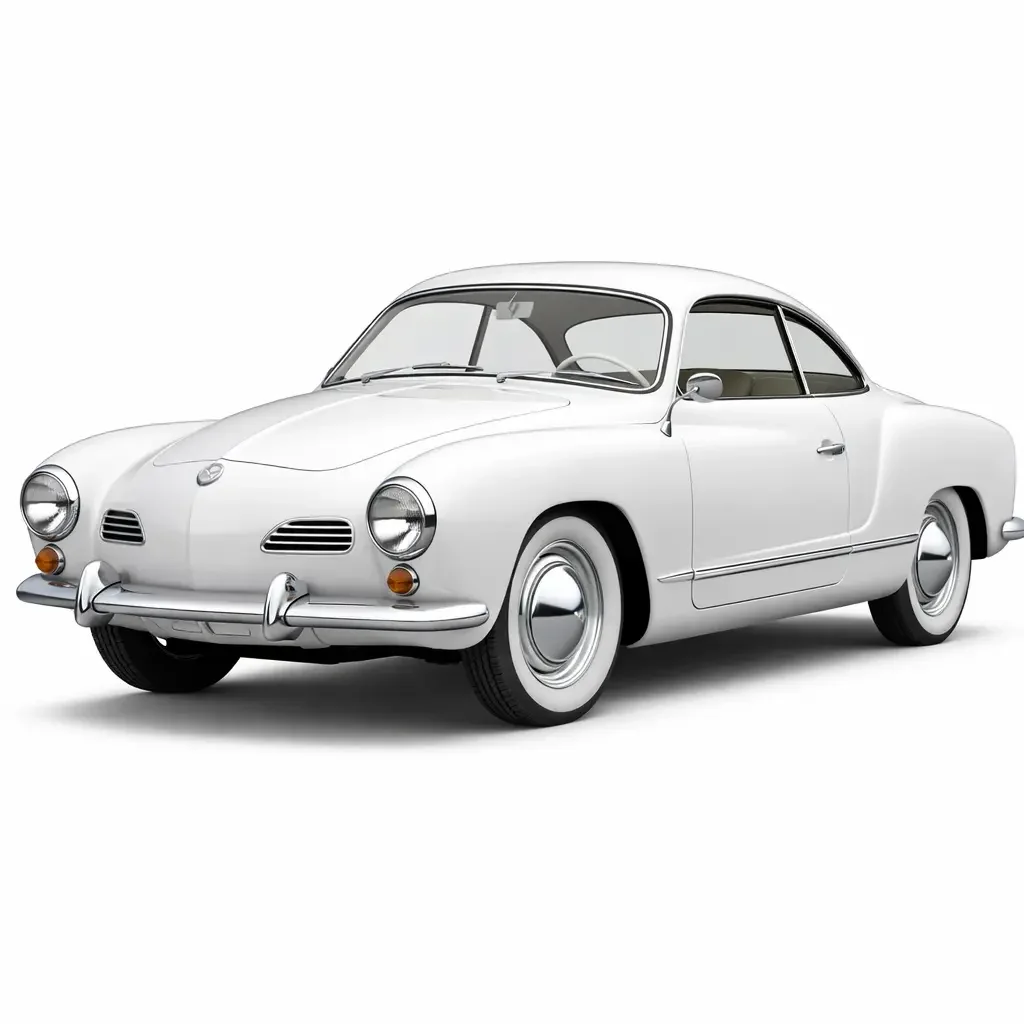
The Volkswagen Karmann Ghia Type 14 was produced from August 1955 through June 1974, a nineteen-year run during which the car remained visually and architecturally continuous while accumulating a series of meaningful mechanical changes that divide the production window into distinct catalog eras. More than 445,000 Type 14s were built at Karmann's plant in Osnabrück, Germany, the majority destined for the United States. The coupe body was offered throughout the full production run; the convertible was introduced in August 1957 and continued through 1974.
The Type 14 is built on a widened version of the Volkswagen Type 1 (Beetle) floorpan. It shares the Beetle's rear-mounted, air-cooled, horizontally opposed flat-four engine, transaxle, torsion bar suspension architecture, and all running gear. The body is specific to the Karmann Ghia and shares nothing with the Beetle. Every mechanical component on a Type 14 has a Beetle cross-reference at matching year and specification. This is the foundational catalog relationship for the Type 14 and is the primary source for parts availability across the full production window.
The Type 34 Karmann Ghia produced from 1961 to 1969 is a separate model on a separate platform. The Type 34 uses the Type 3 floorpan and the Type 3 pancake engine, not the Type 1 Beetle floorpan. A Type 34 is not a variant of the Type 14. Components confirmed for the Type 14 do not cross to the Type 34, and vice versa, except where a shared component can be confirmed at the part number level independently of the platform designation. This guide addresses the Type 14 only.
Platform: Widened Type 1 Beetle Floorpan, Rear Engine, Rear-Wheel Drive
The Type 14 uses the Beetle's pan-type floorpan widened by approximately 76 mm to accommodate the Karmann Ghia's wider body. The engine is mounted in the rear, overhanging the rear axle. Drive goes to the rear wheels through a transaxle integral with the final drive. There is no front-wheel drive and no all-wheel drive on any Type 14.
The front suspension uses a beam axle with transverse torsion bars and trailing arms. From 1955 through the 1965 model year, the front beam uses kingpin-type steering knuckles. From the 1966 model year onward, ball joints replace the kingpins. This is a hard parts-catalog boundary: a kingpin-type front spindle assembly does not cross to a ball-joint application, and a ball-joint front suspension component does not apply to a pre-1966 kingpin car. The year-of-manufacture boundary for this change falls at the August 1965 production cutover for the 1966 model year.
The front suspension also differs from the Beetle in one consistent detail across the full production run: the Type 14 was fitted with a front anti-roll bar from its introduction in 1955. The Beetle did not receive a front anti-roll bar until 1960. For the years 1955 through 1959, a front anti-roll bar component confirmed for the Beetle does not necessarily cross to the Karmann Ghia, because the Beetle of those years did not carry this component. From 1960 onward, front anti-roll bar components cross between the Type 14 and the Beetle at matching year specifications.
The rear suspension from 1955 through the 1968 model year uses a swing-axle arrangement, in which each rear halfshaft acts as both a drive shaft and a suspension member, pivoting on a single joint at the transaxle. From the 1968 model year onward on Autostick-equipped cars, and from the 1969 model year as standard on all Type 14 production, the rear suspension is a fully independent semi-trailing arm design with constant-velocity joints, replacing the swing axle entirely. This is the most significant suspension change in the Type 14's production history and creates a definitive parts boundary: all rear suspension arms, halfshafts, wheel bearings, and rear brake backing plate positions differ between swing-axle and IRS applications. A rear component confirmed for a swing-axle car does not apply to an IRS car, and vice versa.
Electrical System: 6-Volt to 12-Volt Transition
From introduction in 1955 through the 1966 model year, the Type 14 uses a 6-volt electrical system. From the 1967 model year onward, the system is 12 volts. This transition creates a hard boundary for every electrical component on the vehicle: starter motor, generator or alternator, ignition coil, voltage regulator, bulbs, horn, and wiper motor.
A 6-volt component confirmed for a pre-1967 Type 14 does not apply to a 1967-or-later 12-volt car. A 12-volt component does not apply to a pre-1967 car. The production cutover falls at August 1966 for the 1967 model year. Any catalog entry that does not distinguish the 6-volt from the 12-volt era for an electrical component is generating a wrong listing for half the production window.
The charging system also changed within the 12-volt era. The 1967 through approximately 1972 model years use a generator. During the 1973 model year an alternator was introduced, transitioning the charging system from generator to alternator. A generator and an alternator are not interchangeable. A charging system component confirmed for a 1971 car does not apply to a 1974 car without confirming which charging system is present.
Engine Progression: Four Displacement Boundaries Across Nineteen Years
The Type 14 shares its engine with the Type 1 Beetle at every stage of the engine's development. Engine displacement grew four times across the production window, creating four engine families that define the primary application splits for all engine-related service components.
The original 1192cc engine was used from introduction in 1955 through the 1965 model year. This engine produces 30 hp at introduction and 40 hp from 1960 onward following a compression ratio increase. The 1192cc is a 6-volt engine throughout its time in the Type 14, consistent with the pre-1967 electrical era. Spark plugs, ignition points, ignition coil, carburetor, fan belt, and air filter confirmed for the 1192cc Beetle of matching model year cross to the Type 14 at the same year specification.
The 1285cc engine was used for the 1966 model year only. This is the only year the 1300 designation applies to the Type 14. The 1285cc engine coincides with the ball-joint front suspension introduced at the same 1966 model year cutover, and it remains a 6-volt application. The 1966 model year has a high concentration of unique or year-specific components — ball-joint front suspension replacing kingpins, a new engine, and still 6-volt electrics — which makes it one of the two model years in the Type 14's production history most likely to have bespoke parts not shared with adjacent years.
The 1493cc engine was used from the 1967 model year through the 1969 model year. The 1967 model year is the second of the two years with a high concentration of simultaneous changes: the 1500 engine arrived together with 12-volt electrics, front disc brakes, and four-bolt wheel attachment replacing the five-stud pattern. Any component listing that uses the same part number for pre-1967 and 1967-or-later applications without distinguishing the 12-volt transition, the disc brake introduction, or the wheel attachment pattern change is likely to be wrong for at least some of those applications. The 1493cc engine uses a single-port cylinder head throughout its production years in the Type 14.
The 1584cc engine was introduced for the 1970 model year and used through the end of production in 1974. This is the most powerful engine in the Type 14's production history, producing 57 hp at introduction and 60 hp from 1971 onward. The 1970 model year uses a single-port 1584cc head. From the 1971 model year, a dual-port cylinder head and a revised doghouse-style oil cooler relocated within the fan shroud replaced the single-port configuration. The dual-port head, dual-port intake manifold, and doghouse oil cooler are 1971-and-later specific. A single-port carburetor or single-port intake manifold does not cross to a dual-port 1971-or-later application. A dual-port component does not apply to the 1970 single-port 1584cc.
Engine case designations within the 1584cc family track the internal engineering changes: the B-case is the 1970 single-port unit; the AE case and later variants are the 1971-onward dual-port units with improved bearing material, enlarged oil galleries, and dual oil pressure relief valves. These case differences affect engine internal components including main bearings and connecting rod bearings. A bearing confirmed for an AE-case dual-port engine does not necessarily apply to a B-case single-port engine without confirming the bearing specification is shared.
Brakes: Drums Through 1966, Front Discs From 1967
The Type 14 uses four-wheel drum brakes from introduction in 1955 through the 1966 model year. From the 1967 model year onward, front disc brakes replace the front drums. The rear continues to use drum brakes throughout the entire production run. There is no all-disc brake application on any Type 14.
The front disc brake introduction in 1967 is a hard boundary. A front drum brake component — drum, wheel cylinder, backing plate, brake shoe — confirmed for a pre-1967 Type 14 does not apply to a 1967-or-later car at the front axle. A front disc caliper, disc rotor, or disc-specific wheel hub component confirmed for a 1967-or-later car does not apply to a pre-1967 car. The wheel hub itself changed between the drum and disc applications and between the five-stud and four-bolt attachment patterns, making the hub a year-specific component at the 1967 boundary.
The wheel attachment pattern also changed in 1967 from five studs to four bolts. A wheel confirmed for a pre-1967 car on a five-stud pattern does not fit a 1967-or-later four-bolt hub. Wheel bearing specifications may also differ between the five-stud and four-bolt hub designs and must be confirmed at the part number level.
The front disc brake calipers were updated during the 1973 model year when Girling calipers replaced the previous units. A caliper confirmed for a 1967-1972 application may not cross to a 1973-1974 application without confirming the caliper manufacturer and bore specification match.
Transmission: Four-Speed Manual, Autostick Semi-Automatic
The standard transmission throughout the production run is a four-speed manual transaxle integral with the final drive. From introduction in 1955 through the 1960 model year, first gear is not synchronized. From the 1961 model year onward, all four forward gears have synchromesh. A synchro ring or synchro-specific component confirmed for a post-1961 gearbox does not apply to a pre-1961 non-synchro first gear application.
The Autostick three-speed semi-automatic transmission was introduced as an option for the 1968 model year. The Autostick is a conventional three-speed manual gearbox with a vacuum-operated automatic clutch and torque converter, requiring the driver to select gears manually but eliminating the clutch pedal. It is not a conventional automatic transmission with planetary gears, and it is not a dual-clutch DSG. Autostick-specific components — the torque converter, the vacuum servo, and the three-speed-specific gear ratios — do not cross to the four-speed manual application.
The Autostick's introduction in 1968 coincides with the introduction of independent rear suspension on Autostick-equipped cars, which preceded the IRS becoming standard for all cars in 1969. A 1968 Autostick car has IRS; a 1968 manual-transmission car retains swing axles. This is the only model year where transmission type determines rear suspension type, creating a rear suspension application split within a single model year that depends on transmission specification.
The final drive ratio changed in 1973 to a numerically lower 3.88:1 ratio from the previous 4.12:1 or similar ratios on earlier cars. This change affects speedometer calibration and ring-and-pinion components. A ring-and-pinion confirmed for a pre-1973 car does not cross to a 1973-1974 car without confirming the ratio matches.
Body Styles: Coupe and Convertible
The coupe was produced throughout the full 1955-1974 window. The convertible was introduced in August 1957 as a 1958 model year car and continued through 1974. Both body styles share all mechanical and drivetrain components. The body-style distinction matters only for convertible-specific components: the convertible top assembly and frame, the convertible top latches, the convertible rear window, and the convertible-specific body reinforcement at the A-pillar and sill.
The convertible is a strict two-seater without a rear seat. The coupe offers a vestigial rear seat for most of its production life. For the 1974 US model year, the rear seat was removed from US-market coupes and the car was marketed as a two-seater, because the rear seat lacked provisions for the seat belts then required by US safety regulations. This rear seat deletion was a US-specific change and may not apply to all markets in the final model year.
The convertible received a glass rear window for the 1969 model year, replacing the earlier flexible plastic rear window. A rear window component confirmed for a pre-1969 convertible does not apply to a 1969-or-later convertible.
The "lowlight" designation refers to coupes produced through the 1959 model year, in which the headlights were positioned approximately 50 mm lower on the front fenders than on subsequent cars. The 1960 model year brought the headlights to a higher position along with a revised front grille design. Headlight assemblies, front fender panels, and front-end trim components are specific to the lowlight (pre-1960) or highlght (1960-onward) body treatment and do not cross between the two configurations.
Key Production Year Boundaries: A Summary
The Type 14's catalog structure is defined more precisely by production year boundaries than by any other variable. The following boundaries represent genuine parts divides:
The 1960 model year (August 1959 production start) brought the revised front-end styling with higher headlights, a revised front grille, and a more powerful 40 hp version of the 1192cc engine. Components specific to the lowlight pre-1960 front end do not cross to 1960-onward cars.
The 1961 model year brought full synchromesh on all four forward gears, replacing the non-synchro first of earlier cars. Gearbox internal components requiring synchromesh in first gear apply only from 1961 onward.
The 1966 model year brought ball-joint front suspension replacing kingpins, and the 1285cc engine replacing the 1192cc. Front suspension components from the kingpin era (through 1965) do not cross to the ball-joint era (1966 onward), and vice versa.
The 1967 model year brought the most simultaneous changes of any single year in the production run: 12-volt electrics replacing 6-volt, the 1493cc engine replacing the 1285cc, front disc brakes replacing front drums, and four-bolt wheel attachment replacing five-stud. Every electrical component, every front brake component, and every wheel hub component splits at this boundary.
The 1968 model year brought the Autostick semi-automatic option, which on Autostick-equipped cars introduced IRS replacing swing axles one year ahead of the rest of the range.
The 1969 model year brought IRS as standard on all cars, eliminating the swing axle from the entire range. All rear suspension, halfshaft, and rear wheel bearing components split between pre-1969 swing-axle and 1969-onward IRS applications.
The 1970 model year brought the 1584cc single-port engine replacing the 1493cc. Engine service components for the 1500 family do not cross to the 1600 without confirming displacement and port specification match.
The 1971 model year brought the dual-port 1584cc head, the doghouse oil cooler, and a revised engine case. Single-port and dual-port components within the 1584cc family do not cross without confirmation.
The 1973 model year brought an alternator replacing the generator mid-year, Girling front calipers replacing the previous units, and a revised final drive ratio. Charging system components and front caliper components split within the 1973 production year.
The Type 14 and the Beetle: Cross-Reference Scope
All mechanical and drivetrain components on the Type 14 have a direct Beetle equivalent at matching year and specification. This cross-reference is the most useful and most broadly applicable relationship in the Type 14 catalog. Engine components, transmission components, suspension components, brake components, and electrical components confirmed for the matching-year Beetle apply to the Type 14 with the following qualifications.
First, the front anti-roll bar applies to the Type 14 from 1955 and to the Beetle from 1960. For 1955-1959 Type 14 applications, the anti-roll bar is Type 14 specific and has no Beetle cross-reference.
Second, the front disc brake conversion from 1967 onward uses Type 14-specific hub and bearing configurations that match the Beetle only where the Beetle also used the same disc brake setup in the same year. The Beetle's disc brake introduction and wheel attachment pattern changes occurred on the same schedule as the Type 14 from 1967, so the Beetle cross-reference holds from 1967 at the front brake.
Third, any body panel, exterior trim component, glass, sealing rubber, or interior trim component confirmed for the Beetle does not cross to the Type 14. The bodies share no external panels. A Beetle door, fender, hood, deck lid, windscreen, or quarter panel does not fit a Karmann Ghia. The Karmann Ghia's body panels are specific to the Type 14 and were hand-finished to a higher standard than the Beetle's machine-welded panels.
Fourth, the Type 34 Karmann Ghia is on a different platform and has no mechanical cross-reference to the Type 14 at the engine, suspension, or drivetrain level.
Common ACES/PIES Catalog Mistakes
The first error is applying a single brake specification across the full 1955-1974 window. Front drums apply through 1966; front discs apply from 1967. A single front brake entry covering all years without year range qualification is wrong for a large portion of the production run.
The second error is applying a single electrical specification across the full window. Six-volt components apply through 1966; 12-volt components apply from 1967. Any electrical component listed without year-range qualification spanning the 6-volt/12-volt boundary is assigning wrong hardware to at least one era.
The third error is applying a single rear suspension specification across the full window. Swing-axle rear components apply through 1968 for manual cars and through 1967 for Autostick cars. IRS components apply from 1969 for all cars and from 1968 for Autostick cars. A rear suspension component listed without this boundary is wrong for a large portion of the field.
The fourth error is applying a single wheel specification across the pre-1967 five-stud and the 1967-onward four-bolt eras. Wheels and hubs do not cross this boundary.
The fifth error is applying a dual-port engine component to a 1970 single-port 1584cc application, or a single-port component to a 1971-onward dual-port application. Intake manifolds, carburetors, cylinder heads, and oil cooler assemblies split at the 1971 model year boundary within the 1584cc family.
The sixth error is applying a generator to a 1973-or-later car or an alternator to a pre-1973 car. The charging system transition occurred during the 1973 model year and must be resolved by confirming which system is installed rather than by model year alone for 1973 applications.
The seventh error is applying a Type 34 component to a Type 14 application. The Type 34 uses the Type 3 platform and pancake engine. No drivetrain, suspension, or engine component crosses between the Type 14 and the Type 34.
The eighth error is applying a Beetle body panel, glass, or trim component to the Type 14. The bodies are completely different. No exterior panel, door glass, windscreen, or quarter window from the Beetle fits the Type 14.
The ninth error is applying a 1955-1959 lowlight front-end body component to a 1960-onward car. Headlight assemblies and front fender stampings are lowlight-specific and do not cross to the higher-headlight configuration.
The tenth error is applying a pre-1961 non-synchro gearbox component to a 1961-or-later full-synchro application. First-gear synchromesh components apply only from 1961.
The eleventh error is applying a post-1972 Girling front caliper to a 1967-1972 application without confirming the caliper specification matches. The 1973 caliper change is a genuine parts boundary within the disc brake era.
The twelfth error is applying a pre-1966 kingpin suspension component to a 1966-or-later ball-joint application, or vice versa. The front spindle, steering knuckle, and related components are fundamentally different between kingpin and ball-joint designs.
Pre-Listing Checklist for the 1955-1974 Type 14
Model year confirmed or production date confirmed to resolve which side of each boundary the vehicle falls on.
Electrical system confirmed as 6-volt (through 1966 model year) or 12-volt (1967 model year onward); charging system confirmed as generator (1967 through early 1973) or alternator (1973 model year onward).
Engine displacement confirmed as 1192cc (through 1965), 1285cc (1966 only), 1493cc (1967-1969), or 1584cc (1970-1974); within the 1584cc family, port configuration confirmed as single-port (1970) or dual-port (1971 onward).
Front suspension confirmed as kingpin (through 1965 model year) or ball-joint (1966 onward).
Front brake system confirmed as drum (through 1966 model year) or disc (1967 onward); within the disc era, caliper confirmed as pre-Girling (1967-1972) or Girling (1973-1974).
Wheel attachment confirmed as five-stud (through 1966 model year) or four-bolt (1967 onward).
Rear suspension confirmed as swing-axle (manual cars through 1968 model year; Autostick cars through 1967 model year) or IRS (all cars from 1969 model year; Autostick cars from 1968 model year).
Transmission confirmed as four-speed manual (standard throughout) or Autostick semi-automatic (option from 1968 model year).
Body style confirmed as coupe or convertible; convertible rear window confirmed as plastic (through 1968 model year) or glass (1969 onward).
Beetle cross-reference confirmed as applicable for all mechanical and drivetrain components at matching year and specification; body panels confirmed as Type 14 specific with no Beetle cross-reference.
Type 34 confirmed as a different model on a different platform with no mechanical cross-reference to the Type 14.
Final Take
The Type 14 Karmann Ghia is one of the longest-running single-model applications in the VW catalog, and its nineteen-year span encompasses more mechanical revision than its consistent external appearance suggests. The practical challenge for catalog work is that the car looks nearly identical from 1960 through 1974, which tempts a single-entry approach that the mechanical history does not support. The 1967 model year alone — simultaneously changing the electrical system, engine, front brakes, and wheel attachment — creates four independent parts boundaries in a single production cutover. A catalog that treats the 1955-1974 window as a uniform application will be wrong in multiple component categories for every single application it describes.
The Beetle cross-reference is the most valuable tool available for this application and supplies the majority of the mechanical parts catalog. Using it correctly means knowing which Beetle year specification to match to the Type 14 year in question, and it means knowing that the tool stops working at the body — where the Type 14 is entirely its own car, finished by hand to a standard that the Beetle's machine-welded body was never meant to achieve.
Disclaimer
This guide is intended for catalog research, fitment analysis, and parts advisory reference. Production specifications, option availability, and regulatory compliance requirements vary by model year, regional market, and assembly date within any given window. Always confirm application data against vehicle identification number decoding, factory build sheets, and OEM parts documentation before finalizing a listing or parts recommendation. PartsAdvisory and its contributors are not responsible for fitment errors arising from catalog data that has not been independently verified against physical vehicle inspection or official OEM sources.