
Volkswagen GTI (2022-2024): Mk8 MQB EVO Platform Fitment Guide for North America
Written by Arthur Simitian | PartsAdvisory
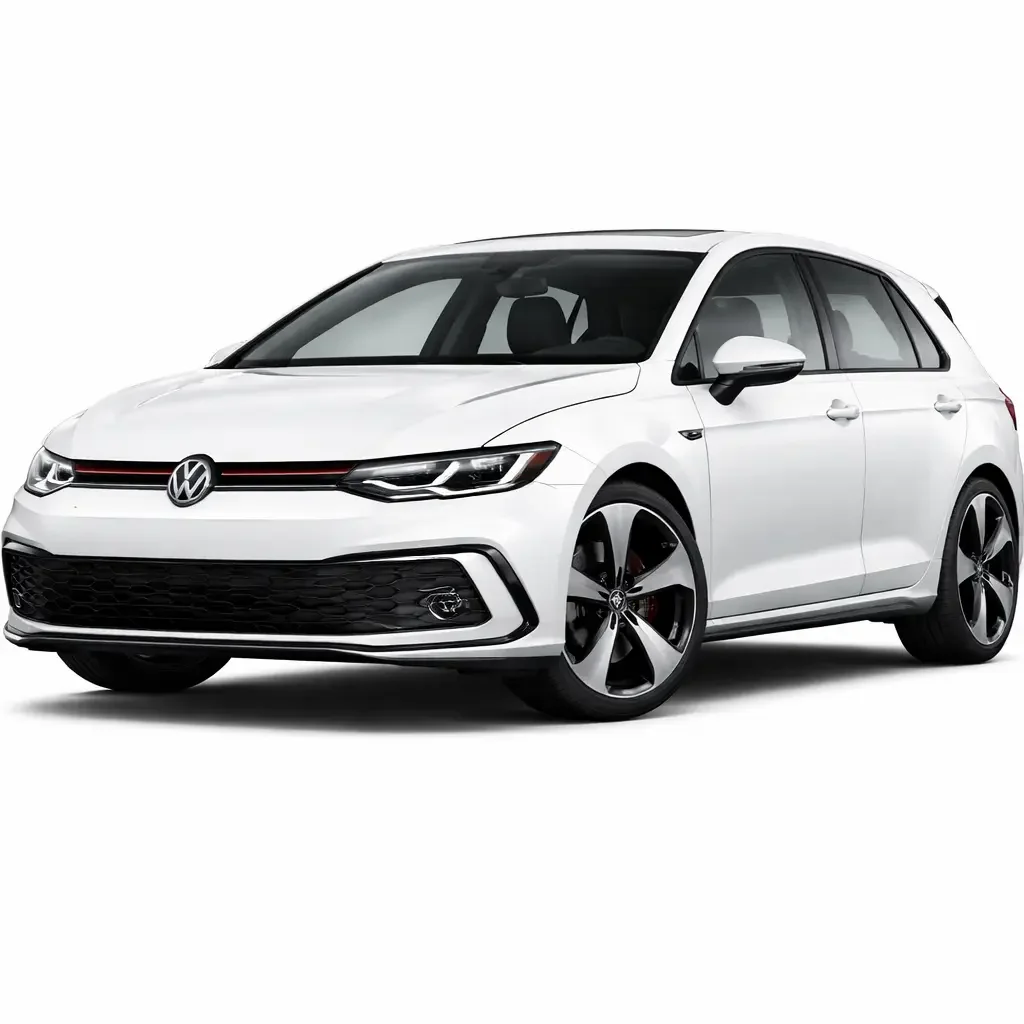
The Volkswagen GTI sold in North America from 2022 through 2024 is the eighth generation of the nameplate, built on the MQB EVO platform and internally designated Typ CD. It arrived in North American showrooms in early 2022, replacing the Mk7.5 after a seven-year production run and bringing a comprehensive redesign of the body, interior electronics architecture, and powertrain specification. The Mk8 GTI is available only in the 4-door five-door hatchback body style in North America. The 2-door configuration was discontinued with the Mk7.5 and does not exist in the Mk8 lineup for this market.
The Mk8 GTI introduces the EA888 Gen4 engine, also referred to as the EA888 evo4, replacing the EA888 Gen3 of the Mk7 and Mk7.5. Despite sharing the EA888 family designation and the same displacement, the Gen4 and Gen3 are different engine specifications with a higher-pressure fuel injection system, revised internal friction management, and different engine management software. Gen3 service components confirmed for Mk7 and Mk7.5 applications must be verified by part number before being applied to the Mk8 Gen4.
The three-year window from 2022 through 2024 contains one catalog boundary of particular historical consequence: the 2024 model year is the final North American GTI to offer a manual transmission. The 2024 GTI 380 edition, applied as a standard equipment package to every manual-transmission S, SE, and Autobahn build for 2024, celebrates the manual's exit from the GTI lineup. This makes the 2024 the last year in the window to carry separate manual and DSG catalog entries, and the manual transmission absence from the Mk8.5 onward must be handled accordingly in the next guide window.
This guide addresses the United States market throughout. Canadian specifications share the same platform, engine, and transmission but may carry different trim pricing structures.
Platform: MQB EVO and What Changed from MQB
The Mk8 GTI is built on the MQB EVO platform, an evolution of the MQB architecture introduced with the Mk7. The fundamental layout is continuous: MacPherson strut front suspension, multi-link independent rear suspension, transverse engine, and front-wheel drive. However, the MQB EVO introduces a new aluminum front subframe in place of the steel subframe used in the Mk7 and Mk7.5. The aluminum subframe reduces unsprung weight and changes the mounting geometry and material of the front subframe bushings. A front subframe confirmed for a Mk7 or Mk7.5 GTI does not cross to the Mk8 application. Subframe bushings, subframe mounting hardware, and front suspension pickup point geometry are all Mk8-specific.
The multi-link rear suspension carries forward in its fundamental layout from the Mk7 and Mk7.5, but spring rates increased by approximately 15 percent and damper specifications were revised for the Mk8. A rear spring or rear shock absorber confirmed for the Mk7 GTI does not cross to the Mk8 without individual part number confirmation. The platform continuity between Mk7 and Mk8 at the rear suspension layout level does not confirm component interchangeability.
The MQB EVO platform also carries a substantially revised electronic architecture that integrates the IQ.DRIVE driver assistance suite, the Vehicle Dynamics Manager, and the touch-capacitive control interface more deeply into the body and chassis control modules than the prior generation. This electronic integration affects sensor, module, and wiring harness specifications throughout the vehicle. A steering angle sensor, wheel speed sensor, or ESC module confirmed for a Mk7 or Mk7.5 must not be assumed to cross to the Mk8 without individual part number verification.
The Mk8 GTI is produced at Volkswagen de Mexico in Puebla, Mexico, continuing the Puebla production origin established for the Mk7. The VIN carries a 3VW prefix throughout the North American Mk8 GTI window.
Engine: EA888 Gen4, Higher Injection Pressure, Consistent Output
The Mk8 GTI uses the EA888 Gen4 (evo4) 2.0-litre turbocharged direct-injection four-cylinder throughout the 2022 through 2024 window in North America. Output is 241 hp and 273 lb-ft of torque across all trims and all three model years. There is no output variation by trim or by transmission within this window. The 241 hp figure is consistent from the base S trim to the Autobahn and through the 2024 GTI 380 edition.
The EA888 Gen4 delivers fuel at a higher injection pressure than the Gen3: approximately 5,076 psi versus approximately 2,900 psi on the Gen3. This elevated injection pressure requires a high-pressure fuel pump and injector specification specific to the Gen4. A high-pressure fuel pump confirmed for an EA888 Gen3 Mk7 or Mk7.5 GTI must not be cross-referenced to the Mk8 Gen4 without individual part number confirmation. The same applies to fuel rail components and injector specifications. These are different fuel system architectures despite sharing the EA888 family name and the same displacement.
The IS20 turbocharger used in the Mk7 and Mk7.5 GTI continues in the Mk8, though the specific turbocharger specification may vary slightly from the Gen3 installation due to the Gen4 engine architecture changes. A turbocharger confirmed for a Mk7 GTI EA888 Gen3 should be confirmed by part number before it is applied to a Mk8 Gen4 application.
The timing chain, water pump, thermostat, oil filter, air filter, and spark plug specifications for the EA888 Gen4 must be confirmed against Mk8-specific OEM part numbers rather than assumed to cross from Mk7 Gen3 listings. The Gen3 and Gen4 share the EA888 architecture but differ in enough detail that routine service item cross-references between the two generations require individual verification.
VAQ Differential: Standard on All Trims, No Performance Package Split
The most significant catalog simplification in the Mk8 relative to the Mk7 is the VAQ electro-hydraulic torque-sensing limited-slip differential becoming standard equipment on every North American GTI trim from 2022 onward. In the Mk7, the VAQ was exclusive to the Performance Package. In the Mk8, it is standard on S, SE, and Autobahn trims without requiring any option package. There is no VAQ-equipped versus non-VAQ-equipped split in the Mk8 GTI application for any model year in this window.
This standardization eliminates the front differential catalog split that required separate entries for Performance Package and non-Performance Package applications in the Mk7. Any front differential, differential actuator, or related halfshaft listing for the Mk8 GTI applies uniformly across all trims without equipment-level qualification for the differential itself.
Transmissions: DQ381 Seven-Speed DSG and the 02Q Six-Speed Manual Through 2024
The sole DSG available in the North American Mk8 GTI is the DQ381 seven-speed wet-clutch dual-clutch unit, the same DSG family introduced with the Mk7.5 from 2019 onward. This is consistent throughout the 2022 through 2024 window. No DQ250 six-speed DSG application exists for any Mk8 GTI. A DQ250 fluid, filter, or mechatronic listing applied to any Mk8 GTI is assigning service components from the wrong transmission.
The six-speed manual 02Q is available throughout the 2022 through 2024 window. For 2024, the manual is designated the GTI 380 build when combined with the 380 equipment package. The 02Q clutch and flywheel specifications in the Mk8 continue with the eight-bolt TSI flywheel pattern established in the Mk6 and Mk7. The 2024 model year is confirmed as the final North American GTI model year to offer the manual transmission. A manual transmission application for the Mk8 must not extend beyond the 2024 model year in any catalog entry covering this generation.
Brakes: Unified Specification Across All Trims
The Mk8 GTI uses a single brake specification across all North American trims, without the Performance Package versus standard split that characterized the Mk7 window. Front brake rotors are 340 mm vented discs. Rear brake rotors are 310 mm vented discs. These are the larger brake dimensions that were Performance Package-exclusive in the Mk7, now standard on every Mk8 GTI.
The electromechanical brake servo is a new feature for the Mk8. Unlike the vacuum-assisted brake servo of prior GTI generations, the Mk8 uses an electromechanical unit that does not draw on engine vacuum for brake assist. This affects the brake booster and brake master cylinder specifications, which are Mk8-specific and do not cross to prior generations. A brake booster confirmed for any Mk7 or Mk7.5 GTI does not apply to the Mk8.
The unified 340 mm front and 310 mm rear brake specification means that a front rotor listing for the Mk8 does not require Performance Package confirmation before assignment, unlike the Mk7. A single front rotor entry applies to all Mk8 GTI applications in the 2022 through 2024 window.
Suspension: Aluminum Subframe, DCC by Trim
The Mk8 GTI uses MacPherson strut front suspension with the new aluminum front subframe. The revised wishbone bearing geometry and updated damping hydraulics are specific to the Mk8 and are not confirmed as crossing to Mk7 applications at the strut or control arm level.
The DCC adaptive damper system is available in the Mk8 GTI but is not standard across all trims. For the 2022 and 2023 model years, DCC is standard on the Autobahn trim and optional or unavailable on lower trims depending on the model year. For the 2024 model year, DCC is standard on all GTI 380 configurations across S, SE, and Autobahn trims, as well as remaining standard on the Autobahn DSG trim. A shock absorber or strut listing for any Mk8 GTI application must confirm DCC or non-DCC specification before the part number is assigned. DCC adaptive damper assemblies and passive damper assemblies are different components and must not be cross-referenced.
Interior Electronics and the Touch Interface Architecture
The Mk8 GTI introduced a substantially revised interior electronics architecture relative to the Mk7.5. The standard Digital Cockpit Pro instrument cluster replaces the prior-generation instrument cluster. The MIB3 infotainment system with either an 8.25-inch display on the S or a 10-inch Discover Pro display on SE and Autobahn replaces the prior MIB2 unit. Touch-capacitive sliders replaced physical buttons for many HVAC and audio controls.
These interior hardware changes mean that instrument cluster modules, infotainment head units, and HVAC control panel specifications are all Mk8-specific. A head unit confirmed for a Mk7 or Mk7.5 GTI does not cross to the Mk8. A climate control panel from the Mk7.5 does not cross to the Mk8's touch-capacitive layout.
Trims: S, SE, Autobahn, and the 2024 GTI 380
The Mk8 North American trim structure is S, SE, and Autobahn throughout the 2022 through 2024 window. The S is the entry-level configuration with the 8.25-inch MIB3 display, standard plaid cloth seats, manual six-speed as standard, and DSG as an option. The SE adds the 10-inch Discover Pro navigation system, KESSY keyless access, and additional driver assistance content. The Autobahn adds a panoramic sunroof, Vienna leather seating, and 12-way power driver seat with memory as standard, along with DCC adaptive damping as standard.
For 2024, the GTI 380 equipment package is applied as standard to every manual-transmission S, SE, and Autobahn build, creating S 380, SE 380, and Autobahn 380 designations. The 380 adds DCC adaptive damping, 19-inch gloss black wheels from the Golf R 20th Anniversary Edition, summer performance tires, gloss black roof and mirror caps, and a golf-ball-dimpled manual shift knob. The 380 does not change the engine, transmission internals, VAQ differential, or brake hardware specification. Its catalog impact is concentrated in the DCC damper fitment confirmation and the wheel and tire specification.
The 40th Anniversary Edition (2023)
For the 2023 model year, Volkswagen offered a limited 40th Anniversary Edition GTI in the North American market, commemorating 40 years of GTI sales in the United States. The 40th Anniversary Edition was based on the SE trim and added specific badging, unique color availability, and interior accents. It does not carry any distinct mechanical specification at the engine, transmission, suspension, or brake level. It is a cosmetic and equipment-level variant with no catalog implications for mechanical service components.
Common ACES/PIES Catalog Mistakes
The first error is applying EA888 Gen3 high-pressure fuel pump or injector components to the Mk8 Gen4 application. The Gen4 operates at significantly higher injection pressure with a different HPFP and injector specification. These components are engine generation-specific and must be confirmed against Mk8 Gen4 part numbers.
The second error is applying a Mk7 or Mk7.5 front subframe or front subframe bushing to a Mk8 application. The Mk8 uses an aluminum front subframe. The Mk7 uses a steel front subframe. The material, mounting geometry, and bushing specifications differ.
The third error is assigning a DQ250 DSG fluid, filter, or mechatronic component to any Mk8 GTI. The Mk8 uses the DQ381 exclusively as its DSG. No DQ250 DSG application exists for the 2022 through 2024 GTI.
The fourth error is assigning a manual transmission application to any Mk8 GTI beyond the 2024 model year within this window, or failing to note in catalog entries that 2024 is the final model year with manual transmission availability in this generation.
The fifth error is applying a Mk7 Performance Package 340 mm front or 310 mm rear brake rotor listing to the Mk8 and treating the two as interchangeable without part number confirmation. The Mk8 uses 340 mm front and 310 mm rear rotors as a standard specification, but the caliper mounting geometry changed with the MQB EVO aluminum subframe. Part number verification is required before a Mk7 PP brake rotor is cross-referenced to a Mk8 application.
The sixth error is applying a vacuum-assisted brake booster from any prior GTI generation to the Mk8. The Mk8 uses an electromechanical brake servo with no vacuum circuit. Brake booster and brake master cylinder components are Mk8-specific.
The seventh error is applying a DCC shock or strut to a non-DCC Mk8 application, or a passive damper to a DCC application. DCC fitment must be confirmed against trim and option specification before any shock or strut listing is assigned.
The eighth error is applying a Mk7 or Mk7.5 instrument cluster or infotainment head unit to a Mk8 application. The Mk8 uses the Digital Cockpit Pro cluster and MIB3 infotainment, both of which are different hardware assemblies from the prior generation.
The ninth error is applying a VAQ differential component listing with a Performance Package qualifier to any Mk8 application. The VAQ is standard on all Mk8 trims without a Performance Package distinction. A listing that restricts the VAQ to Performance Package-equipped vehicles is applying the Mk7 equipment structure to the Mk8.
The tenth error is treating the 2024 GTI 380 as a mechanically distinct configuration at the engine, brake, or differential level. The 380 is an equipment package affecting DCC fitment, wheel specification, tire specification, and exterior trim. It does not change engine, transmission internals, brake hardware dimensions, or VAQ specification relative to a standard 2024 GTI.
Pre-Listing Checklist for the 2022-2024 Mk8 GTI
Platform confirmed as MQB EVO; aluminum front subframe confirmed as Mk8-specific; no Mk7 or Mk7.5 front subframe or subframe bushing applies.
Production confirmed as Puebla, Mexico throughout; VIN prefix confirmed as 3VW.
Body style confirmed as 4-door only throughout; no 2-door body style exists for any North American Mk8 GTI application.
Engine confirmed as EA888 Gen4 throughout; output confirmed as 241 hp across all trims and all three model years; HPFP and injector specifications confirmed as Gen4-specific before any fuel system listing is assigned.
VAQ differential confirmed as standard on all trims without Performance Package qualification; no trim-based differential split exists in the Mk8 window.
Transmission confirmed as DQ381 seven-speed DSG or 02Q six-speed manual; manual confirmed as available 2022 through 2024; 2024 confirmed as final model year with manual transmission; no DQ250 DSG applies to any Mk8 GTI.
Brake specification confirmed as 340 mm front vented and 310 mm rear vented across all trims without Performance Package qualification; electromechanical brake servo confirmed as Mk8-specific; vacuum brake booster from prior generations confirmed as not applicable.
DCC adaptive damper fitment confirmed against trim and model year before shock or strut listing is assigned; DCC standard on Autobahn and GTI 380 trims; passive damper and DCC assemblies confirmed as different components.
GTI 380 confirmed as equipment package for 2024 manual-transmission applications only; no mechanical catalog distinction at engine, brake, or differential level relative to standard 2024 GTI.
Final Take
The 2022 through 2024 Mk8 window is the cleanest three-year GTI catalog entry in the series in terms of within-window variation. Output is uniform at 241 hp, the VAQ differential is universal, the brake specification is uniform, and the DSG is a single unit throughout. The catalog complexity that defined the Mk7 window, particularly the Performance Package brake and differential splits, does not apply here. What complexity does exist is concentrated at the generational boundaries: the Gen4 fuel system separation from the Gen3, the aluminum subframe separation from the steel Mk7 subframe, and the electromechanical brake servo separation from all prior vacuum-assisted generations.
The 2024 model year carries one catalog consequence that has long-term implications beyond this window: the manual transmission application for the GTI ends here. The 2024 is the final model year for the 02Q manual in any North American GTI. Any catalog entry that extends a manual transmission application to a 2025 or later GTI is assigning a drivetrain that is no longer available, and this boundary must be maintained clearly as the series moves into the Mk8.5 window.
Disclaimer
This guide is intended for catalog research, fitment analysis, and parts advisory reference. Production specifications, option availability, and DCC fitment by trim varied across the three-year window. Always confirm application data against vehicle identification number decoding, factory build sheets, and OEM parts documentation before finalizing a listing or parts recommendation. PartsAdvisory and its contributors are not responsible for fitment errors arising from catalog data that has not been independently verified against physical vehicle inspection or official OEM sources.