
Written by Arthur Simitian | PartsAdvisory
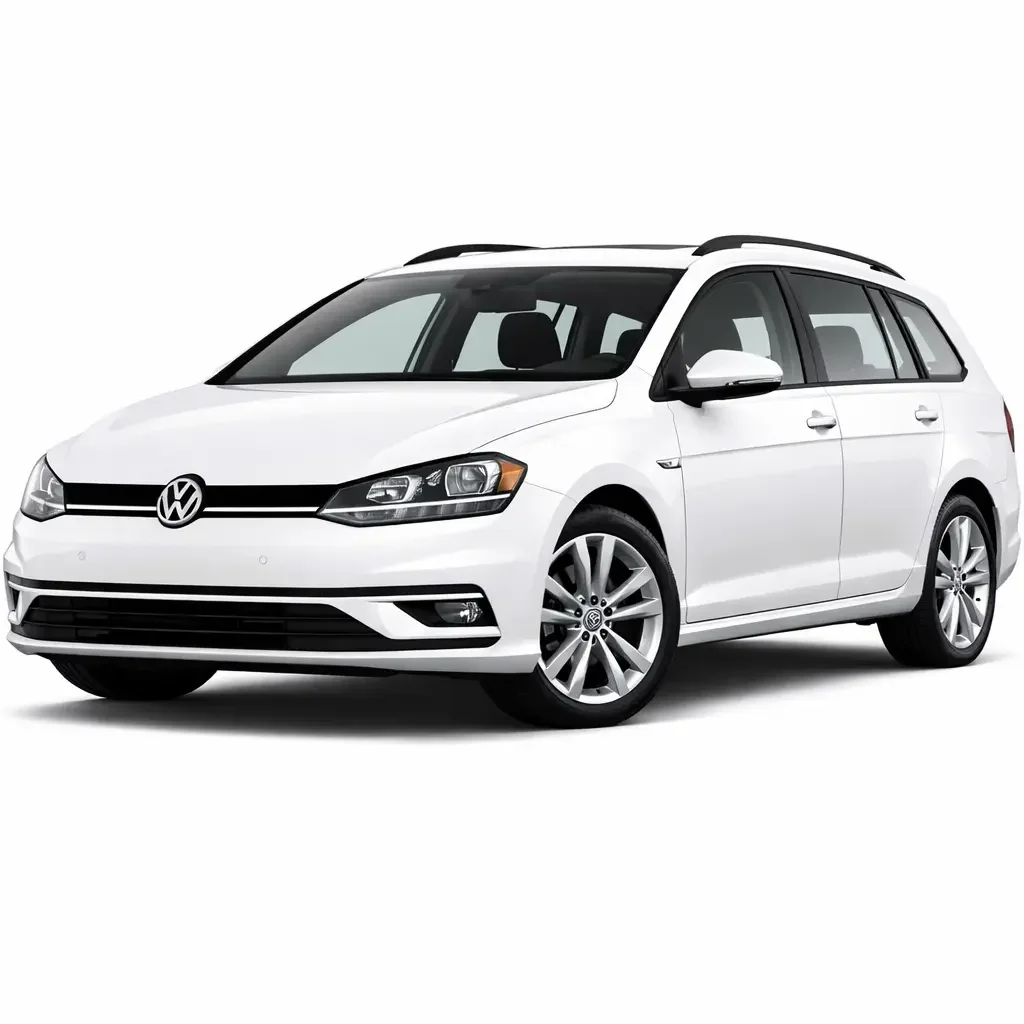
The Volkswagen Golf SportWagen sold in North America from 2015 through 2019 is the Mk7 generation of the Golf-based station wagon, built on the MQB platform and replacing the Jetta SportWagen that occupied this segment through 2014. The nameplate change from Jetta SportWagen to Golf SportWagen aligns the US market with the Canadian and European nomenclature and reflects the structural change underneath: the MQB platform represents a complete break from the PQ35 architecture of the prior generation. No suspension geometry, brake architecture, engine, or transmission component from the Jetta SportWagen crosses to the Golf SportWagen at the platform level.
The five-year window from 2015 through 2019 contains three distinct engine catalog boundaries, a mid-window all-wheel-drive introduction, and the complete removal of the TDI diesel engine from the North American lineup after the Dieselgate emissions enforcement action in September 2015. These boundaries make the Golf SportWagen one of the more complex compact wagon catalog entries in the VW North American lineup for this era.
All North American Golf SportWagen models are assembled at Volkswagen de Mexico in Puebla throughout the window. The VIN carries a 3VW prefix.
Platform: MQB and the Break from PQ35
The Golf SportWagen is the first North American market wagon to use the MQB architecture. The platform carries an independent MacPherson strut front suspension and an independent multi-link rear suspension, replacing the torsion beam rear axle of the prior Jetta SportWagen. The multi-link rear suspension is shared with the Golf hatchback and GTI of the same generation, but is calibrated with wagon-specific spring rates to accommodate the higher rear load capacity of the wagon body. A rear spring confirmed for the Golf hatchback must not be applied to the SportWagen without confirming the spring rate specification, as the wagon uses a higher rear spring rate than the hatchback to support its practical payload.
Front suspension components including front struts, front control arms, front wheel bearings, and front brake hardware are shared with the Golf hatchback and GTI within matching engine weight and trim specifications. Front strut and front brake cross-references between the SportWagen and the Golf hatchback are confirmed at the platform level and represent the most reliable cross-reference family for this vehicle.
The wagon body shares all panels forward of the B-pillar with the Golf hatchback. Rear body structure, rear quarter panels, rear doors, rear glass, rear liftgate, and rear liftgate glass are wagon-specific and do not cross to the Golf hatchback. The rear liftgate is a five-door wagon configuration with no equivalent in the three or five-door Golf hatchback.
Engines: Three Families Across the Window
1.8-Litre TSI: 2015 Through 2018 FWD, 2015 Through 2019 AWD
The primary gasoline engine for the Golf SportWagen from launch in 2015 through 2018 in the FWD configuration, and through the full window in the AWD configuration, is the 1.8-litre turbocharged EA888 Gen3 TSI producing 170 hp and 199 lb-ft of torque. This is the same EA888 Gen3 family used in the Mk7 Golf hatchback and the Mk7 GTI, though the SportWagen uses a lower-output IS12 turbocharger calibration rather than the IS20 of the GTI. Engine consumables including oil filter, air filter, spark plugs, and water pump cross between the SportWagen EA888 Gen3 and the Golf hatchback EA888 Gen3 within the same engine code family, but turbocharger and related boost-side components are tuning-specific and must be confirmed against the IS12 SportWagen application rather than assumed to cross from the IS20 GTI application.
The EA888 Gen3 in the SportWagen uses a timing chain. No timing belt exists on this engine. Any timing belt listing applied to a 1.8T SportWagen application is assigning a service component that does not exist on the vehicle.
1.4-Litre TSI: 2019 FWD Only
For the 2019 model year, the FWD Golf SportWagen replaced the 1.8-litre EA888 with the 1.4-litre EA211 turbocharged four-cylinder producing 147 hp and 184 lb-ft of torque. This engine is shared with the Mk7 Jetta of the same period. The 1.4T EA211 is a fundamentally different engine from the 1.8T EA888. They are different engine families with different displacement, different turbocharger architecture, different oil filter specifications, different air filter dimensions, different spark plug specifications, and different engine mounts.
The 2019 FWD-only SportWagen is the only year in the window to use the EA211. The 2019 AWD SportWagen retained the 1.8T EA888 Gen3. This creates a drivetrain split within the 2019 model year where FWD and AWD applications use different engines, different engine mounts, and different engine service component families. A 2019 FWD SportWagen oil filter, air filter, and spark plug listing does not cross to a 2019 AWD SportWagen, and vice versa.
2.0-Litre TDI: 2015 Only, EA288 CRUA
The 2.0-litre EA288 TDI diesel engine was offered in the Golf SportWagen for the 2015 model year. It produces 150 hp and 236 lb-ft of torque and uses the engine code CRUA in North American specification. The EA288 is the successor to the EA189 used in the prior-generation Jetta SportWagen, and it is a different engine family from the EA189 with different timing drive, different exhaust aftertreatment, and different fuel system architecture.
Critically, the EA288 CRUA in the North American 2015 Golf SportWagen uses a timing belt. The timing belt, water pump, tensioner, and idler are scheduled maintenance items on an interference engine. A timing belt failure causes catastrophic internal damage. Despite the EA888 TSI using a timing chain in the same model year, the TDI uses a timing belt. Any catalog entry for the 2015 TDI SportWagen must include timing belt service components and must not substitute a chain tensioner listing.
The TDI was removed from North American sale when the EPA issued a Notice of Violation of the Clean Air Act to Volkswagen in September 2015 for the defeat device in EA189 and related engines. Although the Golf SportWagen used the newer EA288 rather than the EA189 that was the primary focus of the initial Dieselgate action, North American TDI sales were paused across the entire VW diesel lineup during the investigation and remediation period. No TDI Golf SportWagen was sold in the United States or Canada for the 2016 through 2019 model years. A TDI application for any Golf SportWagen year other than 2015 is applying an engine that was not sold in this vehicle in North America during the window.
All-Wheel Drive: 4Motion from 2017, 1.8T Only
The Golf SportWagen 4Motion all-wheel-drive variant was introduced for the 2017 model year using the Haldex fifth-generation system. The 4Motion SportWagen uses the 1.8T EA888 Gen3 exclusively throughout its North American production run, meaning the 1.4T EA211 introduced for 2019 did not carry over to the AWD application. AWD SportWagen applications for 2019 retain the 1.8T engine while FWD 2019 applications use the 1.4T.
The 4Motion system adds a rear differential unit, rear halfshafts, and a Haldex coupling to the rear axle. The Haldex unit requires its own dedicated fluid service separate from the rear differential fluid. Haldex filter, Haldex fluid, and rear differential fluid are distinct service items. None of these components apply to FWD SportWagen applications. Front halfshafts on the AWD SportWagen may differ in specification from FWD front halfshafts due to the different front subframe load geometry imposed by the AWD rear torque distribution system.
The 4Motion SportWagen was not available in 2015 or 2016. Any AWD drivetrain component assigned to a 2015 or 2016 Golf SportWagen application is assigning hardware to a vehicle that was not offered with AWD in those years.
Transmissions
The transmission configuration across the window varies by engine.
The 1.8T FWD application from 2015 through 2018 used a five-speed manual or a six-speed conventional automatic. The five-speed manual in the 1.8T FWD SportWagen is a lower-ratio set specific to this detuned IS12 application and is not the six-speed MQ350 manual of the GTI. The six-speed conventional automatic in the 1.8T FWD SportWagen is the Aisin-sourced unit, not the DQ250 DSG.
The 1.8T AWD SportWagen from 2017 through 2019 used a six-speed manual or a six-speed DQ250 DSG. The 4Motion AWD application does not use the conventional automatic. DSG fluid and filter service for the AWD application uses the DQ250 wet-clutch specification and must not be cross-referenced to the conventional automatic fluid of the FWD 1.8T application.
The 1.4T FWD application for 2019 used a six-speed manual or a six-speed conventional automatic.
The 2015 TDI application used a six-speed 02Q manual or a six-speed DQ250 DSG dual-clutch automatic. The TDI DSG fluid specification is the same DQ250 G 052 171 specification as the AWD SportWagen DSG. A conventional automatic fluid listing must not be applied to either DSG application.
Wagon-Specific Body and Cargo Area
The Golf SportWagen offers 30.4 cubic feet of cargo space behind the rear seat and approximately 66.5 cubic feet with the rear seat folded, a meaningful increase over the prior Jetta SportWagen and a primary selling point against compact SUV alternatives. The rear seat fold mechanism, cargo floor, and cargo cover are wagon-specific. Rear liftgate strut assemblies, rear liftgate latch, and rear liftgate glass are wagon-specific components with no Golf hatchback equivalent.
The rear suspension spring rates are higher than the Golf hatchback to accommodate the wagon's cargo payload. A rear spring confirmed for the Golf hatchback must not be applied to the SportWagen without confirming the part number is the wagon-specific higher-rate specification.
Common ACES/PIES Catalog Mistakes
The first error is applying any PQ35 Jetta SportWagen suspension, brake, or engine component to the Golf SportWagen. The MQB platform carries different front strut geometry, different front control arm specification, different front wheel bearing, different rear suspension architecture, and different brake hardware from the PQ35. No PQ35 component applies to the MQB Golf SportWagen at the platform level.
The second error is assigning a TDI application to any 2016 through 2019 Golf SportWagen. The TDI was available only for the 2015 model year in North America. No TDI Golf SportWagen exists in the 2016 through 2019 North American catalog.
The third error is applying a timing chain tensioner to the 2015 TDI application. The EA288 CRUA uses a timing belt. A catalog that omits the timing belt kit listing for the 2015 TDI SportWagen, or applies chain service components, is generating a service gap on an interference engine.
The fourth error is applying 1.8T EA888 engine service components to a 2019 FWD SportWagen. The 2019 FWD application uses the 1.4T EA211. Oil filter, air filter, spark plugs, and engine mounts are EA211-specific and do not cross from the EA888 family.
The fifth error is applying 1.4T EA211 engine service components to a 2019 AWD SportWagen. The 2019 AWD application retains the 1.8T EA888. The engine split within the 2019 model year requires drivetrain confirmation before any engine service listing is assigned.
The sixth error is applying AWD drivetrain components, including rear halfshafts, Haldex unit, and rear differential, to any 2015 or 2016 Golf SportWagen. The 4Motion AWD was not available until the 2017 model year.
The seventh error is applying DQ250 DSG fluid or filter to a 1.8T FWD SportWagen equipped with the conventional six-speed automatic. The FWD 1.8T application uses a conventional automatic, not a DSG. The two transmissions use incompatible fluid specifications.
The eighth error is applying Golf hatchback rear spring specifications to the SportWagen. The wagon uses a higher rear spring rate. A rear spring confirmed for the Golf hatchback does not produce the correct ride height or load capacity in the SportWagen application.
The ninth error is applying Golf hatchback rear body panels, rear liftgate, or rear glass to the SportWagen. The wagon and hatchback share body structure only forward of the B-pillar. All rear body components are wagon-specific.
The tenth error is applying GTI IS20 turbocharger components to the SportWagen 1.8T IS12 application. Both use the EA888 Gen3 but with different turbocharger calibrations. Turbocharger, wastegate actuator, and turbocharger oil feed line specifications are application-specific and must not be cross-referenced between the IS12 SportWagen and the IS20 GTI.
Pre-Listing Checklist for the 2015-2019 Golf SportWagen
Platform confirmed as MQB throughout; no PQ35 Jetta SportWagen component applies at the suspension, brake, or engine level.
Production confirmed as Puebla, Mexico; VIN prefix confirmed as 3VW.
Engine confirmed as 1.8T EA888 Gen3 (2015 through 2018 FWD; 2017 through 2019 AWD), 1.4T EA211 (2019 FWD only), or 2.0 TDI EA288 CRUA (2015 only) before any engine service listing is assigned.
TDI confirmed as 2015 model year only in North America; no TDI application exists for 2016 through 2019 Golf SportWagen in this market.
For TDI applications: EA288 CRUA confirmed as timing belt engine; timing belt, water pump, tensioner, and idler confirmed as required maintenance items on an interference engine.
For 1.8T applications: EA888 Gen3 confirmed as timing chain; IS12 turbocharger confirmed as SportWagen-specific and not interchangeable with IS20 GTI application.
For 1.4T applications: EA211 confirmed as 2019 FWD-only; engine service components confirmed as EA211-specific and not interchangeable with EA888 components.
Drivetrain confirmed as FWD or AWD 4Motion; AWD confirmed as available from 2017 only; AWD confirmed as 1.8T EA888 only throughout its production run including 2019; FWD 2019 confirmed as 1.4T EA211.
Transmission confirmed as five-speed manual or six-speed conventional automatic (1.8T FWD), six-speed manual or DQ250 DSG (1.8T AWD), six-speed manual or six-speed conventional automatic (1.4T FWD), or six-speed manual or DQ250 DSG (TDI); DSG fluid confirmed as DQ250 G 052 171 specification; conventional automatic fluid confirmed as not applicable to any DSG application.
Haldex fluid, Haldex filter, and rear differential fluid confirmed as AWD-exclusive service items; no FWD SportWagen application requires Haldex or rear differential service.
Rear spring specification confirmed as wagon-specific higher-rate before assignment; Golf hatchback rear spring confirmed as not applicable.
Final Take
The 2015 to 2019 Golf SportWagen window is defined by an unusually high number of catalog boundaries for a single five-year vehicle window in this segment. The engine split at the 2019 model year between FWD and AWD is the most nuanced boundary, because it requires drivetrain confirmation before either engine service listing is valid, and because the two engines in the same model year are from completely different engine families with different service item families. The TDI discontinuation after 2015 is the cleanest boundary in the window, requiring only that no TDI application be extended beyond the single model year it was sold. The 4Motion AWD introduction at the 2017 model year is a clean annual addition with no overlap.
The platform change from PQ35 to MQB is the structural baseline that defines this entire window relative to the prior Jetta SportWagen, and it is the boundary most likely to generate quiet carry-forward errors in catalogs that were built around the Jetta SportWagen and extended forward without accounting for the full platform separation.
Disclaimer
This guide is intended for catalog research, fitment analysis, and parts advisory reference. The 2015 TDI Golf SportWagen is subject to the Volkswagen Dieselgate EA288 stop-sale and remediation process. Service and emissions component specifications may be subject to recall or technical service bulletin updates. Always confirm application data against vehicle identification number decoding, factory build sheets, and OEM parts documentation before finalizing a listing. PartsAdvisory and its contributors are not responsible for fitment errors arising from catalog data that has not been independently verified against physical vehicle inspection or official OEM sources.