
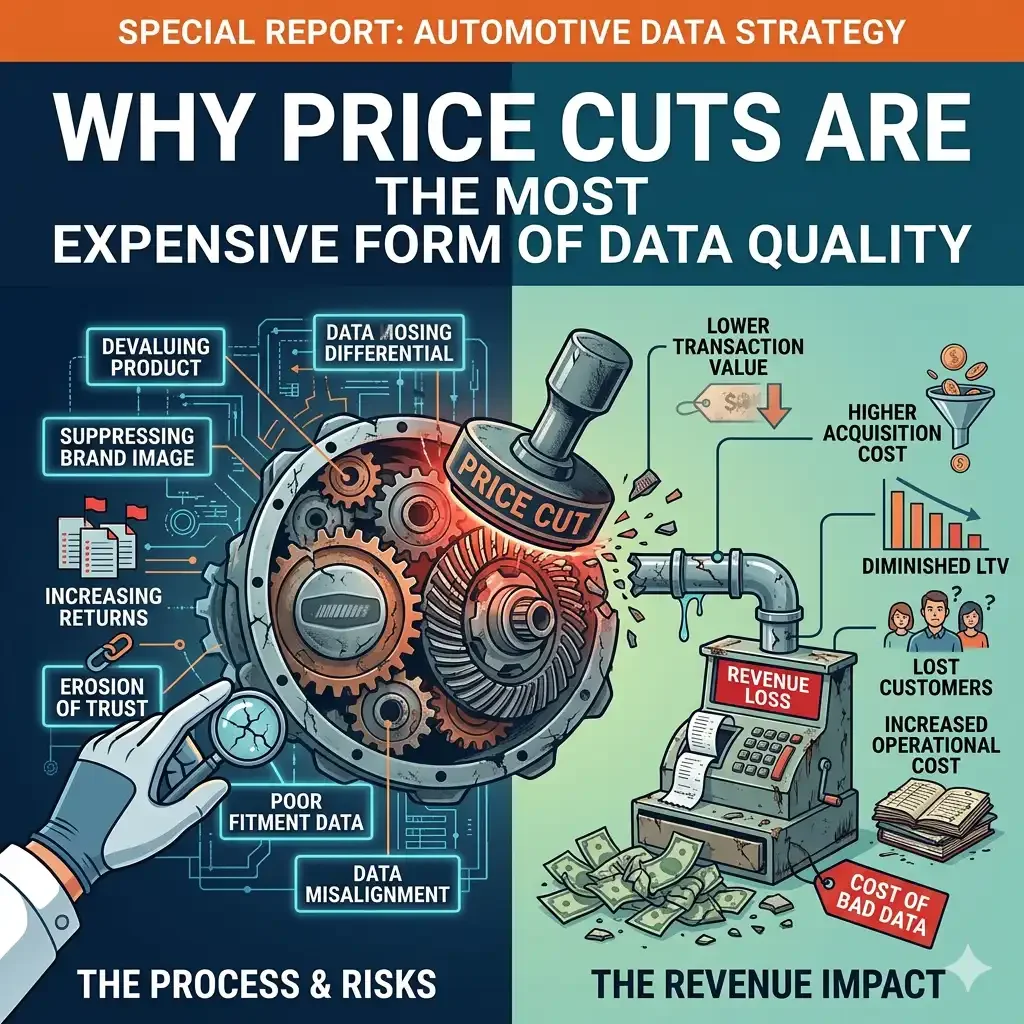
When sales slow down, the instinct is to discount. It feels decisive, it shows up immediately in the numbers, and it is easy to approve. But in the aftermarket auto parts industry, a site-wide price cut is often not a sales strategy. It is a data quality problem in disguise, and one of the most expensive ones at that.
The Math Most Teams Are Not Running
A business operating at 35% gross margin that runs a 20% discount has not reduced profit by 20%. It has surrendered more than half of its gross margin dollars on every affected order, often more once freight, handling, and return costs are factored in.
Here is a simple illustration:
• Original sale price: $100
• Gross margin at 35%: $35
• Sale price after 20% discount: $80
• Gross margin dollars remaining: $15 (assuming same cost of goods)
• Margin lost: 57% of gross margin dollars gone from a 20% price reduction
And that is before accounting for the ripple effects. Discounts train customers to wait for sales. They compress the perceived value of your catalog. They establish a price anchor that is difficult to reverse. The short-term revenue bump rarely offsets the long-term margin erosion.
The Real Reason Shoppers Do Not Convert
That margin did not evaporate because the product was overpriced. It evaporated because the shopper was not confident, and the business chose to buy that confidence with a lower price instead of building it with better data.
In aftermarket parts eCommerce, shopper hesitation is almost always rooted in one of three catalog data problems:
• Incomplete attributes. The listing does not tell the shopper enough about the part to confirm it is the right one for their vehicle.
• Inconsistent fitment language. Proprietary or technical terms are used where plain, searchable language should be. The shopper does not recognize the feature being described.
• Missing or unclear qualifiers. Sub-model, trim, or configuration details are absent, leaving the shopper to guess whether the part applies to their specific vehicle.
When any of these gaps exist, the shopper faces a choice: take the risk at full price, or reduce their risk by paying less. The discount becomes the workaround for a catalog problem that should have been fixed upstream.
Confidence Comes From Clarity, Clarity Comes From Attributes
When the right attributes are present, visible, and consistent, the shopper can self-select the correct part without needing a discount as a safety net. This is not a theory. It plays out in measurable outcomes:
• Lower return rates. Shoppers who are confident in their selection return parts less often. Every prevented return recovers margin that a discount would have permanently sacrificed.
• Higher conversion rates. Clear, complete listings reduce purchase hesitation and eliminate the need for the shopper to seek reassurance through price.
• Stronger organic search performance. Well-attributed listings with customer-friendly language rank better for the specific queries shoppers actually use when looking for parts.
• Reduced customer service volume. Fewer calls, chats, and emails asking whether a part fits, which compounds the cost savings beyond just margin recovery.
What to Do Instead of Discounting
Before approving the next site-wide promotion, it is worth running a quick diagnostic on the catalog data behind the underperforming SKUs. In most cases, the problem is identifiable and fixable without touching the price.
1. Audit the top return SKUs first. High return rates are a direct signal that shoppers are buying incorrectly. Review the fitment data, qualifiers, and attribute completeness on those specific listings before assuming a pricing issue.
2. Check attribute completeness against your PCdb mappings. Missing part type attributes are one of the most common and fixable sources of shopper confusion. A complete PAdb attribute set gives the shopper everything they need to confirm fitment.
3. Translate proprietary fitment qualifiers into plain language. If your fitment notes reference brand-specific technology names, convert them to terms the average shopper would actually search for. This improves both clarity and SEO.
4. Review application overlaps for ambiguous fitment. Overlapping or conflicting vehicle applications create uncertainty. Clean, well-defined fitment ranges reduce the chance of a wrong purchase and the return that follows.
5. Track conversion and return rate by attribute completeness. Once improvements are made, measure the impact separately from pricing changes so the business can see the direct value of catalog quality on revenue.
The Bottom Line
A price cut is a fast, visible action that offers the appearance of a solution. But when the underlying problem is shopper confidence rooted in catalog data gaps, the discount does not fix anything. It temporarily masks the symptom while the root cause continues to drive returns, suppress conversion, and erode margin on every order.
Investing in catalog data quality is not as immediate as running a promotion. But it compounds in the right direction. Every improvement to fitment accuracy, attribute completeness, and qualifier clarity works continuously across the entire catalog, at full price, for every shopper who visits.
That is a return on investment that a discount can never match.
Want to go deeper?
Read The Cost of Silence: Strategic and Financial Consequences for Aftermarket Leaders for a full breakdown of how incomplete catalog data compounds across paid media, returns, customer service, and marketplace performance, and what structural fixes prevent the cycle from repeating. Stop Solving Data Problems with Your Profit Margin