
Written by Arthur Simitian | PartsAdvisory
PartTerminologyID 1760, Drive Axle Shaft Flange Gasket, is the kind of category that disappears into a parts order and reappears as a warranty claim three weeks later.
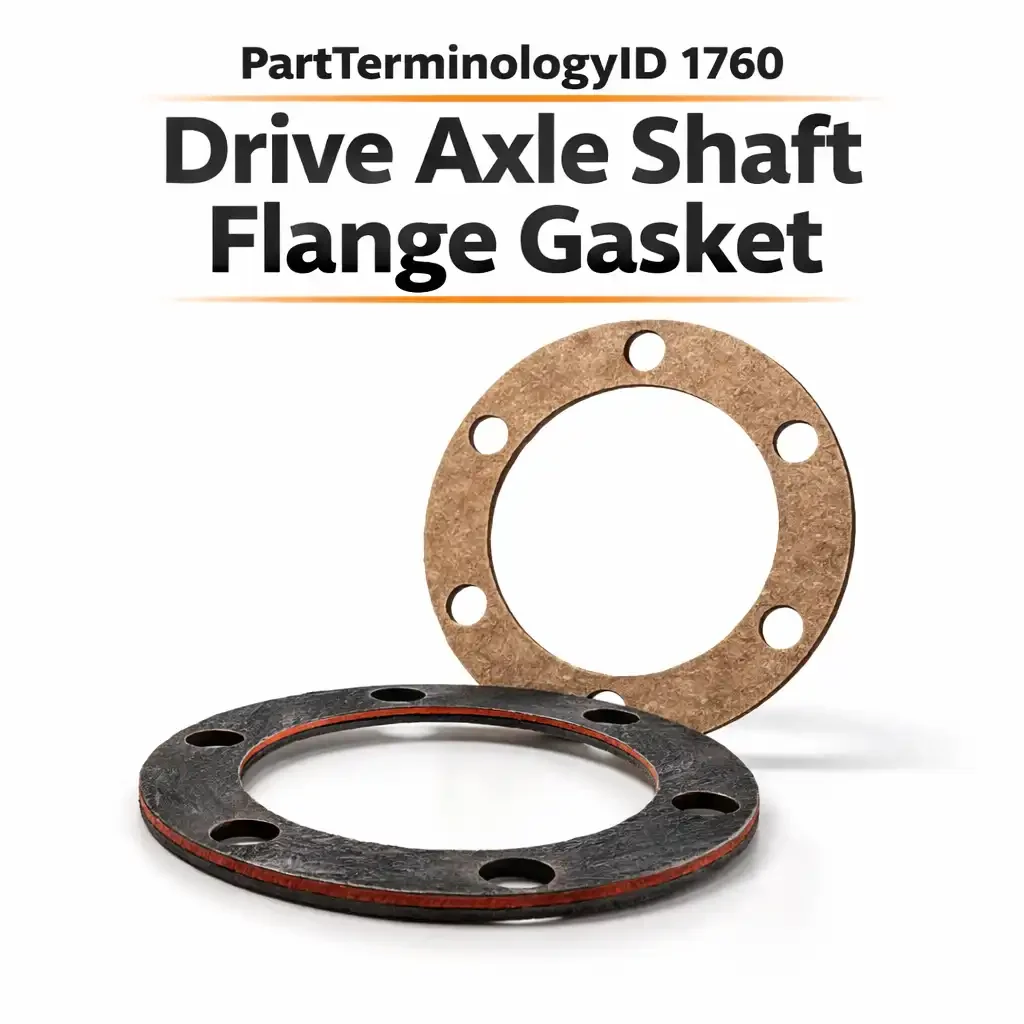
It is a gasket. A flat, shaped piece of material that sits between the axle shaft flange and the hub or housing at the outer end of a drive axle. It seals the interface, contains gear oil, and prevents contamination from getting into the axle assembly.
That is the technical summary.
Here is the commercial reality:
Buyers order the wrong gasket because:
they assume all axle shaft flange gaskets are the same for a given vehicle
they confuse drive axle flange gaskets with differential cover gaskets, pinion seal gaskets, or axle tube seals
they do not verify bolt pattern, inside diameter, outside diameter, or bolt hole count
they do not account for axle model differences within the same year/make/model
they order based on vehicle year alone, missing mid-year production changes or axle option splits
they install a new gasket on a scored or pitted flange surface and blame the gasket when it leaks
Sellers get caught because many listings for Drive Axle Shaft Flange Gasket still look like this:
a generic title with no dimensional context
no axle model reference
no bolt pattern or hole count
no I.D./O.D. spec
no material callout
no surface prep or torque advisory language
no clarification of what this gasket is and is not
The result is a gasket that arrives in the right box for the wrong axle, or a gasket that is technically correct but fails on installation because the buyer did not understand the service context.
This is the PartsAdvisory field guide for PartTerminologyID 1760: Drive Axle Shaft Flange Gasket, built for catalog teams, fitment teams, and sellers who want fewer returns, cleaner ACES/PIES data, and better conversion on a category that most people underestimate.
Status in New Databases
PIES/PCdb: PartTerminologyID 1760 - Drive Axle Shaft Flange Gasket
PIES 8.0 / PCdb 2.0: No change
Why Drive Axle Shaft Flange Gasket Is Still a Problem Category in 2026
This is not a high-dollar part. Most flange gaskets cost between $2 and $15 at retail. But the cost-per-return is wildly disproportionate.
When the wrong gasket ships, the buyer's axle service stalls. When the right gasket gets installed on a bad surface, the axle leaks. When the leak goes undetected, gear oil migrates into brake components, contaminates friction material, and creates a safety issue that traces back to a sub-$10 part.
The hidden challenge
Drive Axle Shaft Flange Gasket sits at the intersection of:
Axle model complexity (Dana, AAM, Spicer, Ford, GM, Chrysler axle families with overlapping YMM coverage)
Dimensional precision (I.D., O.D., bolt circle, bolt hole count and size, thickness)
Service-stack dependency (flange surface condition, bolt torque, sealant use, gear oil level and type)
The part is cheap. The consequences of getting it wrong are not.
That is why this category behaves like a fitment data quality problem, not a gasket problem.
What Drive Axle Shaft Flange Gasket Actually Is (and Isn't)
A Drive Axle Shaft Flange Gasket is the sealing element placed between the axle shaft flange and the wheel hub or axle housing flange on a solid (live) rear or front drive axle.
Its job is to prevent gear oil from escaping at the point where the axle shaft bolts to the hub, and to keep water, dirt, and road debris from entering the axle assembly at that interface.
Where it lives
In a full-floating axle design, the axle shaft has a flange on its outboard end that bolts to the wheel hub. The gasket sits between that flange and the hub face. When you unbolt and remove the axle shaft, the gasket comes out with it or remains stuck to the hub face.
In a semi-floating axle design, the gasket may sit between the axle shaft flange and the bearing retainer or backing plate, depending on the specific axle configuration.
Core construction
Most aftermarket drive axle shaft flange gaskets are:
composite (cellulose, rubber-coated, or fiber-reinforced)
die-cut or stamped to match a specific bolt pattern and bore
designed for a single use (not reusable)
thin and flat (typically 0.015"-0.060" range)
Drive Axle Shaft Flange Gasket is NOT:
a differential cover gasket (PartTerminologyID 1748)
an axle shaft seal / axle tube seal
a pinion seal or pinion flange gasket
an axle housing gasket
a universal "fit-all" gasket that can be trimmed to shape
RTV sealant (though some technicians substitute sealant for the gasket, the OE design calls for a gasket in most applications)
The buyer confusion starts when these distinctions are absent from the listing.
The Axle Type Problem That Drives Most Misfits
The single biggest source of returns in PartTerminologyID 1760 is axle model mismatch within the same vehicle platform.
Why this happens
A single model-year truck may be available with two or more rear axle options depending on trim level, payload package, towing package, or GVWR rating. Each axle model may use a different shaft flange gasket with different dimensions.
For example:
A truck may ship from the factory with either a Dana 60 or a Dana 70 rear axle
The bolt circle, I.D., O.D., and bolt count may differ between these two axles
A Year/Make/Model search returns both gaskets, but the buyer picks the wrong one
This is not a manufacturing defect. This is a catalog data problem.
Full-floating vs. semi-floating axle context
In full-floating axle applications (common on 3/4-ton HD and 1-ton trucks), the axle shaft flange gasket is the primary seal between the axle shaft and the hub. It is a regular service item whenever the axle shaft is removed for brake work, bearing inspection, or hub service.
In semi-floating axle applications (common on half-ton trucks and lighter vehicles), the flange gasket may exist at the bearing retainer plate or may not be present at all, depending on the axle design. Some semi-float axles use only O-rings or sealant at this interface.
If your listing does not indicate which axle type the gasket is designed for, buyers will guess. And they will guess wrong often enough to generate returns.
The Dimensions That Matter (and Why Returns Happen Without Them)
The fastest way to reduce returns in PartTerminologyID 1760 is to publish exact gasket dimensions.
Must-have dimensions in listings
inside diameter (I.D.)
outside diameter (O.D.)
bolt circle diameter
number of bolt holes
bolt hole diameter
gasket thickness
material type
Why bolt hole count matters more than you think
Axle shaft flanges vary by bolt hole count even within the same axle family. A gasket with 6 holes will not work on an 8-bolt flange. A gasket with the right number of holes but the wrong bolt circle will not align.
This is not obvious to most buyers. They see "fits Dana 60" and assume it works. But Dana 60 axle shafts exist in multiple configurations with different flange patterns.
Why I.D. and O.D. matter
If the inside diameter is too small, the gasket interferes with the axle shaft or hub bore. If it is too large, it does not seal the oil path. If the outside diameter is too small, it leaves exposed surface area that can weep. If too large, it may not seat properly against the mating surface.
These are millimeter-level tolerances on a part that most sellers describe in one line of text.
Top Return Scenarios in Drive Axle Shaft Flange Gasket (PartTerminologyID 1760)
Scenario 1: "Wrong part - doesn't match my axle"
The gasket has the wrong bolt pattern or bore for the buyer's axle.
Root cause: Listing relies on YMM only with no axle model qualifier.
Prevention language to include: "Verify axle model (stamped on differential housing or axle tube) before ordering. Multiple axle options may exist for the same vehicle."
Scenario 2: "Gasket leaks after installation"
Buyer installs a correct gasket that leaks within days.
Possible causes beyond gasket quality:
scored, pitted, or corroded flange mating surface
uneven bolt torque or incorrect torque spec
reuse of stretched or damaged flange bolts
gear oil overfill creating excess internal pressure
buyer used RTV sealant on top of the gasket (incompatible with some materials)
old gasket material residue left on mating surface
Prevention language: "Clean both mating surfaces thoroughly before installation. Inspect flange faces for scoring, pitting, or corrosion. Torque flange bolts evenly to manufacturer specification. Do not reuse damaged bolts."
Scenario 3: "Part looks different than expected"
Buyer expects a rubber seal and receives a paper/composite gasket, or vice versa.
Root cause: Listing lacks material description and product image.
Prevention language: "Composite gasket (not a rubber seal). Designed for flange-to-hub interface sealing. Material: [specific material]."
Scenario 4: "I already tried sealant and it didn't work, so I ordered a gasket"
Buyer has an underlying leak problem (worn seal, cracked housing, damaged bearing) and expects the flange gasket to solve it.
Root cause: Buyer misdiagnosis, but the listing does nothing to set expectations.
Prevention language: "This gasket seals the axle shaft flange-to-hub interface only. If gear oil is leaking from the axle tube, differential cover, or pinion area, a different seal or gasket is required. Inspect all sealing surfaces during axle service."
Scenario 5: "Paper gasket vs. sealant - which should I use?"
Some technicians prefer to use RTV sealant instead of a paper gasket. Others use both. Others use neither and rely on a tight flange fit.
Root cause: Industry practice is not standardized, and listings do not address this.
Prevention language: "OE replacement gasket for axle shaft flange. Follow manufacturer installation specifications regarding sealant use. Some applications may specify gasket only, sealant only, or gasket with sealant."
What to Include in the Listing (The Practical Version)
If you want this category to perform in marketplaces and reduce post-sale friction, your listing has to answer buyer questions before checkout.
Core listing essentials
PartTerminologyID reference: PartTerminologyID 1760
component type: Drive Axle Shaft Flange Gasket
position: rear/front (if applicable)
quantity per package (1 gasket, pair, or kit)
scope: gasket only (no bolts, sealant, or hardware unless specified)
Fitment essentials
year/make/model/submodel
axle model (Dana 44, Dana 60, Dana 70, AAM 10.5, AAM 11.5, Ford 9.75, GM 14-bolt, etc.)
axle type: full-floating or semi-floating
production split notes (where applicable)
GVWR or payload/towing package qualifiers
Dimensional essentials
inside diameter (I.D.)
outside diameter (O.D.)
bolt circle diameter
number of bolt holes
bolt hole size
gasket thickness
material type (composite, paper, rubber-coated, etc.)
Service compatibility essentials
surface preparation recommendation
torque specification reference (or "refer to manufacturer spec")
sealant compatibility note
single-use / do-not-reuse advisory
adjacent seal inspection recommendation
Image essentials
flat gasket photo with scale reference or ruler
bolt pattern visible from front
I.D./O.D. labeled
packaging image showing quantity
comparison image if multiple gaskets exist for similar axles
Catalog Checklist for ACES/PIES Teams
For structured data teams, PartTerminologyID 1760 should be treated as a high-precision, low-cost, high-risk category.
Taxonomy and product identity
PartTerminologyID = 1760
Product Type = Drive Axle Shaft Flange Gasket
Component class = gasket / sealing (axle system)
Required attribute discipline
position (rear, front, or both)
axle model qualifier
axle type (full-float, semi-float)
I.D.
O.D.
bolt circle
bolt hole count
bolt hole size
thickness
material
package quantity
Fitment governance
enforce axle model splits across YMM
enforce production date cutoffs where axle changes occurred mid-year
enforce GVWR and payload package qualifiers
avoid "fits all trims" generalization on vehicles with multiple axle options
cross-check against axle shaft and hub assembly pairings
Data QA controls to reduce returns
validation rule: I.D. and O.D. fields cannot be empty for PartTerminologyID 1760
validation rule: bolt hole count must be populated
validation rule: axle model qualifier should be present for vehicles with multiple axle options
validation rule: material field should not be blank
validation rule: position field must be explicit
validation rule: flag duplicate applications with conflicting dimensions
Install Notes That Should Be in the Content (Not Buried in Manuals)
You do not need to write a repair manual in every listing, but you need practical notes that stop common comeback failures.
Install checklist (buyer-facing)
remove old gasket completely from both mating surfaces
clean flange faces with a gasket scraper and solvent - no residue, no debris
inspect both flange surfaces for scoring, pitting, or warpage
inspect axle shaft flange bolts for stretch, thread damage, or corrosion
place new gasket dry on flange face (or per manufacturer sealant spec)
install axle shaft and torque bolts to spec in a star pattern
verify gear oil level after installation
check for leaks after 50-100 miles of driving
Why these notes matter commercially
A buyer who installs a gasket on a scored flange and sees a leak will return the gasket, not the axle shaft. A buyer who overtorques the bolts and cracks the gasket will file a defective-part claim. A buyer who does not check oil level after service will blame the gasket for a low-oil failure.
Every one of these install notes prevents a return that is not actually a product defect.
FAQ (Buyer Language)
What is a drive axle shaft flange gasket?
It is a flat gasket that sits between the axle shaft flange and the wheel hub (or housing flange) on a drive axle. It seals gear oil in and keeps contamination out at the point where the axle shaft connects to the hub.
Is this the same as an axle seal?
No. An axle seal (or axle tube seal) is a different part that sits inside the axle tube and seals around the shaft. The flange gasket seals the bolted interface at the outer end of the axle. Both can cause leaks, but they are different parts in different locations.
Is this the same as a differential cover gasket?
No. The differential cover gasket seals the inspection/service cover on the back of the differential housing. The drive axle shaft flange gasket seals the axle shaft flange at the wheel end of the axle.
How do I know which gasket fits my axle?
Check the axle model stamped on the differential housing or axle tube. Then match the gasket by axle model, bolt circle diameter, number of bolt holes, and I.D./O.D. Do not rely on year/make/model alone if multiple axle options exist for your vehicle.
Can I use RTV sealant instead of a gasket?
Some technicians do this successfully. However, the OE specification for most applications calls for a gasket. If using sealant, ensure it is compatible with gear oil and rated for the operating temperature range. Some manufacturer specs explicitly prohibit sealant at this interface.
Can I reuse the old gasket?
No. Drive axle shaft flange gaskets are designed for single use. Reusing a compressed, torn, or deformed gasket will likely cause a leak.
My gasket is leaking. Is it defective?
Possibly, but more commonly, leaks at this location are caused by surface condition issues (scoring, pitting, debris), incorrect torque, damaged bolts, or gear oil overfill. Inspect the mating surfaces and bolt condition before concluding the gasket is defective.
The "So What" for Aftermarket Teams
PartTerminologyID 1760 is a micro-dollar category with macro-return potential.
The gasket itself is simple. The fitment context is not. And the service-stack that surrounds it determines whether the part performs or comes back.
If you improve these three areas, returns drop fast:
Axle-model-specific fitment data (not just YMM)
Dimensional precision in every listing (I.D., O.D., bolt count, bolt circle)
Practical service context (surface prep, torque, sealant, single-use advisory)
The goal is not just fewer returns. The goal is cleaner data, fewer support tickets, and higher repeat conversion from buyers who trust your catalog because it answers their questions before they have to ask.
Cross-Sell Logic That Actually Helps (Without Looking Pushy)
Drive Axle Shaft Flange Gasket buyers are usually in the middle of an axle service job. They often need adjacent components.
Recommended cross-sell logic
Axle Shaft (matching axle model and position)
Axle Shaft Flange Bolt Kit
Wheel Hub Assembly (for full-floating axle service)
Axle Bearing and Seal Kit
Differential Cover Gasket (if buyer is also servicing the differential)
Gear Oil (correct weight and spec for the axle)
Add this as "frequently needed during axle service," not "you also need this."
That framing improves completion rate without increasing friction.
Common Copy Mistakes That Trigger Avoidable Returns
Mistake 1: "Fits [vehicle]" with no axle model qualifier
The vehicle may have two or three axle options. This single omission generates the majority of misfits.
Mistake 2: No dimensional data anywhere in the listing
If the buyer cannot see I.D., O.D., and bolt count, they cannot self-validate before purchase.
Mistake 3: No image showing bolt pattern and scale
A gasket with the wrong bolt count looks identical in a generic product photo. Buyers need to see the bolt pattern clearly.
Mistake 4: Confusing this gasket with other axle seals or gaskets
If the title or description is vague enough to overlap with differential cover gaskets, pinion gaskets, or axle tube seals, buyers will order the wrong part.
Mistake 5: No material callout
A buyer expecting a rubber seal who receives a paper composite gasket will assume it is wrong or cheap. Material clarity prevents this reaction.
Mistake 6: "Direct fit, no modifications required" without dimensional context
This claim without supporting data creates a false confidence that generates returns when the part does not match the buyer's specific axle.
Better Listing Framework (You Can Reuse)
Use this skeleton for PartTerminologyID 1760 posts:
What it is (plain language, with axle position and sealing function)
What is included / not included (gasket only? bolts? sealant?)
Key dimensions (I.D., O.D., bolt circle, bolt count, hole size, thickness)
Axle model / fitment caveats (which axle models this fits, which it does not)
Top return causes and prevention (surface prep, torque, sealant guidance)
Install notes and single-use replacement advisory
FAQ for buyer uncertainty
Final recommendation and CTA
This flow reduces cognitive load and support burden.
Suggested Compatibility Checklist Block
Every PartTerminologyID 1760 listing should answer:
Position: Rear / Front
Axle Model: (Dana 44 / Dana 60 / Dana 70 / AAM 10.5 / GM 14-bolt / etc.)
Axle Type: Full-floating / Semi-floating
Inside Diameter: (in/mm)
Outside Diameter: (in/mm)
Bolt Circle Diameter: (in/mm)
Number of Bolt Holes: (4 / 5 / 6 / 8)
Bolt Hole Size: (in/mm)
Gasket Thickness: (in/mm)
Material: (Composite / Paper / Rubber-coated / etc.)
Package Quantity: (1 / 2 / kit)
Service Notes: Single-use; clean mating surfaces; torque to spec; inspect for scoring
If these are present, your return risk drops dramatically.
Final Take for PartTerminologyID 1760
Drive Axle Shaft Flange Gasket (PartTerminologyID 1760) is a category where the part cost is trivial but the return cost, warranty cost, and buyer frustration cost are not.
The winners in this category do not sell gaskets. They sell confidence. They document the axle model, the dimensions, the material, and the service context clearly enough that a buyer can self-validate before checkout and self-install without a comeback.
That is what turns a $5 gasket listing from a return generator into a repeat-purchase asset.