
Volvo V70 XC (Cross Country) 1998-2000: The Complete Fitment Guide for Parts Sellers
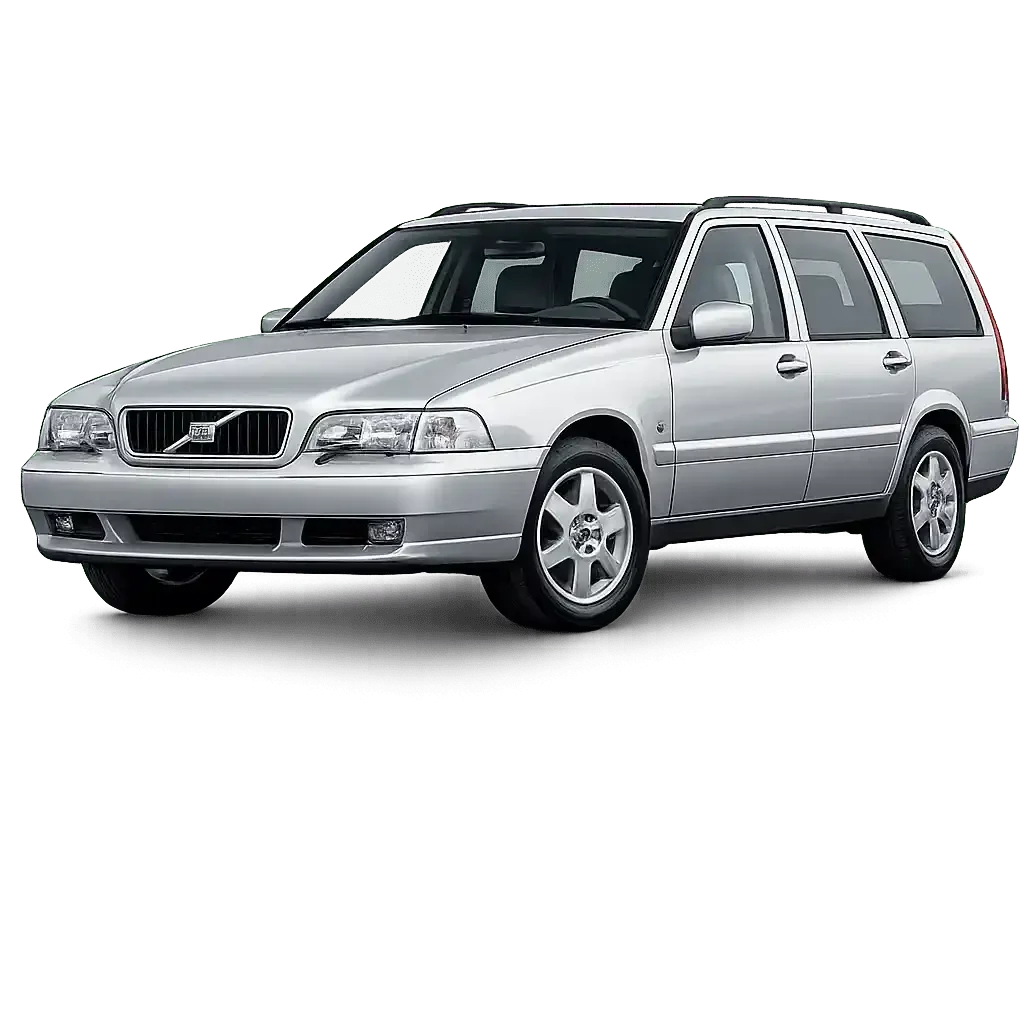
The V70 XC looks like a V70 with a lift kit and plastic cladding. It is not. Volvo built the V70 XC as a specific sub-model with its own suspension tuning, its own spring rates, its own bumpers front and rear, its own grille, its own body cladding, its own roof rails, and its own interior trim, all riding on a completely different rear suspension subframe assembly borrowed from the rear-wheel-drive 900-series and modified for independent rear suspension and all-wheel drive. The V70 XC shares the P80 platform with the standard V70, the S70 sedan, the C70 coupe/convertible, and the earlier 850 on which all of them are based. But the parts that make it an "XC" are specific to the XC, and the parts it shares with the broader P80 family come with their own traps. The V70 XC was only sold for three model years (1998-2000) in the US, was only available with one engine and one transmission in this market, and was only offered with AWD. Yet within those three years, a mid-production change split the AWD drivetrain components into early and late versions that do not interchange. This guide covers every split you need to avoid returns on a vehicle that catalogs make look far simpler than it is.
Brand and Platform Background
The V70 XC (also badged V70 Cross Country, V70 AWD Cross Country, or V70 XC AWD depending on the market and year) debuted at the September 1997 Frankfurt Auto Show for the 1998 model year. It was Volvo's direct response to the Subaru Legacy Outback: take an existing wagon, raise it, add body cladding, make AWD standard, and market it as an adventure vehicle for buyers who wanted all-weather capability without buying a truck or SUV.
The V70 XC sits on the P80 platform, which originated with the Volvo 850 in 1993. The P80 was Volvo's first front-wheel-drive/transverse-engine platform, and it replaced the longitudinal-engine, rear-wheel-drive 200-series and 700/900-series architecture that Volvo had used for decades. When the 850 was facelifted and renamed for the 1998 model year, it became the S70 (sedan), V70 (wagon), and C70 (coupe/convertible). The V70 XC was a specialized version of the V70 wagon with raised suspension, protective body cladding, and standard AWD.
The V70 XC was built at Volvo's Torslanda plant in Gothenburg, Sweden, and at the Ghent plant in Belgium. Production ran from late 1997 through 2000. For the 2001 model year, Volvo moved to the P2 platform and the successor model (initially called the V70 XC, later renamed XC70 for 2003) was an entirely different vehicle. Nothing from the P80-based V70 XC carries over to the P2-based V70 XC/XC70.
What Made the V70 XC Different from a Standard V70
The V70 XC was not simply a V70 AWD with a suspension lift. It had a specific engineering package:
Ride height: 35mm (1.4 inches) higher than the standard V70 overall, with 26mm (1.0 inch) more ground clearance than the V70 AWD. Total ground clearance was 166mm (6.5 inches). Vehicle height was 58.3 inches (vs. 57.2 inches for V70 AWD and 56.2 inches for FWD V70).
Suspension: Taller springs front and rear (XC-specific spring rates, not shared with V70 AWD or V70 R, though physically interchangeable with different ride height results). Nivomat self-leveling rear shocks (shared with V70 AWD and V70 R but with XC-specific valving for the taller ride height).
Rear subframe: The AWD rear drive unit assembly was adapted from the rear-wheel-drive Volvo S90/V90 series, using coil springs instead of a mono-leaf composite spring. This cast aluminum housing contained the rear differential, multi-link independent rear suspension, shock absorbers, and anti-roll bar as a complete subframe unit.
Exterior: Unique front bumper, unique rear bumper, unpainted (gray/black) lower side trim and sill extensions, unique front grille, squarer roof rail design (vs. the V70's rounded rails), black tailgate decal with white "Cross Country" lettering. Optional two-tone "Duo Tone" exterior paint.
Interior: Thicker floor mats, canvas/leather upholstery combination specific to the XC.
Drivetrain: AWD only, automatic transmission only. In the US market: 2.4L low-pressure turbo five-cylinder only, 4-speed automatic only.
Complete Powertrain Reference
US Market (Single Configuration)
In the US, the V70 XC was sold with exactly one powertrain:
Engine: Volvo B5244T (1998-1999) / updated B5244T variant (2000)
Type: 2.4L inline-5 ("white block" / modular engine family)
Aspiration: Low-pressure turbocharged and intercooled (Mitsubishi TD04 turbocharger)
Valvetrain: DOHC, 20 valves (4 per cylinder)
Bore x stroke: 83mm x 90mm
Output: Approximately 190-197 hp (Volvo's published US figures varied between 190 hp and 197 hp depending on source and year), approximately 210 lb-ft of torque
Engine management: Bosch Motronic 4.3 (1998); Bosch Motronic 4.4 (1999); Bosch ME7 with drive-by-wire electronic throttle (2000)
Fuel: Premium unleaded recommended
Transmission: Aisin-Warner AW50-42 4-speed automatic
All US-market V70 XCs used this transmission. No manual transmission was offered on the V70 XC in the US.
The AW50-42 was shared with AWD versions of the V70, S70, and V70 R (automatic).
No 5-speed automatic was offered on the V70 XC. (The AW55-50/51 5-speed automatic appeared on some 2000 model year naturally aspirated FWD V70s but was not used on AWD models.)
AWD System: Viscous coupling (VC) based system
Engine and transmission drive front wheels as primary.
An angle gear (also called bevel gear or transfer case) bolted to the side of the transmission takes power off to a center driveshaft.
The center driveshaft runs to the rear axle, where a viscous coupling distributes torque to the rear differential as needed.
The viscous coupling uses a sealed dilatant fluid that thickens when front and rear plates spin at different speeds (i.e., when the front wheels lose traction). This sends torque rearward automatically.
The rear differential is contained in the rear subframe assembly.
No electronic control of the AWD system. Purely mechanical/fluid-based.
Non-US Markets
Outside the US, a 2.0L version of the V70 XC (2.0L low-pressure turbo) was available for markets with displacement-based taxation. This engine was paired with the same automatic transmission and AWD system.
Engine Management System Change: 1998/1999 vs. 2000
This is an important under-the-hood split that affects electrical and sensor components:
1998-1999 (Motronic 4.3/4.4): Traditional throttle cable from accelerator pedal to throttle body. Physical cable-operated throttle.
2000 (Bosch ME7): Drive-by-wire electronic throttle. The throttle cable was eliminated and replaced by an electronic throttle body with position sensors and an accelerator pedal position sensor. This change was part of Volvo's broader modernization of the P80 platform for its final model year.
This means the throttle body, accelerator pedal assembly, and related wiring harness components differ between 1998-1999 and 2000 models. A throttle body from a 2000 V70 XC will not work on a 1998 V70 XC (and vice versa) without the matching engine management system, wiring, and pedal assembly.
AWD System: The Mid-1998 Production Split
This is the single most important fitment trap on the V70 XC, and it affects the most failure-prone and most frequently ordered components on the vehicle.
The AWD drivetrain components (viscous coupling, rear differential, center driveshaft, and angle gear) were revised at a mid-1998 production break. The split falls within the 1998 model year itself, meaning there are early 1998 and late 1998 V70 XCs with different AWD hardware.
What changed:
Viscous coupling (torque tube): Two different part numbers. The early version (through approximately VIN 465398 on the V70, with the equivalent chassis number break varying by body style) uses one design; the late version (VIN 482861 onward for V70) uses a revised design. They are not interchangeable with each other.
Rear differential: Two variations that follow the same chassis number break as the viscous coupling. The early version (used on 850 AWD and early 1998 V70 AWD/XC) differs from the later version (late 1998 onward).
Center driveshaft (propshaft): The center bearing carrier was upgraded mid-production. Early shafts use a smaller bearing; late shafts use a larger bearing and carrier. The later shaft can be retrofitted to earlier cars by re-drilling the carrier mount holes on the support plate (from 3 inches on center to 2.25 inches on center), but they are not drop-in interchangeable.
Why this matters for parts sellers: A buyer with a late-1998 V70 XC orders a viscous coupling listed as "fits 1998 V70 XC" and receives the early version. It does not fit. Or a buyer with an early-1998 V70 XC orders a rear differential listed as "fits 1998-2000 V70 XC" and receives the late version. It does not match. The VIN/chassis number is the only way to determine which version a particular 1998 vehicle has. 1999 and 2000 models all use the late version.
The viscous coupling and rear differential cross-reference between the V70 XC, V70 AWD, S70 AWD, and V70 R AWD for the same production period. They also cross-reference back to the 850 AWD for the early version.
Step-by-Step Fitment Splits
Split 1: V70 XC vs. Standard V70 vs. V70 R
The V70 XC shares many components with the standard V70 and other P80 variants, but specific categories of parts are XC-only:
XC-specific (do not interchange with standard V70):
Front bumper cover and reinforcement
Rear bumper cover and reinforcement
Front grille
Lower body side cladding/trim (unpainted plastic)
Sill extensions
Roof rails (squarer profile than V70)
Front and rear springs (taller than V70 AWD, shorter than nothing because FWD V70 has no AWD rear subframe)
Nivomat rear shocks (XC-specific valving; physically the same unit as V70 AWD/V70 R Nivomats but with different part numbers for the ride height calibration)
Floor mats
Canvas/leather seat upholstery (XC-specific material combination)
Shared with V70 AWD and other P80 AWD models (verify by year and chassis number):
AWD system components (angle gear, center driveshaft, viscous coupling, rear differential) cross-reference to V70 AWD, S70 AWD, V70 R AWD for the matching production period
Front suspension struts (same as all V70/S70; the ride height difference comes from springs, not strut length)
Front control arms, tie rods, sway bar links
Brake components (front and rear; the V70 R had upgraded rear vented discs, but the XC shared brakes with the V70 AWD)
Engine and transmission (shared with V70 GLT/2.4T AWD in the US)
Radiator, cooling system, turbo system
Electrical components (headlights, taillights, instruments, wiring harness) with exceptions for the 2000 MY throttle-by-wire change
Shared with entire P80 family (850/S70/V70/C70):
Engine internals (white block inline-5 components cross-reference broadly across 850/S70/V70/C70 for the same engine code)
Many interior trim pieces, switches, climate control components
Door panels, window regulators, mirror assemblies (verify body style: wagon vs. sedan vs. coupe)
Steering rack, power steering pump
Split 2: Model Year (Three-Way Split with a Mid-Year Break)
Early 1998 (through mid-production VIN break): Motronic 4.3 engine management. Cable throttle. Early-version AWD components (viscous coupling, rear differential, center driveshaft).
Late 1998 through 1999: Motronic 4.3 (1998) or 4.4 (1999) engine management. Cable throttle. Late-version AWD components.
2000: Bosch ME7 engine management. Drive-by-wire electronic throttle. Late-version AWD components. This is the final year of the P80 platform.
For parts that are not affected by the engine management or AWD production split (body panels, interior trim, most suspension hard parts), the 1998-2000 range is generally continuous.
Split 3: V70 XC vs. 850 AWD (Platform Cross-Reference)
The P80 platform spans the 850 (1993-1997) and the S70/V70/C70 (1998-2000). Many parts cross-reference between them, but with important distinctions:
The V70/S70 was a facelift of the 850, not an entirely new car. Many structural, suspension, and drivetrain components carry over.
However, the front end was completely restyled (new bumper, fenders, hood, headlights, grille). No exterior front-end body panels interchange between 850 and V70.
AWD components from the 850 AWD cross-reference to the early-1998 V70 XC/V70 AWD (before the mid-1998 production change). Post-change V70 AWD components do not interchange with 850 AWD.
Engine internals for the same engine code (B5244T, B5234T, etc.) cross-reference between 850 and V70.
Split 4: Duo Tone vs. Standard Paint
The V70 XC was available with an optional "Duo Tone" two-tone exterior paint scheme, which used a contrasting color on the lower body panels. On Duo Tone cars, the lower body cladding that is normally unpainted gray/black plastic is instead painted in the accent color. This means body cladding and lower trim panels from a Duo Tone car will not match a standard XC (different finish), and standard unpainted cladding will not match a Duo Tone car. Verify paint specification before shipping body cladding components.
Biggest Return Traps
Trap 1: Standard V70 Body Parts Listed for V70 XC
Why they get returned: The V70 XC has unique front and rear bumpers, a unique grille, unique lower body cladding, and unique roof rails. A seller lists a "1998-2000 V70 front bumper" and a V70 XC buyer receives a standard V70 bumper that does not match. The V70 XC bumpers are designed to accommodate the raised ride height and integrate with the lower body cladding.
How to stop returns: Always differentiate between "V70" and "V70 XC" (or "V70 Cross Country") for any exterior body component. Do not list these parts as interchangeable.
Trap 2: AWD Components Without the Mid-1998 Production Break
Why they get returned: A seller lists a "1998-2000 V70 XC viscous coupling" or "1998-2000 V70 AWD rear differential" without specifying the production break. There are two different viscous couplings and two different rear differentials across this range. The break falls within the 1998 model year. A buyer with an early-1998 vehicle receives late components, or vice versa.
How to stop returns: For viscous coupling, rear differential, center driveshaft, and angle gear components, always specify: "Early 1998 (through VIN [break])" or "Late 1998-2000 (VIN [break] onward)." If the exact VIN break is not known for the specific body style, note "Verify by VIN / chassis number, mid-1998 production change. Early and late versions are not interchangeable." The early version also cross-references to the 850 AWD.
Trap 3: FWD V70 Suspension Parts for AWD V70 XC
Why they get returned: The V70 XC's rear suspension is fundamentally different from a FWD V70's rear suspension. FWD V70s use a simpler rear beam/trailing arm setup. AWD V70s (including the XC) use a completely different multi-link independent rear suspension built into the rear subframe assembly with the rear differential. A FWD rear shock, rear spring, or rear suspension arm will not fit an AWD V70 XC.
How to stop returns: For any rear suspension component, always specify "AWD" or "FWD." The V70 XC is always AWD, so any V70 XC rear suspension part listing is inherently AWD-only. Do not list FWD V70 rear components as fitting the V70 XC.
Trap 4: 2000 Model Year Throttle Body or Pedal Assembly for 1998-1999
Why they get returned: The 2000 V70 XC switched to drive-by-wire electronic throttle with the Bosch ME7 engine management system. The throttle body is electronic with integrated position sensors. On 1998-1999 models, the throttle body is cable-operated. These are completely different parts that require different wiring and different pedal assemblies.
How to stop returns: For throttle body, accelerator pedal assembly, and related wiring, always split listings into "1998-1999 (cable throttle)" and "2000 (electronic throttle / drive-by-wire)."
Trap 5: V70 XC Springs Listed as "V70 AWD Springs"
Why they get returned: The V70 XC uses taller springs than the V70 AWD. While the springs are physically interchangeable (same mounting points), they provide different ride heights. A buyer expecting the XC's raised stance receives V70 AWD springs and the car sits lower than factory. Or a V70 AWD buyer receives XC springs and the car rides higher than intended.
How to stop returns: Specify "V70 XC" or "V70 AWD" for springs. Note that the V70 R AWD also uses its own spring specification (firmer, lower than V70 AWD). All three are physically interchangeable but result in different ride heights and handling characteristics.
Trap 6: P2-Generation V70 XC/XC70 Parts Listed for P80 V70 XC
Why they get returned: The P80 V70 XC (1998-2000) and the P2 V70 XC/XC70 (2001-2007) are completely different vehicles on different platforms. Nothing interchanges between them. However, because both are called "V70 XC" (the P2 model carried the V70 XC name through 2002 before being renamed XC70 for 2003), catalog searches routinely mix them up. A buyer with a 2000 V70 XC searches for parts and receives components from a 2001 or later P2-based vehicle.
How to stop returns: Always specify the platform (P80 or P2) or clearly delineate the year range. "1998-2000 V70 XC (P80)" does not share parts with "2001-2002 V70 XC (P2)" or "2003-2007 XC70 (P2)."
Viscous Coupling and AWD System: Known Failure Items
The viscous coupling AWD system on the P80 V70 XC is the most failure-prone system on the vehicle and generates the most parts demand. Understanding this system is essential for parts sellers.
Common failure modes:
Viscous coupling fluid degradation: The dilatant fluid inside the sealed viscous coupling thins with age and heat cycling, causing slower and less consistent engagement. Eventually the coupling fails to transfer torque to the rear wheels. This is a sealed unit and cannot be refilled or serviced. Replacement is the only remedy.
Viscous coupling freewheel unit failure: The freewheel mechanism inside the coupling can fail, causing clunking noises when transitioning between acceleration and deceleration. Often misdiagnosed as a rear differential problem.
Angle gear seal and bearing failure: The angle gear (bolted to the side of the transmission) can develop oil leaks from worn seals and bearing failure. If the angle gear runs dry, it will destroy itself. Seal kits and angle gear oil are regular service items.
Center driveshaft center bearing failure: The rubber-mounted center bearing on the driveshaft wears and fails, causing vibrations. Rebuilt driveshafts (from specialists like Colorado Driveshaft, frequently mentioned in Volvo communities) are a common replacement.
AWD system removal: Many owners of high-mileage V70 XCs with failed AWD components simply remove the center driveshaft and operate the vehicle as front-wheel-drive. This is common enough that buyers searching for AWD parts should be asked whether they are restoring AWD function or converting to FWD (which requires no parts purchase).
Cross-reference note: Viscous couplings, rear differentials, and angle gears cross-reference between the V70 XC, V70 AWD, S70 AWD, and V70 R AWD for the matching production period. The 850 AWD uses the early version only. These are the same parts across all P80 AWD models for the same production era.
Fitment Rules Block
Required attributes for every P80 Volvo V70 XC parts listing:
Model year: 1998, 1999, or 2000
Model specificity: V70 XC (not standard V70, not V70 R, not S70)
For AWD drivetrain components: Early or late production (mid-1998 VIN break). Specify "early 1998" vs. "late 1998/1999/2000."
For engine management / throttle components: 1998-1999 (cable throttle) vs. 2000 (drive-by-wire)
For body/exterior components: V70 XC-specific vs. shared with V70 (most exterior trim is XC-specific)
For suspension components: Specify AWD (all V70 XCs are AWD; do not list FWD V70 rear suspension parts as compatible)
Platform: P80 (1998-2000). Do not cross-list with P2-based V70 XC (2001-2002) or XC70 (2003-2007).
Buyer Confirmation Prompts
Before shipping any part for a P80 V70 XC, confirm:
"What is your exact model year?"
"Is your vehicle a V70 XC (Cross Country) or a standard V70?"
"For AWD drivetrain parts (viscous coupling, rear differential, angle gear, center driveshaft): What is your VIN?" (The mid-1998 production break can only be determined by VIN/chassis number. If the buyer has a 1999 or 2000, they have the late version. If they have a 1998, the VIN is required.)
"For throttle body or pedal assembly: Is your model year 1998-1999 or 2000?"
"Is your vehicle the standard unpainted cladding or the Duo Tone two-tone paint option?"
Quick Identification Guide
V70 XC vs. standard V70 from outside:
Unpainted (gray or black) lower body cladding extending from front to rear wheel arches
Raised ride height (visibly taller than a standard V70, especially noticeable at the wheel gap)
Squarer, more angular roof rails (V70's rails are rounded)
Unique front grille (different pattern from standard V70)
"Cross Country" lettering on a black decal across the tailgate
Unique front and rear bumper designs
Early 1998 vs. late 1998-2000 AWD components:
Cannot be distinguished visually from the exterior. Must verify by VIN/chassis number.
If replacing AWD components, match part numbers exactly. Do not assume interchangeability within the 1998 model year.
V70 XC (P80, 1998-2000) vs. V70 XC/XC70 (P2, 2001-2007):
The P80 V70 XC has a boxier, more angular body style with the 850-derived design.
The P2 V70 XC/XC70 has a rounder, more modern body style with a distinctly different front end and larger overall dimensions.
Ground clearance increased from 6.5 inches (P80) to 8.2 inches (P2).
The P2 introduced the Haldex electronically controlled AWD system (replacing the viscous coupling). No AWD components interchange between generations.
Parts Sourcing Notes
P80 platform cross-references: The V70 XC shares its platform with the Volvo 850 (1993-1997), S70 (1998-2000), V70 (1998-2000), and C70 (1998-2004). Engine internals, front suspension components (struts, control arms, tie rods, sway bar links), steering rack, brake components, and many interior parts cross-reference broadly across the P80 family. Always verify by specific part number, as the C70 coupe/convertible has unique body and structural components, and the AWD rear suspension assembly is specific to AWD models.
Engine cross-references: The B5244T low-pressure turbo inline-5 was used across V70 XC, V70 GLT/2.4T, and was also common in Volvo police vehicles of this era (particularly the 2000 V70). Engine internals, turbocharger, intercooler, and accessories cross-reference to any P80 model with the same engine code. The white block engine family also spans the 850, so 850 GLT engine parts cross-reference for the low-pressure turbo variant.
AWD cross-references: As noted, AWD system components cross-reference between V70 XC, V70 AWD, S70 AWD, and V70 R AWD for the matching production period. The 850 AWD uses the early viscous coupling and rear differential. The rear subframe assembly was adapted from the rear-wheel-drive 900-series (S90/V90), so rear differential internal gears have additional cross-reference to those older RWD Volvos.
Aftermarket and specialist sources: FCP Euro (fcpeuro.com) carries an extensive P80 catalog with lifetime replacement guarantee on wear items. IPD (ipdusa.com) has been a core Volvo aftermarket supplier for decades and offers performance and maintenance parts for all P80 models. Colorado Driveshaft (coloradodriveshaft.com) is widely referenced in Volvo communities for rebuilt center driveshafts at significantly lower cost than dealer pricing. MatthewsVolvoSite (matthewsvolvosite.com) and SwedeSpeed (swedespeed.com) forums maintain detailed parts interchange databases and technical discussions specific to the P80 AWD system.
Disclaimer: This guide is based on publicly available specifications, Volvo press materials, and independent research. Part interchangeability should always be confirmed via VINand OEM part number lookup. Specifications may change without notice. This document does not constitute official Volvo parts catalog data. Visuals and illustrations in this article were generated using AI for representative purposes and may not reflect exact technical schematics.