
Written by Arthur Simitian | PartsAdvisory
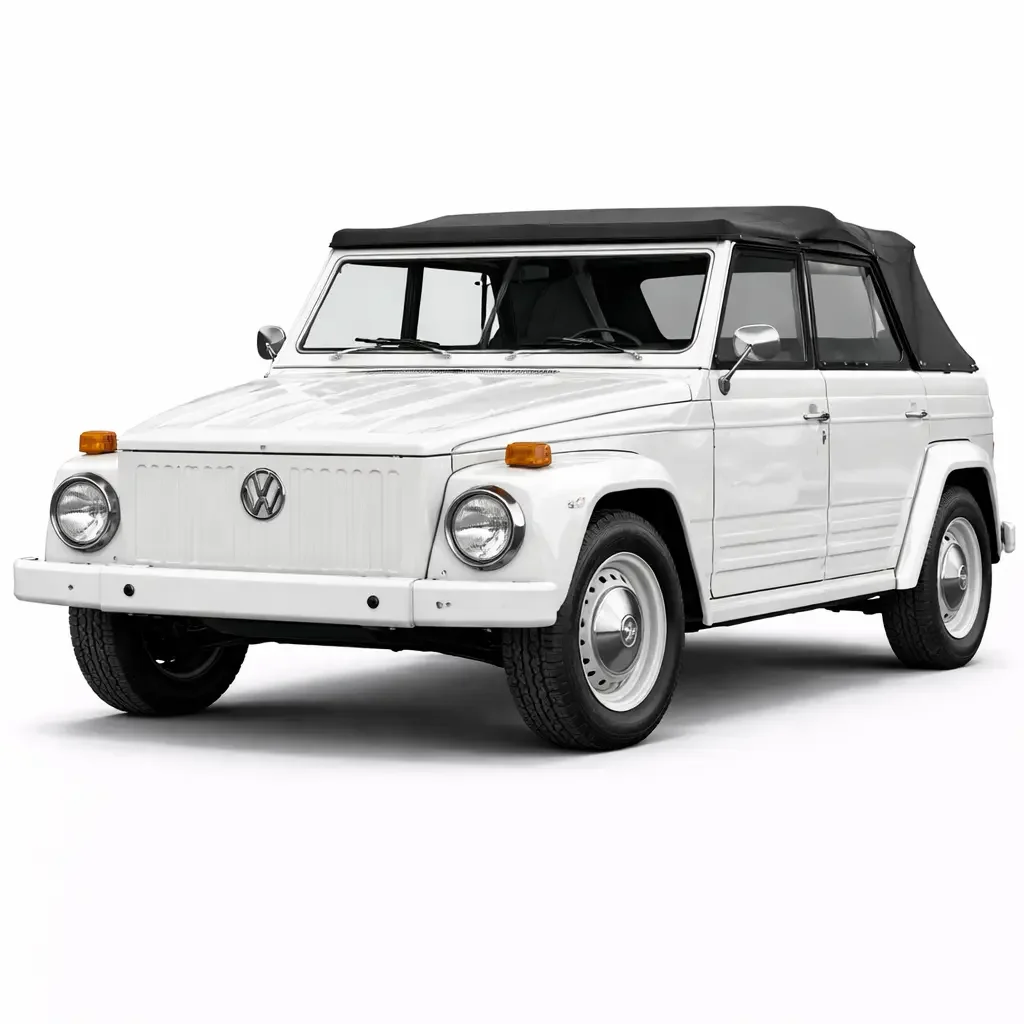
The Volkswagen Thing is the North American market name for the Type 181, a rear-engine, rear-wheel-drive open utility vehicle produced by Volkswagen from 1968 to 1983 in various global configurations. In the United States and Canada it was sold only in 1973 and 1974, with a total of 28,930 units entering the North American market during that window. All US and Canadian Things were exported from the Puebla, Mexico assembly plant and carried export designation codes in the VIN. The 1975 model year was prohibited from the US market because the Type 181 could not meet the tightened crash testing standards that reclassified it as a passenger vehicle rather than a multi-purpose vehicle, ending its North American sales run after just two years.
Despite its short production window in North America, the Thing is commercially significant in the aftermarket because it draws on the same broad air-cooled parts ecosystem as the Type 1 Beetle, the Type 2 Transporter, and the Karmann Ghia. Understanding exactly which components are shared, which are Thing-specific, and where the cross-reference boundaries lie is the central catalog discipline for anyone selling parts for this application. Getting this wrong in either direction, either listing too many Beetle parts as applicable or overlooking valid cross-references, generates both incorrect orders and missed sales.
This guide maps the platform architecture, engine codes, transmission, suspension configurations including the mid-production rear axle change, brake hardware, and the cross-reference boundaries that govern correct parts application for the North American Type 181.
Platform Overview
The Type 181 platform is a derivative of the Type 1 Beetle architecture, but it is not simply a Beetle with different bodywork. The floor pan was sourced from the Type 1 Karmann Ghia rather than the standard Beetle, giving the 181 a wider floor pan than the contemporary Beetle sedan. The body is a separate steel structure mounted to this platform frame, consistent with the Beetle's body-on-platform construction. The wheelbase is 94.5 inches.
The Type 181 part numbering system follows the standard Volkswagen air-cooled convention. Part numbers beginning with 18 identify components that are 181-specific. Part numbers beginning with 11 identify Type 1 (Beetle) components. Because many mechanical parts were shared across the air-cooled family, sellers will encounter both 18-series and 11-series part numbers when cataloging the Thing, and distinguishing between them is essential to accurate fitment claims.
The VIN structure for US market Things uses 18 as the first two digits to identify the Type 181. The third digit encodes the model year: 3 for 1973, 4 for 1974. US export vehicles carry an X following the chassis number and an E within the VIN itself. The DOT compliance sticker appears on the left center door post of US market vehicles. These identifiers are the definitive confirmation that a vehicle is a North American specification Type 181 as opposed to a global market variant.
1973 versus 1974 Production Differences
The two North American model years of the Thing are not identical in specification, and the differences create genuine catalog boundaries for several component categories.
1973 model year: The 1973 Thing arrived with a 1600cc air-cooled flat-four engine producing 46 horsepower, paired with a four-speed manual transmission. All US 1973 Things carried full emissions equipment on the engine as required for the North American market. The 1973 engine tin, including cooling tin and heat exchanger shrouding, is without the holes for heat exchanger tubes because the Thing uses a gasoline-fired cab heater rather than a heat exchanger system for interior heating. This is a direct and consequential distinction from Beetle engine tin of the same era: Beetle heat exchanger tin and Thing engine tin are not interchangeable despite sharing a general appearance.
1974 model year: The 1974 Thing received an uprated engine producing approximately 55 horsepower from the same 1600cc displacement through revised carburetion and ignition calibration. This output increase is the primary mechanical distinction between 1973 and 1974 North American Things and is visible in the engine code. The 1974 also saw a steering column revision: the 1974 steering column uses a different spline from the 1973 column, and the two model years use different steering wheels that are not directly interchangeable. The 1974 steering wheel spline is compatible with many later Volkswagen applications, while the 1973 spline is more model-specific. Sellers listing steering wheels and steering column components must specify model year for this application.
1974 Acapulco edition: A special trim variant of the 1974 Thing, the Acapulco edition was produced in a run of approximately 400 units, making it the rarest configuration of the North American Type 181. It featured blue and white gloss paint, matching interior, running boards, and typically a surrey top with either a hardtop or soft top. Mechanically identical to the standard 1974 Thing, the Acapulco is distinguished by its trim and color-specific components. Sellers cataloging body and interior trim parts should note Acapulco-specific items separately where applicable, as the limited production run means demand is narrow but collector interest is high.
Engine Codes and Configuration
All North American market Things use the air-cooled flat-four engine in 1584cc (1.6-litre) displacement. This engine is derived from the Type 1 Beetle engine but carries a Type 2 or Universal engine case, which differs from the standard Beetle case in that it has attachment points for the skid plates that bolt to the underside of the Thing engine. This case difference is commercially significant: the correct replacement case for a Type 181 engine is the Type 2 or Universal case, not the standard Type 1 case, and listings that specify a Type 1 Beetle case as applicable to the Thing are incorrect for complete engine or short-block replacements.
Engine Code AL: 1973 Model Year
The 1973 North American Thing carries engine code AL, a 1600cc twin-port configuration producing 46 horsepower at 4000 rpm and 72 lb-ft of torque at approximately 2800 rpm. The AL code applies to the Type 181 specifically, running from August 1972 through July 1973 production. Full emissions equipment is fitted as standard. The AL engine uses a single carburetor. Spark plugs, points, condenser, distributor, carburetor, and air filter applications for the AL are shared with the contemporary 1600cc Beetle engine of the same era, with the exception of the air cleaner assembly, which on US Things is a dry-element type with emissions components rather than the oil-bath unit used in some global 181 markets.
Engine Code AB: 1974 Model Year
The 1974 North American Thing carries a revised engine producing approximately 55 horsepower from the same 1600cc displacement. The engine code for this application is confirmed in the AL to AS range depending on production date; the primary code encountered on 1974 US Things is within this family. The output increase over the 1973 specification comes from revised carburetion and ignition timing. Carburetors for the 1974 engine are not interchangeable with the 1973 specification without recalibration, and sellers listing carburetors for the Thing must specify model year. All other base engine service components including spark plugs, points, oil filter, pushrod tubes, valve cover gaskets, head gaskets, and timing components are shared across the 1973 and 1974 applications within the 1600cc twin-port family.
Cross-Reference Pool for Engine Service Components
The 1600cc twin-port air-cooled flat-four used in both North American Thing model years shares its core engine service component pool with the contemporary Type 1 Beetle 1600cc twin-port, the Type 2 Transporter of the same era, and the Type 3 Fastback and Squareback. This cross-reference pool is commercially meaningful and well documented in the air-cooled aftermarket. Spark plugs, ignition points, condenser, rotor, distributor cap, valve cover gaskets, pushrod tube seals, oil drain gasket, oil filter, and timing chain components are all broadly cross-applicable across the air-cooled family of this period. Sellers who articulate these cross-references will serve a much larger buyer pool than those who list the Thing in isolation.
The engine case distinction noted above applies specifically to complete engine cases and short-block assemblies. All top-end and ancillary service components including cylinders, pistons, heads, valves, rocker arms, pushrods, and related hardware are interchangeable between the Type 181 and same-era Type 1 engines of the same displacement.
Transmission
All North American Things use a four-speed manual transmission. There is no automatic transmission option on any US or Canadian market Type 181. The transmission is rear-engine mounted consistent with the Beetle layout.
The Type 181 transmission is related to the contemporary Beetle unit but carries important differences. The Type 181 uses a higher differential ratio than the Beetle, resulting in lower final drive speed for a given engine rpm, suited to the vehicle's intended utility and off-road use character. The CV joint flanges used on the 181 IRS rear axle are different from standard Beetle flanges; while a Beetle transaxle can be used as a replacement, the 181-specific CV joints and CV joint flanges must be retained, as they are designed to operate at more severe drive angles than the standard Bug and Bus CV joints. This is a critical fitment note for any rear transaxle or CV joint listing on the Thing.
The starter motor on all Type 181 transmissions is the type fitted to semi-automatic Autostick Beetles. This starter has only a gear on the end of the shaft and no protruding pin, and it differs from the standard manual Beetle starter. Some 181 transmission bellhousings are not bushed for the standard Beetle starter shaft. Sellers listing starter motors for the Type 181 must specify the Autostick Beetle-type starter; listing a standard manual Beetle starter as applicable to the Thing is incorrect and will produce the wrong part on every order.
Suspension Configuration and the Mid-Production Rear Axle Change
The Type 181 suspension is one of the most catalog-critical variables on this vehicle because a significant rear axle architecture change occurred during 1973 production. All North American Things fall on the post-change side of this boundary, but sellers covering the broader global 181 market or working with imported vehicles must understand the distinction.
Pre-Change: Swing Axle with Reduction Gearing (Pre-Chassis 183 2346 525)
Early Type 181 production, up to chassis number 183 2346 524, used a swing axle rear suspension with reduction gearing sourced from the discontinued split-screen Volkswagen Transporter. This system provided additional ground clearance and a lower effective gear ratio suited to military use. Rear suspension and drivetrain components for this configuration are split-screen Bus derived and are specific to the early production Type 181. No North American 1973 or 1974 Things are built on this early specification, as the change occurred within 1973 production well before US market deliveries reached volume.
Post-Change: IRS Double-Jointed Rear Axle (Chassis 183 2346 525 Onward)
From chassis number 183 2346 525 onward, including all North American 1973 and 1974 Things, the Type 181 uses an independent rear suspension with double-jointed CV axles, the same semi-trailing arm IRS layout used on the 1302 and 1303 Super Beetle. This is the architecture all North American Thing owners will have, and it defines all rear suspension, rear axle, and rear brake component applications for the US and Canadian market.
The IRS rear wheel bearing, rear CV joint, and rear brake drum for the Type 181 are not straightforwardly interchangeable with the contemporary Beetle IRS components despite sharing the same axle layout concept. The Type 181 stub axle was designed to meet NATO military specifications and results in an unusual combination of CV joints, stub axles, and brake drums. The rear brake drum carries the 181-series part number cast into its face and is Type 181 specific. The rear stub axle is Type 181 specific. These components must be listed as 181-specific and must not be cross-referenced to 1302 or 1303 Beetle rear brake drums or stub axles without specific confirmation that the part numbers are identical.
Front Suspension
The front suspension uses trailing arms with torsion bars, consistent with the Beetle front axle architecture of the era. The front axle assembly includes specific front axle support brackets that are not found on the standard Beetle. The right tie rod is Type 181 specific and carries an 18-series part number. The left tie rod is interchangeable with the 1302 and 1303 Beetle. All tie rod ends are interchangeable with either the 1302 and 1303 Beetle or Type 3 applications. Sellers must specify tie rod side (left versus right) because the two sides have different cross-reference pools: the left side draws on 1303 Beetle inventory, the right does not.
The stabilizer bar clamps and rubber mountings carry an 18-series part number but the clamps themselves are interchangeable with Beetle equivalents. Front wheel bearings and front kingpins are shared with the contemporary air-cooled Beetle application of the same era.
Wheels and Brake Configuration
Wheels
All North American 1973 and 1974 Things use 14-inch steel disc wheels introduced from 1 March 1973 in the production changeover. These are 5JK x 14-inch wheels carrying 18-series part numbers and are specific to the Type 181 in terms of offset dimension, which is greater than other 14-inch VW wheels of the period including the Type 2. This offset difference means that wheels from the contemporary Type 2 Bus, though dimensionally similar, will not produce the correct track width and handling geometry on the Thing. Sellers listing wheels for the 1973 to 1974 Thing must specify Type 181 wheels and must not cross-reference Type 2 or Type 1 14-inch wheels as direct replacements.
The standard tire specification for the 14-inch wheel application is 185 SR-14. The maximum tire size that can be fitted to stock 181 wheels and suspension without modification is approximately 205/75 R14, and 215/75 R14 is possible with caution. An upgrade to 15-inch wheels using stock-offset 15-inch units opens up to 205/75 R15, but requires confirmed suspension condition with no sag to avoid rubbing.
Brakes
All North American Type 181 Things use four-wheel drum brakes. The front drums measure 9.6 inches by 1.7 inches. The rear drums measure 9.1 inches by 1.7 inches. There is no disc brake option from the factory on any US or Canadian Thing.
As noted in the suspension section, the rear brake drum is Type 181 specific with an 18-series part number cast into the face and must not be cross-referenced to Beetle or Bus rear drums. The front brake drum application is more broadly compatible with contemporary air-cooled VW applications; sellers should confirm front drum part numbers against 181-series references before applying Beetle cross-references.
Front brake hydraulic lines use the same routing as the Karmann Ghia, consistent with the shared floor pan. The front brake hose part number is closely related to the Beetle front hose and in some cases the Beetle hose is a direct fit, though the 18-series part number is the correct primary reference. Brake master cylinder and wheel cylinder applications should be confirmed against 181-specific part numbers rather than assumed from Beetle fitment, as the wider track resulting from the Karmann Ghia floor pan affects brake line routing and cylinder specifications.
Common ACES/PIES Mistakes for the Type 181 (1973 to 1974)
1. Cross-referencing the rear brake drum to 1302 or 1303 Super Beetle rear drums. The Type 181 rear drum carries an 18-series part number and is specific to the 181 stub axle specification. It is not interchangeable with any Beetle rear drum.
2. Listing a standard manual Beetle starter motor as applicable to the Thing. The Type 181 uses the Autostick semi-automatic Beetle starter type. The standard manual Beetle starter will not fit correctly in all 181 bellhousings.
3. Cross-referencing Type 2 split-screen Bus 14-inch wheels to the 1973 to 1974 Thing. The 181-specific 14-inch wheels have a greater offset than Bus wheels of the same diameter and are not interchangeable for correct track geometry.
4. Listing standard Type 1 Beetle engine cases as applicable to the Thing engine. The Thing uses a Type 2 or Universal case with skid plate attachment points. A standard Beetle case is not the correct replacement.
5. Applying Type 1 Beetle engine tin to the Thing without specifying the absence of heat exchanger holes. Thing engine tin is without heat exchanger tube holes because the vehicle uses a gasoline cab heater. Beetle heat exchanger tin and Thing engine tin are not interchangeable.
6. Not distinguishing 1973 from 1974 for carburetor and steering wheel applications. The 1974 carburetor calibration differs from the 1973. The 1973 and 1974 steering columns use different splines and the steering wheels are not directly interchangeable between years.
7. Cross-referencing the right tie rod to 1302 or 1303 Beetle applications. The right tie rod is 181-specific with an 18-series part number. Only the left tie rod shares fitment with the 1303 Beetle.
8. Listing Bug and Bus CV joints as applicable to the Thing IRS rear axle. The Type 181 uses Type 4-style CV joints designed to operate at more severe drive angles. Standard Bug and Bus CV joints do not have the same angular capability and are not correct replacements.
9. Applying the pre-1973 swing axle rear suspension and reduction box components to the North American 1973 to 1974 Thing. All US and Canadian Things use the IRS double-jointed rear axle that replaced the swing axle configuration mid-1973. Swing axle rear components have no application on any North American market vehicle.
10. Not noting the low production volume of the Acapulco edition when listing 1974 trim and color-specific components. Approximately 400 Acapulco Things were produced, making trim-specific parts rare and separately catalogable from standard 1974 production items.
Catalog Checklist for Type 181 (1973 to 1974 North American Market)
• Use 18-series part numbers as the primary reference for all Type 181-specific components; confirm cross-references to 11-series Beetle or Type 2 numbers individually rather than assuming broad interchangeability
• Specify model year (1973 versus 1974) for carburetor applications, steering wheel and column applications, and engine output-related components
• List rear brake drums, rear stub axles, and rear CV joints as Type 181-specific; do not cross-reference to 1302 or 1303 Beetle rear axle components
• Specify Autostick-type starter motor for all Thing starter motor listings; do not cross-reference to standard manual Beetle starters
• List 14-inch wheels as Type 181-specific with the greater offset dimension; explicitly exclude Type 2 14-inch Bus wheels from cross-reference
• Specify Type 2 or Universal engine case for any complete engine or short-block listing; do not list standard Type 1 Beetle cases as applicable
• Flag engine tin as Thing-specific due to the absence of heat exchanger holes; do not cross-reference Beetle heat exchanger tin
• Apply left tie rod cross-reference to 1302 and 1303 Beetle; keep right tie rod as 181-specific with no Beetle cross-reference
• Note the 1974 Acapulco edition as a distinct variant for trim and color-specific parts, with approximately 400 units produced
• Confirm brake hydraulic line applications against 181-series part numbers before applying Karmann Ghia or Beetle cross-references, given the wider floor pan and resulting routing differences
• For the broad air-cooled engine service cross-reference pool, apply Beetle and Type 2 cross-references for spark plugs, ignition components, valve cover gaskets, pushrod tube seals, oil drain gasket, and similar consumables, as these are genuinely shared across the air-cooled family
Final Take
The Volkswagen Thing is one of the most rewarding and one of the most hazardous applications in the air-cooled Volkswagen catalog. The reward is the broad shared parts ecosystem with the Type 1 Beetle and Type 2 Transporter: for ignition, engine top-end service, and general mechanical consumables, sellers can draw on the widest-available and best-supported parts pool in the vintage Volkswagen aftermarket. The hazard is the set of Type 181-specific components that superficially resemble their Beetle equivalents but are not interchangeable: the rear brake drum, the right tie rod, the CV joints, the starter motor type, the engine case, the engine tin, and the unique 14-inch wheels.
The rear brake drum and CV joint situations carry the highest practical risk for incorrect orders. Both involve components that look like they should cross to the IRS Beetle but do not, because of the Type 181 military specification stub axle. Sellers who list these without 18-series part number verification will generate returns on a consistent basis.
The 28,930 total US market units represent a small but durable collector vehicle population. The Thing has maintained a dedicated ownership community since its discontinuation, and aftermarket demand is sustained by restoration and maintenance activity on vehicles that are now more than fifty years old. Understanding the cross-reference boundaries precisely, rather than treating the Thing as simply a Beetle variant, is what separates a catalog that serves this community correctly from one that frustrates it.
Disclaimer: This guide is based on publicly available specifications, manufacturer documentation, registry research, and independent study of the Type 181 application. Part interchangeability should always be confirmed via VIN, chassis number, and OEM part number lookup. Specifications may vary by production date within a model year. This document does not constitute official Volkswagen parts catalog data.