
Written by Arthur Simitian | PartsAdvisory
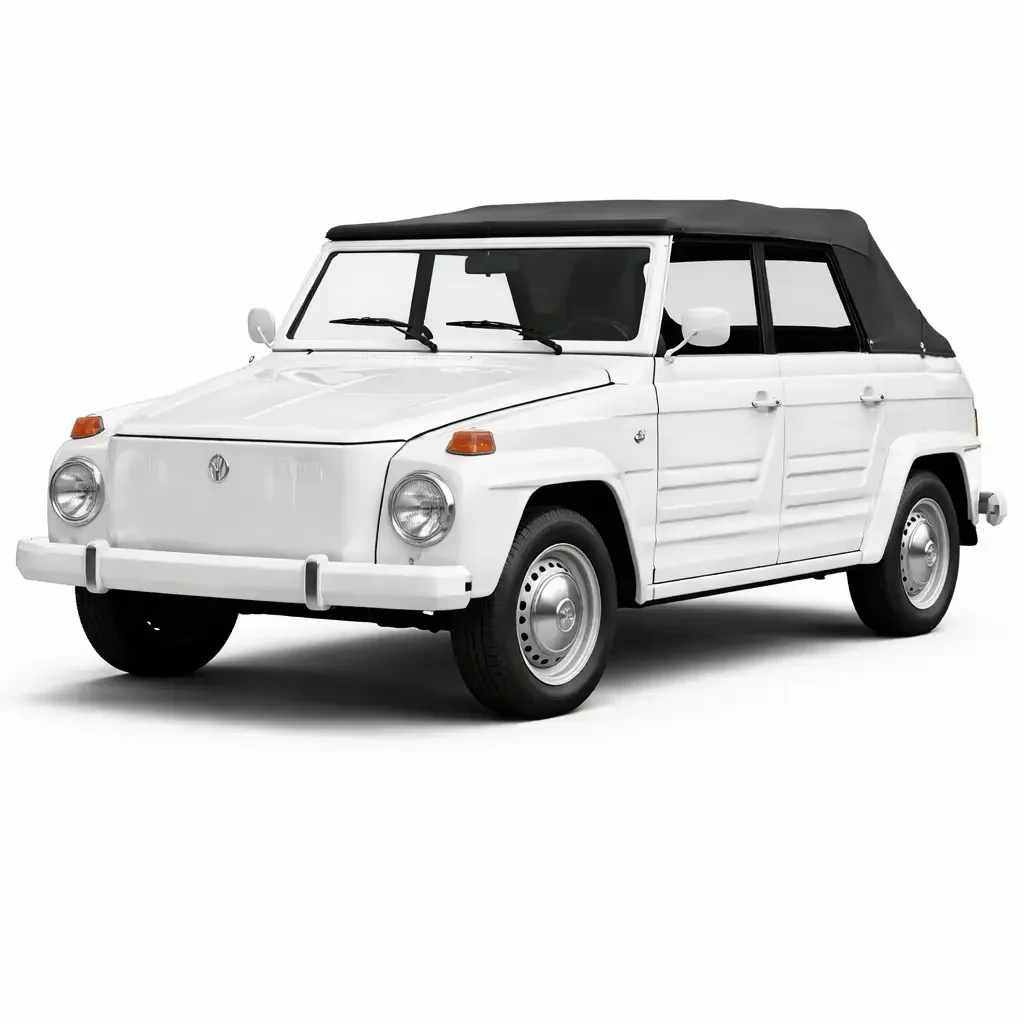
The Volkswagen Safari is the Mexican market name for the Type 181, an open-body four-door utility vehicle produced at the Volkswagen plant in Puebla from 1970 through 1980. In the United States and Canada it was sold as The Thing for the 1973 and 1974 model years only. In West Germany it was the Kurierwagen. In the United Kingdom the right-hand drive Type 182 variant was briefly sold as the Trekker. In Italy it was the Pescaccia. Every one of those regional names describes the same mechanically identical vehicle, but for catalog purposes the Mexican Safari has a specific production identity: it was assembled in Puebla for the full civilian production run, it used low-compression pistons calibrated for Mexican Pemex fuel, and it is the nameplate under which most surviving examples in Latin America are registered and serviced.
The fitment complexity in this window comes from two sources. First, the Type 181 sits at the intersection of multiple VW air-cooled product lines, sharing its mechanicals with the Type 1 Beetle, its floor pan with the Type 1 Karmann Ghia, and its rear suspension architecture with the pre-1968 split-screen Transporter until 1973. Most components cross to at least one sibling, but the body panels, doors, and unique structural elements cross to none of them. Second, the window contains a hard rear suspension architecture change in 1973 that divides it into two distinct mechanical sub-windows. A catalog that does not identify which side of that boundary a vehicle sits on will supply wrong rear suspension and driveshaft components half the time.
Platform Identity and Assembly History
The Type 181 is built on a rear-engine, rear-wheel-drive platform mechanically derived from the Type 1 Beetle. The floor pan is sourced from the Type 1 Karmann Ghia, which has a slightly wider pan than the standard Beetle and provides a more stable base for the wider Type 181 body. The engine, transmission, front beam axle, and electrical architecture are all shared with contemporary Type 1 production. This platform relationship is why the majority of drivetrain and mechanical service parts cross freely to Beetle and Karmann Ghia applications of the same engine code and model year. It is also why the body panels and unique chassis elements require Type 181-specific part numbers with no valid cross-reference to those siblings.
Production at Puebla began in 1970 and 1971 using CKD (completely knocked down) kits shipped from Germany, as the Puebla facility did not yet have body stamping capability. From 1972 onward, local assembly became more fully integrated. Total Mexican production across the civilian window reached approximately 20,364 vehicles. The Puebla plant continued producing the Safari through the end of the civilian window at model year 1980. Military-specification Type 181 production continued at Puebla through 1983 for export to Latin American armed forces, but those units are outside the scope of this civilian parts catalog guide.
The VIN structure for the Type 181 uses a three-digit prefix that advances by model year. The 1971 model year prefix is 181, and the prefix increments through 182 (1972), 183 (1973), 184 (1974), 185 (1975), 186 (1976), 187 (1977), 188 (1978), 189 (1979), and 18A (1980). The last documented production unit is 18A 0100 746. This prefix sequence is the primary ACES year identifier for this vehicle and should be used to verify model year claims before applying any year-specific fitment data.
Engine Codes and the Mexico Specification
The Type 181 uses a 1.6L air-cooled flat-four engine throughout the 1971 to 1980 production window. Earlier German production used a 1.5L unit from 1969 through 1971, but the Puebla-built Safari entered production with the 1.6L specification and continued with it through the end of civilian production. The engine is rear-mounted and air-cooled, derived directly from the Type 1 engine family used in the contemporary Beetle production.
Three engine codes appear in Type 181 service documentation, and distinguishing between them is critical for catalog accuracy in this window. The AG code designates the 1.6L unit fitted to standard civilian Type 181 production for non-US markets and produces 44 horsepower. The AL code designates a 1.6L variant also used in Type 181 applications with 48 horsepower output. The AM code designates the 1.6L fitted to US-export Thing models, which carried full emissions equipment and also produced 48 horsepower. The Mexican domestic Safari used the AG engine code with low-compression pistons specifically calibrated for the lower octane Pemex gasoline grades available in Mexico during this period, with a compression ratio of approximately 6.8 to 1. This is lower than the standard AG specification used in Germany and Europe.
The low-compression Mexican specification has direct implications for parts fitment. Pistons and cylinder assemblies listed for the AG engine in European catalog entries will not match the Mexican domestic compression specification. A catalog that cross-references AG pistons from a German-market Kurierwagen to a Mexican-market Safari without noting the compression ratio difference will supply components that alter the engine's octane requirement and may cause detonation on the fuel grades the vehicle was designed to run. For any internal engine rebuild component, the Mexican domestic specification must be confirmed separately from the European AG specification.
The engine number location on the Type 181 is at the alternator and generator support flange, the same position used on the Beetle and Karmann Ghia. The engine case used in US-export Things is described as a Type 2 or Universal case that includes attachment points for skid plates bolted to the bottom of the engine. This case design is specific to the Thing/Safari application and differs from the standard Beetle engine case in that detail. Catalogs listing engine case assemblies must distinguish between the Type 181 universal case and the standard Type 1 case before applying a cross-reference.
The 1973 Rear Suspension Architecture Change
The most significant mechanical change in the 1971 to 1980 Safari window occurs at the 1973 model year boundary and affects the entire rear suspension and driveshaft assembly. This change divides the window into two mechanically distinct sub-windows: 1971 to 1972 and 1973 to 1980. Catalogs that apply a single rear suspension listing to the entire 1971 to 1980 range are wrong for half the vehicles in the window.
1971 to 1972: Swing Axle with Reduction Gearing
The 1971 and 1972 Safari models use rear swing axle suspension with reduction gearing derived from the discontinued split-screen Volkswagen Transporter (Type 2 T1). This is a portal axle arrangement in which the final drive includes a reduction gearbox at each rear wheel that multiplies torque and raises the axle centerline above the hub centerline, increasing ground clearance. The reduction gearing gives the 1971 to 1972 Safari its characteristic higher stance and the geared-down low-speed pulling ability that made it desirable for rough terrain use.
The components of this system, including the rear axle tubes, the reduction box assemblies, the axle shafts, and the associated wheel bearings and seals, are specific to the early Type 181 and the pre-1968 split-screen Transporter that donated the architecture. They do not cross to the contemporary Beetle rear axle, to the Karmann Ghia rear axle, or to any other Type 1 derivative. Catalogs that attempt to pull Beetle rear suspension listings into the 1971 to 1972 Safari application will supply entirely wrong hardware. The only valid cross-reference point is the split-screen Transporter for the reduction box architecture itself, and that vehicle had been out of production for years by the time the Safari was being sold, making independent sourcing of these components the practical reality for service.
1973 to 1980: IRS Semi-Trailing Arm
Beginning with the 1973 model year, the rear suspension changes to an independent rear suspension semi-trailing arm setup using double-jointed CV axles. This architecture is shared with the 1303 Super Beetle and the US-specification standard Beetle of the same era, and it uses CV joint angles and axle shaft designs developed in collaboration with Porsche. The semi-trailing arm geometry is more conventional than the swing axle and produces more predictable handling. The reduction gearing is eliminated in the civilian specification; the ring and pinion gearing in the transmission is changed to provide slower final drive ratios, and the CV axle shafts are specified to be stronger and more flexible than standard Beetle units to handle the greater range of joint angles possible in the Type 181 application.
The 1973 onward rear suspension does cross to the 1303 Super Beetle and the contemporary US-specification Beetle for many components, but with an important caution: the CV joint specifications are not identical. Hagerty's technical documentation of the Type 181 confirms that the CV joints are designed for higher angles of articulation than the Beetle counterparts due to the different rear geometry of the open-body Type 181. Catalogs that list standard 1303 Beetle CV joints as direct substitutes for Type 181 joints without noting this specification difference should be reviewed before publication.
The front suspension across the entire 1971 to 1980 window is a torsion bar trailing arm beam axle shared with the Type 1 Beetle, but with a different spindle specification that provides greater ground clearance, effectively functioning as a factory suspension lift of approximately two inches over the standard Beetle front geometry. The spindle is Type 181-specific and does not cross to the Beetle. The torsion bars, tube shock absorbers, and beam housing components cross to the Beetle front beam assembly of the same era.
Transmission and Gearing
The Type 181 Safari uses a four-speed manual transmission throughout the production window. The gearbox ratios are specifically calibrated for the Safari application rather than being a direct carry-over from the standard Beetle transmission. The ring and pinion gearing produces a slower final drive ratio than the standard Beetle box, providing better low-speed torque multiplication suited to the vehicle's utility role. This gearing difference means that transmission internal components must be confirmed against Type 181-specific part numbers rather than assumed to match the contemporary Beetle four-speed gearbox.
Gearbox ratios also varied by destination market. VW documentation from the Thing Registry confirms that vehicles destined for Europe and the USA were geared higher than those for domestic German and Mexican use. The Mexican Safari domestic specification uses the lower gearing appropriate for the terrain and use patterns of the primary market. Any transmission internal parts listing that does not specify market destination or gearing ratio should be treated as potentially ambiguous for this application.
Brakes
The Type 181 Safari uses four-wheel drum brakes throughout the 1971 to 1980 window. The drum dimensions are 9.6 by 1.7 inches front and 9.1 by 1.7 inches rear, giving a total swept area of 111 square inches. These dimensions are drawn from the Thing Registry's documented specifications. The brake system shares its fundamental hardware architecture with the contemporary Type 1 Beetle, and brake shoes, wheel cylinders, and drum assemblies cross to the Beetle application of the same era for vehicles that share the same drum diameter specification.
A dual-circuit brake system was introduced on the Type 1 Beetle in 1968 and carried through to the Type 181 in the production years covered by this guide. The dual-circuit master cylinder and its associated plumbing must be listed accordingly. Catalogs that apply a single-circuit master cylinder from early pre-1968 Beetle applications to any year of the Safari are supplying an incorrect and potentially unsafe component.
The rear brake backing plate geometry and the method of attachment to the axle differ between the 1971 to 1972 swing axle reduction gearing setup and the 1973 onward IRS semi-trailing arm setup. Rear brake backing plates and wheel cylinders must therefore be specified by sub-window year range, not by a single unified 1971 to 1980 application.
Body Structure and Body-Specific Components
The Type 181 body is entirely unique to the model. Despite sharing the Karmann Ghia floor pan, the body panels, doors, windshield frame, body sills, and all structural sheet metal above the floor pan are Type 181-specific and carry no cross-references to the Beetle, the Karmann Ghia, or the Transporter. This is the most common source of catalog error for this vehicle: the platform relationship with Type 1 products creates a gravitational pull toward Beetle body part listings that does not hold for any above-floor-pan sheet metal or glass component.
The four doors are a distinctive feature of the Type 181 body. All four door assemblies are identical and fully interchangeable front to back, a deliberate engineering choice made for military logistics simplicity. They are removable without tools. Door seals, door hinges, door latches, and door glass are all Type 181-specific and do not cross to any other VW model. The interchangeability of front and rear doors on the same vehicle is a parts catalog note that should appear as a sub-application clarification to prevent confusion when customers order door components.
The windshield is unique to the Type 181 and folds flat against the hood when fully lowered. The windshield glass, the folding frame mechanism, the windshield seals, and the wiper system components are all Type 181-specific. The wiper motor and linkage assembly cross-reference options for the standard Type 1 Beetle should be approached with caution; while the electrical architecture is similar, the physical mounting and sweep geometry of the Type 181 wiper system differs from the standard Beetle due to the folding windshield design.
The convertible top hardware, including the top bows, top latches, and top material, is Type 181-specific. A fiberglass hardtop was available as an optional factory accessory; hardtop mounting hardware is specific to the Type 181 body and does not cross to any other VW cabriolet application. A trunk-mounted auxiliary heater was also available as a factory option for markets where cold weather operation was required.
Floor Pan and Shared Underfloor Components
The floor pan is sourced from the Type 1 Karmann Ghia, which is wider than the standard Beetle pan. This wider pan is the foundation for the Type 181's wider track and more stable stance. Components attached to or integral to the floor pan, including the frame head at the front, the central tunnel structure, and the torsion bar housing at the front beam, share dimensions with the Karmann Ghia floor pan application rather than the narrow Beetle pan.
The fuel tank and fuel system components at the front of the vehicle, under the front hood, cross to the Type 1 family. The fuel tank capacity is approximately 10.6 US gallons and the single Solex 34 PICT-3 carburetor is the standard fuel delivery system across the window. Carburetor listings for the Type 181 cross to the same Solex unit used in the contemporaneous Type 1 Beetle application for the AG engine code, with the caveat that the Mexican low-compression specification may use jet sizes calibrated for the lower-octane fuel.
Electrical System
The Type 181 uses a 12-volt electrical system shared with the Type 1 Beetle. The alternator, voltage regulator, ignition system, starter motor, and battery are all cross-referenceable to the contemporaneous Beetle application for the same engine code and model year. The fuse box and wiring harness are Type 181-specific in their routing and connector geography because the body layout differs substantially from the Beetle, but the individual electrical components at the module and switch level share part numbers with the Type 1 family.
Military-specification Type 181 units were equipped with low-noise ignition systems designed to minimize radio frequency interference for military communication purposes. These components are military-spec only and do not apply to the civilian Safari application.
The US-Export Thing and Its Catalog Relationship to the Mexican Safari
The US-market Thing sold in 1973 and 1974 was built at the Puebla plant and exported from Mexico to Volkswagen of America dealerships. It used the AM engine code rather than the Mexican domestic AG specification, carried full US emissions equipment, had energy-absorbing bumpers and revised seating required for the Multi-Purpose Vehicle classification, and included a US DOT sticker and an E suffix in the VIN. The letter X following the chassis number identifies export-spec vehicles.
For catalog purposes, the US-export Thing and the Mexican domestic Safari are mechanically closely related but not identical. Engine components for the AM code differ from the AG code in compression specification, piston design, and emissions hardware. The US-export bumpers are heavier and use energy-absorbing mounts not present on the Mexican domestic specification. Brake and suspension components are shared between both specifications. Catalogs that apply a single unified application across all Type 181 production without distinguishing market specification will supply correct suspension and brake parts but may supply wrong engine, emissions, and bumper components depending on which specification the vehicle actually carries.
The Acapulco variant produced in 1973 and 1974 is a Safari subvariant built at Puebla with a distinctive blue and white color scheme and running boards. It is the rarest Type 181 variant with approximately 400 units produced, most exported to the US market. Mechanically it is identical to the standard Thing for that year. Catalog listings that identify Acapulco-specific exterior trim components must note the limited production run and the trim-only distinction from the standard model.
Cross-References That Hold
Engine internal components cross to the contemporaneous Type 1 Beetle for the same engine code and model year: pistons and cylinders (with the Mexican compression ratio caveat noted above), connecting rods, crankshaft, camshaft, valvetrain, oil pump, flywheel, cooling tin, and fan assembly. The single Solex 34 PICT-3 carburetor crosses to the Beetle AG application with the same octane caveat.
Front beam suspension torsion bars, tube shock absorbers, and beam housing components cross to the Type 1 Beetle front beam for the same era. The front spindle does not cross due to the Type 181-specific ground clearance specification.
For 1973 to 1980 rear suspension, semi-trailing arm components cross to the 1303 Super Beetle and contemporary US-specification Beetle IRS with the CV joint angle caveat. Rear torsion bars and trailing arm bushings cross within this sub-window.
Electrical components, including the alternator, voltage regulator, starter motor, ignition coil, distributor, and spark plugs, cross to the contemporaneous Beetle for the same engine code. Brake shoes and wheel cylinders cross to the Type 1 Beetle for the same front drum specification and for rear drums on the 1973 onward IRS-equipped vehicles, subject to drum diameter confirmation. The master cylinder crosses to the dual-circuit Type 1 Beetle system.
Cross-References That Do Not Hold
All body panels above the floor pan, including front and rear fenders, hood, engine lid, body sills, and structural sheet metal, are Type 181-specific and cross to no other VW model. The Karmann Ghia donates the floor pan width but not any above-pan body structure.
All four door assemblies are Type 181-specific. They do not cross to Beetle, Karmann Ghia, or any other VW model. Door glass, door seals, door latches, and door hinge hardware are all Type 181-specific.
The windshield and folding windshield frame assembly are Type 181-specific. No other VW production vehicle uses a folding windshield of this design.
The front spindle is Type 181-specific due to the elevated ground clearance specification. It does not cross to the standard Beetle front spindle despite sharing the same beam architecture.
The 1971 to 1972 swing axle reduction gearing rear axle assembly crosses only to the split-screen Type 2 Transporter, which was out of production before the Safari was in civilian sale. No cross-reference to the Beetle or Karmann Ghia rear axle applies.
Engine pistons and cylinder assemblies from European-market AG engine applications cross to the Mexican Safari only if the compression ratio is confirmed to match the Mexican low-compression Pemex specification. European-spec AG pistons at standard compression are not correct substitutes for Mexican domestic Safari engine rebuilds without this confirmation.
Military-specification Type 181 components, including reduction box rear axles, military engine tin, low-noise ignition systems, and dual oil bath air cleaners, do not apply to the civilian Mexican Safari.
Common ACES/PIES Catalog Mistakes
1. Applying a single rear suspension listing to the full 1971 to 1980 window without splitting at the 1973 model year. The 1971 to 1972 rear axle uses swing axle reduction gearing from the split-screen Transporter. The 1973 to 1980 rear axle uses IRS semi-trailing arms with CV axle shafts shared with the 1303 Beetle. These two systems share no hardware. A unified application entry will supply wrong rear axle, driveshaft, wheel bearing, and rear brake backing plate components for half the vehicles in the window.
2. Crossing Beetle body panels to the Type 181. The platform relationship between the Type 181 and the Type 1 Beetle causes this error repeatedly. The Beetle and the Safari share the Karmann Ghia floor pan width and the engine and drivetrain. They share nothing above the floor pan. Fenders, hoods, engine lids, body sills, and structural sheet metal have no Beetle cross-reference. A catalog that generates Type 181 body panel suggestions from Beetle listings is using the wrong parent vehicle for every above-pan component.
3. Listing European AG engine pistons and cylinders as compatible with the Mexican Safari without a compression ratio qualifier. The Mexican domestic Safari uses low-compression pistons at approximately 6.8 to 1 compression for Pemex fuel compatibility. European AG specifications run higher compression. These are not interchangeable for Mexican domestic engine rebuilds. A catalog that carries a single AG piston listing without a market or compression qualifier will supply mismatched components to Safari owners using Pemex fuel.
4. Applying standard Beetle front spindles to the Type 181. The Safari uses a Type 181-specific spindle that raises the front axle centerline approximately two inches above the standard Beetle geometry. A standard Beetle spindle will fit the beam but will lower the front ride height and alter the steering geometry in a way that makes the vehicle incorrect for the Type 181 specification. This error occurs when catalog systems pull front suspension listings from the Beetle by engine code without filtering for the Type 181-specific spindle part number.
5. Conflating the US-export Thing (AM engine code) with the Mexican domestic Safari (AG engine code) in fuel system and engine listings. The two specifications use different engine codes, different piston and compression specifications, and different emissions hardware. The Thing carried full US emissions equipment; the Safari did not. Any catalog entry that applies a single engine code across both market specifications without a destination qualifier will mix incompatible components in the engine and fuel system listings.
6. Applying standard 1303 Super Beetle CV joint listings to the 1973 to 1980 Safari rear axle without a Type 181 angle-specification qualifier. The IRS rear suspension of the 1973 onward Safari is related to the 1303 Beetle but uses CV joints specified for greater articulation angles. A direct substitution of standard 1303 CV joints may fit physically but may not withstand the operating range of the Type 181 rear geometry. The catalog note must specify the Type 181 high-angle CV joint specification.
7. Listing military-specification rear axle reduction boxes against civilian Safari applications. The military Type 181 retains the swing axle portal reduction gearing as a permanent feature for enhanced ground clearance and low-speed torque. Civilian Safaris after 1972 switched to IRS semi-trailing arms and do not use reduction gearing. Military reduction box listings must be marked as military-specification only and must not appear as alternatives or substitutes in civilian Safari parts listings.
8. Treating door components as having Beetle or Karmann Ghia cross-references. The Type 181 door is a unique four-way interchangeable removable unit found on no other production VW. Door glass, seals, latches, and hinges are all Type 181-specific. The error typically originates from catalog systems that search for door hardware by body style classification and group the Type 181 with other open-body or cabriolet VW applications.
Pre-Listing Checklist for the 1971 to 1980 Safari
• Model year confirmed via VIN prefix: 181 (1971) through 18A (1980), noting that the 1973 boundary subdivides the rear suspension application
• Engine code confirmed as AG (Mexican domestic low-compression), AL (standard civilian), or AM (US export Thing); compression ratio noted for piston and cylinder listings
• Rear suspension sub-window identified: 1971 to 1972 swing axle reduction gearing, or 1973 to 1980 IRS semi-trailing arm; separate part number listings required for each
• Front spindle confirmed as Type 181-specific elevated ground clearance unit; not crossed to standard Beetle spindle
• Body panel listings confirmed as Type 181-specific for all above-floor-pan components; no Beetle or Karmann Ghia body cross-references applied
• Door components listed as Type 181-specific interchangeable four-door units; all four positions share the same part number
• 1973 to 1980 rear CV joint listings confirmed as high-angle specification, not standard 1303 Beetle fitment
• Brake master cylinder confirmed as dual-circuit Type 1 specification; single-circuit pre-1968 Beetle master cylinder excluded
• Military-specification components, including reduction box axles and low-noise ignition, excluded from civilian Safari listings
• Assembly origin confirmed as Puebla, Mexico for the civilian Safari; German-built Kurierwagen is a separate market application
• US-export Thing components confirmed as AM engine code specification; Mexican domestic Safari components confirmed as AG engine code specification
Final Take
The VW Safari is a vehicle that rewards catalog precision and punishes assumptions made from platform familiarity. Its Type 1 mechanical roots are genuine and mean that the majority of drivetrain, ignition, and fuel system components cross cleanly to the contemporaneous Beetle. But the body is entirely its own, the front spindle is raised and vehicle-specific, the 1971 to 1972 rear axle is a relic of split-screen Transporter architecture found nowhere else in the Type 1 family, and the Mexican domestic compression specification sits below everything published for the European AG engine code.
The 1973 rear suspension change is the most operationally critical date in the window. A parts advisor who knows which side of that boundary the customer's vehicle sits on will get the rear axle hardware right. A parts advisor who does not will supply components from the wrong architecture entirely. The VIN prefix table in this guide resolves that question in seconds. Everything else in the catalog flows from confirming three facts first: the model year prefix, the engine code, and which of the two rear suspension architectures is fitted.
Disclaimer
This guide is intended for catalog research, fitment analysis, and parts advisory reference. Production specifications, option availability, and regulatory compliance requirements vary by model year, regional market, and assembly date within any given window. Always confirm application data against vehicle identification number decoding, factory build sheets, and OEM parts documentation before finalizing a listing or parts recommendation. PartsAdvisory and its contributors are not responsible for fitment errors arising from catalog data that has not been independently verified against physical vehicle inspection or official OEM sources.