
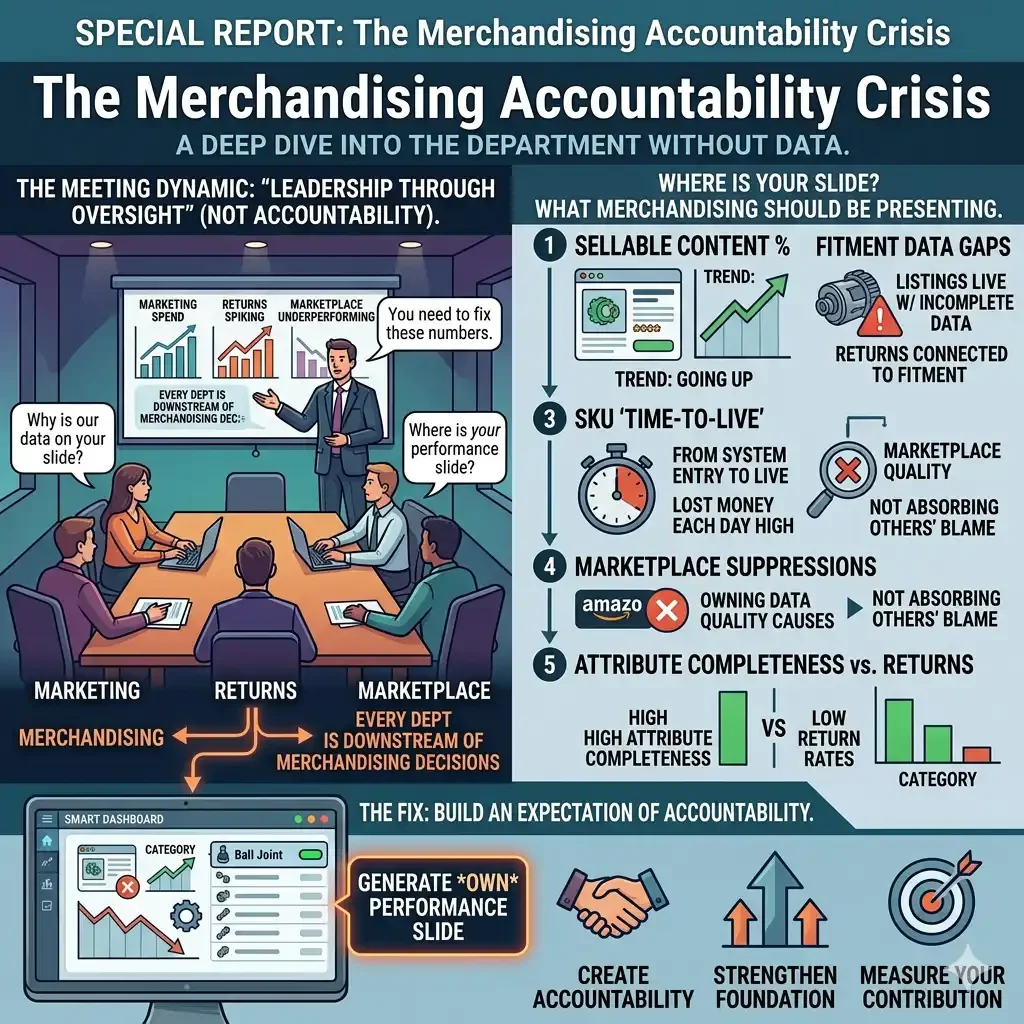
I have been in this meeting. You probably have too.
The merchandising team walks in with a polished deck. Marketing spent too much in this category. Returns are spiking in that one. The marketplace team is underperforming here. They have numbers for everything. Charts, trend lines, sharp questions for every department in the room. It looks like leadership. It looks like oversight.
What it actually is, is a team that has mastered the art of being the most informed person in the room while never once being accountable for anything in it.
The Pattern Is Not Accidental
Here is how it works. The merchandising team controls the catalog. The catalog drives everything: what converts, what gets returned, what ranks on marketplaces, what marketing is spending money to promote. Every department in that meeting room is downstream of the decisions merchandising makes every day.
But instead of presenting the health of the catalog, they present the health of everyone else. Marketing's spend. The returns team's numbers. The marketplace team's rankings. They ask hard questions. They point out gaps. They look engaged and analytical and indispensable.
And because the presentations are thorough and the questions are sharp, leadership rarely stops to ask the obvious: where is your slide? What are your numbers? How is the work your team does every day contributing to or hurting the business?
That question never gets asked. And when it never gets asked, there is no incentive to ever answer it.
What a Merchandising Team Should Be Presenting
If the catalog is the foundation of the business, then the team managing it should be the most accountable team in the room, not the most comfortable one. Here is what that accountability actually looks like:
• What percentage of active SKUs have complete, sellable content? Not an estimate. A real number, tracked weekly, with a trend line. If this number is not going up, the catalog is quietly getting worse.
• How many listings went live this period with incomplete fitment data? Every one of those is a potential return. The returns team is already presenting that return rate. Connect the two numbers and the conversation changes immediately.
• What is the average time from a new SKU entering the system to it being content-complete and live? Every day that number is high is a day the business is leaving money on the table from a part it already owns.
• How many marketplace suppressions this period were caused by data quality issues? The marketplace team is presenting suppression rates. If merchandising is not owning their share of that number, someone else is absorbing the blame for a problem they did not create.
• Which categories have the lowest attribute completeness and the highest return rates? If those two lists overlap, that is not a coincidence. That is a catalog problem presenting itself as a returns problem, and it should be said out loud in the room.
Why This Dynamic Is Toxic
When a team can point to everyone else's problems without ever being measured against their own contribution, a few things happen that quietly damage the business.
Other departments start spending resources solving problems that merchandising created. Marketing increases spend to compensate for low conversion on poorly attributed listings. Operations absorbs return volume that traces back to fitment data gaps. Customer service handles calls that a complete product page would have prevented. The cost is real. It just gets booked under someone else's budget.
And because merchandising is never in the room as a contributor to those costs, they are also never in the room as a solution. The fixes happen around them instead of through them. The same problems surface quarter after quarter.
I was personally part of this environment. What I observed is that the people doing it were not incompetent. They were often very good at their jobs. But the structure rewarded visibility over accountability, and they adapted to the incentive in front of them. That is what organizations do when leadership does not ask the hard question.
The Fix Starts With One Question
It does not require a reorganization or a new performance framework. It requires one question at the next meeting where the merchandising team presents everyone else's data:
Where is your slide?
Not as an accusation. As a genuine requirement. The catalog is the foundation. The team managing it should be able to show, clearly and specifically, whether that foundation is getting stronger or weaker, and what it is costing the business either way.
Every other department in the room is already answering for their piece of the outcome. Merchandising should be no different. The data exists. The connection to business results is clear. The only thing missing is the expectation that it gets presented.
Build that expectation, and the dynamic changes on its own.