
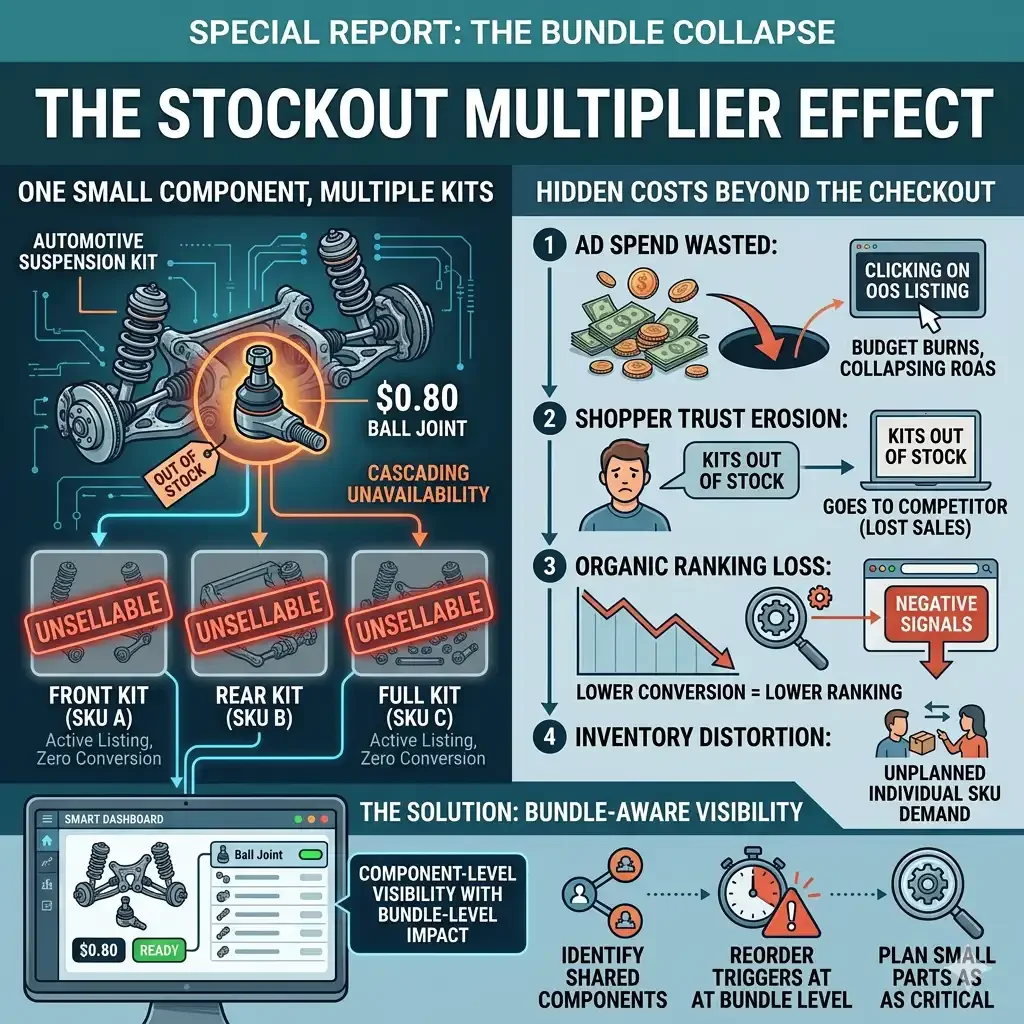
It is rarely the big item that breaks a bundle. It is not the strut. It is not the control arm. It is the ball joint. Or the boot kit. Or the small hardware piece that nobody thinks to flag until the orders stop coming in and someone finally traces the drop back to a single SKU that has been sitting at zero for three weeks.
In aftermarket parts eCommerce, bundles and suspension kits are among the highest-value listings in a catalog. They carry strong average order values, attract serious buyers, and when done right, they reduce return rates because the shopper is buying a complete solution rather than guessing at individual components. But that strength is also their vulnerability. A bundle is only as strong as its weakest stocked component.
One Stockout, Many Casualties
Consider how a typical suspension kit catalog is structured. There is the full 4-wheel kit. There is a front-only version and a rear-only version. There is a 4WD variant and an FWD variant. There may be a heavy-duty option and a standard option. Each of these listings is a separate SKU, but many of them share components underneath.
When a shared component goes out of stock, the damage does not stop at one listing. It cascades. The full kit goes down. The front kit goes down. The 4WD version goes down. Every bundle that depends on that one part becomes unsellable, often without any visible alert to the team managing the catalog. The listings may still appear active. The traffic keeps coming. And every shopper who lands on an out-of-stock bundle page and leaves is a lost sale that never gets attributed to the real cause.
This is the stockout multiplier effect. One component failure does not create one lost sale. It creates as many lost sales as there are bundles dependent on that component, for every day the stockout goes unresolved.
The Real Cost Is Bigger Than the Missing Sale
The immediate cost of a bundle stockout is obvious: lost revenue on orders that did not happen. But the full cost runs deeper than the checkout page.
• Ad spend with nowhere to land. If paid campaigns are driving traffic to bundle listings, a stockout means you are paying for clicks that cannot convert. The budget keeps running. The ROAS collapses. And unless someone is watching closely, the campaign optimizes toward the wrong conclusion.
• Shopper trust erosion. A shopper who arrives ready to buy a complete suspension kit and finds it unavailable does not simply wait. They go to a competitor. And because suspension is a considered purchase, there is a good chance they complete the transaction elsewhere and do not return.
• Organic ranking loss. Search engines reward listings that convert. A bundle page that accumulates traffic with no purchases sends negative engagement signals that take time to recover from, even after the stockout is resolved and the listing goes live again.
• Inventory distortion downstream. When a bundle goes dark, some shoppers shift to buying the components individually. This moves individual SKUs at an unplanned rate, creating demand distortion that is difficult to trace back to the original bundle failure.
None of these costs show up on the stockout report. They surface weeks later in ROAS dashboards, conversion rate reviews, and inventory reconciliation meetings, rarely connected back to the single component that started the chain reaction.
Inventory Planning for Bundles Requires a Different Mental Model
Most inventory planning is built around individual SKUs. Reorder points are set per part number. Safety stock is calculated per item. Demand forecasting runs at the component level. This works reasonably well for standalone parts. It breaks down for bundles.
Bundles require component-level visibility with bundle-level consequences. That means asking a different set of questions during the planning process:
• Which components are shared across multiple bundle configurations? These are your highest-risk items. A single stockout on a shared component does not just affect one listing. Map every bundle back to its components and identify which parts appear in more than one kit.
• What is the true demand signal for shared components? If a ball joint appears in six bundle configurations, its demand is not just its individual sales velocity. It is the combined sales rate of every bundle that depends on it. Planning only from individual part sales understates the real requirement significantly.
• What is the lead time on the smallest components? High-value bundle components often have short lead times because they are prioritized. But small hardware, boot kits, and minor subcomponents can have longer lead times precisely because nobody treats them as critical. That assumption is the risk.
• Is there a bundle-level stockout alert in place? If the only alerts in your system are at the individual SKU level, a bundle can go dark before anyone is notified. A bundle is out of stock the moment any single required component hits zero, not when all of them do.
The Fix Is Not More Safety Stock. It Is Smarter Visibility.
The answer is not to overstock every small component across the board. That approach ties up working capital and creates its own problems. The answer is to build visibility that connects component inventory to bundle performance in real time.
Know which components are shared. Know which bundles depend on them. Set reorder triggers at the bundle level, not just the component level. And treat the small, low-cost parts with the same planning discipline as the high-value items, because in a bundle context, their impact on revenue is identical.
A suspension kit that retails for $400 does not care whether it went out of stock because the strut was unavailable or because a $4 hardware kit ran out. The lost sale is the same either way.
The businesses that protect their bundle revenue are not the ones with the most safety stock. They are the ones who understand exactly which small parts are holding their biggest listings together.